(1/14) Many of you are probably familiar with the fact that the Soviets used autoloaders on their late-Cold War tanks.
Today I only really want to talk about something special about the T-64's (and T-80B's) autoloader that is mostly ignored. But first, some background...
Today I only really want to talk about something special about the T-64's (and T-80B's) autoloader that is mostly ignored. But first, some background...
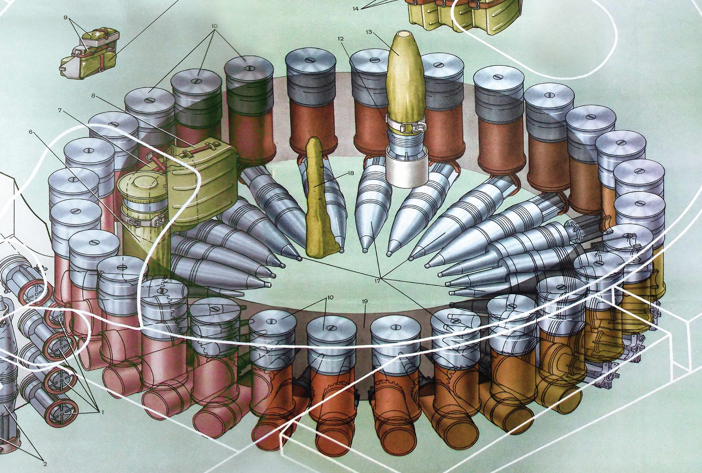
(2/14) Some of you may also know that the T-64/80 and T-72 families use different basic autoloader designs.
The T-64's (left) is known in Russian as the механизм заряжания ('loading mechanism', MZ), while the T-72's (right) is the автомат заряжания ('automatic loader', AZ).
The T-64's (left) is known in Russian as the механизм заряжания ('loading mechanism', MZ), while the T-72's (right) is the автомат заряжания ('automatic loader', AZ).


(3/14) I won't get into the reasons/justifications why these tanks ended up using different autoloaders, (long story short: rivalry between the Kharkov and Ural design teams/factories), but let's take a closer look at some of the MZ control panels.

(4/14) In particular, note these switches on the T-64A (left) and T-64B (right) gunner control panels for the MZ. They are labelled 'СЕРИЯ' ('SERIES').


(5/14) When turned on, these buttons activate the 'series' working mode for the MZ autoloader.

(6/14) Ordinarily, for both the MZ and AZ autoloaders, you must press a button to tell the autoloader to load the next round, as shown in this Switchology video for the T-72M1.
(7/14) However, tanks with the MZ autoloader, like the T-64 and T-80, can activate 'series' mode, where the autoloader will automatically load the next round of the selected type (APFSDS/HE-Frag/HEAT) without the gunner's intervention.

(8/14) This means that if you stow your rounds together in type groups, you can obtain the fastest possible reloading time of the MZ autoloader (6 s), since the autoloader only has to rotate to the round immediately next to the one just fired, until that type runs out.
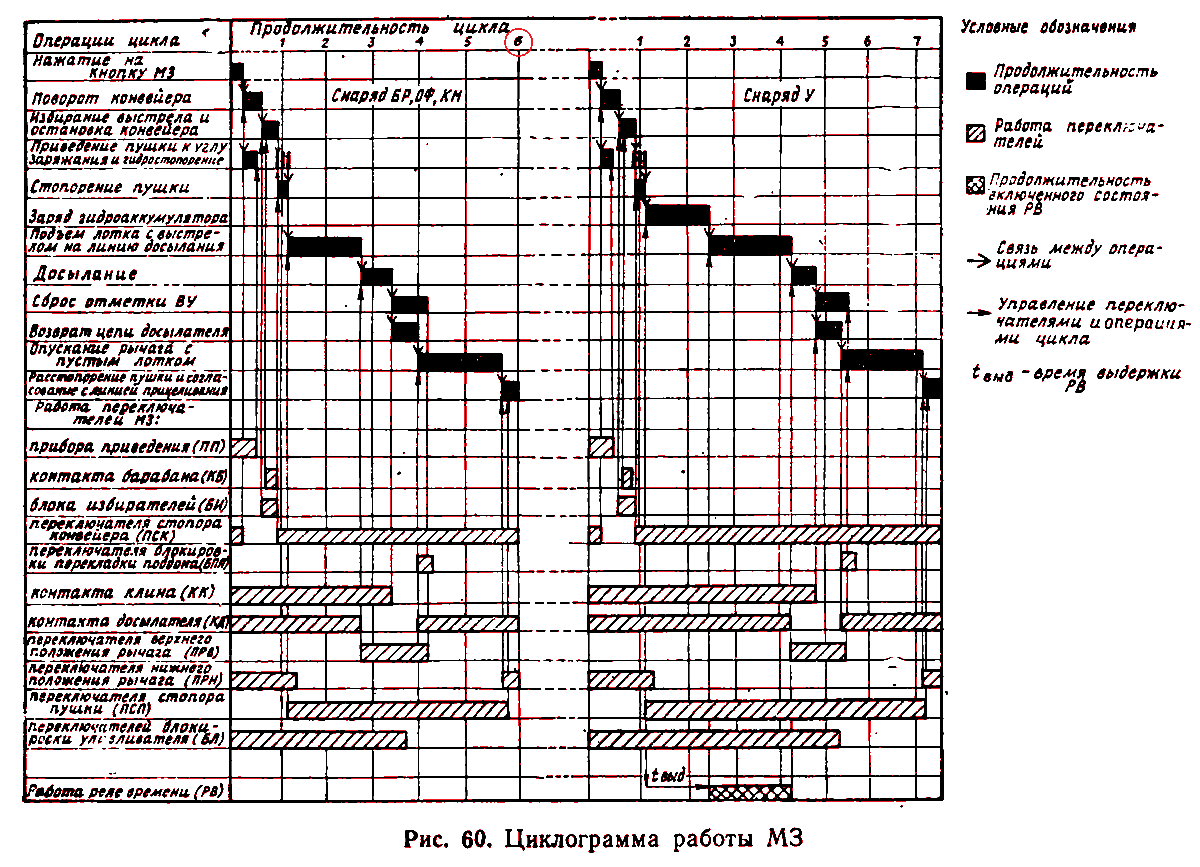
(9/14) Note that on the T-64B and T-80B, this mode cannot be used with the 9M112 Kobra gun-launched ATGM, but this is irrelevant today since Ukraine no longer uses the Kobra.


(10/14) This 'series' mode is not present on any of the T-72s (T-72B shown left) or the T-80U (right) or T-80UD.


(11/14) The 'series' mode, along with the superior 1A33 Ob fire control system compared to contemporary T-72s' TPD-K1 or 1A40 semi-automated FCS, allows T-64s to outshoot and out-reload contemporary T-72s (modern T-72B3s have a superior FCS).
rusi.org/explore-our-re…
rusi.org/explore-our-re…

(12/14) The 1st Tank Brigade in Chernihiv faced the 41st Combined Arms Army and elements of the 90th Tank Division, which at the beginning of the war was exclusively equipped with T-72s ranging from ancient T-72As to T-72B3s.
gurkhan.blogspot.com/2021/09/c-2021…
gurkhan.blogspot.com/2021/09/c-2021…
(13/14) The T-72's AZ cyclogram gives it a reload of ~7.7 s. If the next round to be fired is next to the previous round, then this will reduce the time to about ~7–7.1 s. It may be longer depending on crew reaction, since a button push is needed.
thesovietarmourblog.blogspot.com/2015/05/t-72-s…
thesovietarmourblog.blogspot.com/2015/05/t-72-s…

(14/14) So, even though it's often claimed their rates of fire are similar, under certain configurations/mode of operations, the T-64 can have an edge. This is confirmed by crew testimony such as from Dominikanets, who has experience with both the T-72 and T-64.

(BONUS) Dominikanets has created an interesting document listing his opinions of both tanks.
dart-werther.livejournal.com/309465.html
I have made an English translation of it here:
docs.google.com/document/d/1yv…
He is also on YouTube: youtube.com/@asscold13
dart-werther.livejournal.com/309465.html
I have made an English translation of it here:
docs.google.com/document/d/1yv…
He is also on YouTube: youtube.com/@asscold13
• • •
Missing some Tweet in this thread? You can try to
force a refresh