The confirmation bias is one of the most widely known cognitive biases. It reflects the fact that we favour information that confirms our existing beliefs.
But contrary to this accepted wisdom, looking for confirmatory information is likely not a bias at all. 🧵
But contrary to this accepted wisdom, looking for confirmatory information is likely not a bias at all. 🧵

The confirmation bias has been described as a candidate for being the “single problematic aspect of human reasoning that deserves attention above all others”. (Nickerson, 8500 Scholar citations)

Interest in the confirmation bias has also grown with the rise of political polarisation in several Western countries. This bias appears to contribute to the phenomenon of "echo chambers," where people are exposed only to opinions that reinforce their pre-existing views.
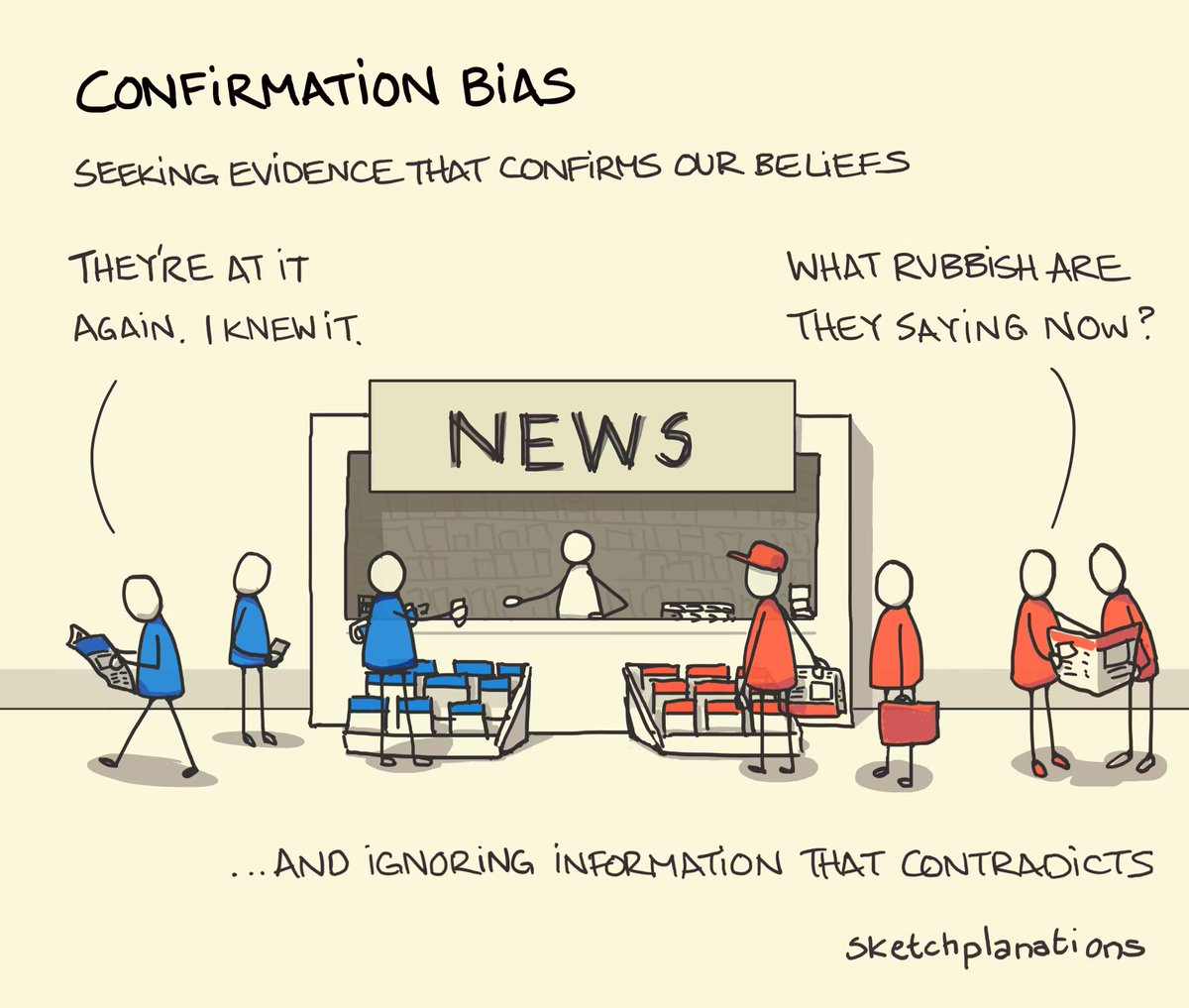
The search for confirmatory information can intuitively appear to be a “cognitive bias”. But is it though?
For it to be a bias, we would need to know what is the *right* way to collect information.
For it to be a bias, we would need to know what is the *right* way to collect information.
Is balance the right way to acquire information? There are good reasons we don’t systematically pursue balance. If we believe a contrarian information source is not credible, wouldn't attending to it simply waste our time?

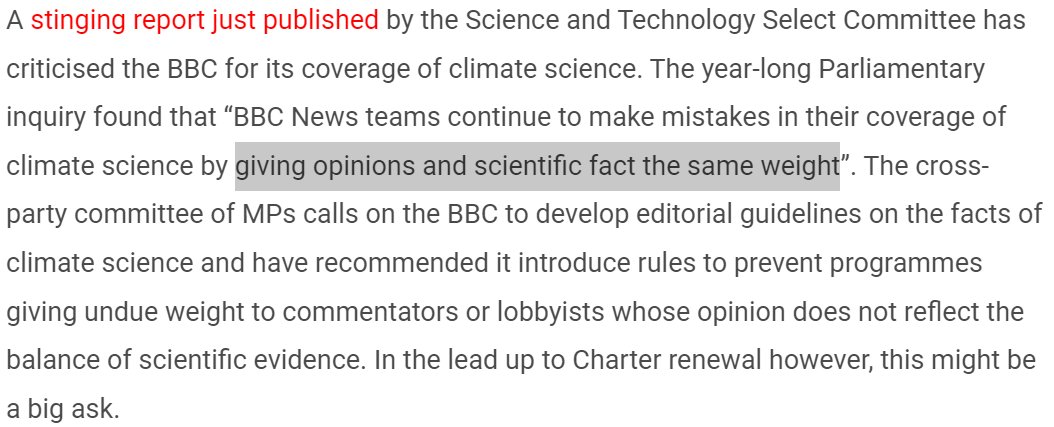
News media, like for instance the BBC, can be criticised for an over-commitment to apparent impartiality leading to promoting a "false balance", dedicating airtime to improbable perspectives.
blogs.lse.ac.uk/medialse/2014/…
blogs.lse.ac.uk/medialse/2014/…
And when looking for advice, people disagreeing with us may not be helpful. Instead, they can waste our time raising criticisms we deem irrelevant. Looking at the problem of choosing an advisor optimally, Suen concluded in a paper published in the Economic Journal in 2004:

What is the best way to acquire information then? Zhong (2022) looked at a very general situation:
1) Acquiring information & waiting to make a decision is costly
2) You can choose the type of information you get.
👉The optimal solution is to look for confirmatory information!
1) Acquiring information & waiting to make a decision is costly
2) You can choose the type of information you get.
👉The optimal solution is to look for confirmatory information!
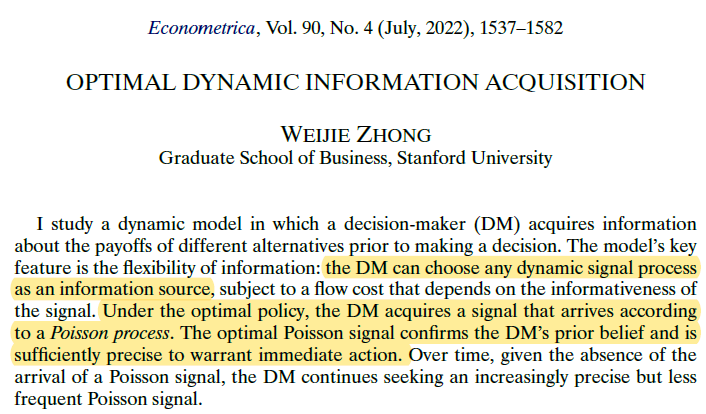
The optimal solution is for you to follow a source of information that can only give you news in the direction you expect to be true. As you wait for positive news, your initial belief will wane. But as soon as you get confirmatory information you stop confidently (“I knew it”).
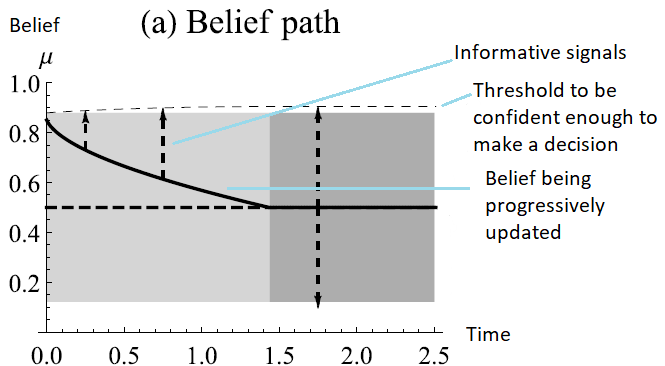
For example, if we learn that a politician is accused of fraudulent behaviour, it will make sense to follow news sources that would release evidence in the direction we most likely believe to be true (if this evidence exists).

So, is seeking confirmatory information really a “bias”? Not in principle. When information is costly, the optimal strategy can involve seeking confirmation of what we already believe to be true. It minimises the expected cost of acquiring enough information to make a decision.
The so-called "confirmation bias" might actually be an efficient allocation of our attention. This doesn’t mean that there aren’t biases in gathering & interpreting information. But seeking confirmatory evidence given these beliefs isn't a proven bias in itself.
You might think, "this isn't proof that no confirmation bias exists". That's right. However, the alleged proof of this bias is that people look for confirmatory information. As this observed behaviour can credibly be an optimal strategy, the burden of proof is on the prosecution.
Key insight here: Advancements in theories on decision-making can help us understand certain "biases" better. Often behaviours, initially perceived as biases, might have sound explanations when we consider the real-world constraints we operate within.
I develop these points in this post, the second one looking at classical “biases” that are likely not biases.
The next post will be on perhaps the most famous one in behavioural economics: reference-dependence (sensitivity to gains & losses). End/ tinyurl.com/49zmusnm
The next post will be on perhaps the most famous one in behavioural economics: reference-dependence (sensitivity to gains & losses). End/ tinyurl.com/49zmusnm
• • •
Missing some Tweet in this thread? You can try to
force a refresh