
 Read on Twitter
1/24 Explainer 🧵on testing of masks. What do the numbers on the masks mean? They are harmonic mean fit factors which allow us to grade different respirators- from SCBA even down to earloop masks based on how well they are protecting the wearer vs a wide range of particle sizes. 

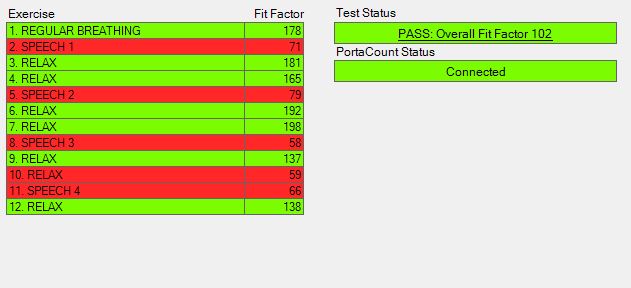
2/24 How do you get these numbers? With a portacount machine. This is a particle counter that measures particles inside/outside of a probed mask during a fit test. The ratio of particles inside vs outside is converted into a numerical score called a fit factor.


3/24 Individual fit factors come from each fit test exercise. The combined scores of all exercises are calculated into a harmonic mean. This calculation makes the score more conservative. The machine can do this by itself and it is a term that is rarely mentioned.
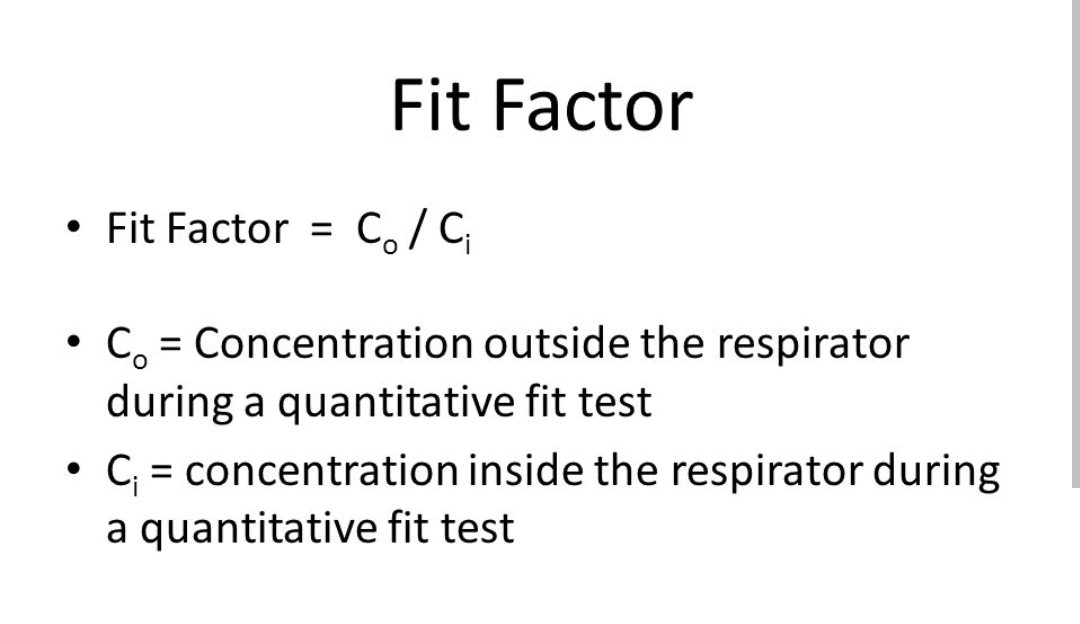
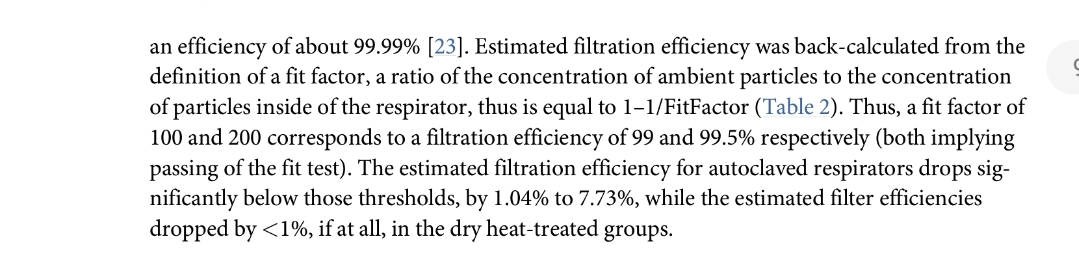
4/24 What do the scores mean? You can convert them into filtration efficiency. The formula is: 1-(1/FITFACTOR). A FF of 2(surgical mask) is 50%.(though in reality likely less since some particles have been "filtered" by the lungs). FF of 100 is 99%. Some N95/FFP2/P2+ exceed this.
5/24 How does it differ from occupational tests? OSHA protocols are industry standard. They don't emphasize jaw movement and do speech at the end. We do lots of jaw movements(singing is encouraged) and it starts early. Target is 2cm of jaw movement. This is more reflective.
6/24 Occupational tests on disposable respirators use "N95 Mode". This testing mode does NOT test for filter penetration and ONLY measures for leaks around the face seal. We measure a large range of particles whether they came in through filter or face seal. This is N99 mode.
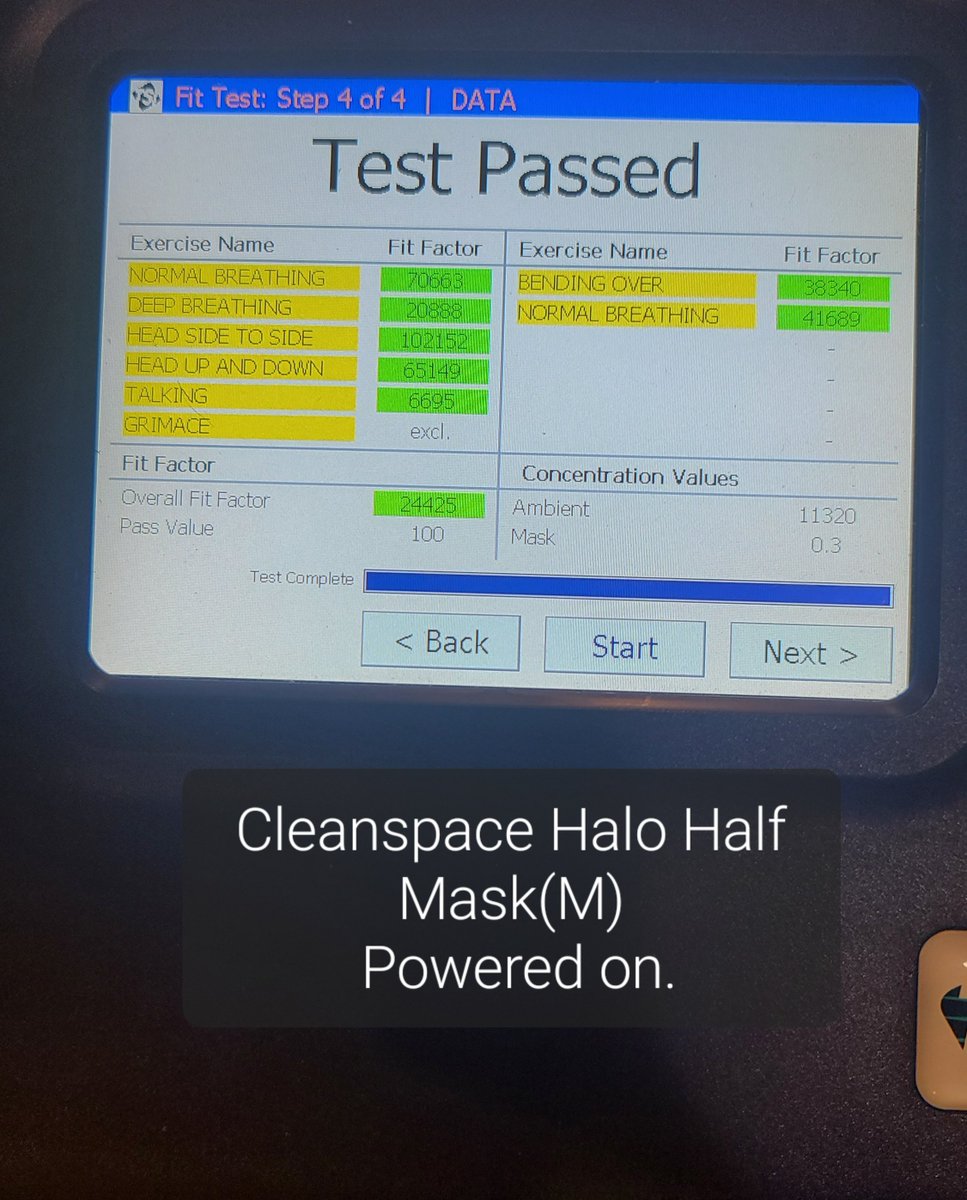
7/24 Higher scores in N99 mode mean higher overall protection. This could be in the hundreds for a "perfect" N95 or similar type mask. Elastomeric respirators could score in thousands, PAPR's in tens of thousands as an example my Cleanspace Halo.
8/24 Why test? To help family & my community & to provide data to all. For years I followed Aaron Collins(masknerd) who provided excellent information on different masks, showing the very best the mask could do and gave very good advice on breathability, fit & sourcing.
9/24 I would select masks that Aaron had rated very highly and then do my own home fit tests with Saccharin. I have no doubt this helped keep me and my family safe. More recently I discovered this very different, new testing style from @fittestmyplanet.
10/24 The goal is to not show what the filter media is capable of, but to provide a conservative estimate on real world protection! Such a rigorous test will help to weed out bad masks, but may make some halfway decent ones look bad but that's okay because we have many options!
11/24 This form of testing showed that some of the masks that passed my qualitative fit tests with saccharin actually "failed" even an easier quantitative test. It also showed a huge difference in protection between the "passing" masks. They are NOT EQUAL!
12/24 Now common criticisms: "These tests only apply to you!" Wrong. Three panel disposables such as 3M Aura and Trident may have pass rates well exceeding 90%. This applies to anyone who may possibly fit any one of these sizes or styles of respirator we test.
13/24 We make the test aggressive and the score more conservative. If a mask does well it has a better chance of protecting you. This is even more true if it does well against a wide range of testers such as Aura and Trident. I do recommend you do some kind of fit test yourself.
14/24 "You only test on yourself!". False. I have done testing on entire families all at the same time. I test anyone who is interested to help them learn about their respirators and collect data. If you are in or near San Diego area I can help. I also hope to send out machines.
14/24 "The mask that scored low is really a great mask, you are dumb!" Unlikely you should trust a mask that consistently scores low for many testers. I would recommend more rigorous testing and looking at other options, not attempting to sling insults. I can help offer advice.
15/24 There are exceptions such as the kids Flo Mask which can have a perfect face seal but doesn't filter as much as we might like. It's still one of the very best kids masks if there is consistent seal and it is comfortable would recommend. N95 mode actually helps here.

16/24 This style of testing is about to take off with many people across the world buying up surplus portacounts and I hope to help anyone who is interested. Soon this will also become cheaper and more accessible as an open source particle counter is even being developed!
17/24 Will finish by linking some of my threads. Cleanspace Halo:
https://twitter.com/CriticalAerosol/status/1654801001935941632?s=20
18/24: PAPR Buggy testing:
https://twitter.com/CriticalAerosol/status/1655328650869493760?s=20
19/24 Readimask Nose Hack:
https://twitter.com/CriticalAerosol/status/1656480298459332609?s=20
20/24: Adult Trident:
https://twitter.com/CriticalAerosol/status/1662618370561429507?s=20
21/24: Kids masks 1:
https://twitter.com/CriticalAerosol/status/1662618370561429507?s=20
22/24: Family testing:
https://twitter.com/CriticalAerosol/status/1668080778570534913?s=20
23/24: Kids masks 2:
https://twitter.com/CriticalAerosol/status/1669910220259340295?s=20
24/24: Viral thread on adult respirators:
Questions? Comments? Concerns? DM's always open
Questions? Comments? Concerns? DM's always open
https://twitter.com/CriticalAerosol/status/1673159079261519872?s=20
Sorry, here is the correct link for Kids masks 1. It is my pinned tweet:
https://twitter.com/CriticalAerosol/status/1665238277136187393?s=20
Sorry, here is the correct link for Kids masks 1. It is my pinned tweet:
https://twitter.com/CriticalAerosol/status/1665238277136187393?s=20
@NgoTheWorld N95 mode is of limited utility since it only tests face seal leak and it is artificially capped at a score of 200+. We may actually see scores start to decrease in N99 mode a few minutes before they do in N95 mode so some minute breaks in seal already happen before score drops.
@NgoTheWorld If a respirator has a good face seal it should stay at 200+ and if it drops during an exercise it should go back up to 200+(this means the respirator has successfully resealed on its own as it should)
• • •
Missing some Tweet in this thread? You can try to
force a refresh






