Read on Twitter
EBITDA is flawed and unfit for most of the roles it has today.
So if you evaluating a company’s financial performance...
Don’t just use EBITDA.
So if you evaluating a company’s financial performance...
Don’t just use EBITDA.

🎯 EBITDA frequently gets adjusted to suit users individual needs and help mitigate their risks.
🎯 EBITDA needs replacing with a better profitability/cash flow measure that:
☑️ includes working capital investment
☑️ includes long term capital investment
🎯 EBITDA needs replacing with a better profitability/cash flow measure that:
☑️ includes working capital investment
☑️ includes long term capital investment
☑️ includes payment obligations on debt
☑️ includes tax payment obligations
Here are 5 alternatives to EBITDA you can consider, depending on your business objectives:
☑️ includes tax payment obligations
Here are 5 alternatives to EBITDA you can consider, depending on your business objectives:
**1. Adjusted EBITDA**
= Net Income + Interest + Taxes + Depreciation + Amortization + Adjustments
⚫Possible Adjustments List:
>> non-recurring expenses (management/M&A)
>> normalized depreciation/amortization (management, M&A)
>> rental expenses (banks)
= Net Income + Interest + Taxes + Depreciation + Amortization + Adjustments
⚫Possible Adjustments List:
>> non-recurring expenses (management/M&A)
>> normalized depreciation/amortization (management, M&A)
>> rental expenses (banks)
>> proforma “what-if” expenses or cost savings (M&A)
>> CAPEX
>> cash taxes
>> distributions (banks)
>> working capital investments
>> fixed capital investments
✅**Pros**: easily calculated
>> CAPEX
>> cash taxes
>> distributions (banks)
>> working capital investments
>> fixed capital investments
✅**Pros**: easily calculated
❌**Cons:** most adjustments won't include debt payments, CAPEX or working capital investments
**2**. 𝗢𝗽𝗲𝗿𝗮𝘁𝗶𝗻𝗴 𝗖𝗮𝘀𝗵 𝗙𝗹𝗼𝘄(𝗢𝗖𝗙)
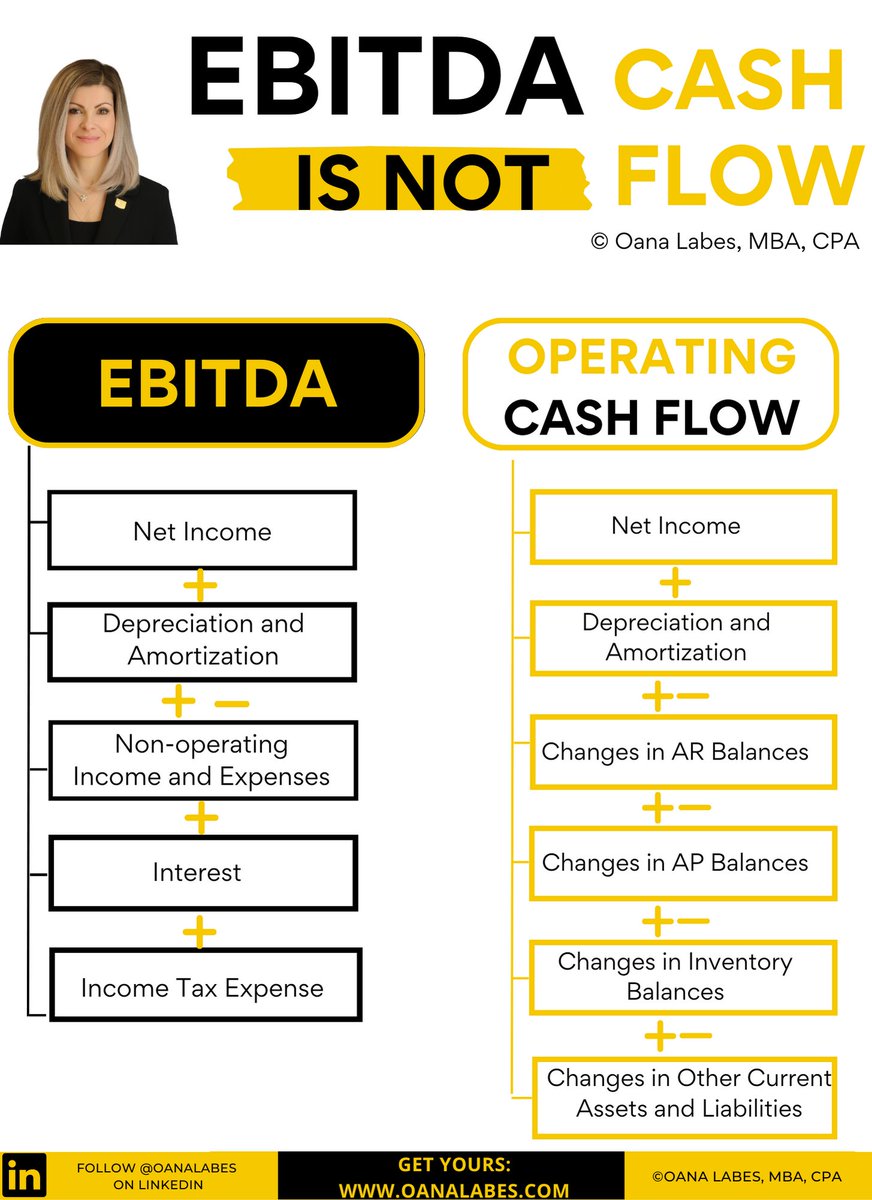
= Net Income + Depreciation/Amortization + Other Non Cash Items +/ Changes in Working Capital
✅**Pros**: includes tax payment obligations and working capital investment
= Net Income + Depreciation/Amortization + Other Non Cash Items +/ Changes in Working Capital
✅**Pros**: includes tax payment obligations and working capital investment
❌**Cons**: doesn’t include long term capital investment or payments on debt obligations
**3**. 𝗙𝗿𝗲𝗲 𝗖𝗮𝘀𝗵 𝗙𝗹𝗼𝘄 𝘁𝗼 𝘁𝗵𝗲 𝗙𝗶𝗿𝗺 (𝗙𝗖𝗙𝗙 𝗼𝗿 𝗨𝗻𝗹𝗲𝘃𝗲𝗿𝗲𝗱 𝗖𝗮𝘀𝗵 𝗙𝗹𝗼𝘄)
= Operating Cash Flow + Interest x (1- Tax Rate) +/- Changes in Fixed Assets
= Operating Cash Flow + Interest x (1- Tax Rate) +/- Changes in Fixed Assets
✅**Pros**: includes tax payment obligations, working capital investment, and long term capital investment
❌**Cons**: doesn’t include debt principal payment obligations
❌**Cons**: doesn’t include debt principal payment obligations
4. 𝗙𝗿𝗲𝗲 𝗖𝗮𝘀𝗵 𝗙𝗹𝗼𝘄 𝘁𝗼 𝗘𝗾𝘂𝗶𝘁𝘆 𝗛𝗼𝗹𝗱𝗲𝗿𝘀 (𝗙𝗖𝗙𝗘 𝗼𝗿 𝗟𝗲𝘃𝗲𝗿𝗲𝗱 𝗖𝗮𝘀𝗵 𝗙𝗹𝗼𝘄)
= Operating Cash Flow +/- Changes in Fixed Assets +/- Changes in Net Debt
= Operating Cash Flow +/- Changes in Fixed Assets +/- Changes in Net Debt
✅**Pros**: includes working capital investment, tax payment obligations, long term capital investment, and payment of debt obligations
❌**Cons**: could be complex to calculate and information may not be readily available
❌**Cons**: could be complex to calculate and information may not be readily available
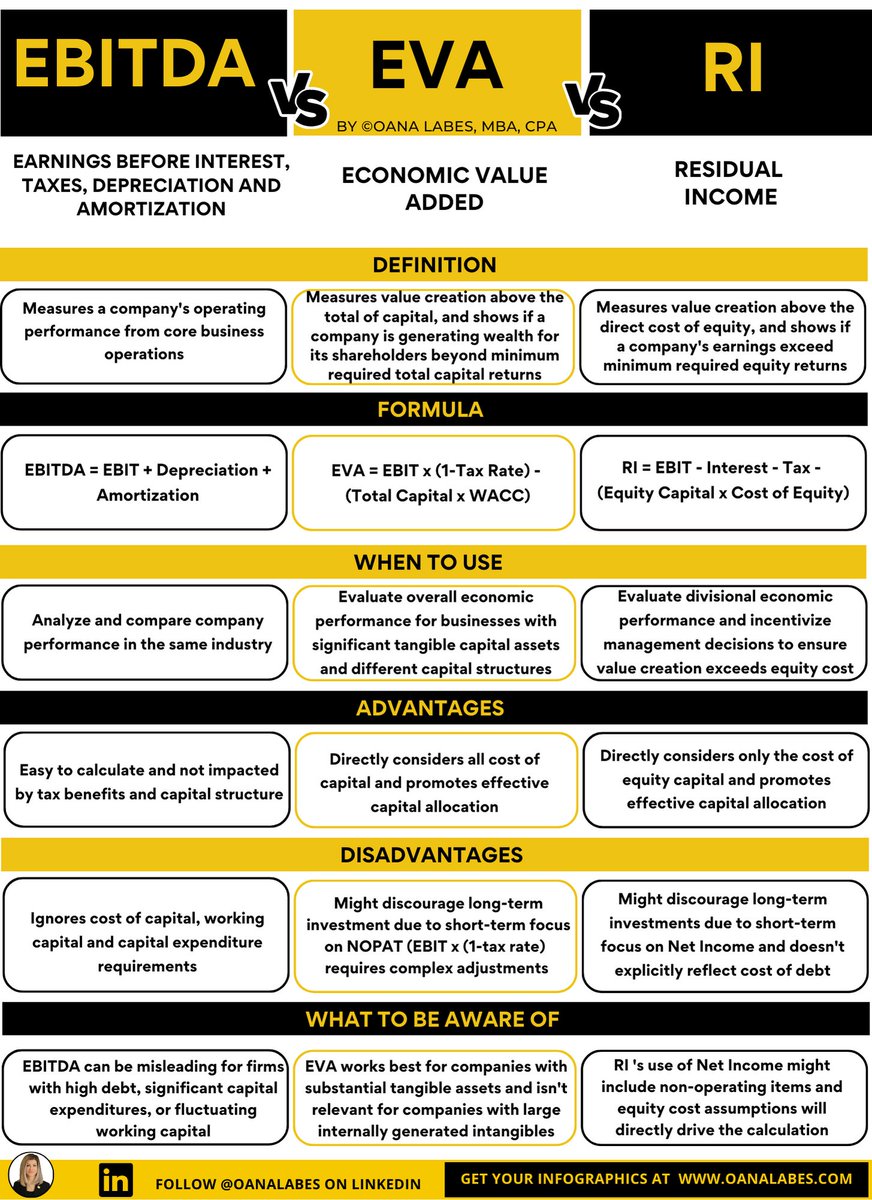
**5. Economic Value Added**
= EBIT - Taxes - WACC x (Fixed Assets + Net Working Capital)
✅**Pros**: includes tax payment obligations as well as a cost of capital charge for working capital investment, long term capital investment, and outstanding debt.
= EBIT - Taxes - WACC x (Fixed Assets + Net Working Capital)
✅**Pros**: includes tax payment obligations as well as a cost of capital charge for working capital investment, long term capital investment, and outstanding debt.
❌**Cons**: could be complex to calculate.
What do you think?
If you enjoyed this thread:
1. Follow me @IAmOanaLabes for more of these
2. RT the tweet below to share the knowledge
3. You will love my free newsletter. Join 30,000 subscribers for full posts: https://t.co/p8ruNqi1LHthe-finance-gem.beehiiv.com/subscribe
If you enjoyed this thread:
1. Follow me @IAmOanaLabes for more of these
2. RT the tweet below to share the knowledge
3. You will love my free newsletter. Join 30,000 subscribers for full posts: https://t.co/p8ruNqi1LHthe-finance-gem.beehiiv.com/subscribe
https://twitter.com/1612701806697627650/status/1680638288556613634
• • •
Missing some Tweet in this thread? You can try to
force a refresh