John F Sullivan Profile picture
Jul 16 11 tweets 4 min read Twitter logo Read on Twitter
To avoid a Bankrupt understanding of Sun Tzu, consider Chapter 11

The problematic 11th chapter of the Art of War is critical to understanding the overall text’s purpose and intent, yet most simply gloss over it. Here is why I think it deserves a closer reading …
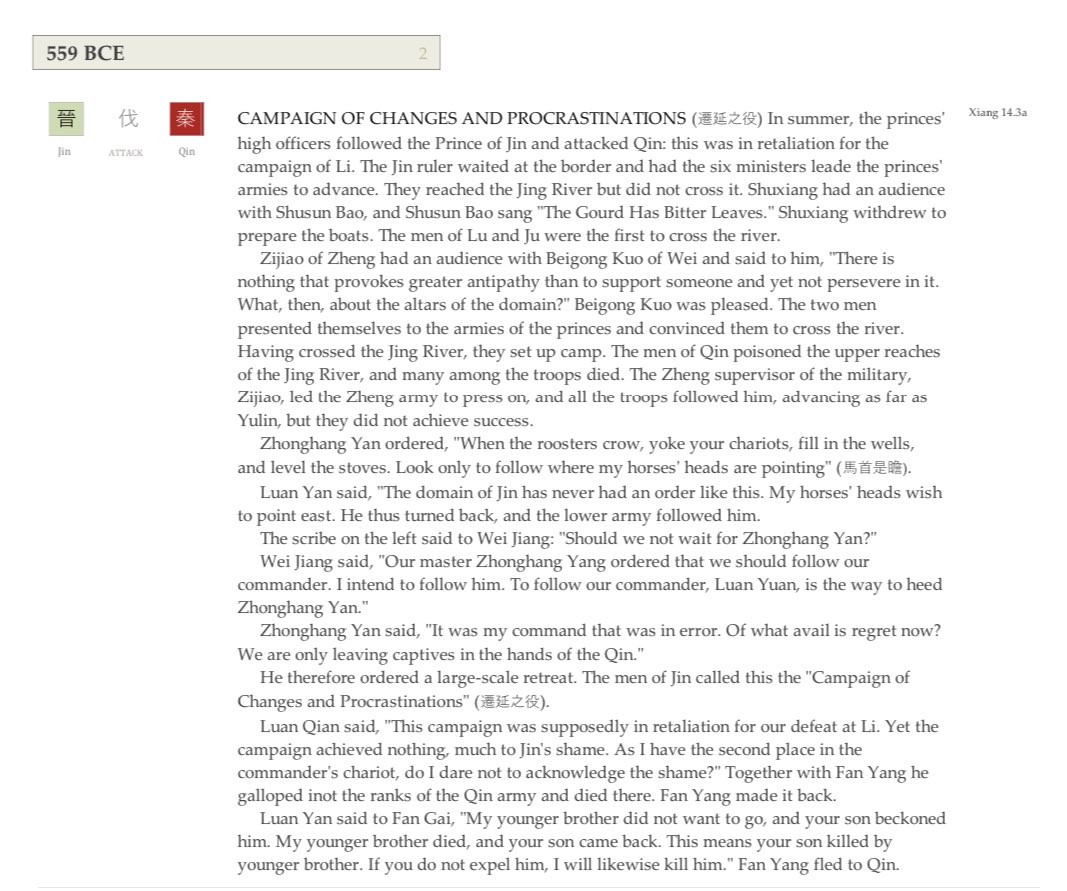
Image
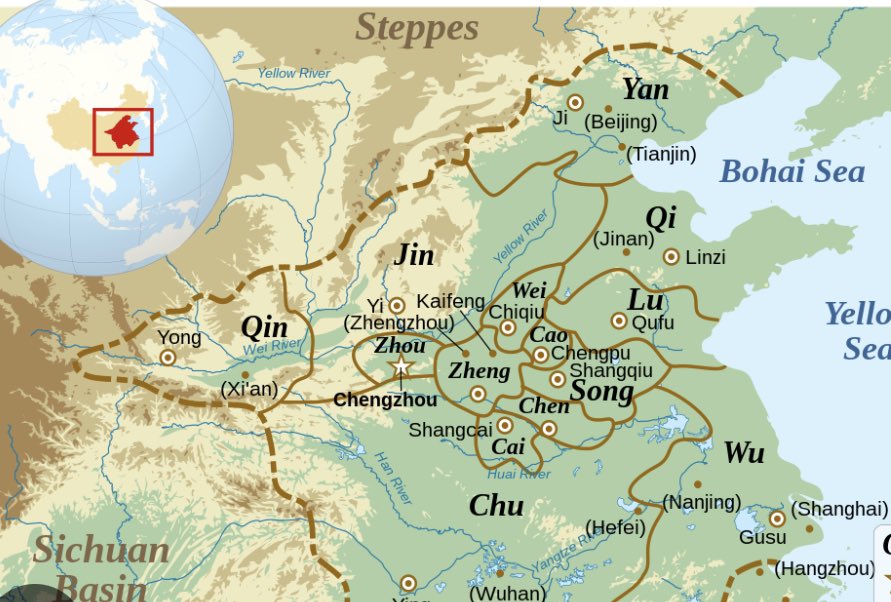
Image
This chapter has often confounded readers of the text. It is by far the longest chapter in the book, and its organization is often chaotic, with some sections simply corrupted repetitions, and other topics drifting aimlessly into non-sequiturs.
Moreover, given the descriptions of various terrains found in chapters 8, 9 and 10, this chapter is often thought of as simply a summary of the information already covered in previous sections of the book. Chapter 11, though, is unique and worthy of more careful analysis.
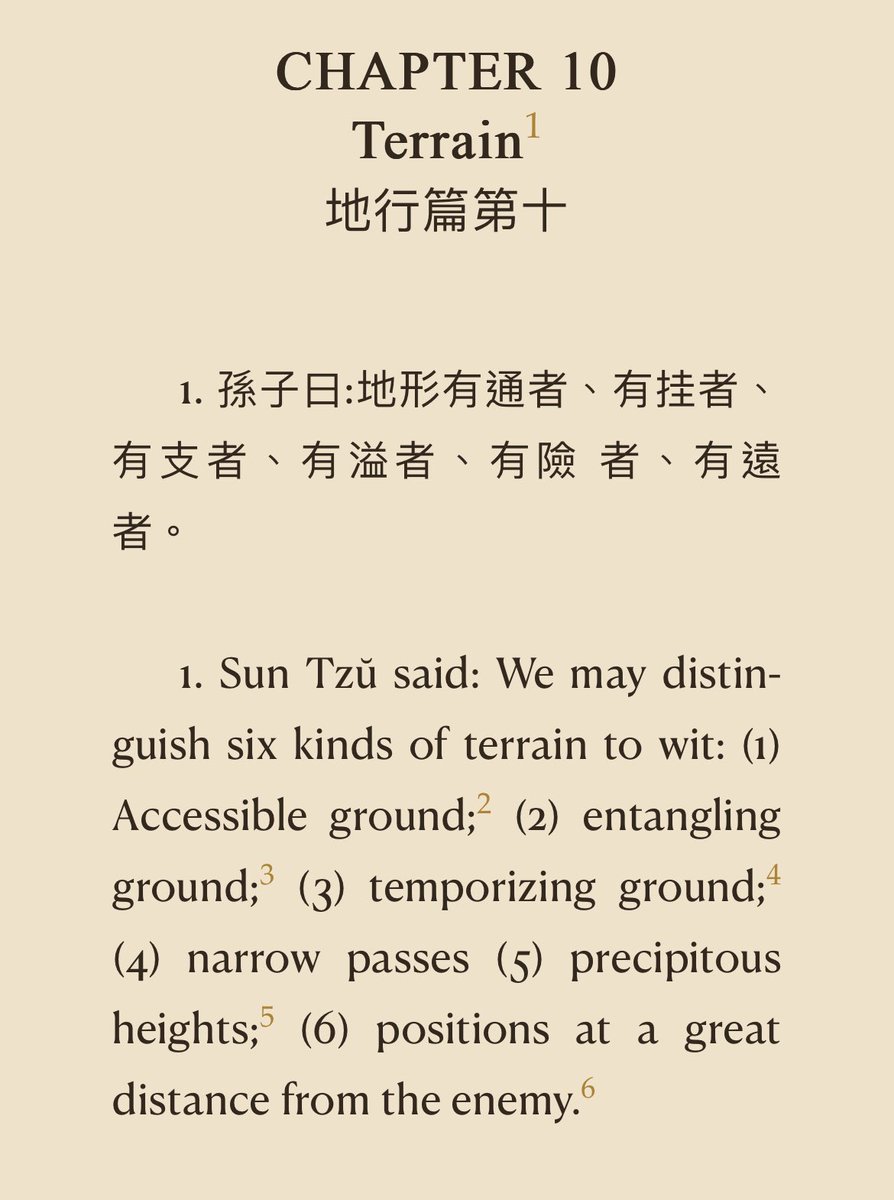
Image
Image
More than any other section of the book, this chapter follows a close approximation of modern operational design. The sequence of terrains (zones) outlines Sun Tzu's vision for how an offensive operation should ideally unfold in terms of both time and space, from the initial
invasion across the enemy border to the culminating decisive battle that will achieve victory for one's army.

Terrain does not adequately reflect what Sun Tzu is describing. He is not concerned here with the actual physical properties of the terrains he is listing.
His thinking is aligned more with the more modern military term of “zone.”

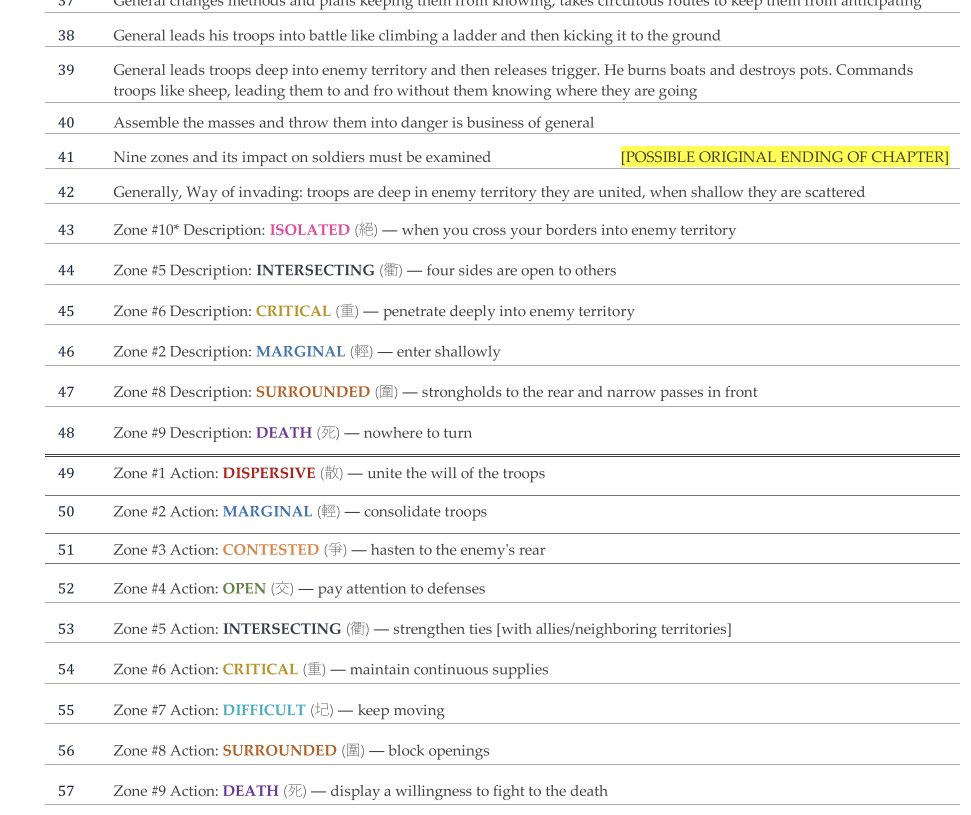
The heart of the chapter is a DESCRIPTION and corresponding recommend ACTION for each of the zones Sun Tzu expects to encounter. Here is a brief synopsis: Image
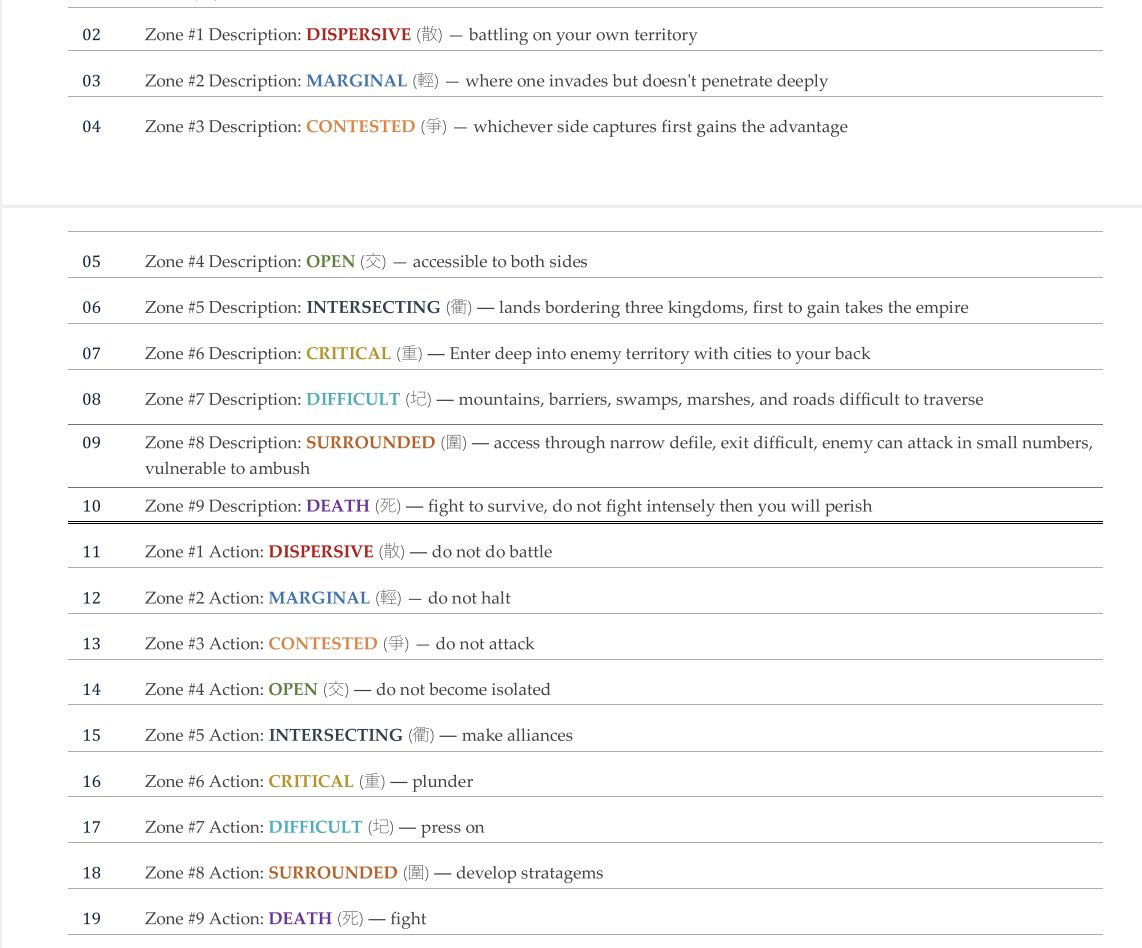
Later in the chapter this pattern will be confusingly duplicated, but this time it is corrupted. It adds a 10th “zone” 絕 (Isolated) and not all of the other zone descriptions are included. My theory is that the chapter naturally concludes shortly before this section of the text.
What comes after is questionably added material, including reworked passages, duplications, and other passages (such as the one mentioning hegemons) that don’t necessarily fit into the original text. Image
Going back to the original 9 zones then, what is clear is that while the first eight are meant to be either endured, avoided, or temporarily exploited, it is only in the last, death ground (死地) that one has any expectation of obtaining victory.
The takeaway from this is that there are two main elements to Sun Tzu's operational concept: drive deeply into the enemy's territory and then intentionally seek " death ground " for your soldiers before initiating the attack.
As I’ve mentioned before, the concept of reliance on “death ground” to achieve victory is Sun Tzu’s primary original idea. Chapter 11 helps visualize how it fits into the text’s overall theoretical structure.

• • •

Missing some Tweet in this thread? You can try to force a refresh

 

Keep Current with John F Sullivan

John F Sullivan Profile picture

Stay in touch and get notified when new unrolls are available from this author!

Read all threads

This Thread may be Removed Anytime!

PDF

Twitter may remove this content at anytime! Save it as PDF for later use!

Try unrolling a thread yourself!

how to unroll video
  1. Follow @ThreadReaderApp to mention us!

  2. From a Twitter thread mention us with a keyword "unroll"
@threadreaderapp unroll

Practice here first or read more on our help page!

More from @JohnF_Sullivan

Apr 17
“War is a subject of vital importance to the STATE”

This is the opening line of Sun Tzu’s Art of War.

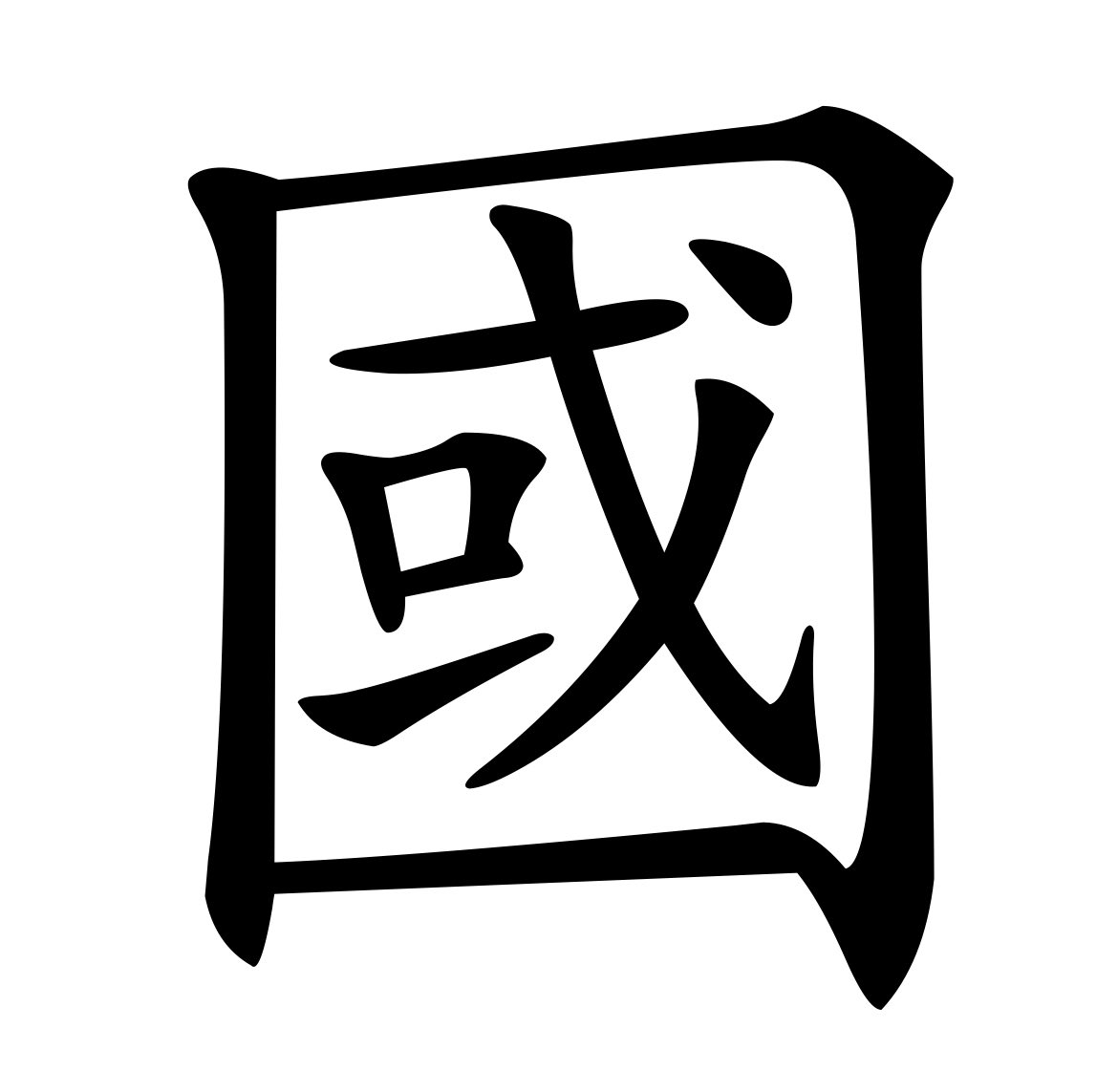
But what did the STATE (國) actually mean in the context of a military work compiled during an era of declining Zhou authority? Image
The clear majority of translators render 國 (guo) as “state” invoking a Weberian sense of the term. Several prefer nation or country as an alternative, and the (thankfully) few Sun Tzu-as-CEO oriented translations tend to go with “organization” as an acceptable substitute. Image
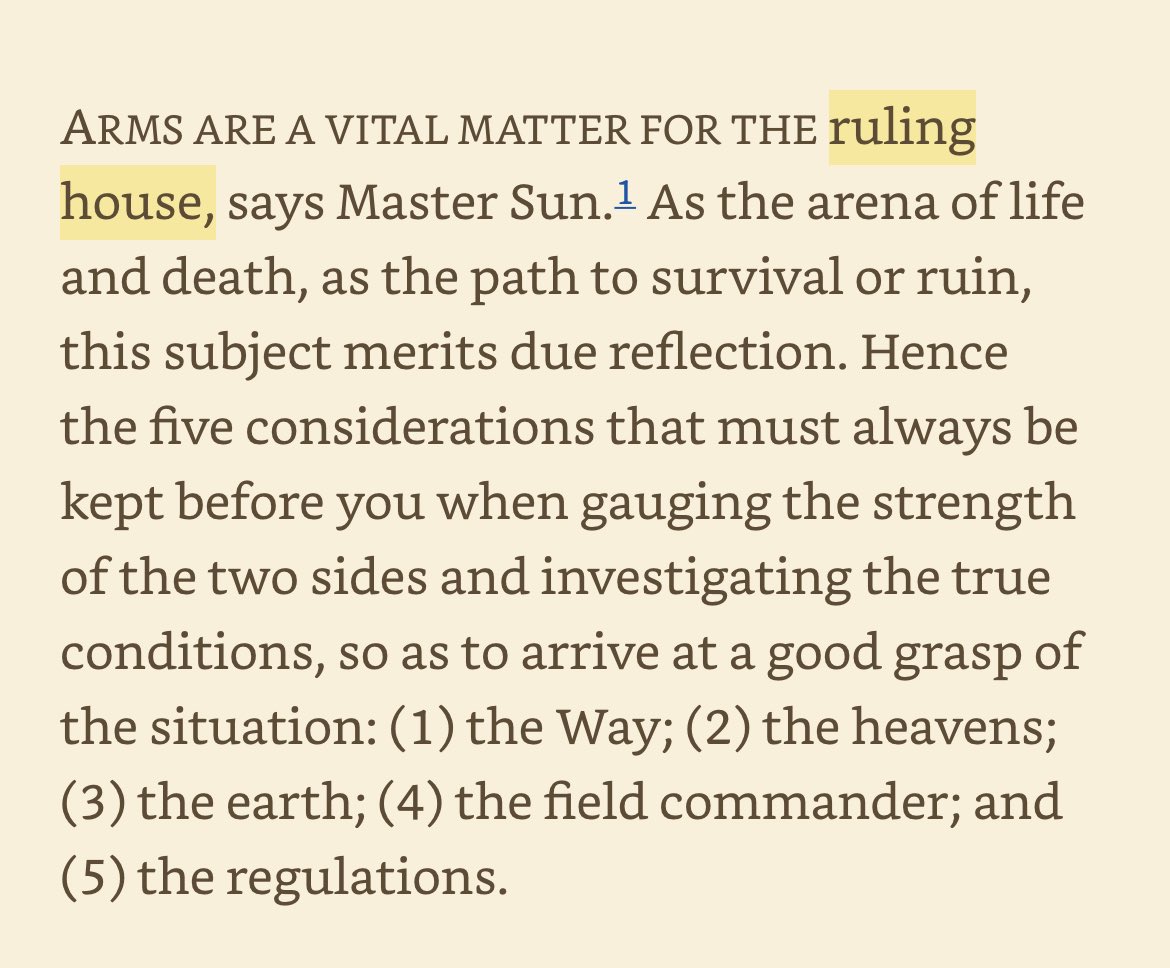
The latest major translation effort by Michale Nylan and her team bucks this convention. She renders 國 as referring to the “ruling house,” implying that warfare is of vital interest to the family of the feudal lords, but not necessarily the entire “state” in any modern sense. Image
Read 13 tweets
Apr 16
While a third biography of Chiang Kai-shek is probably superfluous, I’m enjoying this latest version by Alexander Pantsov. Where Fenby’s version is highly critical of him and Taylor goes to the opposite extreme in trying to restore his reputation, this one seems more balanced. Image
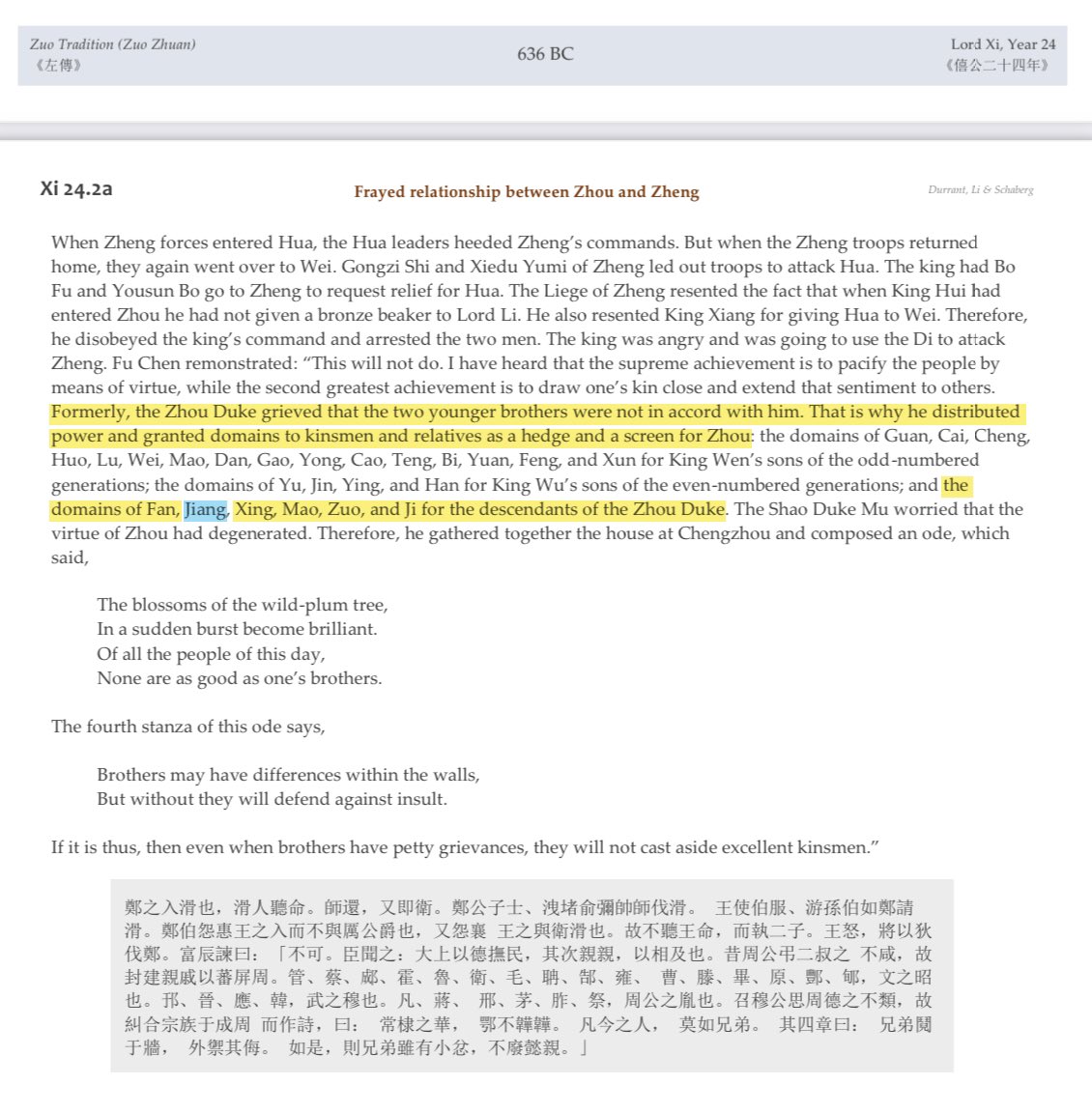
It has some interesting details I didn’t pick up from the earlier biographies. First, the Chiang (Jiang in pinyin) family name was thought to derive from the Duke of Zhou’s son, Bo Lin, who was enfeoffed with the small state of Jiang (蔣) soon after the Zhou was established. Image
This connection is confirmed in a passage found in the Zuozhuan which notes that the Duke of Zhou reserved some territories, including Jiang, for his own sons use to serve as a “hedge and a screen” to protect the Zhou rulers. Image
Read 8 tweets
Apr 14
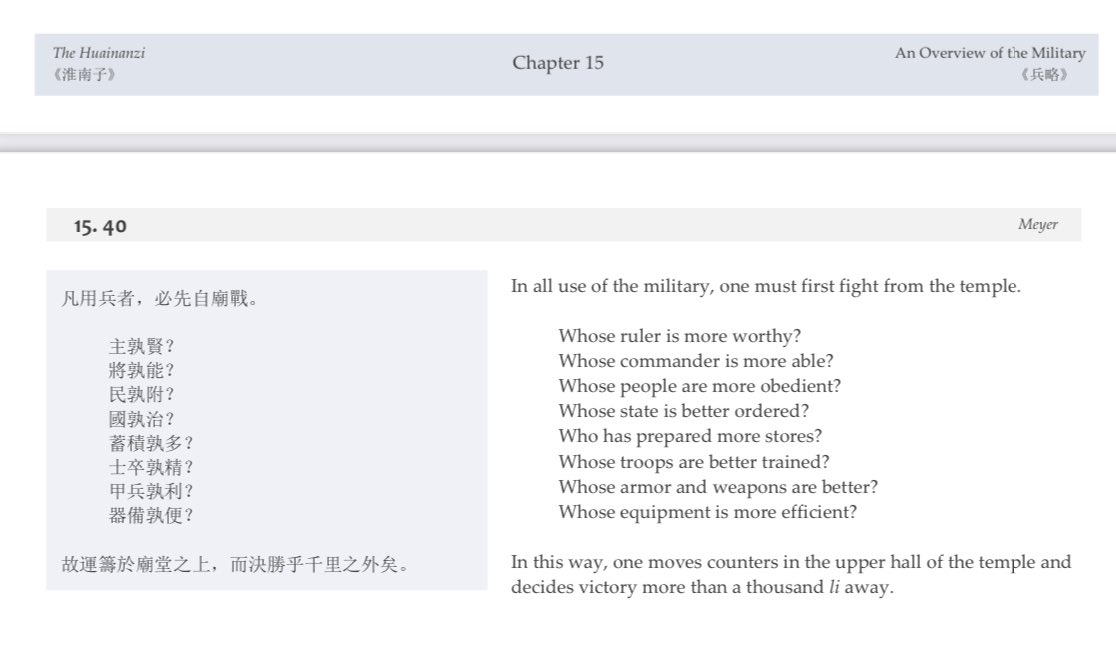
In the Huainanzi, a 2nd cent BC text on governance, a chapter entitled “An Overview of the Military” (兵略) contains a verse describing the 7 comparisons with a potential enemy a general must analyze from the temple (廟) before deciding to go to war.

Sun Tzu had a similar verse: Image
Although the format and grammatical patterns are nearly identical, there are interesting differences between what factors the two texts emphasize. The only exact match is “which general is most capable” (將孰能). Image
While the Sunzi asks us to consider which ruler posses the Dao (道), the Huainanzi instead seeks to know which ruler is more “worthy” (賢), perhaps reflecting Mohist influences, which established “elevating the worthy” as one of their core philosophical doctrines. Image
Read 6 tweets
Apr 12
In discussing the centrality of “death ground” in Sun Tzu, a common response is that I’m overemphasizing its importance—instead it was meant only as a last resort tactic.

Contrarily, I believe it was not simply an expediency or last resort, it was the main part of his theory … Image
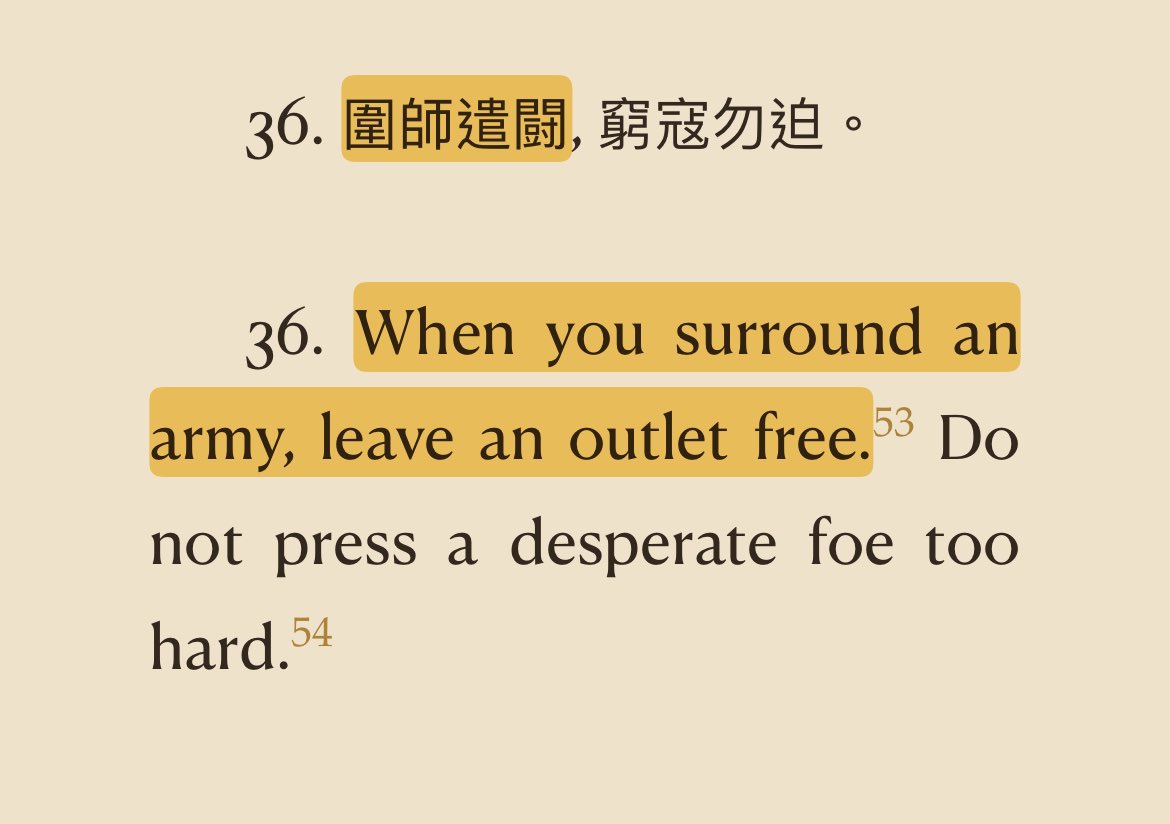
To see this, it’s easiest to start with an admonition Sun Tzu provides at the end of the 7th chapter:

“when you surround (圍) an army, leave an outlet free.” Image
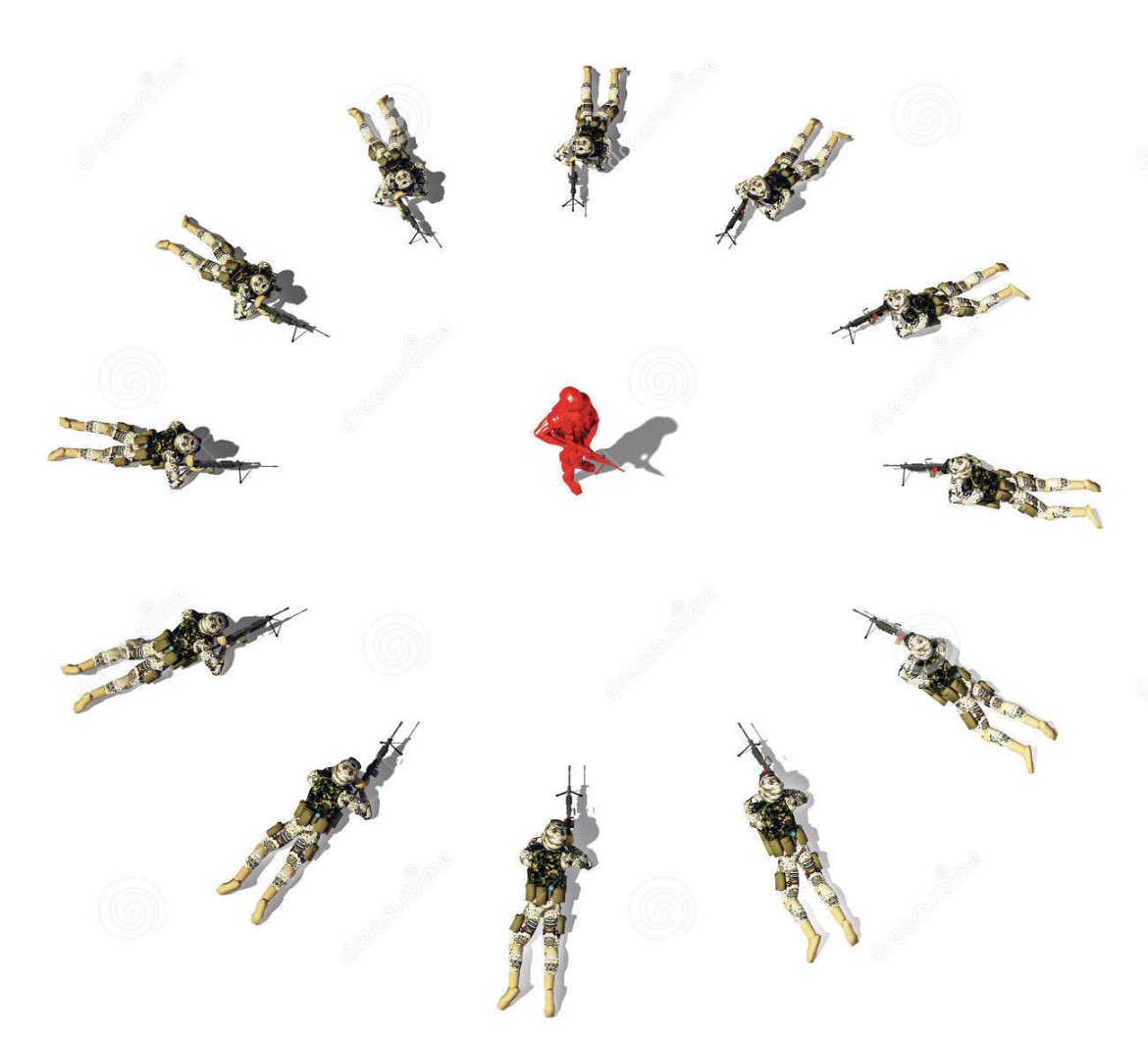
But earlier, in the 3rd chapter, Sun Tzu carved out an exception. If your force ratio is 10:1, then it is recommended that you DO surround (圍) the enemy’s army.

How do we explain this contradiction? Image
Read 13 tweets
Apr 2
“All states [that raise armies] possess a Dao of warfare (道兵) of which there are three:

there are those who act for PROFIT (利);

those who act out of RIGHTEOUSNESS (義); and

those who act out of ANGER (忿).”

Which Dao does Sun Tzu’s Art of War follow? …
First let's examine RIGHTEOUSNESS (義):

Sun Tzu's Art of War is an outlier compared to the other ancient China military texts in terms of explicit references to "righteousness," a key philosophical term of its era.

ctext.org/school-of-the-…
The lone reference of righteousness occurs in the last chapter, "Using Spies" which is itself an outlier chapter, thought by other scholars to be a later addition to an original twelve chapter core text.
academia.edu/37516732/Sun_T…
Read 8 tweets
Apr 1
559 BC—Campaign of Changes and Procrastinations (遷延之役)

Although a relatively minor engagement described in the Zuozhuan between the states of Jin and Qin during the Spring & Autumn era, it provides some interesting insights into what Sun Tzu was trying to fix in his text …
Although Jin’s main enemy was the southern state of Chu, it’s neighbor to the west, Qin was also a source of strategic concern and the two states fought several major battles and minor border skirmishes.
This campaign was Jin’s retaliation for its defeat at the hands of Qin in a battle fought several years earlier. According to the Zuozhuan, Jin was defeated because it had not taken Qin’s threat seriously.
Read 10 tweets

Did Thread Reader help you today?

Support us! We are indie developers!


This site is made by just two indie developers on a laptop doing marketing, support and development! Read more about the story.

Become a Premium Member ($3/month or $30/year) and get exclusive features!

Become Premium

Don't want to be a Premium member but still want to support us?

Make a small donation by buying us coffee ($5) or help with server cost ($10)

Donate via Paypal

Or Donate anonymously using crypto!

Ethereum

0xfe58350B80634f60Fa6Dc149a72b4DFbc17D341E copy

Bitcoin

3ATGMxNzCUFzxpMCHL5sWSt4DVtS8UqXpi copy

Thank you for your support!

Follow Us on Twitter!

:(