Read on Twitter
ROI vs ROIC vs ROE vs ROCE vs ROE vs ROA
Performance metrics are confusing. Here’s how to navigate them.
Performance metrics are confusing. Here’s how to navigate them.
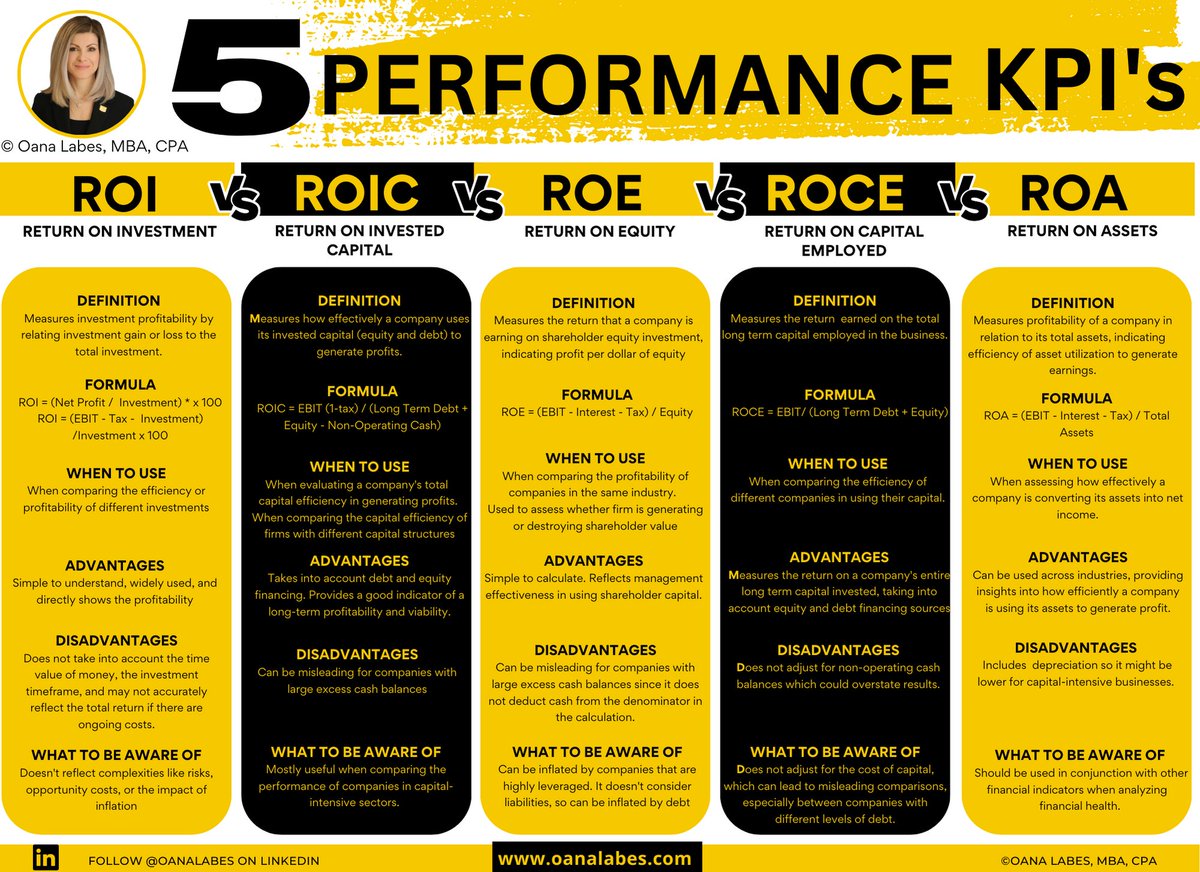
1️⃣ Return on Investment (ROI)
- Formula: ROI = (Net Profit / Cost of Investment) * 100%
- Caveat: ROI doesn't consider the time value of money, which makes it less useful for multi-period investments.
- Formula: ROI = (Net Profit / Cost of Investment) * 100%
- Caveat: ROI doesn't consider the time value of money, which makes it less useful for multi-period investments.
2️⃣ Return on Invested Capital (ROIC)
- Formula: ROIC = NOPAT / (Long Term Debt + Equity - Cash)
- Caveat: ROIC may be misleading for companies with large non-operating cash balances.
- Formula: ROIC = NOPAT / (Long Term Debt + Equity - Cash)
- Caveat: ROIC may be misleading for companies with large non-operating cash balances.
3️⃣ Return on Equity (ROE)
- Formula: ROE = Net income / Shareholder's equity
- Caveat: ROE can be heavily inflated by excessive use of leverage
- Formula: ROE = Net income / Shareholder's equity
- Caveat: ROE can be heavily inflated by excessive use of leverage
4️⃣ Return on Capital Employed (ROCE)
- Formula: ROCE = EBIT / (Long Term Debt + Equity)
- Caveat: ROCE's lack of consideration for cost of debt can lead to misleading results for companies with substantial leverage and interest costs
- Formula: ROCE = EBIT / (Long Term Debt + Equity)
- Caveat: ROCE's lack of consideration for cost of debt can lead to misleading results for companies with substantial leverage and interest costs
5️⃣ Return on Assets (ROA)
- Formula: ROA = Net Income / Total Assets
- Caveat: ROA also does not consider borrowing costs, making it less accurate for companies with high levels of debt.
- Formula: ROA = Net Income / Total Assets
- Caveat: ROA also does not consider borrowing costs, making it less accurate for companies with high levels of debt.
What do you think?
If you enjoyed this thread:
1. Follow me @IAmOanaLabes for more of these
2. RT the tweet below to share the knowledge
3. You will love my free newsletter. Join 30,000 subscribers for full posts: https://t.co/C82h2MZ1tTthe-finance-gem.beehiiv.com/subscribe
If you enjoyed this thread:
1. Follow me @IAmOanaLabes for more of these
2. RT the tweet below to share the knowledge
3. You will love my free newsletter. Join 30,000 subscribers for full posts: https://t.co/C82h2MZ1tTthe-finance-gem.beehiiv.com/subscribe
https://twitter.com/1612701806697627650/status/1680699906611109890
• • •
Missing some Tweet in this thread? You can try to
force a refresh