1/ Thread: There is a common narrative in politics, that social issues are a distraction by the elites, and the real issue is class issues. Heres why I don't think that narrative is accurate:
3/ Another issue is that class is highly fluid. 9 percent of Americans will spend a year in the top 5 percent of the income distribution, 56 percent in the top 10 percent, and 73 percent will spend a year in the top 20 percent of the income distribution. nytimes.com/2014/04/20/opi…
4/ Not directly related, 89% Americans say that they are part of the middle class. Often class identity is about occupation as much as income. Do a trucker and a college professor consider themselves a part of the same class if they are paid the same? rand.org/blog/2021/05/m…
5/ Billionaires seem divided by the political spectrum just like everyone else. There is no conspiracy of the elites to force a certain political program. forbes.com/sites/chasewit…
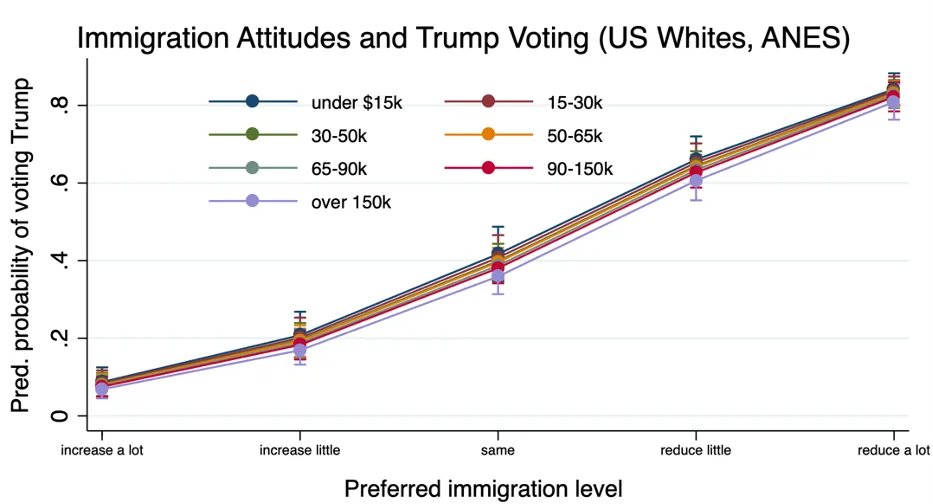
6/ And contrary to the idea that the powerful wants you to hate immigrants, the elites are more supportive of immigrants than the general population.
7/ Looking at regions around the world that want to secede, identity tends to trump income. People genuinely care about their identity, it isn't some distraction cooked up by the elites. osf.io/preprints/soca…
• • •
Missing some Tweet in this thread? You can try to
force a refresh

1/Short thread on race and Greek life. This legal scholar recently filed some FOIA requests for public universities to get some data on mainstream frats and sororities (IFC/Panhellenic) and this is what the data looks like overall:
2/ The IFC fraternities they looked at were slightly less white at around 72%. Everywhere greeks life was at least 15% whiter than the university population as a whole.
3/ Comparison between % of undergrads who are black vs panhellenic sororities. At the schools that turned over chapter level data almost half of chapters had no black members.
1/ Short thread. The WSJ asked business historians to rank the greatest entrepreneurs and business leaders in American history. Here are the racial demographics:
1/ Short thread. Meadow Pollack was an 18 year old student at Parkland High School with dreams of becoming an attorney. She was fatally shot as she draped her body over a younger student attempting to protect her.
2/ In the aftermath of the shooting, her father tried to figure out what policies lead to her death and teamed up with a researcher to write this book. amazon.com/Why-Meadow-Die…
3/ Here are some excerpts from this book. The book goes through all of the ways in which in which the shooting could have been prevented. If the shooter had a criminal record of one of the serious crimes that he committed he would not have been able to legally purchase a firearm.
1/ Short thread. What was the "best" year if you were to judge it solely by paying to attention to the news and not Pinkeresque metrics like child mortality in Lesotho?
2/ For the purpose of this thread we will look at years 1992 and onwards since this is when the cold war was over. We can immediately exclude years like 1994, 2001, 2004, and 2020 due to major world events.
3/ Next lets exclude every year with more than 100,000 combat deaths. That gets rid of 1999, 2013-2017 and 2021 onwards.