Read on Twitter
IRR vs. ROI 
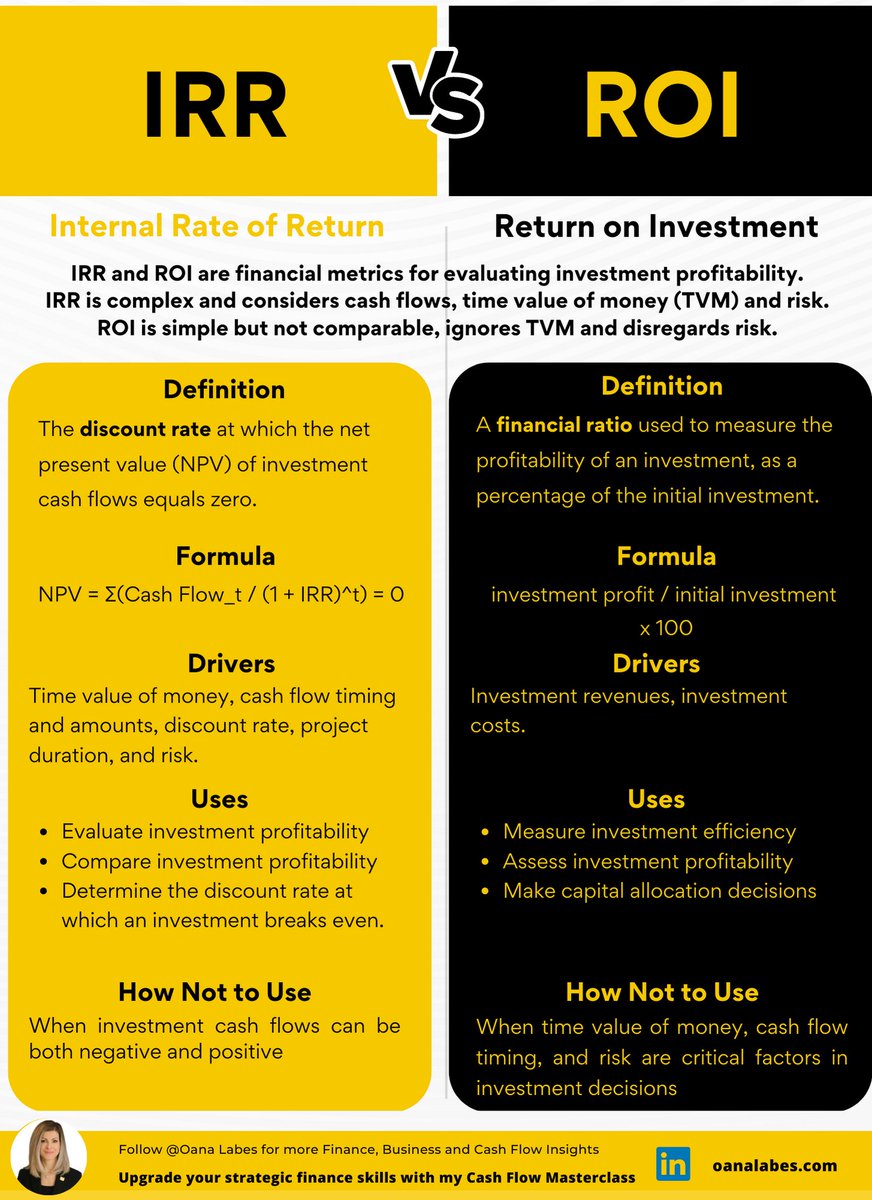
They’re both financial metrics used to evaluate investment profitability and to compare the profitability of different investments.
🎯 Definition:
⚫ IRR (Internal Rate of Return): The discount rate making the net present value (NPV) of investment cash flows zero.
🎯 Definition:
⚫ IRR (Internal Rate of Return): The discount rate making the net present value (NPV) of investment cash flows zero.
🟢 ROI (Return on Investment): A financial ratio measuring the profitability of an investment as a percentage of the initial investment.
🎯 How do you calculate them?
⚫ IRR: NPV = ∑(Cash Flow_t / (1 + IRR)^t) = 0
🎯 How do you calculate them?
⚫ IRR: NPV = ∑(Cash Flow_t / (1 + IRR)^t) = 0
🟢 ROI: (Investment cash flow - cost of investment) / cost of investment
🎯 What drives IRR & ROI?
⚫ IRR: Time value of money, cash flow timing, cash flow amounts, discount rate, project duration, risk.
🎯 What drives IRR & ROI?
⚫ IRR: Time value of money, cash flow timing, cash flow amounts, discount rate, project duration, risk.
🟢 ROI: Investment cash flow, cost of investment, project duration, risk.
🎯 How should you use them?
⚫ IRR: Evaluates investment profitability, compares different investments, determines break-even discount rate.
🎯 How should you use them?
⚫ IRR: Evaluates investment profitability, compares different investments, determines break-even discount rate.
🟢 ROI: Measures investment efficiency, compares different investments, decides where to allocate funds.
🎯 How should you NOT use them?
⚫ IRR: Avoid when investment cash flows are expected to be both positive and negative during project
🎯 How should you NOT use them?
⚫ IRR: Avoid when investment cash flows are expected to be both positive and negative during project
🟢 ROI: Avoid when time value of money, cash flow timing, and risk are crucial in investment decisions.
🎯 How are they different?
⚫ IRR is more complex, considering the time value of money.
🎯 How are they different?
⚫ IRR is more complex, considering the time value of money.
⚫ IRR accounts for cash flow timing and amounts, providing a more accurate profitability picture
⚫ IRR may produce multiple solutions or none, making it difficult to interpret
⚫ IRR considers risk by accounting for the required discount rate to achieve a positive NPV
⚫ IRR may produce multiple solutions or none, making it difficult to interpret
⚫ IRR considers risk by accounting for the required discount rate to achieve a positive NPV
🟢 ROI is easier to calculate and understand
🟢 ROI ignores the time value of money
🟢 ROI doesn't consider risk
🟢 ROI ignores the time value of money
🟢 ROI doesn't consider risk
What do you think?
If you enjoyed this thread:
1. Follow me @IAmOanaLabes for more of these
2. Sign up for my free newsletter. and join 30,000 subscribers:
3. RT the tweet below to share the knowledge: https://t.co/X2RiL4Vjcgthe-finance-gem.beehiiv.com/subscribe
If you enjoyed this thread:
1. Follow me @IAmOanaLabes for more of these
2. Sign up for my free newsletter. and join 30,000 subscribers:
3. RT the tweet below to share the knowledge: https://t.co/X2RiL4Vjcgthe-finance-gem.beehiiv.com/subscribe
https://twitter.com/1612701806697627650/status/1683476716310654986
• • •
Missing some Tweet in this thread? You can try to
force a refresh