Long time followers know I'm a huge fan of @TidesHistory and also believe the Bible to be a valid and correct historic account. So it was with mingled excitement and trepidation I saw Wyman had two episodes on Late Bronze/Iron Age Israel and Judah.
Here I'll do a review of them!
Here I'll do a review of them!
So after just a single generation, the unity breaks. Judah keeps the inheritance basis, Israel doesn't. Israel burns through dynasties left and right. Judah keeps the line of David unbroken until the very end. Israel is a wealthy tribal monarchy, Judah a poor kingship.
The collapse of David/Solomon's military prowess opens a vaccuum, and Shoshenq in Egypt is also ticked off that some of Egypt's spice trade gets interrupted by Israel, Edom, nomads, etc.
So Judah loses the spice trade, and is poor again. They remain bumpkins for a long time. They have priestly groups who insist on Yahweh-monotheism, but also tons of syncretism and Canaanite polytheism. The northern kingdom has a modified Yahweh-worship, perhaps including...
... formal worship of another goddess, Asherah. Because Judah and Israel share a cultural sphere, multiple rulers marry, many cross-border families, Israel's more syncretic Yahweh-worship often bleeds into Judah.
Again, THIS IS ALL IN THE BIBLE.
Again, THIS IS ALL IN THE BIBLE.
Eventually Israel is destroyed. Judah makes gains in the vaccuum and has a renaissance. Yahweh-worship is even more entrenched. Then Judah is destroyed. You know the rest.
Lastly, ethnically speaking, the Biblical account suggests Abraham is northwest Semitic, migrates into Canaan in 1700-1400 ish, his kin have some intermarriage, he picks up local retainers, ultimately a few dozen move to Egypt. More intermarriage, and they pick up some locals...
... so genetically we'd expect them to be pretty similar to northwest Semitic groups and Canaanites, MAYBE with some enrichment of African/Egyptian genetic signatures? But we wouldn't expect a super unique Hebrew genetic signature in this area.
My telling varies from the "traditional view" scholars like to skewer in many places. The Bible does not attest to 3 million Hebrews, or even 600,000. The Bible does not attest to a centralized bureaucratic united monarchy. The Bible does not attest to widely-practiced monotheism
The Bible attests to unstable, poor tribal confederal monarchies where a small clique of monotheistic prophets and priests threw their weight into trying to sway monarchs to endorse their religion while much of the populace was syncretic and heretical.
THIS IS LITERALLY WHY THE PROPHETS SAY JUDAH AND ISRAEL ARE DESTROYED.
So now let's get to the historical interpretation.
1) United Monarchy. @TidesHistory suggests that there's no evidence for a strong united monarchy. I agree. There's also no biblical claim for a strong united monarchy. There's a biblical claim for a personal union of tribes with a king who FOR LESS THAN 40 YEARS had taxing power
It isn't clear to me why we would expect to see any material evidence for this monarchy.
That said, archaeologically, we do see increases in fortification construction at many of the sites where the Bible says Solomon built forts. BTW, I locate David 1011-971, Solomon 971-931.
That said, archaeologically, we do see increases in fortification construction at many of the sites where the Bible says Solomon built forts. BTW, I locate David 1011-971, Solomon 971-931.
So right off the bat, when @TidesHistory says (as he repeatedly does) that Judah was really the more marginal kingdom, that the monarchy wasn't really united, that Israel was actually the big player.... yes. That is what the Bible says.
HOWEVER, many Sunday school classes DON'T say these things because in fact many Sunday schools do not teach the Bible very seriously.
More importantly, the Bible is MOSTLY concerned with the story OF THE PRIESTS AND PROPHETS. And from their perspective, Judah was LEGITIMATE.
More importantly, the Bible is MOSTLY concerned with the story OF THE PRIESTS AND PROPHETS. And from their perspective, Judah was LEGITIMATE.
This is crucial.
The Bible's claim is not that Judah was POWERFUL. Judah like almost never actually wins a battle. There are like.... 4 battles that Judah wins in the bible, maybe. They basically get saved by miracles/luck.
The Bible's claim is Judah is LEGITIMATE.
The Bible's claim is not that Judah was POWERFUL. Judah like almost never actually wins a battle. There are like.... 4 battles that Judah wins in the bible, maybe. They basically get saved by miracles/luck.
The Bible's claim is Judah is LEGITIMATE.
But even there, the Bible's claim is that Judah is MORE LEGITIMATE than Israel, BUT STILL FULL OF SINNERS WHOM GOD WILL PUNISH.
That's the point-- the Bible is extremely not-okay with the state of Israelite/Judaean religion.
That's the point-- the Bible is extremely not-okay with the state of Israelite/Judaean religion.
So when we excavate these sites, we should expect to find that.... the people worship many gods, but Yahweh is primary. Yahweh is the elite god, the official god, the royal god... but the people sometimes pray to Asherah for fertility.
The Bible repeatedly refers to popular pagan worship throughout the ENTIRE monarchic period. At no point was orthodox Yahweh-worship obviously the majority faith even within Judah, in the Biblical account.
So what would we expect to see in such a context?
Simple:
1) We would expect essential core-identitarian markers to be Yahweh-centric
2) But popular practice to be syncretic
This is what we do find.
Simple:
1) We would expect essential core-identitarian markers to be Yahweh-centric
2) But popular practice to be syncretic
This is what we do find.
We find tons of pork bones in Philistine sites with butcher marks. We find a modest number of pork bones with butcher marks in uncontested Canaanite sites. We find virtually zero pork bones with butcher marks in the likely Israelite sites.
Food is identity.
Food is identity.
Here's evidence on food taboos and identity in a modern context. You are what you eat. And in well-attested Israel sites they weirdly didn't eat hardly any pork even tho it was a perfect environment for pork. nber.org/papers/w25693
We also occasionally find pottery fragments with personal names on them.
There is only one historically attested name associated with Israel which contains a deity name other than Yahweh (or perhaps "el" a generic Canaanite word for any god). That name might be a misreading...
There is only one historically attested name associated with Israel which contains a deity name other than Yahweh (or perhaps "el" a generic Canaanite word for any god). That name might be a misreading...
... but if the name really is what it seems, the name is "Jerubbaal." Fun fact, that name is also in the Bible as a nickname for Gideon, and as a way to *mock Baal*. OTOH, we have lots of attestations of names in Israel/Judah referring to Yahweh.
So, when it came to key PUBLIC IDENTITY markers like "what animals are in your pasture" and "what is your name," the people were Yahweh-ist. They avoided pork, dog, and donkey as food, and they named their kids good Yahweh names.
But they also kept a crapton of idols and cult symbols and liked to do sex stuff related to Canaanite gods. Both/and. They were flexible.
Also, throughout the entire archaeological record, to my knowledge there are ZERO finds of a person with a Yahweh-name who is NOT associated with Israel/Judah.
This is important because @TidesHistory says Yahweh was originally a Canaanite god.
This is important because @TidesHistory says Yahweh was originally a Canaanite god.
To be clear, it's totally possible Biblically speaking that non-Israelites worshipped Yahweh. Naaman does after the healing in the Jordan.
But if Yahweh is a Canaanite deity whom the Israelites picked up and emphasized, we should have some Canaanites named "Hezekiah" etc
But if Yahweh is a Canaanite deity whom the Israelites picked up and emphasized, we should have some Canaanites named "Hezekiah" etc
In practice, to my knowledge, nobody has ever found a Canaanite with a Yahweh name. I'm open to being corrected, but AFAIK it isn't out there.
The closest I know of is an Egyptian inscriptrion referring to a people group called the "Shasu of YHWH" but in the context it seems to be a place-name coincidence, not a reference to Yahweh.
Sorry, that was 1) United Monarchy AND then onto 2) Yahweh-ism origins.
Yahweh-ism is not well-attested at Canaanite sites, and the account of it given in the Bible fits with what we find at Israelite sites. There's no contradiction here. That most Yahweh-ists were...
Yahweh-ism is not well-attested at Canaanite sites, and the account of it given in the Bible fits with what we find at Israelite sites. There's no contradiction here. That most Yahweh-ists were...
... not actually very good at the religion is exactly what the Bible says. They literally misplace their only copy of the law for like a century and then are all wow'd when they find it again. Orthodox Yahweh-ism was an elite priestly practice with limited mass practice.
The mass religion was a syncretic blend of Yahweh-ism and other religions, and always was, exactly as the Bible says.
3) Textual Composition - I won't bother with this too much, I'll just say that @TidesHistory should still to archaeology. The textual studies are extremely contested and debated and evidentiary standards in that field are rock-bottom low.
Like Serious Scholars will be like "this word kinda looks like this word so the whole book was written in 243 BC" etc. Textual composition is complicated, multilayered, and simply doesn't have the same standard of evidence as the archaeology, because *it can't*.
That said, "A bunch of stuff got written down under Jeroboam II and then again under Hezekiah" is very plausible and I think likely true, just, exactly what the basis of that writing-down was is totally unknowable. We're making smart guesses, but still guesses.
4) Canaanite Emergence - This is the first place I want to flag what I take to be a real factual erro by @TidesHistory . He makes really strong claims, supported by many scholars who are wrong, that Israel *emerged from* Canaan.
This is literally impossible.
This is literally impossible.
The reason why is this paper, which I perhaps @TidesHistory has not seen? When I first listened I thought I heard Wyman say that population rose in Canaan 1400-1000 ish, a clear error, but in trying to find the exact reference I haven't found it again. journals.sagepub.com/doi/abs/10.117…
Regardless, this paper shows us a very good estimate of relative population trends in Canaan over time. Let's focus on the Cisjordan Highlands, the area where we all agree Israel/Judah had their heartland. Here's relative population over time: 

The graph is hard to interpret, but if you line it up with real dates, it shows that between the 1700s and the 1300s, population fell by 60%. Between the 1300s and the 800s population rose 400%.
Egyptian rule DESTROYED Canaanite population.
Egyptian rule DESTROYED Canaanite population.
From his comments on Egyptian rule, it seems that @TidesHistory is not aware of the well-documented ruinous effects of Egyptian rule in very nearly eradicating the native Canaanite population. I mean by the 1100s, it's plausible under 25,000 people lived in the Highlands.
There are extremely few stable urban sites that are large in 1300 in the highlands and in 1100.
Now, let's take a specific period: 1300 to 800. In this period, there was about 400% growth in highland population.
That makes annual growth rates of 0.32%.
World population growth 2000 BC to 0 AD averaged 0.07%.
So Cisjordan Canaan grew at 5x the global rate.
That makes annual growth rates of 0.32%.
World population growth 2000 BC to 0 AD averaged 0.07%.
So Cisjordan Canaan grew at 5x the global rate.
Did it do that via fertility?
Well, it's unlikely that there was a baby boom during a period where we also know 1) there was a lot of population movement, 2) basically every city got burned to the ground a bajillion times
Well, it's unlikely that there was a baby boom during a period where we also know 1) there was a lot of population movement, 2) basically every city got burned to the ground a bajillion times
But what if we focus on JUST 1200 to 1000 BC? 200 years, during which time I believe maybe 30-50,000 Hebrews moved into the Cisjordan Highlands.
How many babies would every Canaanite woman in 1200 need to have to get the 120% increase between 1200 and 1000 BC without migration?
How many babies would every Canaanite woman in 1200 need to have to get the 120% increase between 1200 and 1000 BC without migration?
Assuming child mortality rates of 30%, the answer is 10-14. Canaanite women would need to EACH have more children than has been documented for almost any premodern population.
And since actually this is bad land with poor subsistance and, remember, ALL THE CITIES GET BURNED MANY TIMES, child mortality is probably even higher around 50%. So really you need like 14-19 babies per woman.
That's. Not. Possible.
That's. Not. Possible.
Nor am I alone in this assessment. Devers' "Who Were the Early Israelites?" suggests at the time of a possible Hebrew entrance the highlands were *practically devoid of people*, and he is no partisan of the traditional view. Indeed he sees this as contra the Bible.
I cite Devers partly because if I recall, @TidesHistory maybe actually said he interviewed him? I'm not sure. But here's a quote from his book:

The synthesis Devers and others propose is a comical mess of problems, however. They recognize that THERE HAD TO HAVE BEEN HUGE MIGRATION. They insist it was other Canaanite groups. They also insist the resulting millieu was ethnically mixed, i.e. not just Canaanite.
SO WHERE WERE THOSE NON-CANAANITES FROM?
And what do we even mean by "Canaanite"? The ancient term "Canaanite" doesn't refer to an ethnicity per se. It's just.... whoever happens to be there (we'll come to that more below when we get to genetics, the fun stuff).
And what do we even mean by "Canaanite"? The ancient term "Canaanite" doesn't refer to an ethnicity per se. It's just.... whoever happens to be there (we'll come to that more below when we get to genetics, the fun stuff).
Devers and others say this was people moving from the lowlands up into the highlands.
They are wrong. Here's Cisjordan Lowland and Highland population together, changes over time mapped to the paper I linked above, absolute numbers chained to consensus Iron age pop.
They are wrong. Here's Cisjordan Lowland and Highland population together, changes over time mapped to the paper I linked above, absolute numbers chained to consensus Iron age pop.
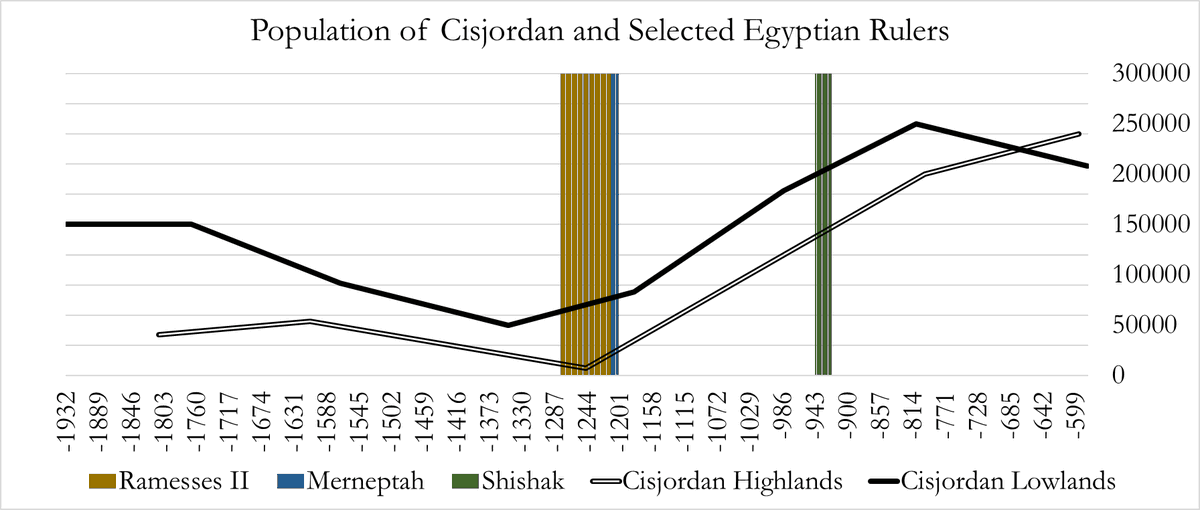
The problem with the theory Devers offers is that actually population exploded simultaneously in the lowlands AND the highlands!
Now, Israel probably did include some lowland refugees, especially who merged into the tribe of Dan. But the math doesn't work for it to be all local.
Now, Israel probably did include some lowland refugees, especially who merged into the tribe of Dan. But the math doesn't work for it to be all local.
It is absolutely a requirement to make the demography work for the Cisjordan region to have received AT LEAST a hundred thousand migrants during that boom.
We KNOW at least 10,000 were Philistines.
Totally plausible the Hebrews make up some of that balance.
We KNOW at least 10,000 were Philistines.
Totally plausible the Hebrews make up some of that balance.
Again, I didn't inbvent those population trends. I showed you the source. I'm just a demographer telling you how many babies it takes to make those lines and telling you it's not possible, mass migration is a mathematical necessity for those lines to be right.
One of the things I REALLY appreciate about @TidesHistory is his willingness to take migration seriously without falling back into the "EVERYTHING IS ETHNIC MIGRATION" tropes of past work. He should take more seriously a migration as a partial source for Israel.
And remember, even that migration is NOT ethnically homogenous! It contains other people picked up as they exited Egypt even in the biblical account, and converts like Rahab! So saying "Migration did it" is not the same as saying "big homogenous ethnic movement"
Several of the destruction events in Joshua/Judges have strong historical attestations. Some are not as tidy a fit. The book of Joshua itself isn't always super clear in terms of what happened win. But the emerging archaeodemographic evidence strongly favors a large migration.
And it favors the idea that this migration had fairly limited actual battles and sieges (as the Bible says) because the land was mostly empty (as the Bible says) and that the migrants had a Yahweh focus but also a lot of syncretism (as the Bible says).
So, did Israel emerge from Canaan?
Well even in the Biblical story the Abrahamc genome includes Canaanite DNA. And also...
5) What IS a Canaanite anyways?
Well even in the Biblical story the Abrahamc genome includes Canaanite DNA. And also...
5) What IS a Canaanite anyways?
I do not know how @TidesHistory missed the genomic study of Canaanite DNA, but y'all it's a piece. sciencedirect.com/science/articl…
This study is ONLY of remains found in CANAANITE sites. And AFAIK, nobody is out there with a draft of a comparable study for Israelite sites. Several reasons: 1) burial was simple inhumation and didn't usually leave much to work with 2) huge ethico-political constraints
Simple version of 2) is modern Jewish populations have huge beefs with defiling the graves of their ancestors or using them for scientific research, a beef I understand and respect. Upshot is we don't know what an Israelite genome looks like.
BUT WE KNOW THE "CANAANITE" GENOME! Which is so cool. Guys, it's really cool.
Except there kinda isn't a Canaanite genome?
Except there kinda isn't a Canaanite genome?
So here's your fun genetic admixture plot. Geneticists are gonna dunk on me for this, but FOR TOTAL LAYPEOPLE, you can imagine the bar chart as showing, "how much of that person's genome came from the source genepool indicated by the color bar."

The dotplot is a kind of simple way of saying "which person is genetically like which person." The blue and green are Canaanites. Red are Caucasus. Purple Iran/Zagros. Light blue ancient Israel.

What you can see is "indigenous" Canaanites are *kinda* clustered but not *that* much, so there's fair internal diversity (but also a fair number of outliers), and also that Canaanites are almost as similar to Armenians as pre-agricultural people in the same area as Canaan.
Upshot is, Canaanites included LOTS of geneflow from other areas.
When and from where? Geneflow into the region from Iran/Armenia began sometime before 2400 BC, and continued AT LEAST until 1578 BC.
So northwest semitic people were moving into Canaan... right when Abraham did.
When and from where? Geneflow into the region from Iran/Armenia began sometime before 2400 BC, and continued AT LEAST until 1578 BC.
So northwest semitic people were moving into Canaan... right when Abraham did.
The data includes two sibling children who very likely had immigrant parents from further northeast.
Also, archaeologically, the city they were in we know had people with Hurrian names, which matches this. Ergo, Canaan had considerable migration from the northeast.
Also, archaeologically, the city they were in we know had people with Hurrian names, which matches this. Ergo, Canaan had considerable migration from the northeast.
So much so that northeasterners end up making up almost as much of the Canaanite genetic signature as Neolithic Canaanites did by the late Bronze/early Iron age.
The authors conclude that "Canaanite" populations had shared ancestry EXCEPT for Phoenicia, which was genetically distinct, AND for the constant recurrent migrant events.
In other words, Canaanites welcomed a lot of migrants into "their" gene pool.
In other words, Canaanites welcomed a lot of migrants into "their" gene pool.
It is a recognizable group in comparison to some neighbors like the Philistines, but it was a constant shifting amalgamation, especially with inflows from the northeast, where Abraham came from.
These remains are almost 100% from pre-Exodus/Conquest.
These remains are almost 100% from pre-Exodus/Conquest.
Many of the other "-ites" in the Bible aren't ethnicities at all. The Perizzites are just "people who live in walled cities." Kenites are itinerant ironsmiths. The identity label we render "-ite" doesn't always mean ethnicity. Identity can be place, or even job!
I really appreciated @TidesHistory 's discussion of this in the Hallstadt culture episode. Same is true in Canaan.
And in fact, we KNOW Israel wasn't ethnically defined: Rahab is a convert! We have quite a few conversion accounts, in fact! Israel is a *mode of being*.
And in fact, we KNOW Israel wasn't ethnically defined: Rahab is a convert! We have quite a few conversion accounts, in fact! Israel is a *mode of being*.
What that mode is isn't 100% clear. Yahweh supremacy is a big part. Pig/dog/donkey abstention for food does too. One assumes maybe circumcision but other cultures sometimes also did that. But it was something people could join.
This is hard to get an archaeological handle on, and someday when Israelite remains are genetically sequenced, some biased scholar is gonna be like "SEE ISRAEL ISN'T REAL" even though the Bible clearly says it wasn't just an ethnic group.
6) Boars Tusk Helmets - Okay this one is a sidebar but important. I liked when @TidesHistory said Homer had genuine historic memory because of the mention of boars tusk helmets, an item ONLY relevant in a certain epoch and not later.
We have that in the Bible too.
We have that in the Bible too.
Judges 3, the story of Ehud gives us a weird artifact that would be impossible a century or two early and totally unremarkable a century or two later.
Your Bible in the Ehud story says Ehud made a sword "גֹּ֣מֶד" in length. That word is rendered "cubit."
It does not mean cubit.
Your Bible in the Ehud story says Ehud made a sword "גֹּ֣מֶד" in length. That word is rendered "cubit."
It does not mean cubit.
Here I am leaning on this paper by a very smart old testament scholar who I am also very biased in favor of (spoiler: he is my dad).
Suffice to say, the word means "rigid." The sword is "rigid" along its whole length. Not bendy or curved.
jstor.org/stable/2561021…
Suffice to say, the word means "rigid." The sword is "rigid" along its whole length. Not bendy or curved.
jstor.org/stable/2561021…
Why does the author think it's important to say the sword is not bendy?
Because many bronze age swords sucked and were bendy. That's why much bronze age fighting was spear, axe, club, bow. Swords were not the typical weapon.
Because many bronze age swords sucked and were bendy. That's why much bronze age fighting was spear, axe, club, bow. Swords were not the typical weapon.
Starting in the European bronze age however a new sword type emerges, which we call Naue II. @TidesHistory has some good episodes about it about the Celts. The Naue II corresponds to a sudden explosion in massed infantry and cavalry combat (as opposed to chariot-centric).
The reason (probably) is that the Naue II is really the first sword that is strong enough to hand classic *sword fighting*. If an axe hits it it doesn't shatter or flop out of the way. It is rigid. Strong. You can stab through some armor with it.
It's the first weapon to give a soldier in one tool a weapon that has stabbing power competitive with a one-handed spear thrust AND slashing power competitive with a one-handed axe slash. It is devastating.
Over the bronze age it spreads widely and with it spreads war. Around the "late bronze age collapse" it reaches the southern Levant, Egypt, etc, give or take a bit. It is a novel item for a short window of time, worth remarking on.
By David's life, swords are not being described as "rigid" because EVERY sword is rigid, this is just how you make swords. It is only in a narrow window of time where *not all swords are rigid* that you describe swords as rigid.
Ehud's story, then, contains a kernel not even of genuine historic memory, but genuine historic *composition*. It was *written* by people who thought that it was worthwhile to remark on how rigid his sword was.
I don't have a date for when, you don't have to believe the story is *true* based on that word. But it does suggest that during the period when Naue II swords were novel and new in Canaan (1200-1000 BC), Israelites were telling stories about knocking over pagan idols for Yahweh.
This suggests that Yahweh-ism really did emerge *before* 1000 BC. Ehud's world before 1000 BC has many mysteries, but it contained a tribe of Benjamin with a hero who wielded a Naue II to killed a pagan king *as a religious act* and then knock over pagan idols.
Again, none of this means you MUST believe the Bible is inerrant truth. There are tons of Bible stories without good extrabiblical evidence, and some where the extrabiblical evidence is not very friendly to a plain reading of the Bible.
But it absolutely is not the case that Israel emerged from Canaan through purely local migrations or natural fertility, it is not the case that Yahweh was simply one of many Canaanite gods, and in general the archaeological record squares well with the Biblical emergence account.
Anyways, that's a wrap. Highly endorse @TidesHistory , super fun show, loving the Celtic episodes. My best to Wyman and family, solidarity for name similarity is important 😉, and I think it would be cool for @TidesHistory to interview experts who think The Conquest Happened.
A few more tidbits, here's Devers on the idea of a purely-local origin for highland Israelite emergence.
That view is just wrong. There was a migration event. The question is just "From where?"
That view is just wrong. There was a migration event. The question is just "From where?"

Devers wants to say Canaanite lowlanders moved into the highlands, but this is clearly wrong since we now know a lot about the lowland population as well.
Also, I mentioned Mount Ebal. It is Biblically named as an important early religious site. The altar described in the Bible has pretty much been found at this point as it's described Biblically. And we have a pottery fragment with Yahweh's name on it. And no other gods.
You can read about the pottery fragment here:
In my view it's "too early," but also I'm aware the dating these researchers call for is contested; it might plausibly be 1100s in fact, depends on how you interpret the dirt layers.…ritagesciencejournal.springeropen.com/articles/10.11…
In my view it's "too early," but also I'm aware the dating these researchers call for is contested; it might plausibly be 1100s in fact, depends on how you interpret the dirt layers.…ritagesciencejournal.springeropen.com/articles/10.11…
The authors actually even have a note at the bottom that they disagree among themselves about the exact dating. I'd prefer a late date obviously. But the point is, the earliest evidence of Yahweh-worship is at a Biblically-described site where no other gods are ever evinced.
@tobinsparfeld @TidesHistory But more importantly, a few tens of thousands of declasse foreigners being deported during what was already a chaotic time for Egypt is hardly noteworthy for Egypt.
• • •
Missing some Tweet in this thread? You can try to
force a refresh