Read on Twitter
Top 10 EBITDA Flaws You Should be Aware of and Beware
How many did you already know about?
Comment below and let me know!
How many did you already know about?
Comment below and let me know!
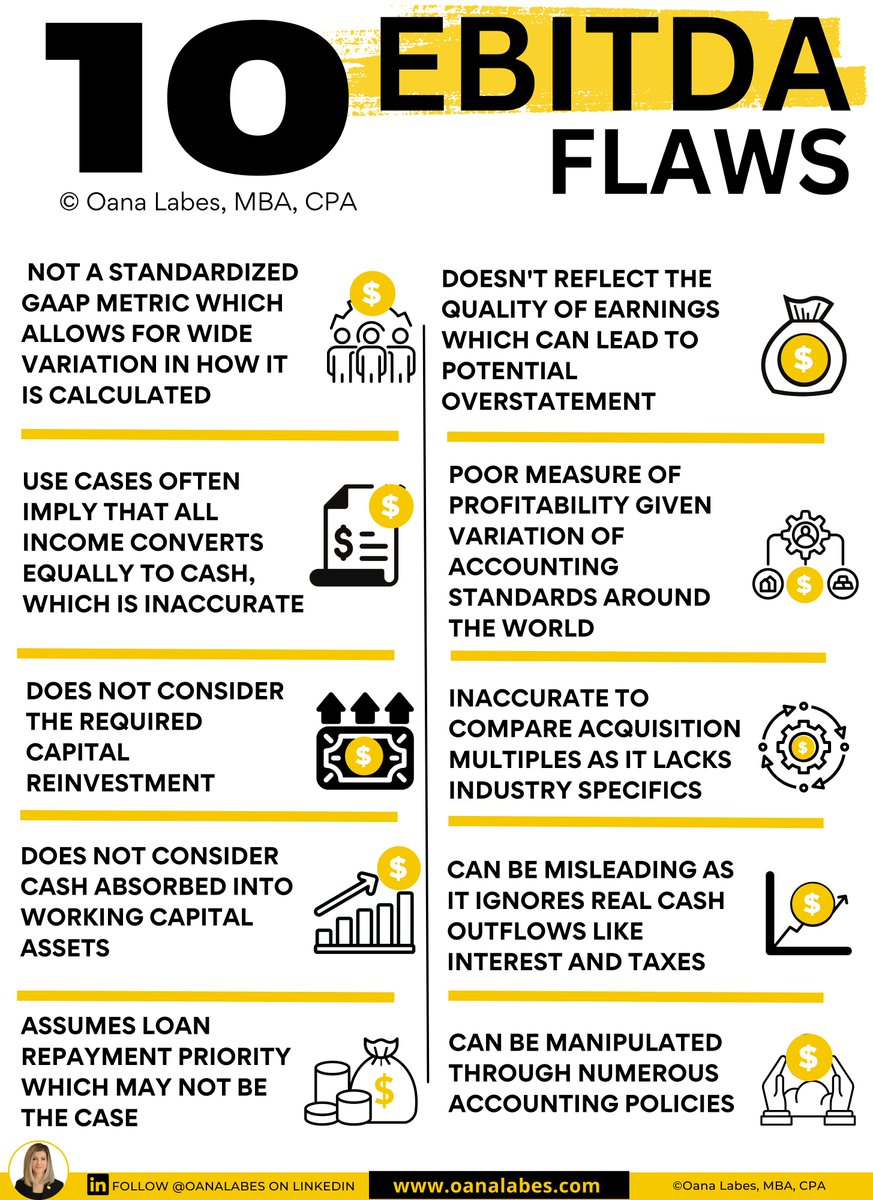
1️⃣ EBITDA is not a standardized GAAP metric, which means there is wide variation in how it is calculated.
- There's no standardized formula for calculation, leading companies to calculate it in a way that benefits them the most
- There's no standardized formula for calculation, leading companies to calculate it in a way that benefits them the most
- Stock based compensation for example may be included in EBITDA by some analysts and excluded by others. It can also be estimated in several ways which will change the expensed amount
2️⃣ EBITDA implies that all net income converts to cash equally, which is not accurate.
2️⃣ EBITDA implies that all net income converts to cash equally, which is not accurate.
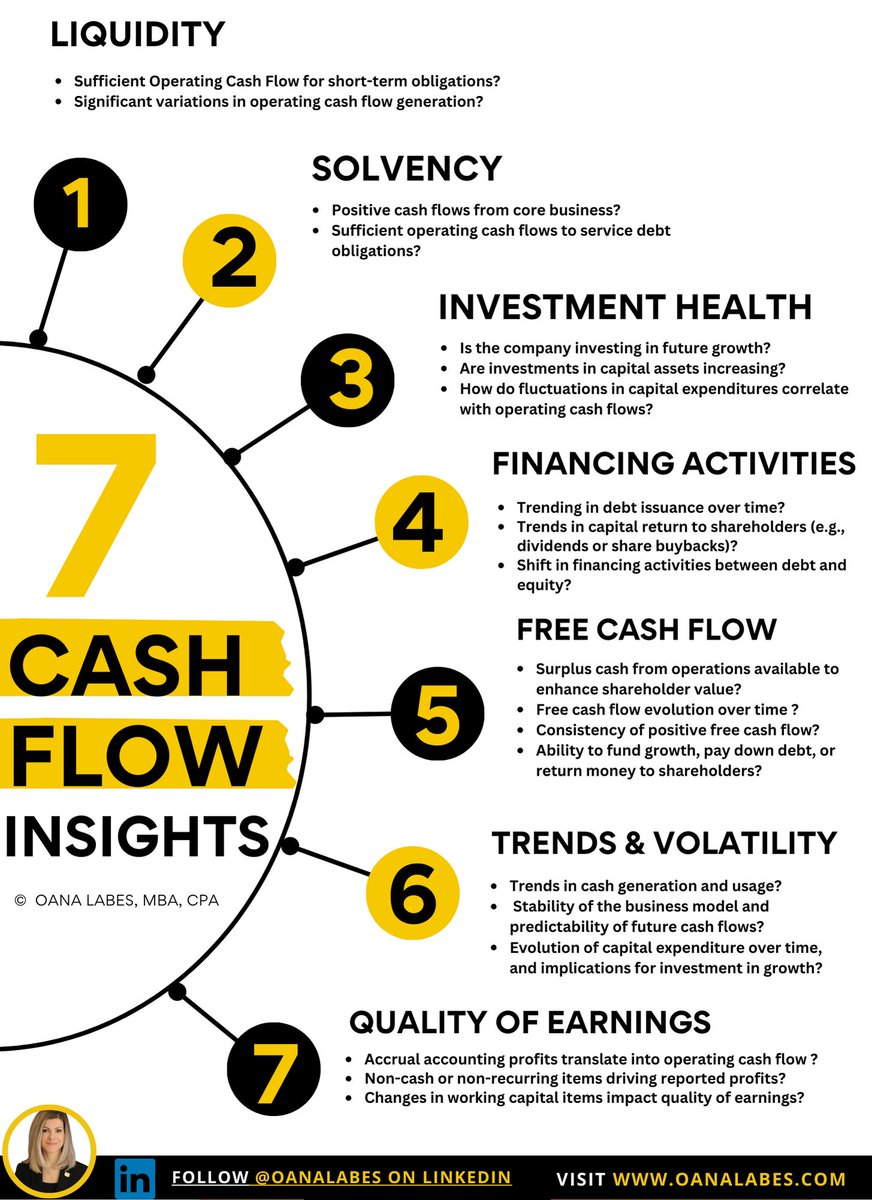
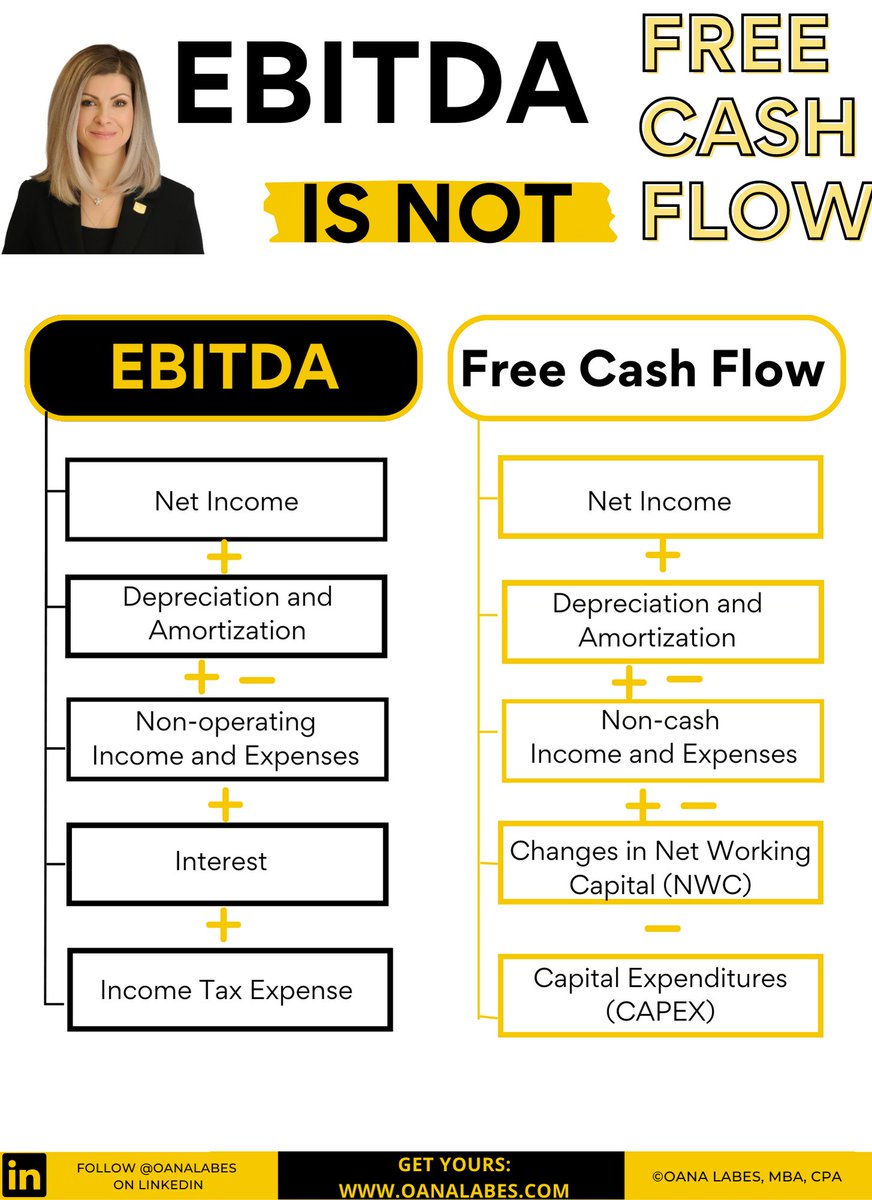
- EBITDA is a proxy for operational cash flow, but not a direct measure of it
- It ignores the required investment into working capital assets to support future growth
- It also doesn't consider the timing and nature of revenue recognition and accrued expenses
- It ignores the required investment into working capital assets to support future growth
- It also doesn't consider the timing and nature of revenue recognition and accrued expenses
3️⃣ EBITDA does not consider the required capital reinvestment
- While Depreciation and Amortization are non-cash items, CAPEX investments aren't captured in EBITDA
4️⃣ It does not account for cash absorbed into working capital assets
- While Depreciation and Amortization are non-cash items, CAPEX investments aren't captured in EBITDA
4️⃣ It does not account for cash absorbed into working capital assets
- Changes in receivables, payables, and inventory balances can lead to a distorted view of operating cash flow
5️⃣ EBITDA implies that loan repayment is prioritized, which may not be the case
5️⃣ EBITDA implies that loan repayment is prioritized, which may not be the case
- Companies may use cash for growth, acquisitions, or capacity expansions instead, leaving no residual capital for loan repayment
6️⃣ It doesn't reflect the quality of earnings, leading to potential inflation.
6️⃣ It doesn't reflect the quality of earnings, leading to potential inflation.
- Earnings and EBITDA may be inflated with deferred expenses, aggressive accounting policies, or underfunded pension liabilities
7️⃣ EBITDA is a poor measure of profitability due to differing accounting standards.
7️⃣ EBITDA is a poor measure of profitability due to differing accounting standards.
- GAAP revenue recognition criteria vary worldwide, which can overstate earnings
8️⃣ EBITDA is inadequate for comparing acquisition multiples, as it doesn't capture industry-specific requirements
8️⃣ EBITDA is inadequate for comparing acquisition multiples, as it doesn't capture industry-specific requirements
- It doesn't account for industry-specific capital investment needs or company-specific underlying strength in operating earnings
9️⃣ EBITDA can be misleading as a measure of cash flow due to its ignorance of real cash outflows
9️⃣ EBITDA can be misleading as a measure of cash flow due to its ignorance of real cash outflows
- It ignores several real cash outflows and understates the future expected increase of those cash outflows
- Interest and taxes are real cash outflows that reduce earnings in practice
🔟 EBITDA can be easily manipulated through aggressive accounting policies.
- Interest and taxes are real cash outflows that reduce earnings in practice
🔟 EBITDA can be easily manipulated through aggressive accounting policies.
- Management can manipulate earnings and inflate EBITDA through a variety of methods, including:
☑️ aggressive percentage of completion revenue recognition
☑️ deferring expenses
☑️ understating pension liabilities
☑️ understating provisions
☑️ aggressive percentage of completion revenue recognition
☑️ deferring expenses
☑️ understating pension liabilities
☑️ understating provisions
What did I miss?
1. Follow me @IAmOanaLabes for more of these
2. Sign up for my free newsletter. and join 30,000+ subscribers:
3. RT to share the knowledge: https://t.co/92ZgohfeCmthe-finance-gem.beehiiv.com/subscribe
1. Follow me @IAmOanaLabes for more of these
2. Sign up for my free newsletter. and join 30,000+ subscribers:
3. RT to share the knowledge: https://t.co/92ZgohfeCmthe-finance-gem.beehiiv.com/subscribe
https://twitter.com/1612701806697627650/status/1689638320782127105
Join 30,000 subscribers and enjoy my finance gems every Saturday in your inbox: the-finance-gem.beehiiv.com/subscribe
• • •
Missing some Tweet in this thread? You can try to
force a refresh