Read on Twitter
Aeon R thread: Remember the open cycle thread? Yeah, I'm still not a big fan of that cycle. But, @thetimellis once sad, @relativityspace will run Aeon R at a surprisingly high main chamber pressure. That got me thinking. What could that value be? 1/ https://t.co/5bSZWE175H

https://twitter.com/Phrankensteyn/status/1657816348414599168

At first: Why is high pressure useful?
When burning the propellant to increase temperature, the gas particles gain speed. Keep in mind, temperature is a measure for average kinetic energy per particle. But those particles fly chaotically. Not useful for directed thrust. 2/
When burning the propellant to increase temperature, the gas particles gain speed. Keep in mind, temperature is a measure for average kinetic energy per particle. But those particles fly chaotically. Not useful for directed thrust. 2/
To bring order in that chaos, the nozzle helps. A bit like a reverse satellite dish, it guides the chaotic particles more towards the opposite direction of the rocket. So every particle collision with the nozzle pushes the rocket to a degree in the right direction. 3/
For this, the nozzle needs to increase its diameter gradually to allow more right direction collisions. An infinite diminishing return process. But there are limits. In space, there's a trade-off between size and mass of the nozzle vs gained thrust. 4/
In the atmosphere, we have more problems. In that nozzle bouncing process, the density of the particle stream decreases because they get disperse over the steadily widening nozzle. On the outside, the atmosphere though bounces against the nozzle in the wrong direction. 5/
Once the pressure, the combined kinetic energy in a volume of particles, is stronger on the outside, the inner particles lose the battle. Additionally, the outside atmosphere presses inside the nozzle exit and messes things up - which could be destructive to the nozzle. 6/
This means, we need a minimum pressure at the nozzle exit to win the bouncing particle battle. This limits the nozzle expansion. But if we increase the ratio between the pressure in the chamber/at nozzle throat and nozzle exit, more expansion and more thrust is possible. 7/
That's why we need a lot of pressure in the chamber. But with open cycles, we learned, that you have to use a lot of fuel to keep the gas turbine combustion temperature low AND this fuel then doesn't get burned in the main chamber to produce thrust. 8/
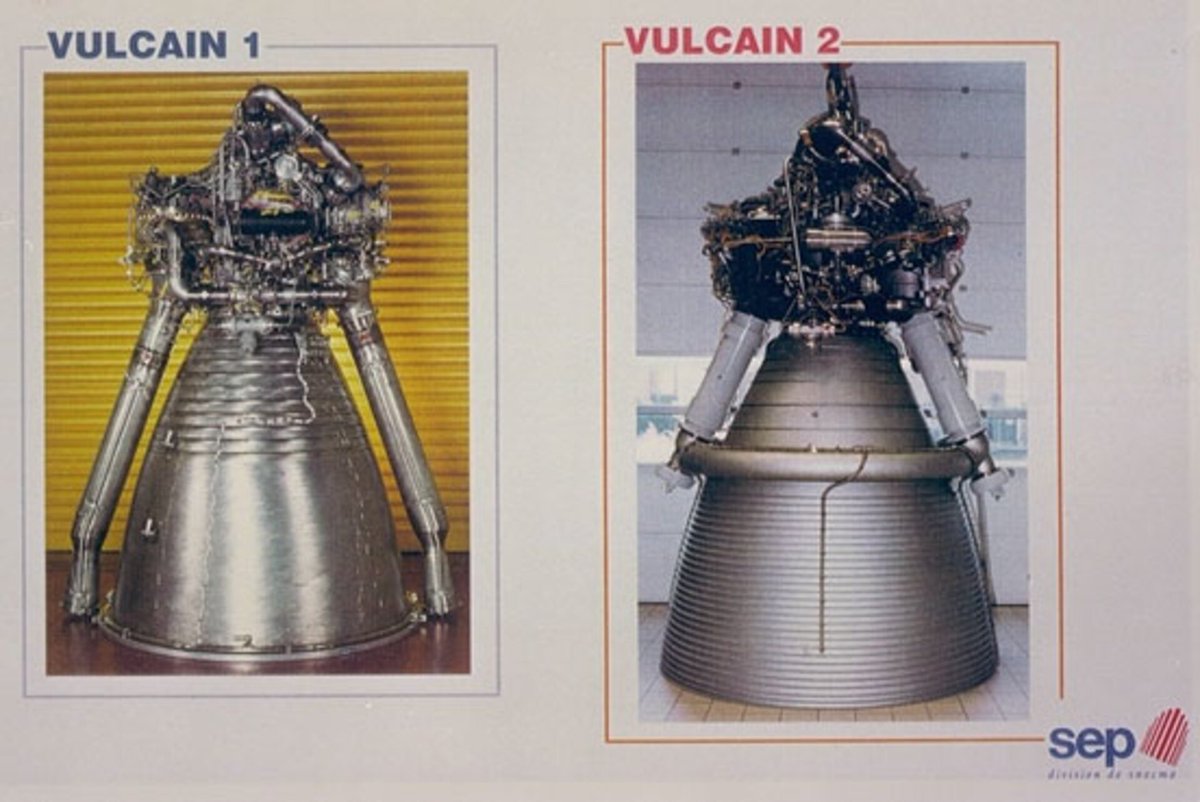
So with open cycles, it's a trade-off between the additionally thrust you gain vs additionally "cooling fluids" carried. The highest main chamber pressure of an open cycle engine (I'm aware of) is 117 bar. It's the Vulcain 2. 9/
Luckily, I found the mass flows of Vulcain 2. With those values, I can calculate the O/F ratio in the gas generator (it's 1) - assuming the overall mixture ratio here () is correct. 10/ https://t.co/bTuwTCD75zen.wikipedia.org/wiki/Vulcain_(…
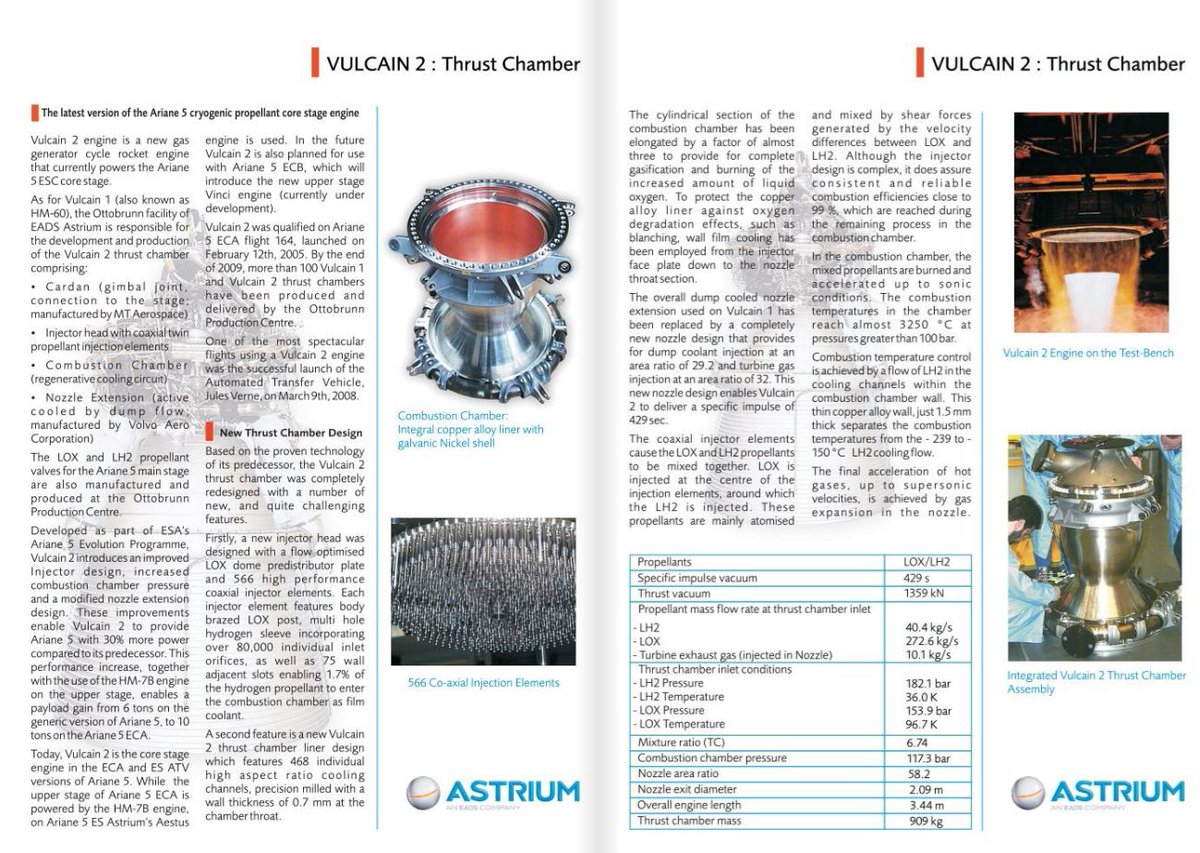
With those values and the pressure values of the fluids they have when they exit the pump, I can estimate the combined gas turbine and pump efficiency (~20%) and pressure ratio between pump and the main chamber - since there's some pressure lost in pipes (chamber cooling!). 11/
Now adding ideal Isp values with RPA at different main chamber pressures, we can do a lot of math, to see the compromise Snecma chose for the Isp.
Given that Vulcain 2 is a sustainer engine, it does make sense to optimise for vacuum flight instead of atmospheric flight. 12/
Given that Vulcain 2 is a sustainer engine, it does make sense to optimise for vacuum flight instead of atmospheric flight. 12/

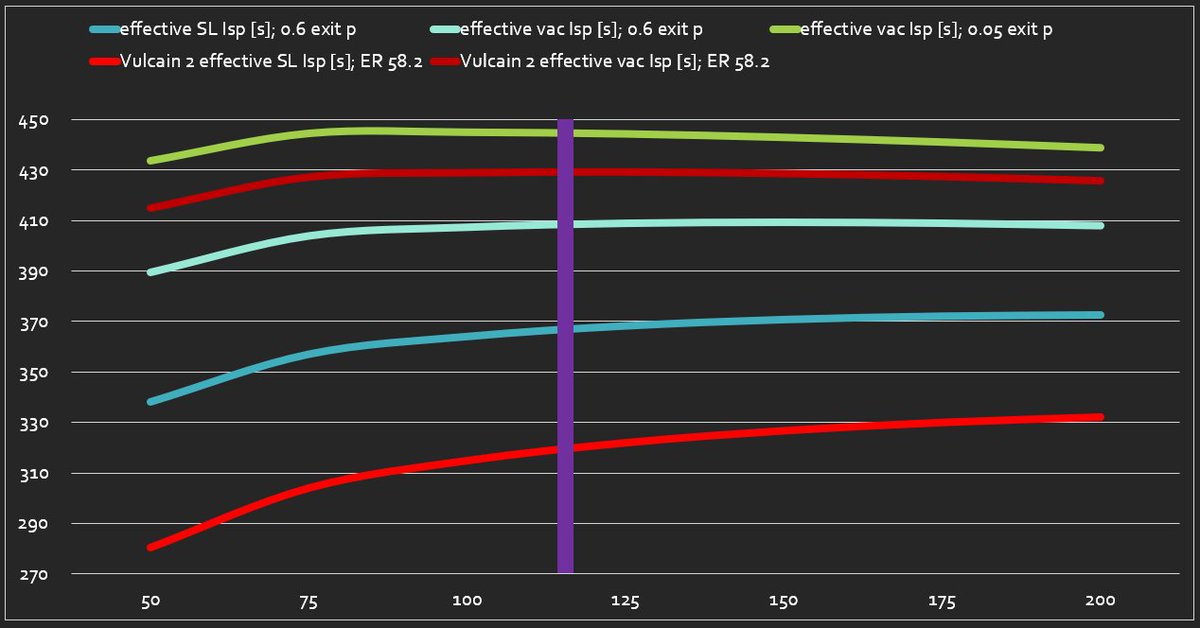
As you might have noticed, I did not only show estimates for Vulcain 2 but some sea level and vacuum engine you'd typically use for a 2-stage-vehicle - like Terran R with Aeon R. With the gas turbine O/F we also know a good estimate for the gas turbine temperature. 13/
That value is ~980 K. Using the data I extracted from CEARUN, this requires a methalox O/F of ~0.35. Still, I'm not convinced that CEARUN is correct here, but that's all I have. 14/

Applying all that knowledge onto methalox data and the typical 2-stage-vehicle engines, I came up with this. So I wouldn't be surprised if Aeon R for the first stage runs at 150 bar main chamber pressure, while the 2nd stage version might go for something at 110 bar. 15/

I'm happy to explain the math in more detail if some are interested. Maybe a Discord group call or the Youtubers want to have a streamed discussion about this. 16/16
• • •
Missing some Tweet in this thread? You can try to
force a refresh