Read on Twitter
The Income Statement & The Balance Sheet are the most popular financial statements.
But few appreciate that the Cash Flow Statement is where the true power is.
Because even though a company might be profitable on the P&L.
But few appreciate that the Cash Flow Statement is where the true power is.
Because even though a company might be profitable on the P&L.
It may still face bankruptcy without sufficient cash to:
>> cover operating costs
>> invest in growth
>> service debt
>> cover operating costs
>> invest in growth
>> service debt
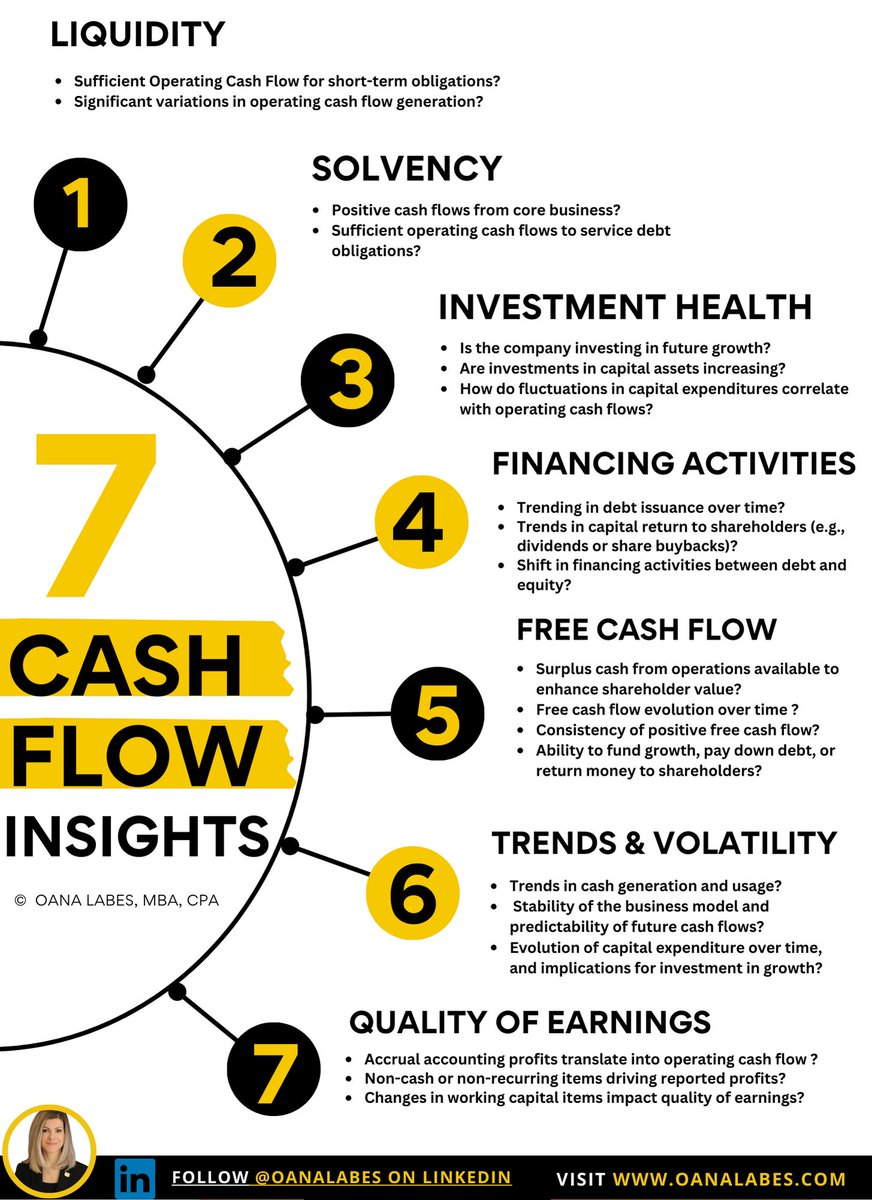
Here are 7 Essential Cash Flow Insights you get from a company’s Cash Flow Statement:
1️⃣ Solvency:
- Whether the company generates sufficient operating cash flows to comfortably service debt obligations.
1️⃣ Solvency:
- Whether the company generates sufficient operating cash flows to comfortably service debt obligations.
- Whether their use of operating cash flow for debt payments aligns with industry standards, demonstrating strong solvency and an acceptable risk profile.
2️⃣ Liquidity:
2️⃣ Liquidity:
- Whether the company’s operating cash flow reliably covers current liabilities, indicating a strong ability to meet short-term obligations.
- Whether the management of operating cash flow maintains the company’s financial stability and minimizes its liquidity risk.
- Whether the management of operating cash flow maintains the company’s financial stability and minimizes its liquidity risk.
3️⃣ Free Cash Flow:
- Whether the company's free cash flow has shown positive growth over time, reflecting a robust and flexible business model.
- Whether the company's free cash flow has shown positive growth over time, reflecting a robust and flexible business model.
- Whether the company consistently generates positive free cash flow, demonstrating its capacity to self-fund growth, pay down debt, and return money to shareholders.
4️⃣ Financing Activities:
4️⃣ Financing Activities:
- Whether the company strategically shifts its financing activities towards debt or equity as conditions require, demonstrating a flexible and savvy financial strategy.
- Whether the company demonstrates strong performance and confidence in its future prospects by consistently returning capital to shareholders through dividends or share buybacks.
5️⃣ Investment Health:
5️⃣ Investment Health:
- Whether the company is proactively investing in its future growth by increasing capital expenditure over time.
- Whether the company skillfully aligns its capital expenditure with operational cash flows, ensuring financial health and a sound investment strategy.
- Whether the company skillfully aligns its capital expenditure with operational cash flows, ensuring financial health and a sound investment strategy.
6️⃣ Trends and Volatility:
- Whether the company's capital expenditure has been progressively increasing over the years, indicating a solid investment in growth.
- Whether the company's capital expenditure has been progressively increasing over the years, indicating a solid investment in growth.
- Whether the company's revenue and earnings display a consistent pattern, underscoring the predictability of its future performance.
7️⃣ Quality of Earnings:
7️⃣ Quality of Earnings:
- Whether the company primarily relies on genuine business activities, to achieve its reported profits vs relying on non-cash or non-recurring items
- Whether the company optimizes working capital items like accounts receivable, inventory, and accounts payable, maintaining a stable cash flow from operations and high quality of earnings.
What did I miss?
1. Follow me @IAmOanaLabes for more of these
2. Sign up for my free newsletter. and join 30,000+ subscribers:
3. RT to share the knowledge: https://t.co/UloUTY7f3nthe-finance-gem.beehiiv.com/subscribe
1. Follow me @IAmOanaLabes for more of these
2. Sign up for my free newsletter. and join 30,000+ subscribers:
3. RT to share the knowledge: https://t.co/UloUTY7f3nthe-finance-gem.beehiiv.com/subscribe
https://twitter.com/1612701806697627650/status/1690309763567947777
Join 30,000 subscribers and enjoy my finance gems every Saturday in your inbox: the-finance-gem.beehiiv.com/subscribe
• • •
Missing some Tweet in this thread? You can try to
force a refresh