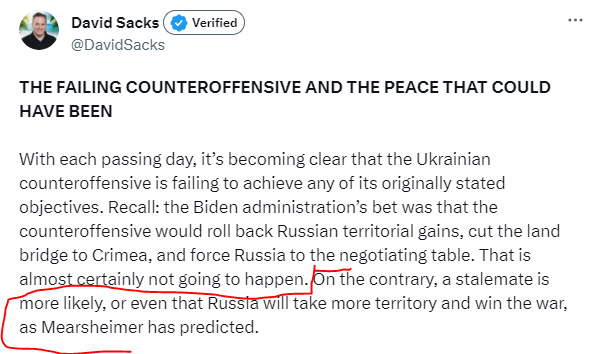
Read on Twitter
I wanted to go through this point by point, respectfully and assuming every question raised was in absolute good faith.
Note: I know nothing about this man or his politics (though I can guess) and am treating his questions seriously for the benefit of other readers.
Note: I know nothing about this man or his politics (though I can guess) and am treating his questions seriously for the benefit of other readers.
https://twitter.com/DeplorableVet84/status/1674125214924394516
The US has exactly as many serving troops fighting in Ukraine as its NATO European allies: zero.
The US **is** contributing a lot of materiel, but Europeans collectively are also sending a lot, both in real terms and as a percentage of GDP.
The US **is** contributing a lot of materiel, but Europeans collectively are also sending a lot, both in real terms and as a percentage of GDP.

This conflict started in 2014 under Obama, continued throughout the entirety of Trump's term, and sharply escalated in 2022 under Biden when Putin arbitrarily decided to seize Kyiv.
If you want to draw causal linkages there you're welcome to. I struggle to see them.
If you want to draw causal linkages there you're welcome to. I struggle to see them.
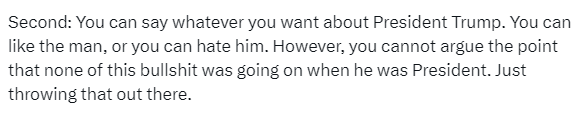
This isn't true at all. There is at least one New York Times Story every hour about how Ukraine's counter-offensive isn't going as fast as we'd all like.
The bit of news from that kid's leak that 'has been wiped' was a clearly photoshopped casualty report.
The bit of news from that kid's leak that 'has been wiped' was a clearly photoshopped casualty report.
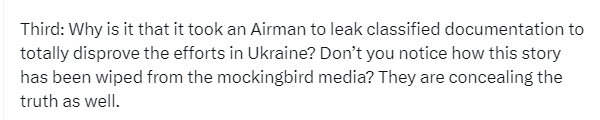
Even if you assume that the intelligence community analysis in the leaks was somehow revelatory, it's not clear what this proves.
Ukrainians are suffering in the face of Russian artillery, mines and prepared defences.
That feels like an argument for more weapons, not fewer.
Ukrainians are suffering in the face of Russian artillery, mines and prepared defences.
That feels like an argument for more weapons, not fewer.
A lot of the confusion and anger around Ukrainian military aid comes from the fact that for convenience, it's delineated in USD which makes it sound like someone is wiring money from the Treasury to Zelenskyy's personal Venmo.
That's not what's up.
That's not what's up.
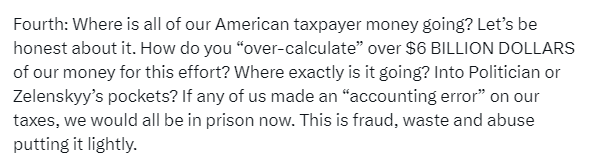
In actuality when Congress says, "we authorise $25b in transfers" what they are actually saying is, "we are letting you take $25b WORTH OF STUFF out of storage and send it to Ukraine."
That's why it's not 'money that could have gone to Hawaii.'
It's tanks, not dollars.
That's why it's not 'money that could have gone to Hawaii.'
It's tanks, not dollars.
The $6b 'accounting error' in question therefore wasn't someone misplacing billions of dollars.
There are two ways you can value assets:
a) Their value at purchase;
b) Their present value as per the depreciation schedule.
The $6b came when the Pentagon switched from (a) to (b).
There are two ways you can value assets:
a) Their value at purchase;
b) Their present value as per the depreciation schedule.
The $6b came when the Pentagon switched from (a) to (b).
In other words, the Pentagon was able to squeeze more equipment into an existing Congressional authorisation by pricing things by their present value to the Pentagon rather than by their price from the manufacturer.
No money was stolen, just a different accounting approach.
No money was stolen, just a different accounting approach.
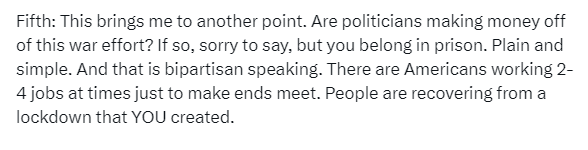
Look, if there's evidence of American politicians profiteering off aid then of course that's egregious... but I don't think we've seen much yet.
Ukraine military aid is a small fraction of US annual military spending. There are easier ways to skim or profiteer.
Ukraine military aid is a small fraction of US annual military spending. There are easier ways to skim or profiteer.
Diplomacy is happening all the time. That's how the Black Sea Grain Deal happened, and how the prisoner swaps are arranged.
But talks to end the war aren't happening because the two sides fundamentally and inflexibly disagree on the most important question on the table.
But talks to end the war aren't happening because the two sides fundamentally and inflexibly disagree on the most important question on the table.

Putin considers acceptance of Russian sovereignty over the four annexed oblasts, most of which Russia doesn't even hold, to be a precondition for talks.
Ukraine cannot accept that, for reasons I hope are obvious.
Until one of those changes, talks are pointless.
Ukraine cannot accept that, for reasons I hope are obvious.
Until one of those changes, talks are pointless.
Talks are also not taking place because it seems unlikely that outside powers would be willing to offer Ukraine meaningful security guarantees to enforce an outcome - so any treaty would be held together by trust in Putin's word.
There's not a lot of that going around.
There's not a lot of that going around.
As the opening poster himself concludes, these are complicated issues on which he is not an expert.
There's nothing wrong with asking questions or probing the official line, but genuine inquiry means being open to the idea that it may be correct.
Scepticism != Contrarianism.
There's nothing wrong with asking questions or probing the official line, but genuine inquiry means being open to the idea that it may be correct.
Scepticism != Contrarianism.
I hope this thread was interesting or useful to people trying to better understand the war in Ukraine, and the US' contribution to it.
/end
/end
Addendum:
Another good thread on this post from @kevinbaum013 which is worth your time:
Another good thread on this post from @kevinbaum013 which is worth your time:
https://twitter.com/kevinbaum013/status/1690881679961804800?s=20
• • •
Missing some Tweet in this thread? You can try to
force a refresh