Everyone knows that alcoholism is bad. Drink too much, you'll fry your brain, or so the wisdom goes.
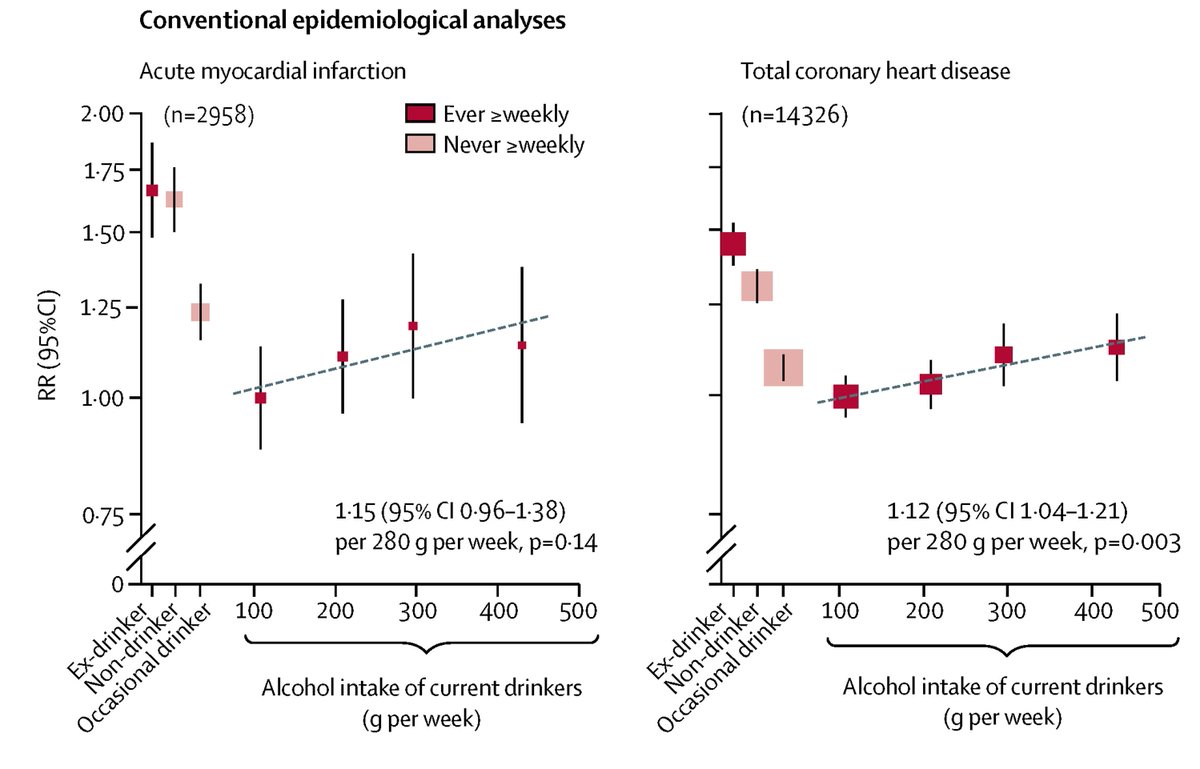
But it's also common knowledge that a little bit of alcohol is good for you. I mean, just take the conventional epidemiological result:
Clearly people who used to drink and people who never drink do worse than the people who drink a bit. And when people start drinking even more than a bit, they look a little better. Beyond that, they start to look a bit worse, but at no point are they worse than the non-drinkers.
Right?
The problem with the conventional analysis is that selection is at play. The people who don't drink at all and the ex-drinkers are selected into not drinking in weird ways. For example, an ex-drinker might be someone who was a heavy drinker in the past; a never-drinker might be a socially odd person. Who knows! But the potential that they're not normal is very much there.
It would be unethical to run human experiments to figure out what alcohol does, so, how can we know what alcohol does to health?
With a clever little method called Mendelian Randomization, or MR. MR is basically an answer to the question What if I used genes as instrumental variables?
Using Chinese data and genes that affect alcohol metabolism, that's exactly what Millwood et al. did! Since the alcohol metabolism genotypes they used should be otherwise independent of risk, everything should be good to go for using these as predictors of alcohol's effects.
But just to be sure: one of the ways we know these genotypes don't have independent effects is that there were no effects in women, who, for cultural reasons, are pretty close to being non-drinkers. Just take a look at the male-female difference in drinking!
So putting this wonderful genetic predictor to use, we can finally see what alcohol actually does.
Well, the effect of the unconfounded difference in alcohol consumption is that, when it comes to heart health, alcohol doesn't seem to do much, rather than being a bit protective.
But the heart isn't everything. There's certainly more!
Alcohol did increase risk for ischemic stroke, intracerebral hemorrhage, and total strokes.
Not only that, but in another study using a similar method, alcohol increased hypertension, blood pressure, waist circumference, waist-to-hip ratio, fasting blood glucose, and triglycerides. But, consistent with these results, in that paper it didn't seem to have a significant effect on cardiovascular disease or coronary heart disease, and it both increased HDL and decreased LDL.
In aggregate, alcohol is likely to be bad for your health at any level, but selection into disuse means the downsides have been hidden in traditional analyses. And even if alcohol doesn't negatively impact heart health on its own, the fact that it's not protective and it increases other risks means it's risky on net.
Sources:

But it's also common knowledge that a little bit of alcohol is good for you. I mean, just take the conventional epidemiological result:
Clearly people who used to drink and people who never drink do worse than the people who drink a bit. And when people start drinking even more than a bit, they look a little better. Beyond that, they start to look a bit worse, but at no point are they worse than the non-drinkers.
Right?
The problem with the conventional analysis is that selection is at play. The people who don't drink at all and the ex-drinkers are selected into not drinking in weird ways. For example, an ex-drinker might be someone who was a heavy drinker in the past; a never-drinker might be a socially odd person. Who knows! But the potential that they're not normal is very much there.
It would be unethical to run human experiments to figure out what alcohol does, so, how can we know what alcohol does to health?
With a clever little method called Mendelian Randomization, or MR. MR is basically an answer to the question What if I used genes as instrumental variables?
Using Chinese data and genes that affect alcohol metabolism, that's exactly what Millwood et al. did! Since the alcohol metabolism genotypes they used should be otherwise independent of risk, everything should be good to go for using these as predictors of alcohol's effects.
But just to be sure: one of the ways we know these genotypes don't have independent effects is that there were no effects in women, who, for cultural reasons, are pretty close to being non-drinkers. Just take a look at the male-female difference in drinking!
So putting this wonderful genetic predictor to use, we can finally see what alcohol actually does.
Well, the effect of the unconfounded difference in alcohol consumption is that, when it comes to heart health, alcohol doesn't seem to do much, rather than being a bit protective.
But the heart isn't everything. There's certainly more!
Alcohol did increase risk for ischemic stroke, intracerebral hemorrhage, and total strokes.
Not only that, but in another study using a similar method, alcohol increased hypertension, blood pressure, waist circumference, waist-to-hip ratio, fasting blood glucose, and triglycerides. But, consistent with these results, in that paper it didn't seem to have a significant effect on cardiovascular disease or coronary heart disease, and it both increased HDL and decreased LDL.
In aggregate, alcohol is likely to be bad for your health at any level, but selection into disuse means the downsides have been hidden in traditional analyses. And even if alcohol doesn't negatively impact heart health on its own, the fact that it's not protective and it increases other risks means it's risky on net.
Sources:


• • •
Missing some Tweet in this thread? You can try to
force a refresh