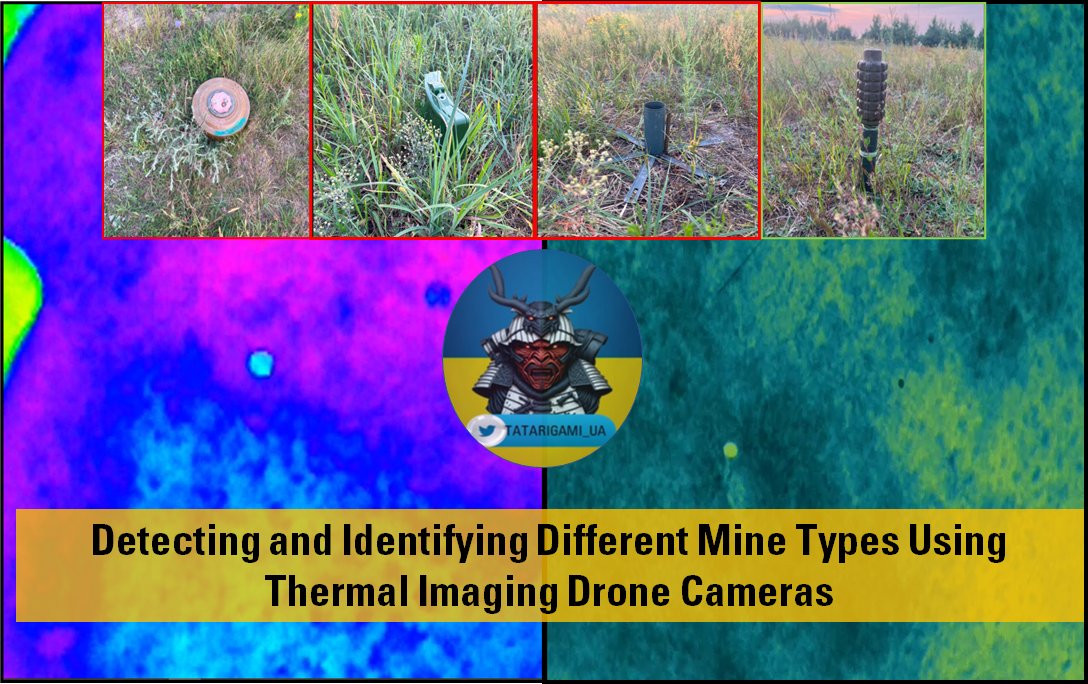
Expanding upon the ongoing dialogue about utilizing drones for mine detection, questions have emerged regarding the practicality of employing thermal imaging. In this thread, I will discuss this matter by referencing a specialized manual dedicated to this topic.🧵Thread:
2/ To begin, it's essential to consider a few key aspects. Mines aren't always placed on a top of soil - some remain hidden, making them invisible to drones. This distinction is important, emphasizing the need to refrain from regarding this method as panacea
3/ The parameters for this presentation are outlined as follows:
Temperature: Range of +18 to +20°C (64.4 to 68°F)
Vegetation: Moderate level
Time: 21:00 (9 PM) local time
Altitude: Varied and indicated for each scenario in the image.
Drone: DJI Mavic 3T
Deployment time: 11 AM
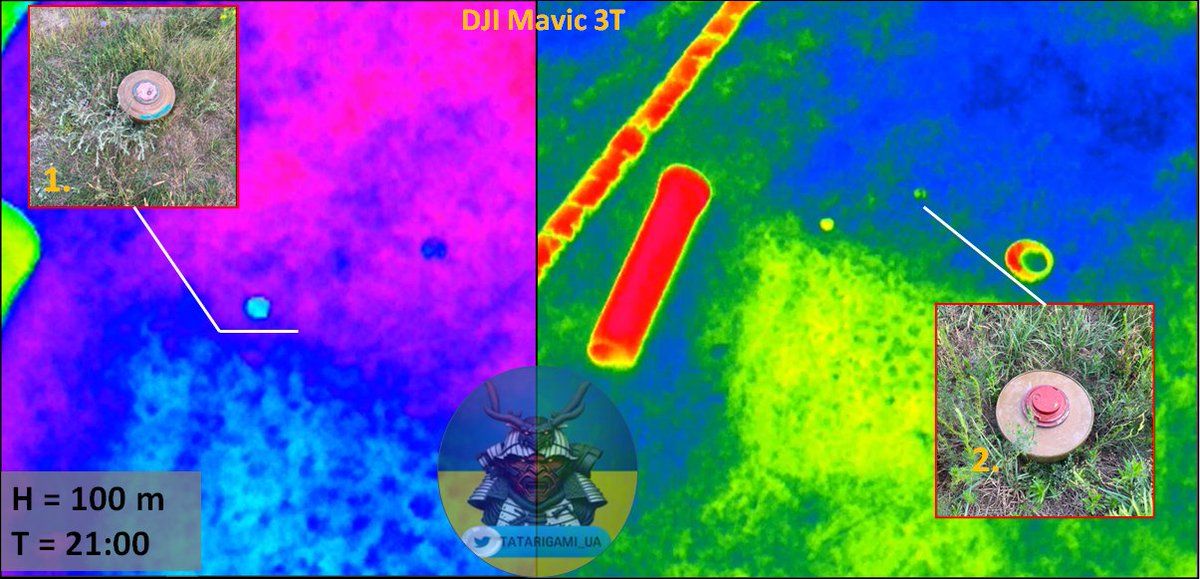
4/ In this specific instance, both mine #1 (ТМ-62 М) and mine #2 (ТМ-62П3) are clearly visible when positioned atop the soil. They exhibit a noticeable contrast in terms of shape and color compared to their surroundings.
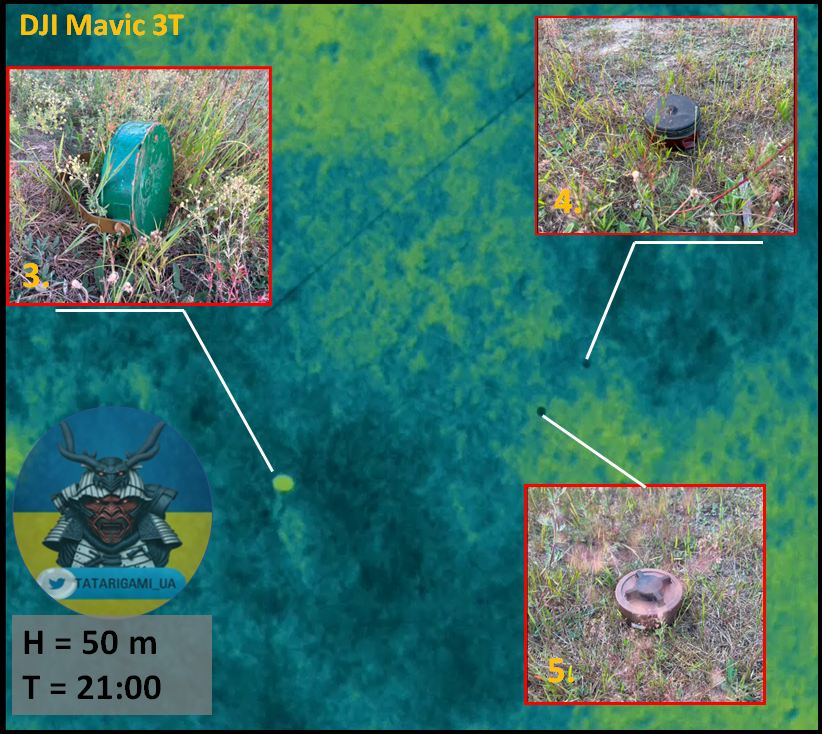
5/ In this scenario, AP mine #3 (MOН-100) stands out significantly and can be readily identified, whereas the smaller AP mines — mine #4 (ПМН-2) and mine #5 (МС-3) — are diminished visually, even at an altitude of 50 meters, and look the same.
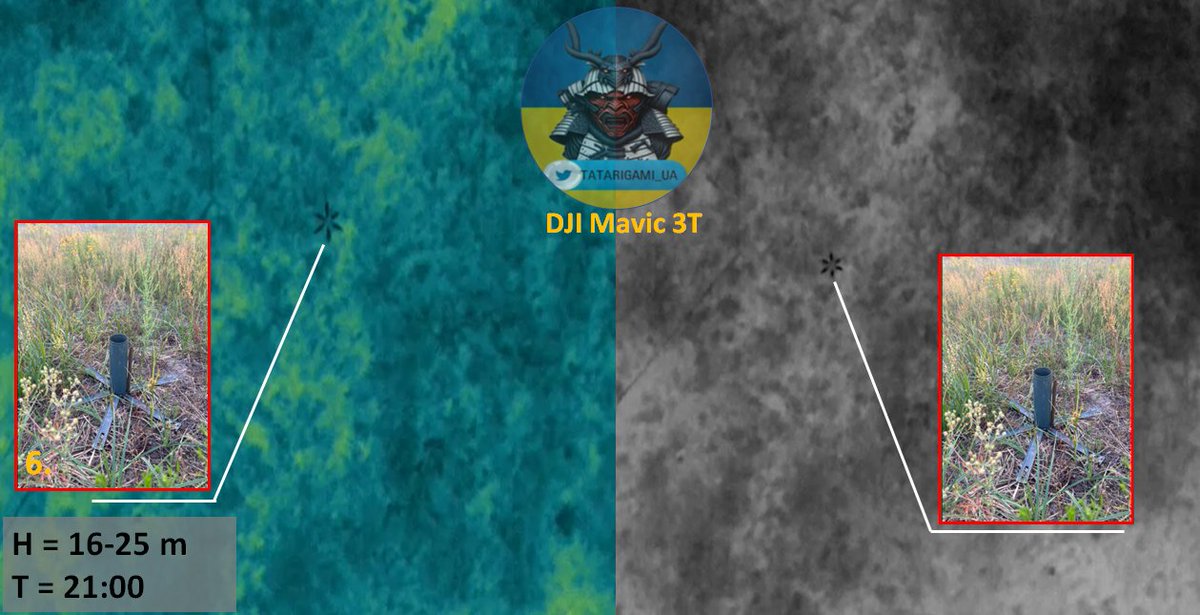
6/ Mines that are remotely deployed, such as mine #6 (ПОМ-3), can also be detected effectively. In this specific instance, the distinct shape of the mine is clearly apparent to the drone operator. The altitude in this case ranges from 16 to 25 meters.
7/ Mine detection is also achievable based on features that deviate from natural object forms. Nevertheless, it's noteworthy that this necessitates the operator to possess experience and/or training in order to discern less conspicuous objects.
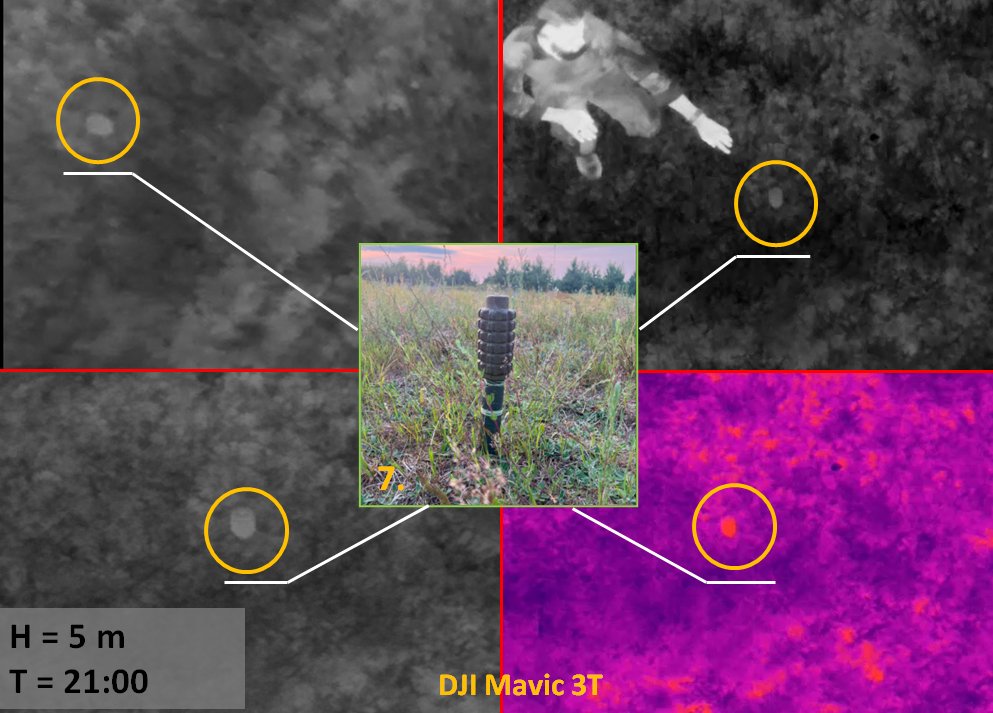
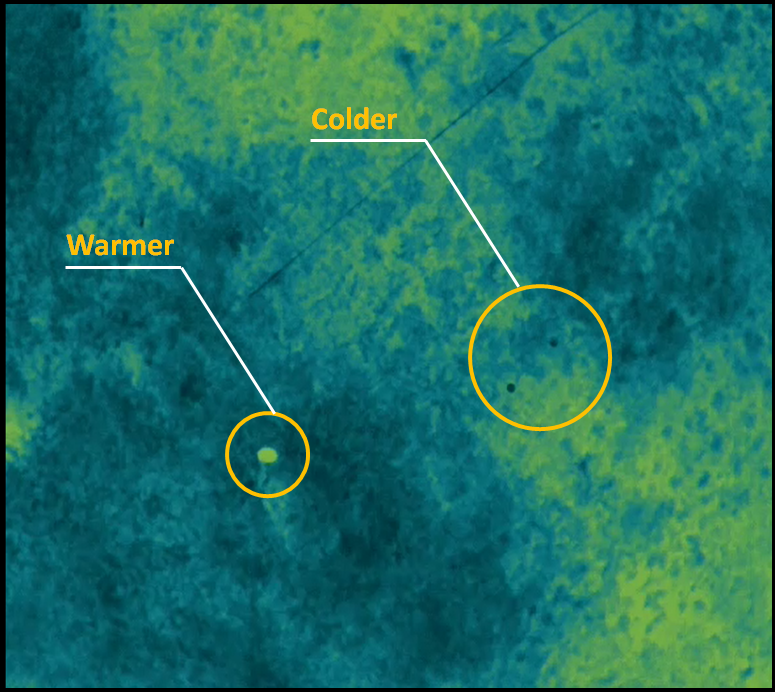
8/ It should be emphasized that mines with non-metallic enclosures had cooled by the time of testing, in contrast to metallic ones that retained warmth. Notably, both types of mines remained discernible due to distinct temperature signatures relative to the environment.
9/ If you found this thread valuable, please support by liking and retweeting the first message of the thread. Your engagement enables me to provide better materials more frequently.
• • •
Missing some Tweet in this thread? You can try to
force a refresh

The grooming of Orban's regime as a Trojan horse inside the EU and NATO is no longer speculative: it's now evidence-based, confirmed by leaked Budapest-Moscow communications. Agentstvo reports that roughly half of all Russian embassy staff maintain ties to intelligence services:
2/ The EU officially identifies Russia as one of its primary security threats. Yet Orban has been systematically distancing Hungary from both the EU and NATO, deteriorating relations with neighbors including Ukraine, while growing increasingly reliant on Russian influence.
3/ Moscow has no genuine interest in Hungary itself, or in the country's long-term wellbeing. What it wants is a lever - to undermine EU institutions, erode European support for Ukraine, and seed distrust between member states toward one of their own EU members and NATO allies
There’s been a lot of discussion about the potential threat FPV drones could pose to US forces on the ground, with some going as far as claiming that American troops would suffer heavy casualties from FPV drones. That’s possible, but it’s also worth questioning the assumptions:
2/ First, it’s not clear to what extent Iran has actually trained and prepared its ground forces for large-scale use of small drones. Even relatively decentralized militaries still operate within ORBAT and logistics. So far, there isn’t strong evidence of systemic changes within the Iranian army to support widespread FPV deployment.
3/ Second, we’ve seen relatively little FPV usage from Iran-supported groups like Hamas or Hezbollah, despite continuous war with Israel. A few examples have emerged from Iraq, but we’re talking about a handful of videos at most. That’s not a level of a large-scale implementation
With an uncertain battlefield position, Russia has intensified hybrid operations to shape European public opinion. A key element is the spread of narratives portraying Ukraine as using “energy blackmail” against Europe, often echoed by politically sympathetic actors. 🧵Thread:
2/ Since the full-scale invasion began, Russian missile and drone strikes have targeted Ukraine’s energy system, damaging power plants, gas facilities, and transmission networks nationwide. Ukraine has lost about 11.5 GW of capacity, with damage reportedly exceeding $24.8 billion
3/ The war has also affected energy transport infrastructure. Ukrainian oil facilities have been attacked more than 400 times since the invasion began. On 27 January 2026, a strike damaged equipment working for the Druzhba pipeline near Brody in western Ukraine.
Leaked internal files from Moscow reveal that Russia’s ruling party, United Russia, keeps intelligence-style dossiers on its own politicians. They document corruption facts, criminal ties, and personal vulnerabilities, information used to manage Russia’s politics
Thread 🧵:
2/ United Russia is the political party that dominates Russia’s parliament and regional governments and serves as the main political vehicle of Putin.
Leaked documents from the party, published by @dallasparkua and @256CyberAssault, reveal details of an internal vetting process
3/ Meet Evgeniy Gnedov, who oversees the vetting of candidates for various lawmaking bodies - from local assemblies to the federal parliament.
A longtime security official, he spent decades inside the Federal Penitentiary Service of Russia, eventually rising to a senior role
Russia’s war in Ukraine has increasingly become a war of drones, but artillery still plays a key role on the battlefield. Newly obtained documents from 2014 to 2025 show that Russia continues to modernize its artillery production using industrial machinery from Europe. 🧵Thread:
2/ In a joint analysis, Frontelligence Insight and the @dallasparkua company reviewed hundreds of internal documents from Russian defense contractor Zenit-Investprom and found that Plant No. 9, a maker of artillery barrels and tank guns, went through major upgrades in 2025
3/ Six facilities within the Uralmash industrial zone were found to be undergoing modernization, including planned delivery of industrial machinery from several European countries. Several workshops were dedicated to work on the Armata project and the Koalitsiya SPG.