Read on Twitter
It is hard to overstate the importance of social norms. They dictate how we should behave with others in our countless daily social interactions. But what are they? A 🧵on how game theory helps unveil what social norms are and how they work. 

What are social norms? In an influential 2001 article, Christine Horne emphasised that the jury was still somewhat out in sociology about the nature of norms, how they work and how they emerge.

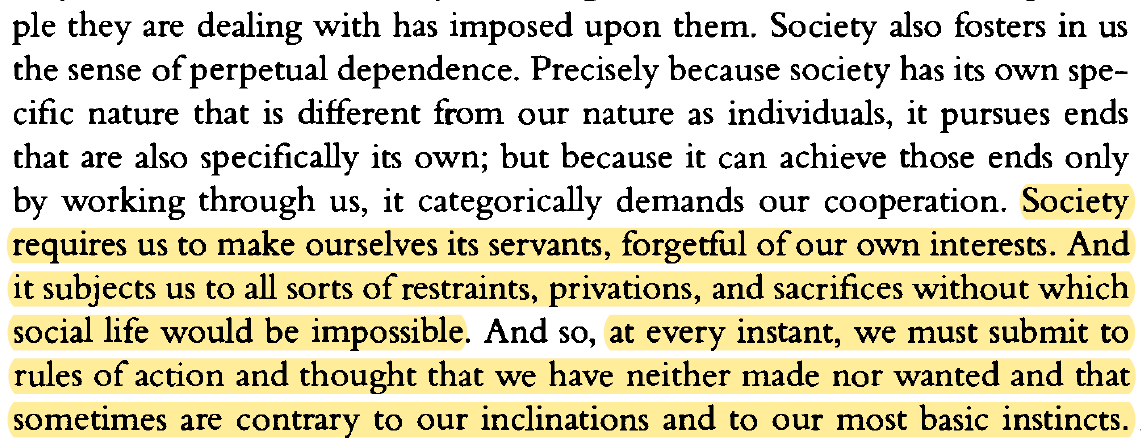
Sociology has however produced a set of classical ideas about social norms. Durkheim, the father of the discipline, stressed that they are constraints imposed by society on individuals, and they are beyond individuals’ control. Durkheim (1912):
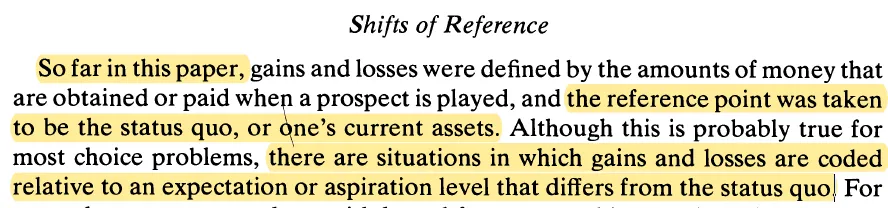
These norms are internalised by individuals, shaping their preferences and beliefs, and leading to feelings of guilt and shame when they violate the norms. Parsons and Shils (1951):
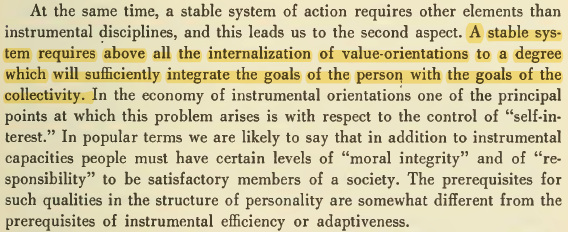
This vision of social norms coming from “society” and constraining individuals with limited agency has influenced social sciences and even popular discussions about norms, in particular when they are criticised, like gender norms.

But this vision raises questions: How does “society” impose norms? Why do we have some norms rather than others? How do norms evolve?
Game theory helps answer these questions by shifting our understanding of what norms are: they are equilibria of social games.
Game theory helps answer these questions by shifting our understanding of what norms are: they are equilibria of social games.
The philosopher David Lewis (1969) was one of the first scholars to propose that they are the equilibria of social games where we need to coordinate our behaviours and expectations.

A typical example is the choice of driving on one side of the road. For arbitrary reasons, a country may have adopted one side instead of the other as a convention. It is then in the interest of every driver to follow this convention and not deviate.
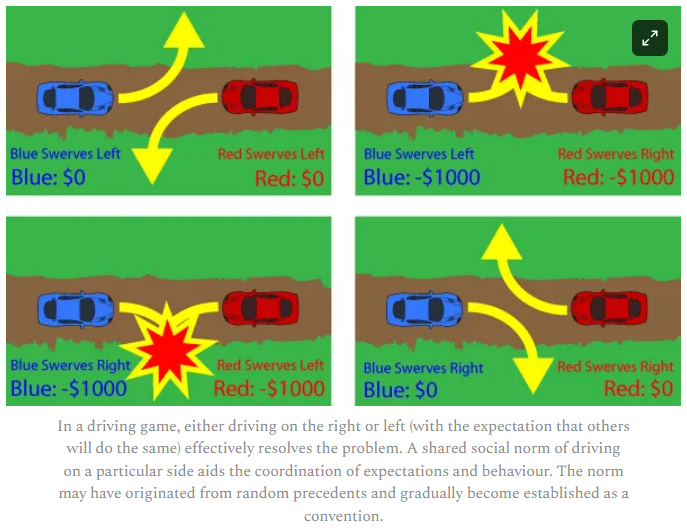
Situations requiring social coordination are everywhere: from walking in the street to talking turns speaking in meetings. We need a shared understanding to navigate these social interactions.
When we break social norms, we break all this shared understanding with other people. That is why it is hard to break norms and we feel bad about it. There is much more at stake than the specific norm violated.
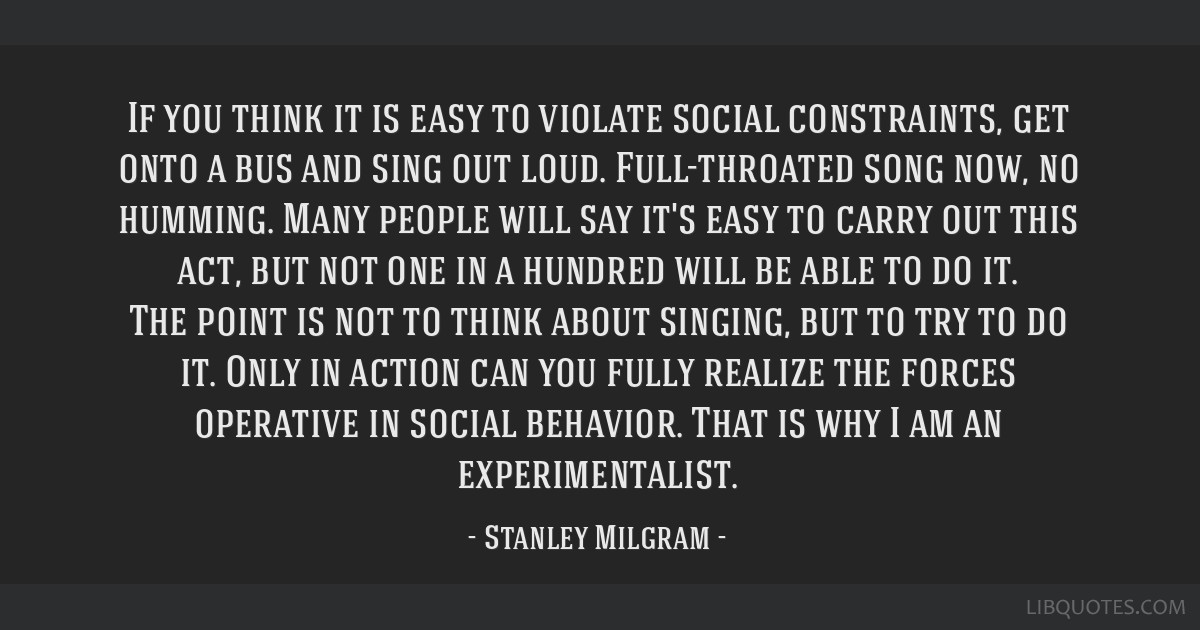
The game theorist Ken Binmore extended this understanding to norms of fairness.
There are many ways to agree to cooperate and share the gains from cooperation. Norms of fairness allow us to seamlessly coordinate and agree on one of the many possible solutions.
There are many ways to agree to cooperate and share the gains from cooperation. Norms of fairness allow us to seamlessly coordinate and agree on one of the many possible solutions.

Game theory therefore helps recover key insights from sociology about social norms:
- They are external to individuals because they are equilibria: stable configurations of behaviours and expectations.
- They constrain individuals because deviations from equilibria are costly.
- They are external to individuals because they are equilibria: stable configurations of behaviours and expectations.
- They constrain individuals because deviations from equilibria are costly.
At the same time, it helps us answer the puzzles about norms:
- People are not social pawns following norms blindly but actors trying to navigate social situations successfully
- Shame and guilt are psychological warnings reflecting the future possible costs of deviations
- People are not social pawns following norms blindly but actors trying to navigate social situations successfully
- Shame and guilt are psychological warnings reflecting the future possible costs of deviations
Understanding norms as social equilibria also helps us understand that:
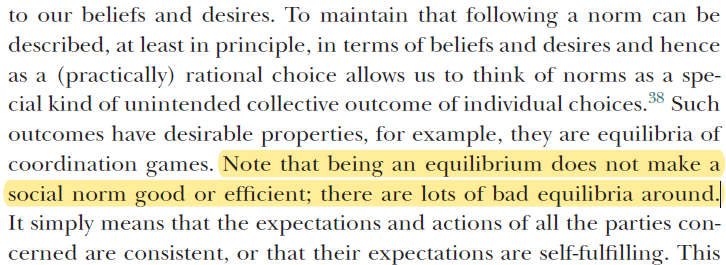
- They can be “bad” (collectively undesirable)
- “Bad” norms can be hard to change, even if most people think they are bad!
Bicchieri (2005):
- They can be “bad” (collectively undesirable)
- “Bad” norms can be hard to change, even if most people think they are bad!
Bicchieri (2005):
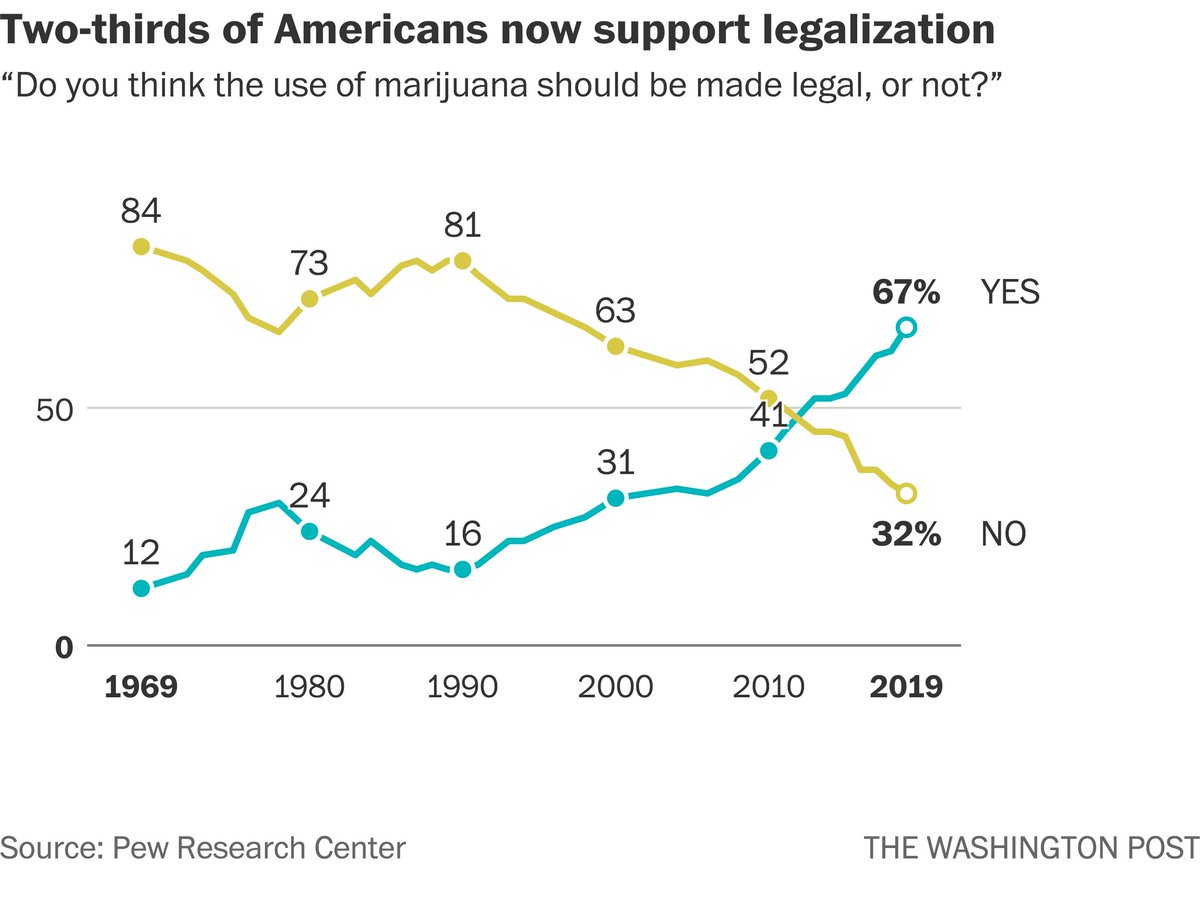
Norms tend to be sticky, but when they change they tend to change quickly as society shifts from one equilibrium of behaviours and expectations to another one. The dynamics of the changes in laws on marijuana or same-sex marriage are good examples.

When a norm changes, attitudes tend to change quickly too. Instead of people being brainwashed by internalised norms, their views can be very flexible when the whole society shifts to another norm.
Understanding norms as equilibria also explains the role of leaders and role models in changing norms. They can act as coordination devices. When they recommend changing a norm, it can help people trust that others will synchronously change their behaviour and expectations.

In conclusion, viewing social norms as social equilibria helps us understand how they work. It also helps us appreciate that people are not social pawns. They are actors who try to successfully navigate social games, though they (mostly) do not set the games’ rules. End/
This thread builds on this recent post which is part of a series on how game theory helps make sense of a wide range of behaviours.
tinyurl.com/36ttyb9b
tinyurl.com/36ttyb9b
• • •
Missing some Tweet in this thread? You can try to
force a refresh