France used to be the "China of Europe"—1 in 25 people globally was French and 1 in 5 Europeans was French.
Now, France is smaller than Germany and virtually identical in population to Britain
Why?
Thanks to some wonderful new work, we probably know the answer!🧵
Now, France is smaller than Germany and virtually identical in population to Britain
Why?
Thanks to some wonderful new work, we probably know the answer!🧵

The answer has to do with secularization: if your faith says to be fruitful and multiply while its secular replacement does not, it's reasonable to expect fertility to fall.
We can observe this secularization through the rapid decline of religious wills and perpetual masses.
We can observe this secularization through the rapid decline of religious wills and perpetual masses.
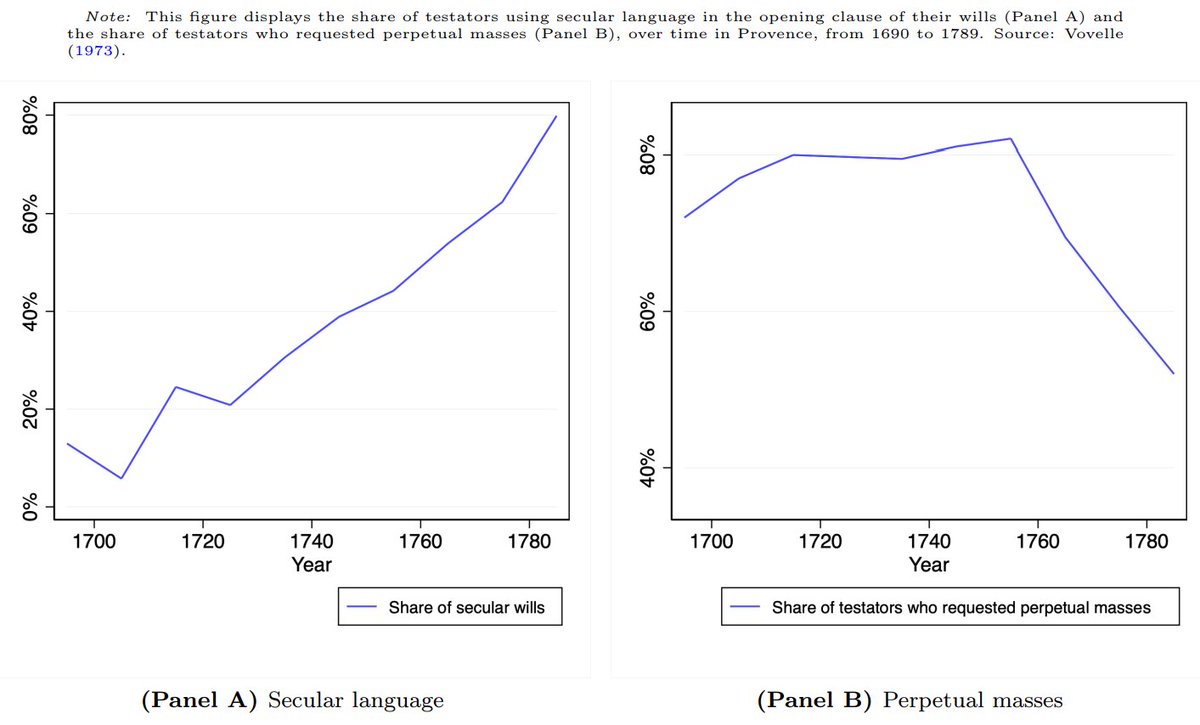
As this secularization spread, fertility declined.
And we know it was secularization that drove the dates in which areas began the demographic transition, not increased human capital, population density, or urbanization.
And we know it was secularization that drove the dates in which areas began the demographic transition, not increased human capital, population density, or urbanization.

More tests support this.
For example, it stands to reason that more religious people need more clergymen.
Well, the greater the population-weighted share of clergymen in an area, the greater its fertility, but only after secularization set in and religiosity variance emerged.
For example, it stands to reason that more religious people need more clergymen.
Well, the greater the population-weighted share of clergymen in an area, the greater its fertility, but only after secularization set in and religiosity variance emerged.

And we know part of why secularization kicked off, too.
Consider this: as in America with tea, France also had a horribly unpopular tax on foodstuffs: the gabelle, a tax on salt.
This tax was actually a part of the cahiers de doléance during the French Revolution.
Consider this: as in America with tea, France also had a horribly unpopular tax on foodstuffs: the gabelle, a tax on salt.
This tax was actually a part of the cahiers de doléance during the French Revolution.

This tax varied wildly, so its extent can be used to assess how extractive institutions were.
To understand how, we need one more piece of history: the Counter Reformation.
See the dashed lines in France?
Those were disputed during the French Wars of Religion.
To understand how, we need one more piece of history: the Counter Reformation.
See the dashed lines in France?
Those were disputed during the French Wars of Religion.

In those places where the Counter Reformation was dominant during the French Wars of Religion, there's more modern Easter mass attendance.
But, there's actually *less* if there was evidence that the counter-reformers led extractive institutions, as indicated by the gabelle.
But, there's actually *less* if there was evidence that the counter-reformers led extractive institutions, as indicated by the gabelle.

Secularization was likely partly a backlash against cruel, absolutist, "divine right" monarchy.
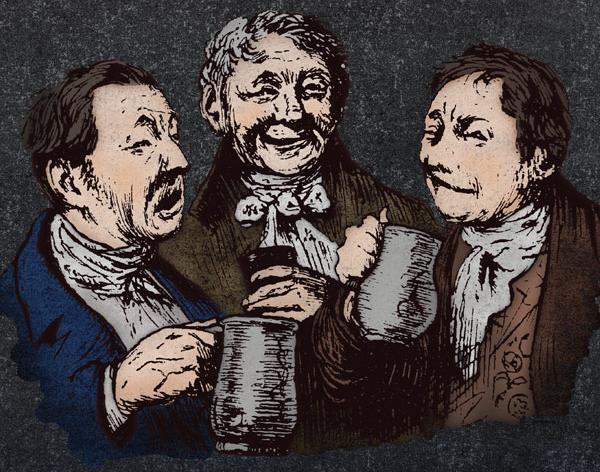
You know, the sort that inspired this image of the Third Estate bearing the nation's tax burdens.
You know, the sort that inspired this image of the Third Estate bearing the nation's tax burdens.

This matters!
In this time period, Britain grew their economy and population simultaneously, catching up to France in population.
France instead enriched its population through constraining its size.
The per capita GDPs in each country became virtually identical.
In this time period, Britain grew their economy and population simultaneously, catching up to France in population.
France instead enriched its population through constraining its size.
The per capita GDPs in each country became virtually identical.

In other words, Britain became rich by growing the numerator more than the denominator; France just constrained the denominator.
The convergence of France and Britain is truly remarkable.
Imagine the world where French growth during the Industrial Revolution mirrors Britain's.
The convergence of France and Britain is truly remarkable.
Imagine the world where French growth during the Industrial Revolution mirrors Britain's.
In such a world, the lingua franca might still be "Franca".
These findings come from a great new paper by @gguillaumeblanc: guillaumeblanc.com/files/theme/Bl…
These findings come from a great new paper by @gguillaumeblanc: guillaumeblanc.com/files/theme/Bl…
• • •
Missing some Tweet in this thread? You can try to
force a refresh