
 Read on Twitter
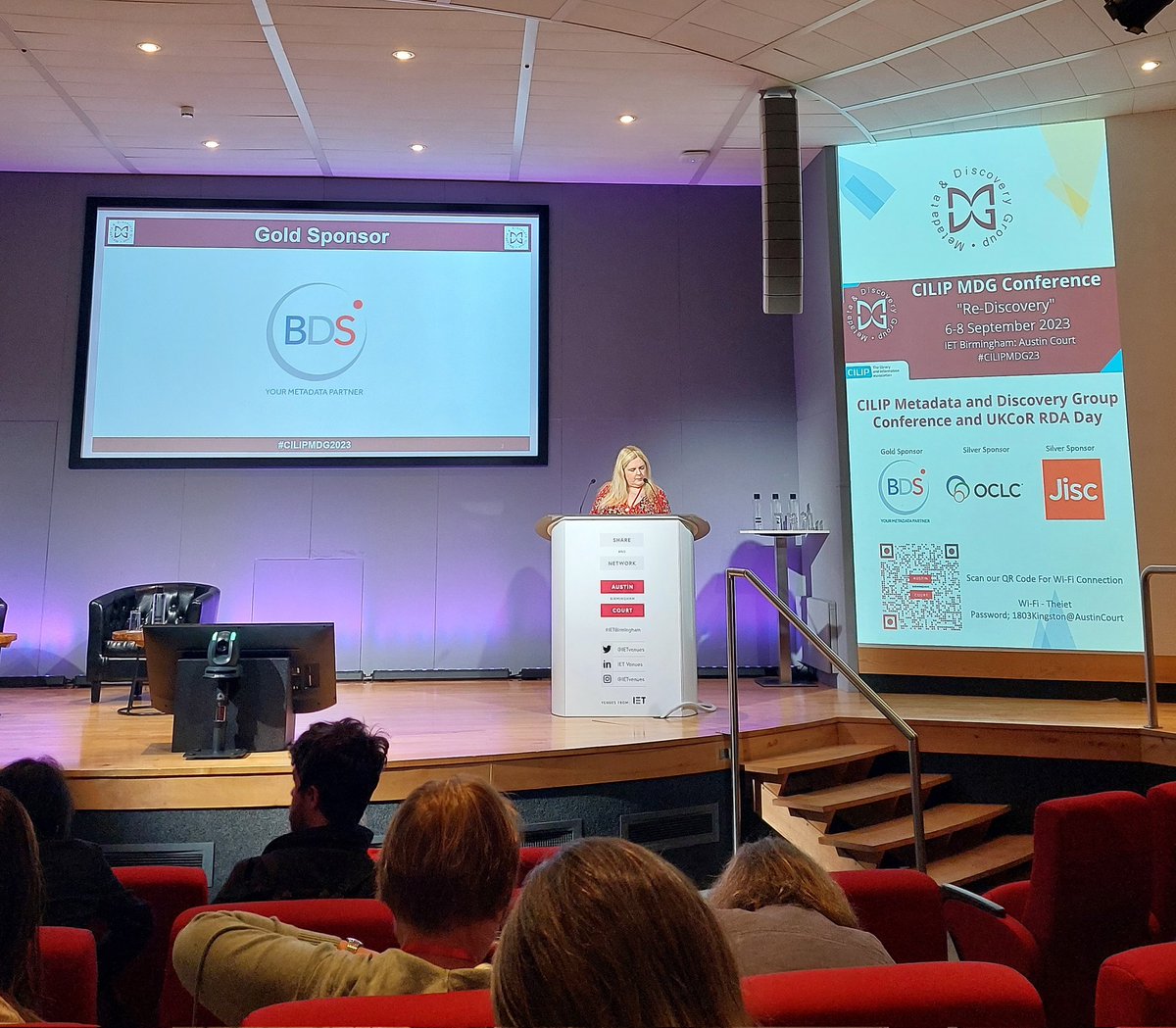
We are just getting underway at the Metadata and Discovery Group Conference and RDA Day with MDG chair Prof Diane Rasmussen McAdie @infogamerist #CILIPMDG23 
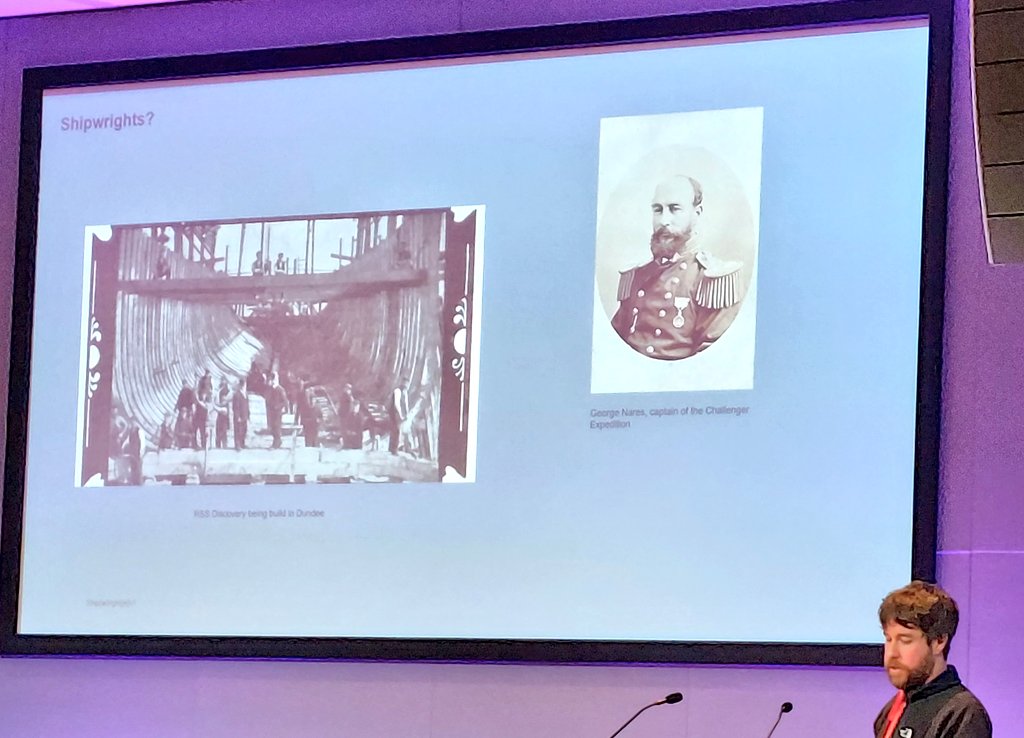
@NHM_London What relationship does the Captain of a Ship on a given Expedition have to the works collected as part of that Expedition? - Not an author, or editor, but they can be named on the title page of written works associated with an Expedition #CILIPMDG23
@NHM_London Natural history knowledge
from indigenous people from around the world captured
through colonial encounters needs to be more widely acknowledged for their impact on society with their narratives sitting alongside those
specimens & artefacts within
museums
#CILIPMDG23
from indigenous people from around the world captured
through colonial encounters needs to be more widely acknowledged for their impact on society with their narratives sitting alongside those
specimens & artefacts within
museums
#CILIPMDG23
@NHM_London NHM therefore wants to catalogue these works with an acknowledgement of their colonial context. This means considering questions of dependent & independent titles, ships as corporate bodies & other entity relationships, form/genre headings, geographic headings & LCSH. #CILIPMDG23
@NHM_London Now we are hearing about the “UK NACO funnel : progress, obstacles, and solutions” - Martin Kelleher (University of Liverpool) #CILIPMDG23
@NHM_London The funnel has been set up across UK libraries but required access to an OCLC subscription for contributing records to the Name authority file - not all libraries have an OCLC contract #CILIPMDG23
@NHM_London The alternative is to sign up to SkyRiver from Innovative - the contract for this is being negotiated by the funnel contributors #CILIPMDG23
@NHM_London Solent University and the Open University have recently joined the UK NACO Funnel and are undertaking the required training #CILIPMDG23
@NHM_London On 7 July, an email from PCC indicated next training day would be open for both new trainees & refreshers, so Martin told all
enquirers to encourage signing up ASAP.
Places were filled within a matter of hours. #CILIPMDG23
enquirers to encourage signing up ASAP.
Places were filled within a matter of hours. #CILIPMDG23

Martin finishes by saying that all libraries should join the funnel because it's brilliant! #CILIPMDG23
Our final Lightning talk is: “Revamping in-house cataloguing training” - Victoria Parkinson @VLParkinson (King’s College London). #CILIPMDG23
@VLParkinson At King's one team does ordering, reading lists, accessioning, processing, & cataloguing.
Shelf-ready: 85-90%
In-house: 10-15%, foreign language, audio-visual, self-published books, and
scores.
#CILIPMDG23
Shelf-ready: 85-90%
In-house: 10-15%, foreign language, audio-visual, self-published books, and
scores.
#CILIPMDG23
@VLParkinson Prior to the pandemic Kings had the Aleph LMS and no laptops, so cataloguing training was in-person with presentations & paper-based exercises. It worked fairly well #CILIPMDG23
@VLParkinson Cataloguers could then assess and upgrade vendor supplied shelf-ready records, and do original cataloguing on items that required it. #CILIPMDG23
@VLParkinson The pandemic changed everything with a lot of staff turnover & lack of practice during
2020-2022. This left the library with a skills gap.
A new LMS was also implemented (Alma) meaning new instructions & ways of cataloguing #CILIPMDG23
2020-2022. This left the library with a skills gap.
A new LMS was also implemented (Alma) meaning new instructions & ways of cataloguing #CILIPMDG23
@VLParkinson Victoria had to train multiple people at once and hybrid working made it harder to get everyone together in the same place and time.
There were also some barriers to practising after training:
- Time
- Priorities
- Books arrive at busiest time #CILIPMDG23
There were also some barriers to practising after training:
- Time
- Priorities
- Books arrive at busiest time #CILIPMDG23
@VLParkinson The response to these challenges was to use the expertise of the teaching librarians to develop:
- Short videos
- Exercises and quizzes
Victoria had to learn the mantra: "Don't try to tell the audience everything!" #CILIPMDG23
- Short videos
- Exercises and quizzes
Victoria had to learn the mantra: "Don't try to tell the audience everything!" #CILIPMDG23
@VLParkinson Victoria created an Online course space in the VLE & used feedback from previous training & experience about what worked well to develop the training.
3 weeks training were followed by 3 weeks of drop-
ins which meant staff could get hands-on as soon as possible. #CILIPMDG23
3 weeks training were followed by 3 weeks of drop-
ins which meant staff could get hands-on as soon as possible. #CILIPMDG23
@VLParkinson Victoria aimed to encourage curiosity in those she was training, welcoming questions and being supportive to develop thrif understanding of cataloguing and the library's catalogue and their role in the library. #CILIPMDG23
@VLParkinson The benefits have been lots of engagement & positive feedback.
Staff get to grips with cataloguing "real" books which can inform other parts of their job.
#CILIPMDG23
Staff get to grips with cataloguing "real" books which can inform other parts of their job.
#CILIPMDG23
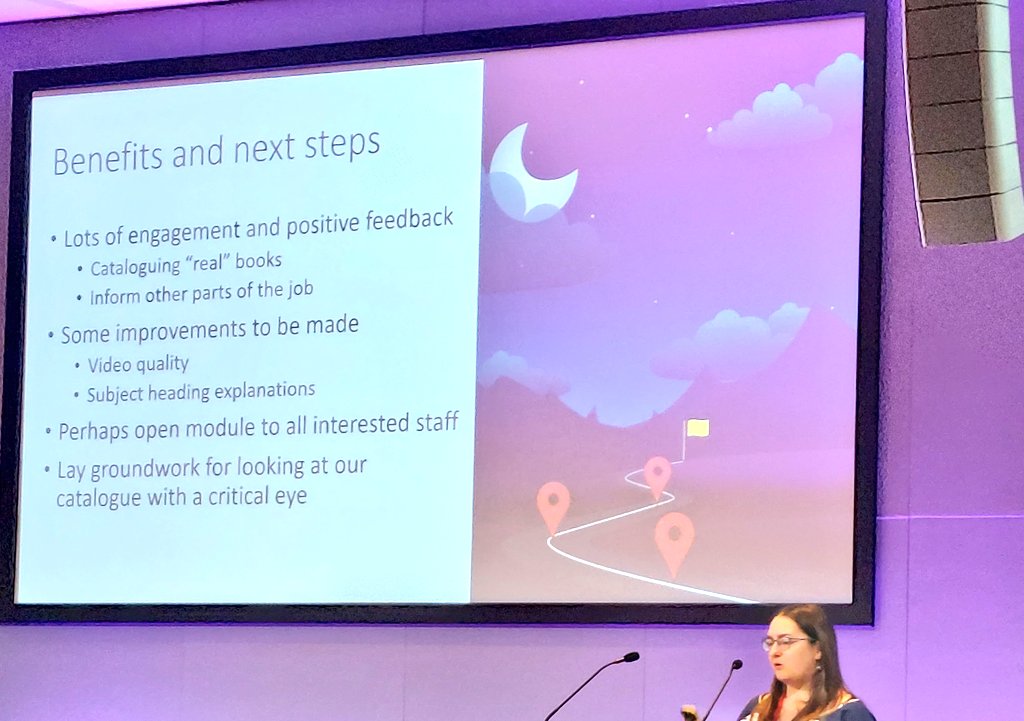
@VLParkinson Victoria has also made some improvements to the training:
- Video quality
- Subject heading explanations.
She is considering opening the VLE module to all interested staff to lay the groundwork for helping staff to look at the library catalogue with a critical eye. #CILIPMDG23
- Video quality
- Subject heading explanations.
She is considering opening the VLE module to all interested staff to lay the groundwork for helping staff to look at the library catalogue with a critical eye. #CILIPMDG23
@VLParkinson That's the end of the Papers and Talks for today - we now move to the AGM with MDG chair Diane Rasmussen McAdie @infogamerist #CILIPMDG23
https://twitter.com/infogamerist/status/1699806547788898754
Morning everyone- we are about to start the RDA Day with UKCoR. With a great programme put together by @jenniferswright Thurstan Young @BLMetadata & @gordondunsire #CILIPMDG23

@jenniferswright @BLMetadata @gordondunsire There's even RDA Bingo!! #CILIPMDG23
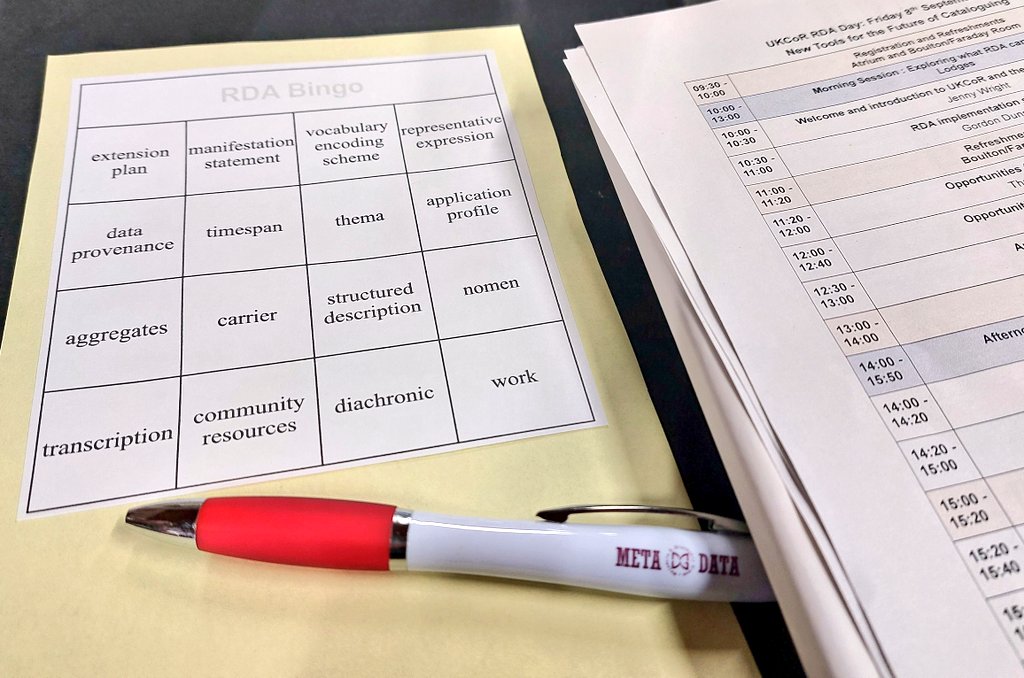
@jenniferswright @BLMetadata @gordondunsire @jenniferswright provides some background on UKCoR and how it interacts with other bodies to influence the development of @rdatoolkit via @EURIG_RDA and the RDA Steering Committee #CILIPMDG23 #RDAday
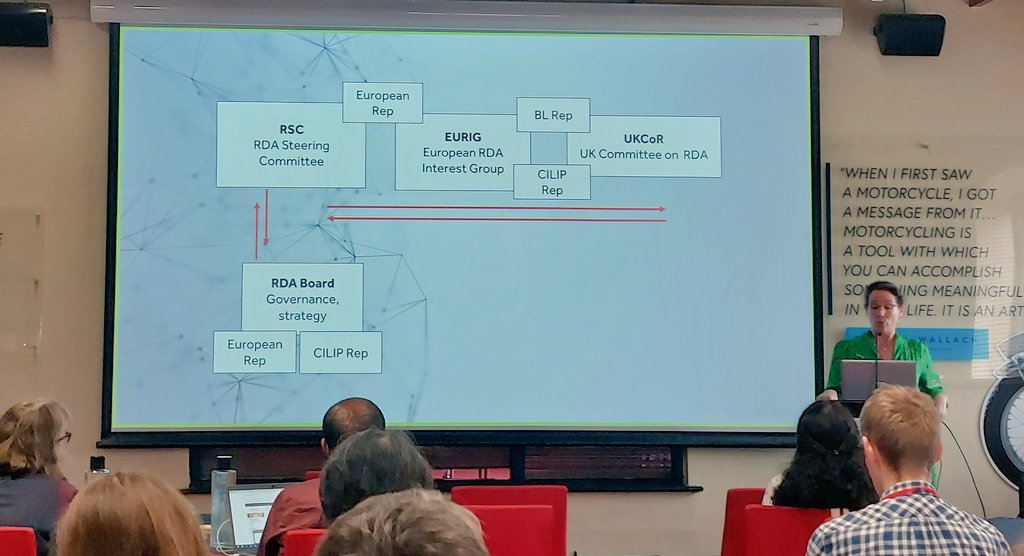
RDA was created by the RDA Steering Committee (formerly the Joint Steering Committee for the Development of RDA) as part of its strategic plan (2005-2009) to replace the Anglo-American Cataloguing Rules, 2nd Edition Revised, which were first published in 1978. #CILIPMDG23 #RDAday
RDA is a package of data elements, guidelines, and instructions for creating library and cultural heritage resource metadata that are well-formed according to international models for user-focussed linked data applications.
#CILIPMDG23 #RDAday
#CILIPMDG23 #RDAday
RDA is published by:
The American Library Association @ALALibrary
The Canadian Federation of Library Associations @CFLAFCAB
CILIP: Chartered Institute of Library and Information Professionals @CILIPinfo
#CILIPMDG23 #RDAday
The American Library Association @ALALibrary
The Canadian Federation of Library Associations @CFLAFCAB
CILIP: Chartered Institute of Library and Information Professionals @CILIPinfo
#CILIPMDG23 #RDAday
@ALALibrary @CFLAFCAB @CILIPinfo RDA is based on the @IFLA Library Reference Model (LRM). When first published, RDA was based on the precursors to the LRM: FRBR, FRAD, and FRSAD.
#CILIPMDG2 #RDAdayifla.org/wp-content/upl…
#CILIPMDG2 #RDAdayifla.org/wp-content/upl…
RDA also uses linked data principles based on Resource Description Framework (RDF) and the Dublin Core Abstract Model (DCAM), following the Data Model Meeting at the British Library in 2007. #CILIPMDG23 #RDAday
RDA is not a cataloguing manual, & it is no longer exclusively rooted in Anglo-American traditions. Instead, it is an international standard which provides a higher-level framework for aspects of the bibliographic universe. #CILIPMDG23 #RDAday
Flexibility in application and in world-wide implementation were key drivers in the design of RDA. #CILIPMDG23 #RDAday
@gordondunsire joins us remotely from Edinburgh to present on RDA Implementation Scenarios #CILIPMDG23 #RDAday

@gordondunsire RDA Toolkit supports four different scenarios for processing
metadata:
A: Linked open data
B: Relational or object-oriented data
C: Bibliographic/authority data
D: Flat file data
#CILIPMDG23 #RDAday
metadata:
A: Linked open data
B: Relational or object-oriented data
C: Bibliographic/authority data
D: Flat file data
#CILIPMDG23 #RDAday
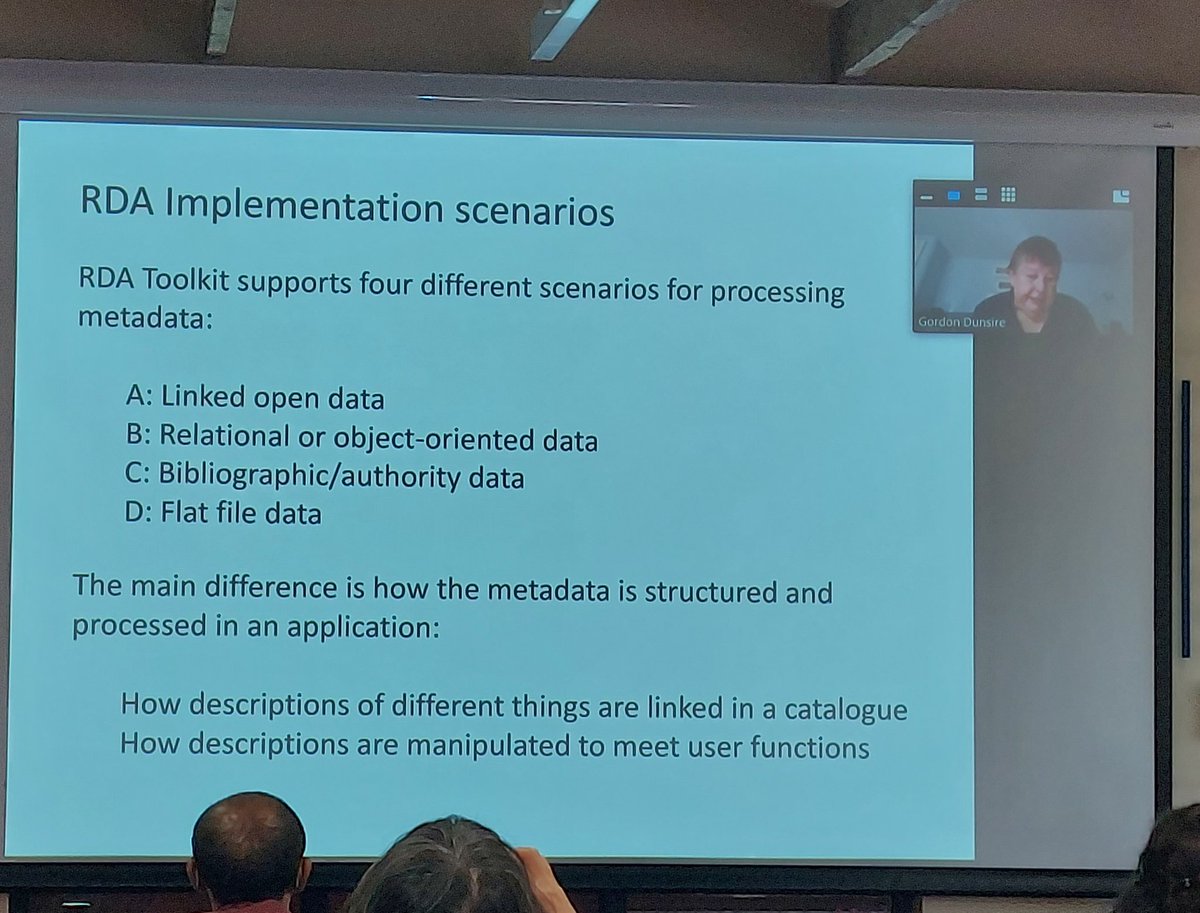
@gordondunsire The main difference is how the metadata is structured and
processed in an application:
- How descriptions of different things are linked in a catalogue
- How descriptions are manipulated to meet user functions
#CILIPMDG23 #RDAday
processed in an application:
- How descriptions of different things are linked in a catalogue
- How descriptions are manipulated to meet user functions
#CILIPMDG23 #RDAday
@gordondunsire RDA Toolkit provides 4 different methods for recording the same information about some 'thing' in a description:
1 unstructured description (eg name/title, note)
2 structured description (eg access point, controlled term)
3: identifier [string]
4 IRl [thing]
#CILIPMDG23 #RDAday
1 unstructured description (eg name/title, note)
2 structured description (eg access point, controlled term)
3: identifier [string]
4 IRl [thing]
#CILIPMDG23 #RDAday

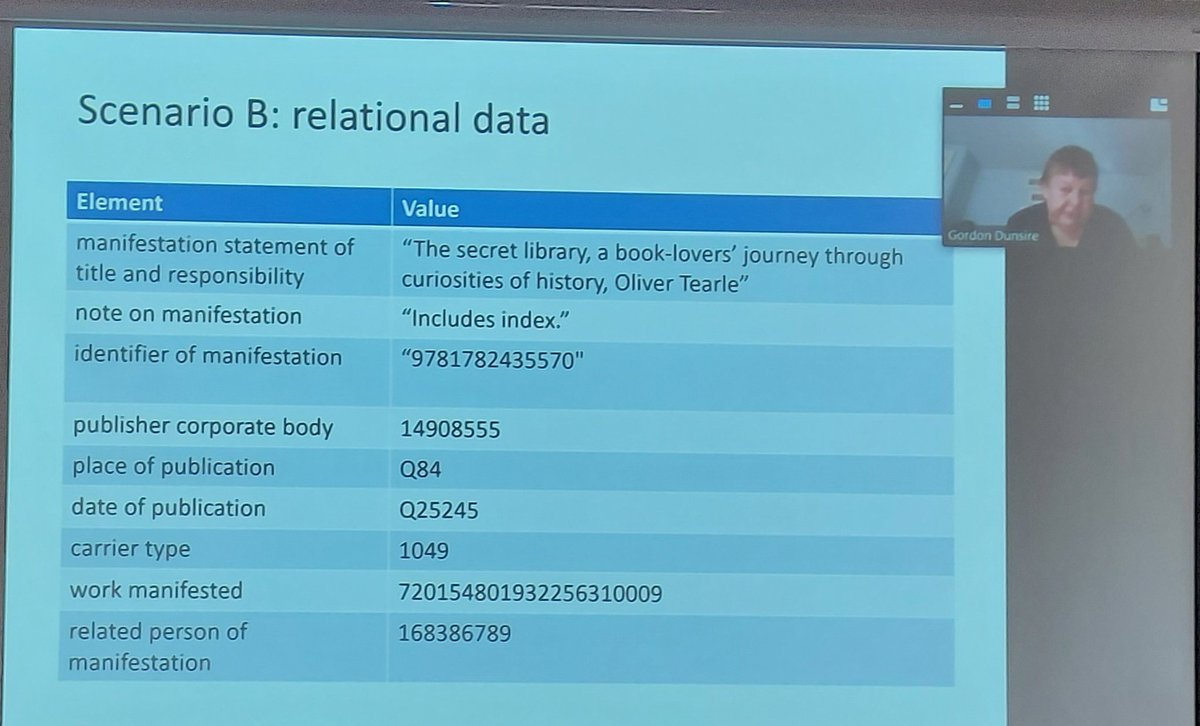
@gordondunsire Data is linked in each implementation scenario with a recording method:
A: Linked open data => IRI
B: Relational or object-oriented data => identifier
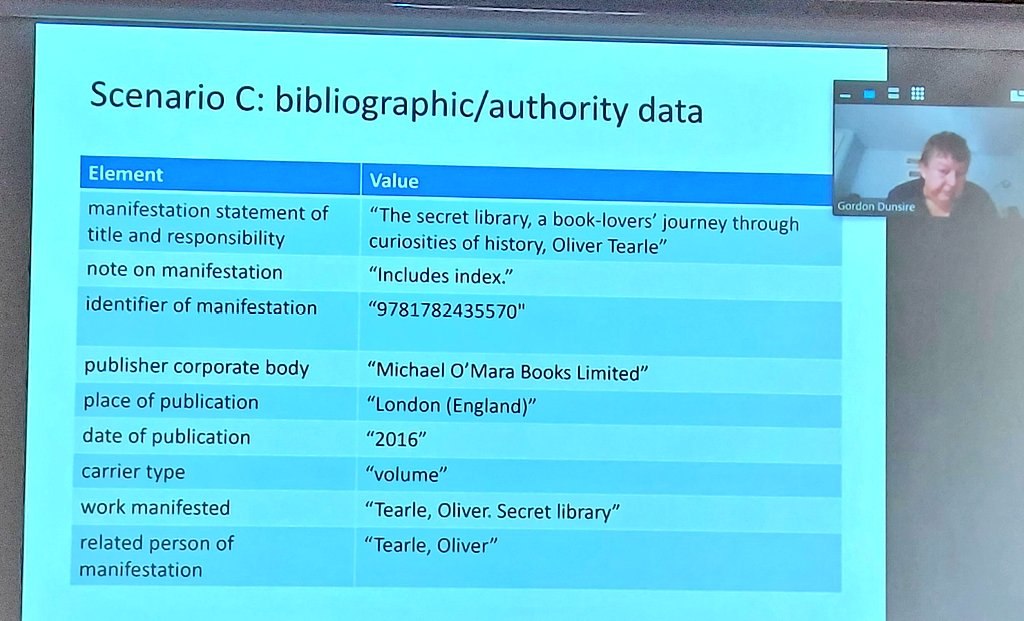
C: Bibliographic/authority data => structured description
#CILIPMDG23 #RDAday
A: Linked open data => IRI
B: Relational or object-oriented data => identifier
C: Bibliographic/authority data => structured description
#CILIPMDG23 #RDAday
@gordondunsire Only some RDA elements, options, and recording methods
are relevant for any particular implementation or application.
An application profile specifies which ones to use, plus other
stuff like controlled vocabularies (authority files and value
vocabularies)
#CILIPMDG23 #RDADay
are relevant for any particular implementation or application.
An application profile specifies which ones to use, plus other
stuff like controlled vocabularies (authority files and value
vocabularies)
#CILIPMDG23 #RDADay
@gordondunsire It is very difficult to use RDA Toolkit without an Application profile (or policy statements, etc.)
#CILIPMDG23 #RDAday
#CILIPMDG23 #RDAday
Policy statements are community-based decisions about RDA options. They are published in the RDA Toolkit and are linked to RDA guidance and instructions through the preview pane.
#CILIPMDG23 #RDAday
#CILIPMDG23 #RDAday
Most policy statements come from national libraries, professional bodies &/or specialist communities that have a legal obligation to make their policies freely available to the public, Toolkit supports this through documents on the separate Policies tab.
#CILIPMDG23 #RDAday
#CILIPMDG23 #RDAday
Scenario A for RDA implementation: Linked Data
#CILIPMDG23 #RDAday
#CILIPMDG23 #RDAday

Scenario B: Relational database #CILIPMDG23 #RDAday
Scenario C: Bibliographic & Authority data
#CILIPMDG23 #RDAday
#CILIPMDG23 #RDAday
Scenario D: flat file data
#CILIPMDG23 #RDAday
#CILIPMDG23 #RDAday
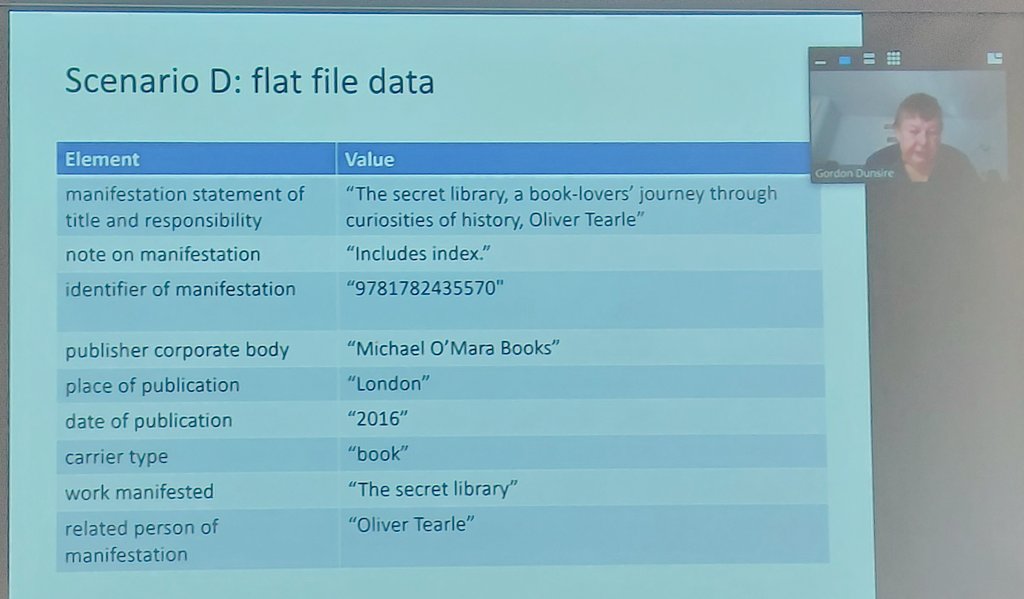
In Summary:
RDA Toolkit supports a wide-range of metadata
implementations.
An application profile is necessary to select the correct tools and methods for a specific
implementation.
#CILIPMDG23 #RDAday
RDA Toolkit supports a wide-range of metadata
implementations.
An application profile is necessary to select the correct tools and methods for a specific
implementation.
#CILIPMDG23 #RDAday
Factors that influence a profile include:
- Representation vs Context (description vs relationships)
- Cost vs Benefit (data processing: hardware, systems, skills)
- Open vs Closed (data gathering and sharing)
#CILIPMDG23 #RDAday
- Representation vs Context (description vs relationships)
- Cost vs Benefit (data processing: hardware, systems, skills)
- Open vs Closed (data gathering and sharing)
#CILIPMDG23 #RDAday
The internal coherency of the RDA Toolkit provides a basis for
interoperability of metadata between different profiles and applications.
#CILIPMDG23 #RDAday
interoperability of metadata between different profiles and applications.
#CILIPMDG23 #RDAday
Gordon's presentation is available on
#CILIPMDG23 #RDAdaygordondunsire.com/presentations.…
#CILIPMDG23 #RDAdaygordondunsire.com/presentations.…
Full record examples of RDA cataloguing are available using pure RDA elements, MARC 21 encoding, and RDA linked data. Other training resources may be found on the Toolkit website.
#CILIPMDG23 #RDAdayrdatoolkit.org/examples
#CILIPMDG23 #RDAdayrdatoolkit.org/examples
We are now hearing from Thurstan Young @BLMetadata regarding: "Opportunities for economy in RDA" #CILIPMDG23 #RDAday
@BLMetadata The Official RDA Toolkit supports efficient resource discovery by:
Meeting fundamental user needs
Reducing the requirement for manual intervention
Increasing the scope programmed intervention
Increasing the scope for reuse of bibliographic metadata
#CILIPMDG23 #RDAday
Meeting fundamental user needs
Reducing the requirement for manual intervention
Increasing the scope programmed intervention
Increasing the scope for reuse of bibliographic metadata
#CILIPMDG23 #RDAday
@BLMetadata The new RDA Toolkit provides opportunity for efficiency based on Minimal Description #CILIPMDG23 #RDAday
@BLMetadata Minimum description is a description that is the least data required for a well-formed metadata description set.
#CILIPMDG23 #RDAday
#CILIPMDG23 #RDAday

@BLMetadata Minimum metadata description set of a resource entity must conform to the requirements and constraints given in:
Guidance: Resource description. #CILIPMDG23 #RDAday
Guidance: Resource description. #CILIPMDG23 #RDAday
@BLMetadata A coherent description of an information resource must include a description of at least one of its entities. An entity
is described by recording a value for at least one appellation element of the entity using the recording method appropriate for the element. #CILIPMDG23 #RDAday
is described by recording a value for at least one appellation element of the entity using the recording method appropriate for the element. #CILIPMDG23 #RDAday
@BLMetadata An entity is related to another entity by recording a value for relationship a element using any of the recording methods.
#CILIPMDG23 #RDAday
#CILIPMDG23 #RDAday
@BLMetadata A minimum description of a manifestation must include:
Manifestation: appellation of manifestation
or Manifestation: title of manifestation
or Manifestation: title proper
or Manifestation: access point for manifestation
#CILIPMDG23 #RDAday
Manifestation: appellation of manifestation
or Manifestation: title of manifestation
or Manifestation: title proper
or Manifestation: access point for manifestation
#CILIPMDG23 #RDAday
@BLMetadata or Manifestation: authorized access point for manifestation
or Manifestation: įdentifier for manifestation
#CILIPMDG23 #RDAday
or Manifestation: įdentifier for manifestation
#CILIPMDG23 #RDAday
@BLMetadata Relationship shortcuts:
A relationship element that directly relates 2 RDA entities that are indirectly related through 1 or more intermediary entities.
The 2 entities can be associated without recording any of the intermediary entities or
relationships
#CILIPMDG23 #RDAday
A relationship element that directly relates 2 RDA entities that are indirectly related through 1 or more intermediary entities.
The 2 entities can be associated without recording any of the intermediary entities or
relationships
#CILIPMDG23 #RDAday
@BLMetadata Official RDA Toolkit's options for more efficient resource discovery
support:
- the end user in finding and identifying bibliographic resources (e.g. title indexing, free text searching)
#CILIPMDG23 #RDAday
support:
- the end user in finding and identifying bibliographic resources (e.g. title indexing, free text searching)
#CILIPMDG23 #RDAday
@BLMetadata - the freeing up of staff time (e.g. for backlog reduction, targeted metadata enhancements)
- the increased application of machine driven processes as a means of capturing bibliographic
metadata (e.g. object character recognition)
#CILIPMDG23 #RDAday
- the increased application of machine driven processes as a means of capturing bibliographic
metadata (e.g. object character recognition)
#CILIPMDG23 #RDAday
@BLMetadata - the interoperability of metadata which has been created using different RDA implementation
scenarios (e.g. relational / object-oriented vs, flat file)
#CILIPMDG23 #RDAday
scenarios (e.g. relational / object-oriented vs, flat file)
#CILIPMDG23 #RDAday
@BLMetadata Thurstan Young explains that 'efficiency' in application of RDA Toolkit is not just about saving the time of the cataloguer, it's also about the use-case:- the resource being described and the needs of the end-user #CILIPMDG23 #RDAday
@BLMetadata It's all about flexibility - it's not about allowing standards to slip... 'basic' or 'minimal' description is not sub-standard metadata as long as it is accurate (does not contain errors) #CILIPMDG23 #RDAday
@BLMetadata Fuller, more detailed records that contain inaccuracies and errors are arguably more problematic and sub-standard than brief, or minimal records that still provide an accurate description of a resource #CILIPMDG23 #RDAday
@BLMetadata A comment from the floor: "we need to stop talking about good and bad data - we need to talk about data that is fit-for-purpose, and those purposes differ across stakeholders and use-cases" #CILIPMDG23 #RDAday
@BLMetadata Thurstan now turns to Opportunities for Enrichment with RDA #CILIPMDG23 #RDAday
@BLMetadata RDA Toolkit: "The metadata describing an entity should be sufficient to meet the needs of the user with respect to selection of an appropriate entity" #CILIPMDG23 #RDAday
@BLMetadata An example of enrichment beyond sufficiency or minimal description is recording an Extension Plan - this is a categorisation that reflects an intention to extent the content of a work #CILIPMDG23 #RDAday
@BLMetadata Another example is 'Representative Expression' - the values of specific elements used to identify a work & distinguish it from other works.
Selection of a representative expression & values recorded for a work depend on an application that uses the data #CILIPMDG23 #RDAday
Selection of a representative expression & values recorded for a work depend on an application that uses the data #CILIPMDG23 #RDAday
@BLMetadata A further example of possible enrichment - recording Data Provenance: providing information about the metadata that is recorded in an element or set of elements. This information can be used to infer the context & quality of the metadata. #CILIPMDG23 #RDAday
@BLMetadata It's essentially metadata about metadata, or metametadata #CILIPMDG23 #RDAday
@BLMetadata The metadata being described by data provenance is treated as a metadata work that consists of a metadata statement or a metadata description set. #CILIPMDG23 #RDAday
@BLMetadata For example, a descriptive catalogue record is a set of statements about a specific information resource that often includes subsets of statements for the work, expression, manifestation, and item that constitute the resource. #CILIPMDG23 #RDAday
@BLMetadata The catalogue record is a metadata work that is realized in a specific encoding scheme and embodied by a carrier such as a microfiche or online manifestation. #CILIPMDG23 #RDAday
@BLMetadata In sum: Official RDA Toolkit's options for enriched resource discovery support:
1 selection policy for & inventory control of diachronic resources based on their anticipated development over time
#CILIPMDG23 #RDAday
1 selection policy for & inventory control of diachronic resources based on their anticipated development over time
#CILIPMDG23 #RDAday
@BLMetadata 2 identification & selection of resources based on their original or canonical characteristics.
3 contextualization & quality assessment of cataloguing.
4 metadata at broad & narrow levels.
#CILIPMDG23 #RDAday
3 contextualization & quality assessment of cataloguing.
4 metadata at broad & narrow levels.
#CILIPMDG23 #RDAday
@BLMetadata Jenny is now explaining about Application Profiles - these are essential for having a narrative for navigating the Toolkit #CILIPMDG23 #RDAday
@BLMetadata An application profile specifies the entities, elements, and vocabulary encoding schemes that are expected in a set of metadata that meets the functions and requirements of an application that uses the metadata. #CILIPMDG23 #RDAday
@BLMetadata The specification may include the minimum and maximum number of times an element may be used to describe or access a member of its class or domain (or instance of an entity). #CILIPMDG23 #RDAday
@BLMetadata These numbers determine if an element is mandatory (minimum equals 1), optional (minimum equals 0), or repeatable (maximum greater than 1). #CILIPMDG23 #RDAday
@BLMetadata We are now workshopping what we want from an Application Profile #RDAday #CILIPMDG23
@BLMetadata Back from lunch and it's time for some 'Only Connect' RDA style #CILIPMDG23 #RDAday
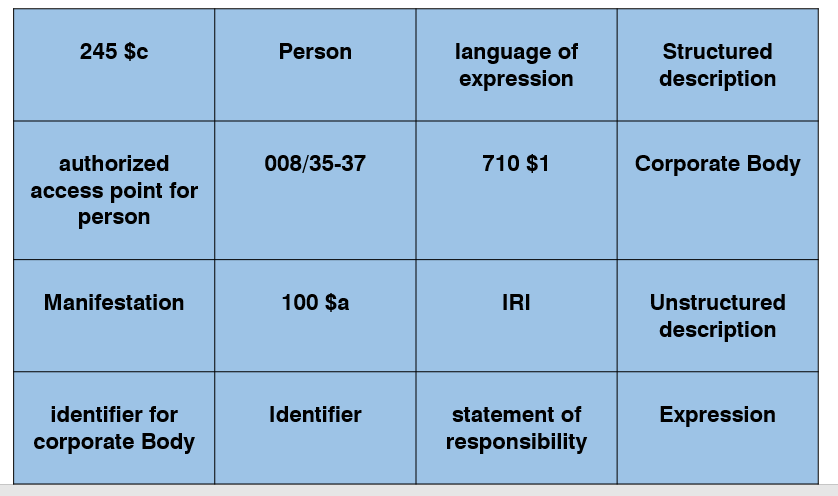
MARC element ; RDA attribute ; Domain ; Recording method
#CILIPMDG23 #RDAday
#CILIPMDG23 #RDAday

And it's an Application Profile! #CILIPMDG23 #RDAday
Demystifying Application Profiles - an example from @BLMetadata
#CILIPMDG23 #RDAday
#CILIPMDG23 #RDAday

@BLMetadata What metadata do we need for our use case?
- so which RDA elements do we need?
- what recording methods suit our scenario?
- which options will we apply?
What metadata is ESSENTIAL?
#CILIPMDG23 #RDAday
- so which RDA elements do we need?
- what recording methods suit our scenario?
- which options will we apply?
What metadata is ESSENTIAL?
#CILIPMDG23 #RDAday
@BLMetadata The UKCoR Guide to RDA: Resource Description and Access is available at:
#CILIPMDG23 #RDAdaycilip.org.uk/members/group_…
#CILIPMDG23 #RDAdaycilip.org.uk/members/group_…
@BLMetadata We are now hearing from @rdatoolkit chair Jamie Hennelly about Community Resources in the RDA Toolkit which are in the Resources tab. There is legacy content in English & active content in French. #CILIPMDG23 #RDAday

@BLMetadata @rdatoolkit There are 2 ways to add content to the Community Resources area - via Partners (orgs that have translation or policy statement agreements with RDA Toolkit) & via Contributors (any org can request to be a CR Contributor) #CILIPMDG23 #RDAday
@BLMetadata @rdatoolkit Partner organisations can contribute now & the Jan 2024 release will include infrastructure for full CR plan.
March 2024 will see Contributor organisations able to add documents, and policies regarding appropriate contributions will be determined. #CILIPMDG23 #RDAday
March 2024 will see Contributor organisations able to add documents, and policies regarding appropriate contributions will be determined. #CILIPMDG23 #RDAday
@BLMetadata @rdatoolkit Legacy content is locked and will not be updated.
A group willing to take on ownership of the legacy documents has yet to emerge.
The content may be used by a CR organisation as a starting point for new documents.
#CILIPMDG23 #RDAday
A group willing to take on ownership of the legacy documents has yet to emerge.
The content may be used by a CR organisation as a starting point for new documents.
#CILIPMDG23 #RDAday
@BLMetadata @rdatoolkit The RSC will determine what happens to the legacy documents as new CR content is added, it may continue to exist in CR in its current state or move to Instruction Archive in the Revision History section. #CILIPMDG #RDAday
@BLMetadata @rdatoolkit We finish with "Challenges to Implementation" with @jenniferswright
#CILIPMDG23 #RDAday
#CILIPMDG23 #RDAday

@BLMetadata @rdatoolkit @jenniferswright Time!
Money!
Terminology!
Technical expertise!
Systems Limitations!
#CILIPMDG23 #RDAday
Money!
Terminology!
Technical expertise!
Systems Limitations!
#CILIPMDG23 #RDAday
And that's a wrap on the #RDAday and #CILIPMDG23 - thanks so much to all speakers and delegates for attending and helping to create a great conference - it has been wonderful to connect with you all!
Thanks also to our Gold Sponsor @BdslifeM and our Silver Sponsors @OCLC & @Jisc
Thanks also to our Gold Sponsor @BdslifeM and our Silver Sponsors @OCLC & @Jisc
If you have enjoyed the MDG Conference and have ideas about else @CilipMDG could be doing with/for the metadata community please get in touch. You can DM us here or email us at chair.mdg@cilip.org.uk or secretary.mdg@cilip.org.uk
#CILIPMDG23
#CILIPMDG23
We are actively looking for new Committee Members to help us deliver more events, training and community support - do get in touch if you are interested in joining @CilipMDG Committee!
You can DM us or email us at chair.mdg@cilip.org.uk or secretary.mdg@cilip.org.uk #CILIPMDG23
You can DM us or email us at chair.mdg@cilip.org.uk or secretary.mdg@cilip.org.uk #CILIPMDG23
@threadreaderapp unroll please
• • •
Missing some Tweet in this thread? You can try to
force a refresh




