Jeff Gilchrist Profile picture
Sep 12, 2023 41 tweets 9 min read Read on X
Novavax & Moderna XBB.1.5 Fall Booster Performance

This thread provides some data from preprint studies about how well the updated #Novavax and #Moderna #booster #vaccine performs on recent #variants including some details on #immune #imprinting. 🧵1/ Graphic of COVID variants. Image from: https://www.fnha.ca/about/news-and-events/news/hot-topics-questions-about-covid-19-virus-variants-here-are-some-answers
An unrolled one-page web view for this long thread that may be easier to read or share can be found here ( ). 2/
If you want to learn more about how Novavax differs and some benefits it has compared to the mRNA vaccines including info about mixing mRNA and Novavax for even better results, see this thread ( ). 3/
While Pfizer has only put out a press releases about the lab performance of their fall boosters, Novavax has recently made their preprint study available for people to see the full details ( ). H/T: @Daniel_E_Park 4/biorxiv.org/content/10.110…
Looking at the methodology is important as it tells you what kind of previous variant exposure the test subjects had which helps you understand if it remotely resembles what your previous exposure experience may be. 5/
The Novavax fall booster is based on the XBB.1.5 "Kraken" variant and testing was done on mice and non-human primates in the lab so their results are estimates of how the updated vaccine could perform. 6/
** Pseudoviruses **
The other thing to point out is that the tests are using pseudovirus which is an approximation of the real thing so they can be conducted in lower biosafety level labs. 7/
Pseudoviruses don't continue to replicate making them safer to study and their surface is replaced with those of the SARS-CoV-2 virus to help get insight into how it might infect cells ( ). 8/the-scientist.com/news-opinion/w…
Unfortunately pseudoviruses can't be used to fully simulate how the virus propagates or study mechanisms which the virus uses to circumvent the body's immune system (which COVID-19 uses multiple tricks to do - ). 9/
Interesting side note that researchers are required to use pseudovirus because handling the real virus is dangerous to study even in a lab. 10/
Meanwhile the real virus is routinely found spreading throughout poorly ventilated indoor public spaces like schools and offices without any safety standards in place. 11/
You can learn more about additional layers of protection to help prevent you from being exposed to pathogens in the first place in this thread ( ). 12/
Many of the scenarios that Novavax used for the updated vaccine was the test subject first getting two bivalent (original + BA.5) doses (which were never commercially available to the public) and then one updated XBB.1.5 booster. 13/
People who got one mRNA bivalent BA.5 vaccine dose which was commercially available and also infected with a BA.5 variant may have an immune exposure in the same ballpark as this scenario. 14/
** Novavax Results **
Novavax included results with non-human primates were they tested a scenario with 2 original doses of vaccine and then a single XBB.1.5 booster which may be more likely for people who never got any kind of bivalent vaccine or Omicron COVID-19 infection. 15/
One dose of the updated Novavax booster elicits antibodies that can neutralize XBB.1.5 as expected but also XBB.1.16 "Arcturus", XBB.2.3 "Acrux" and the EG.5.1 "Eris" variant which is currently dominant in many places. 16/ Humoral Responses Following XBB.1.5 Booster in Rhesus Macaques. (A) Pseudovirus neutralization titers in rhesus macaques boosted with XBB.1.5 approximately 8 months after Prototype or bivalent (Prototype + BA.5) priming regimens. Sera were collected two weeks after the booster dose. Open circles represent individual data points, solid bars represent group geometric mean titers, error bars represent 95% confidence intervals, and the horizontal dashed line represents the assay limit of detection (LOD). Image from: https://www.biorxiv.org/content/10.1101/2023.08.30.554497v1.full
"Importantly, the XBB.1.5 booster was immunogenic irrespective of priming regimen, as the general population includes individuals primed with diverse vaccination and infection backgrounds." 17/
In Ontario, the variant families currently circulating the most are EG.5.1 "Eris", followed by XBB.1.9* "Hyperion", XABB.1.16* "Arcturus", still some XBB.1.5* "Kraken", XBB.2.3* "Acrux" and FL.1.5.1* "Fornax". Visualization by @Mike_Honey_ 18/ Graph of top 7 COVID variant family frequencies from PCR test genomic sequencing. Visualization tool was created by @Mike_Honey_ ( https://app.powerbi.com/view?r=eyJrIjoiNzE5YzczODItMDQzMS00M2EzLWFjNWYtMjg3OTY3NTNhZDM3IiwidCI6ImRjMWYwNGY1LWMxZTUtNDQyOS1hODEyLTU3OTNiZTQ1YmY5ZCIsImMiOjEwfQ%3D%3D )
** Moderna Results **
Moderna also released a preprint of their updated XBB.1.5 booster performance with pseudovirus lab test results involving humans test subjects ( ). 19/medrxiv.org/content/10.110…
Their participants all received 3 doses of the original Moderna mRNA vaccine and then 1 dose of the Moderna bivalent original/BA.5 booster dose. 20/
Participants then either received a monovalent XBB.1.5 booster or a bivalent XBB.1.5/BA.5 booster with a median time of 8 months from their 4th dose. They compared blood sera immune responses just before they got their updated booster with 15 days after the updated booster. 21/
Their first set of results looked at XBB.1.5, XBB.1.16 and older variants. The green bar graphs on the left are people who received a monovalent XBB.1.5 vaccine dose which is the one being made available to the public and the results to look at. 22/
While there was little neutralization activity of XBB.1.5 and XBB.1.16 before the updated booster, that increased significantly after the XBB.1.5 booster dose. 23/ Graphs of GM=geometric mean; GMFR=geometric mean fold rise at day 15 relative to pre-booster. GM-levels of neutralizing antibody titers were assessed at pre-booster and at day 15 post-vaccination for the monovalent (mRNA-1273.815) and bivalent (mRNA-1273.231) vaccines using a lentivirus-based pseudovirus assay as described previously3 and in the Supplementary Methods. Analyses were performed in all participants in the Per-protocol Set for Immunogenicity (those with and without prior SARS-CoV-2 infection), and in those with prior infection and without prior infection. Image from: https://www...
Moderna also released results with newer variants using a different pseudovirus and only a subset of their participants. Similarly, the vaccine showed significantly increased neutralization levels for XBB.2.3.2, EG.5.1, FL.1.5.1 and BA.2.86 after the booster dose. 24/ Analysis of neutralizing antibody titers against variants in randomly-selected all participants (n=20) and in those with (n=10) and without (n=10) SARS-CoV-2 infection from mRNA-1273.815 arm using a research grade VSV-based pseudovirus assay (supplementary methods). **p≤0.01 and ****p<0.0001 by the Wilcoxon t-test. Dotted line denotes the limit of detection (20) of the assay. Image from: https://www.medrxiv.org/content/10.1101/2023.08.22.23293434v2.full-text
Moderna found that vaccine adverse events were similar to those reported with their original and bivalent vaccines. 25/
** Immune Imprinting **
A number of people have been asking if the latest variants have changed so much, do we just need one booster dose of the updated vaccine or do we need two doses to be effective? 26/
@yunlong_cao discovered people needed more than one exposure of Omicron to generate *new* Omicron specific memory immune cells instead of just recalling the antibodies for the original COVID-19 virus elicited by the original vaccines ( ). 27/
For people who haven't been exposed to Omicron variants (either by infection or getting a bivalent BA.5 vaccine) may need two booster doses to produce new memory B cells targeting the updated variant ( ). 28/
Novavax found that having 2 doses of bivalent vaccine instead of just the original resulted in even higher levels of neutralization for all of the latest variants since having two BA.5 exposures helped. 29/
Novavax never released a BA.5 bivalent vaccine so people would have had to be infected with one or two Omicron variants to get a similar kind of exposure. While it seems the updated Novavax and Moderna XBB.1.5 vaccines elicit antibodies... 30/
...that can neutralize these latest variants, it still remains to be seen what percentage of those XBB.1.5 specific antibodies become memory immune cells to be recalled for the next exposure. 31/ Click "Show replies" 👇 to continue.
As @michaelzlin explains, for people who were never infected with an XBB or EG.5 variant, the XBB.1.5 booster will act like a priming event so may not be enough to protect against infection depending on the exposure level. 32/
If you then had an actual EG.5 or BA.2.86 infection after the XBB.1.5 booster, your immune system should produce antibodies rapidly enough to prevent more severe disease ( ). 33/
The Novavax study provides a good example of how memory B cells will recall antibodies for specific variants it has been exposed to before. The original vaccine (Prototype) on its own (left side) produces antibodies with high levels of neutralization... 34/
for the original variant (first column) , but low levels for XBB.1.5 (third column). Similarly on the right side, the XBB.1.5 vaccine on its own produces antibodies with low levels of neutralization for the original variant but high for XBB.1.5. 35/ Pseudovirus neutralization in mice sera collected one week following primary series vaccination with two doses of monovalent Prototype, XBB.1.5, or XBB.1.16. Open circles represent individual data points, solid bars represent group geometric mean titers, error bars represent 95% confidence intervals, and the horizontal dashed line represents the assay limit of detection (LOD). Image from: https://www.biorxiv.org/content/10.1101/2023.08.30.554497v1.full
But when you had two doses of the original vaccine and then get an XBB.1.5 booster dose the antibodies that get produced have the highest neutralization for the original (Prototype) variant because earlier memory B cells for the original variant still exist... 36/ Humoral Responses Following XBB.1.5 Booster in Rhesus Macaques. (A) Pseudovirus neutralization titers in rhesus macaques boosted with XBB.1.5 approximately 8 months after Prototype or bivalent (Prototype + BA.5) priming regimens. Sera were collected two weeks after the booster dose. Open circles represent individual data points, solid bars represent group geometric mean titers, error bars represent 95% confidence intervals, and the horizontal dashed line represents the assay limit of detection (LOD). Image from: https://www.biorxiv.org/content/10.1101/2023.08.30.554497v1.full
and were restimulated by the XBB.1.5 vaccine, explaining the high neutralization levels. The antibodies are now a mixture of old and new instead of mostly being targeted to newer variants. 37/
In order for your immune system to start focusing on the newer variants and storing more memory cells specifically targeting them, @yunlong_cao's study found you need multiple exposures. 38/
You can see the same thing in the Moderna results where the neutralization levels of the original variant (Ancestral D614G) is already high before the booster (similar to the post-booster levels of XBB.1.5) and... 39/ Graphs of GM=geometric mean; GMFR=geometric mean fold rise at day 15 relative to pre-booster. GM-levels of neutralizing antibody titers were assessed at pre-booster and at day 15 post-vaccination for the monovalent (mRNA-1273.815) and bivalent (mRNA-1273.231) vaccines using a lentivirus-based pseudovirus assay as described previously3 and in the Supplementary Methods. Analyses were performed in all participants in the Per-protocol Set for Immunogenicity (those with and without prior SARS-CoV-2 infection), and in those with prior infection and without prior infection. Image from: https://www...
...then multiple times higher than the XBB.1.5 levels after the booster showing massive production of antibodies targeting the original variant still. 40/
@threadreaderapp please unroll

• • •

Missing some Tweet in this thread? You can try to force a refresh

 

Keep Current with Jeff Gilchrist

Jeff Gilchrist Profile picture

Stay in touch and get notified when new unrolls are available from this author!

Read all threads

This Thread may be Removed Anytime!

PDF

Twitter may remove this content at anytime! Save it as PDF for later use!

Try unrolling a thread yourself!

how to unroll video
  1. Follow @ThreadReaderApp to mention us!

  2. From a Twitter thread mention us with a keyword "unroll"
@threadreaderapp unroll

Practice here first or read more on our help page!

More from @jeffgilchrist

Jul 1
*** Ontario Variant Update | July 01 ***

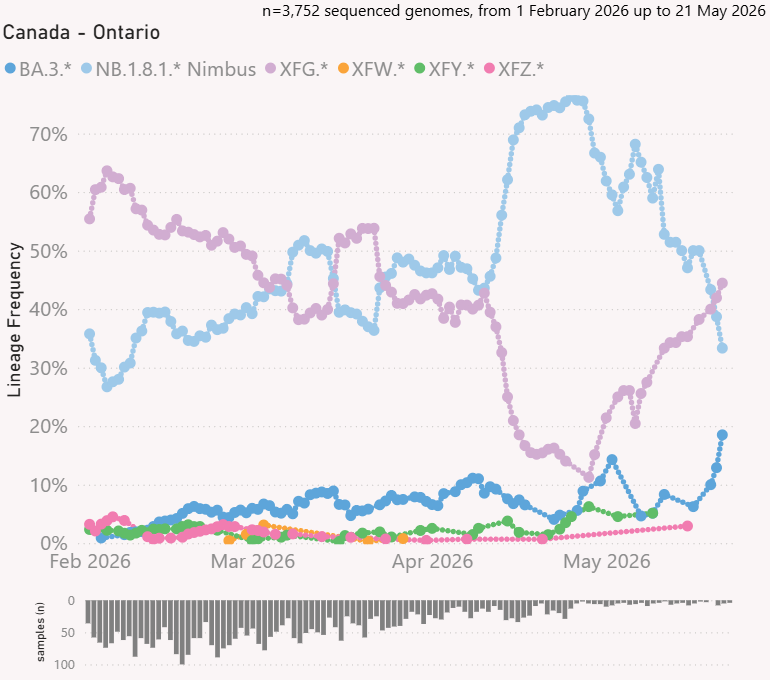
In Ontario, the XFG.* "Stratus" family regained the lead at 42% while the NB.1.8.1.* "Nimbus" variant family decreased to 33% of sequenced genomes from COVID tests. 🧵1/

#Ontario #COVID #Variant #Stratus #BA.3.2 #Cicada #Nimbus This multi-line chart tracks the lineage frequency of various COVID-19 variant families in Ontario over time, based on sequenced genome samples. The graph illustrates the changing prevalence of specific variant families, showing how different lineages compete and evolve as the dominant strains within the province.
The BA.3.2 "Cicada" family increased to 19% but the low # of sequences means results are not very representative. 2/
Ontario released another month of sequencing data by age and we continue to see high ratios of Cicada in children with another 5 BA.3.2.* sequences out of 18 new child sequences ( ). 3/publichealthontario.ca/-/media/docume…
Read 24 tweets
Jun 30
*** Ontario Virus Update | June 30 ***

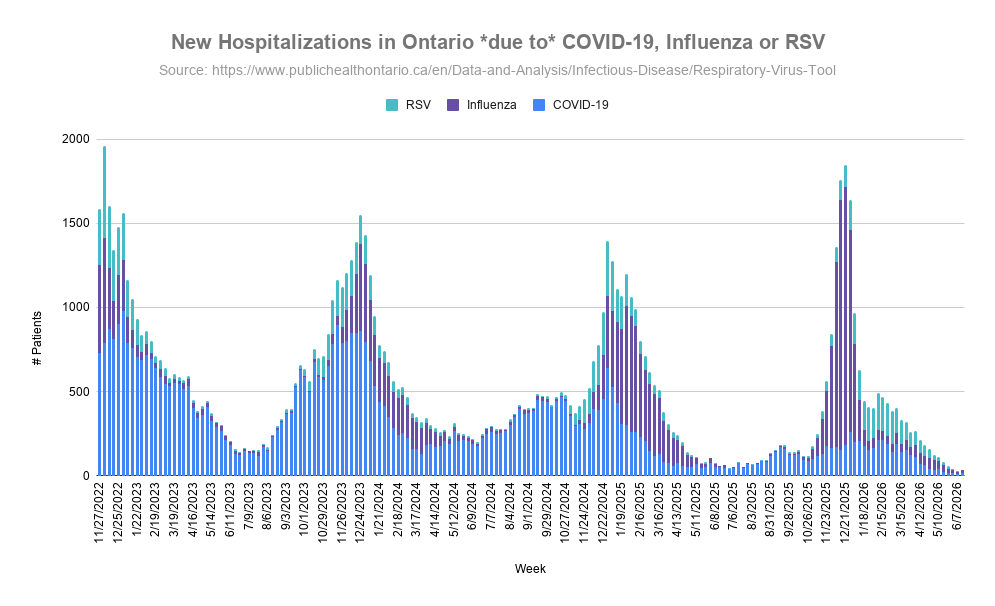
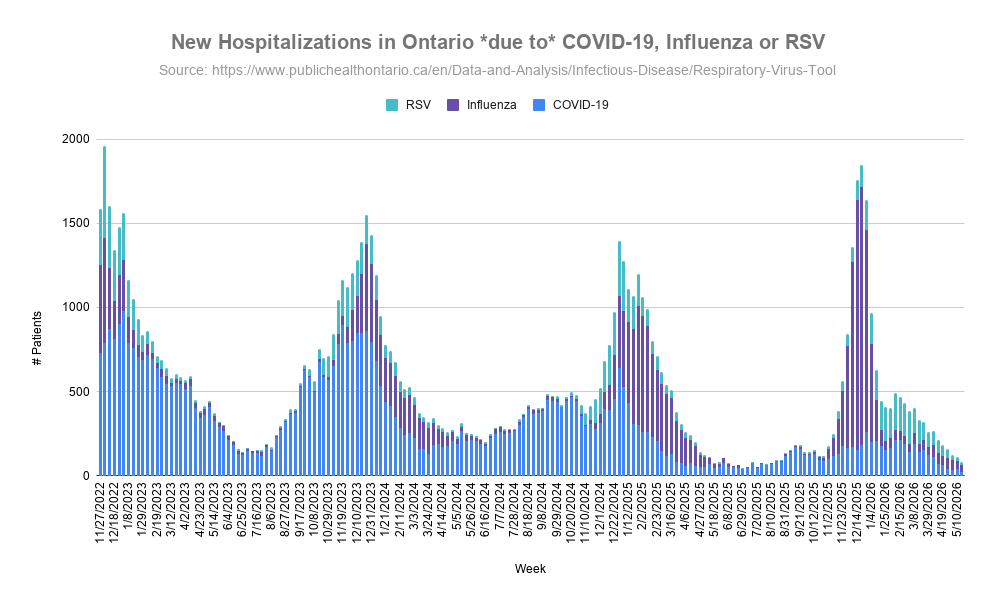
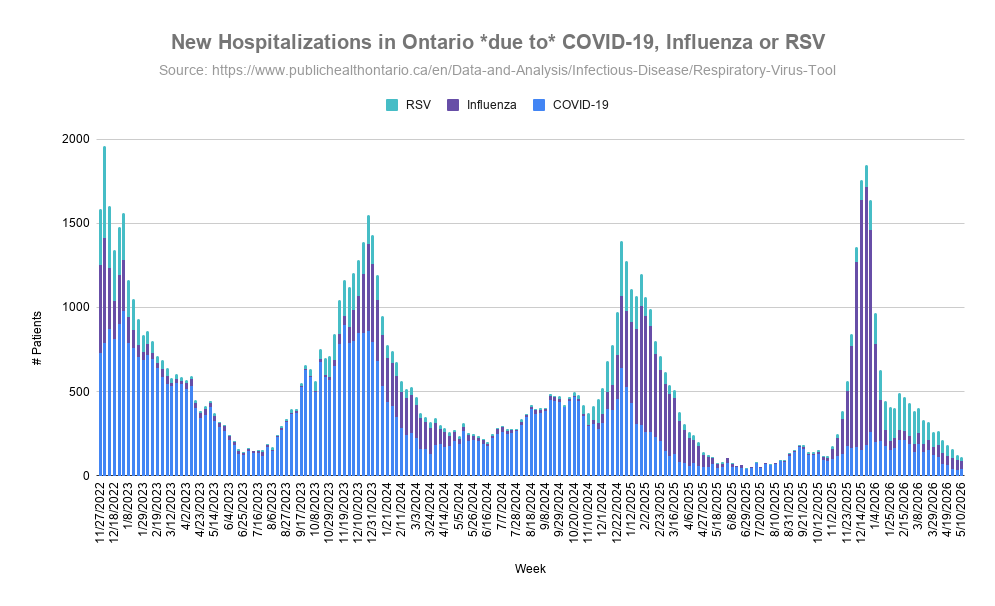
Hospitalizations due to COVID have increased from 9 to 18 in the last update. Influenza hospitalizations remained stable at 13 and RSV increased from 3 to 5 so not quite finished for the season yet for those two.🧵1/

#Ontario #Virus #COVID This stacked bar chart displays weekly new hospitalizations in Ontario specifically attributed to COVID-19, Influenza, and RSV. The data tracks the fluctuating volume of patients over time, highlighting seasonal surges and the relative contribution of each respiratory virus to the overall healthcare burden.
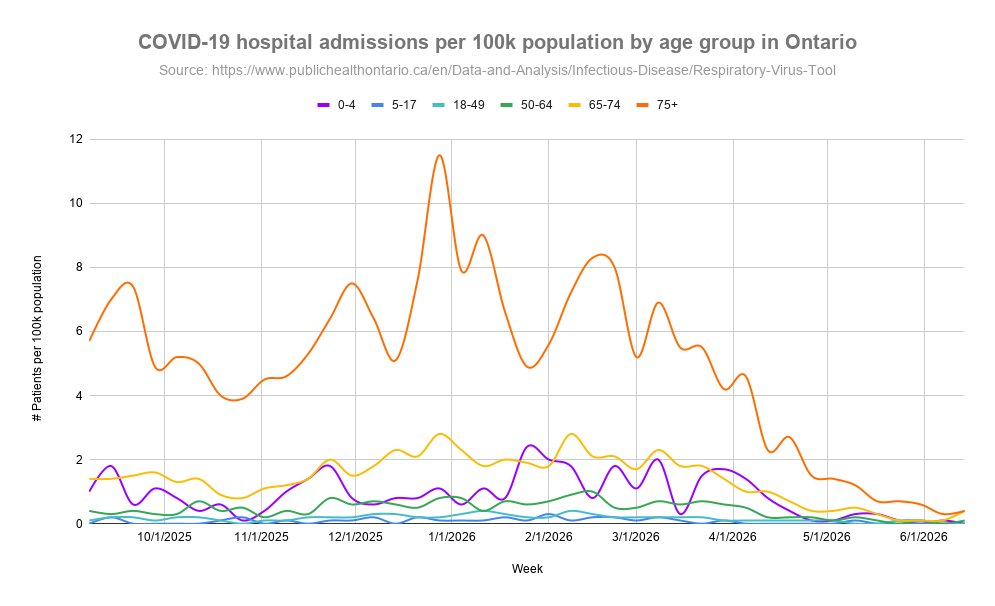
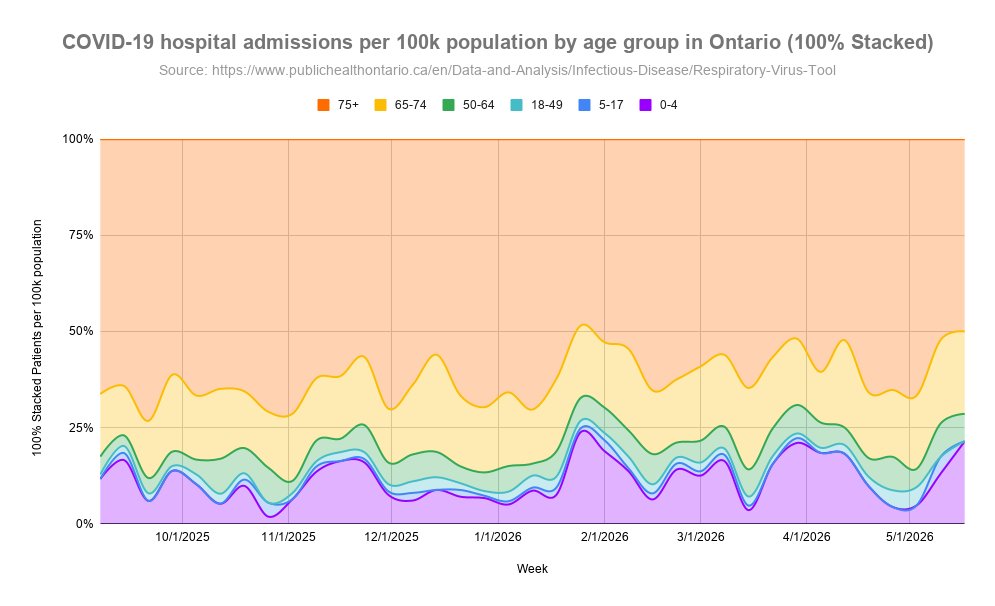
Looking at age groups, those age 75+ and 65-74 tied for having the highest rates of hospitalization due to COVID and both increased since last update. The only other age group with hospitalizations was 50-64, no children this past update. 2/ This multi-line graph tracks the weekly rate of hospital admissions per 100,000 population in Ontario across various age demographics. The visualization highlights shifting clinical trends over time, showing the weekly fluctuations and comparative hospital burden between different age categories ranging from infants to seniors aged 75 and older.
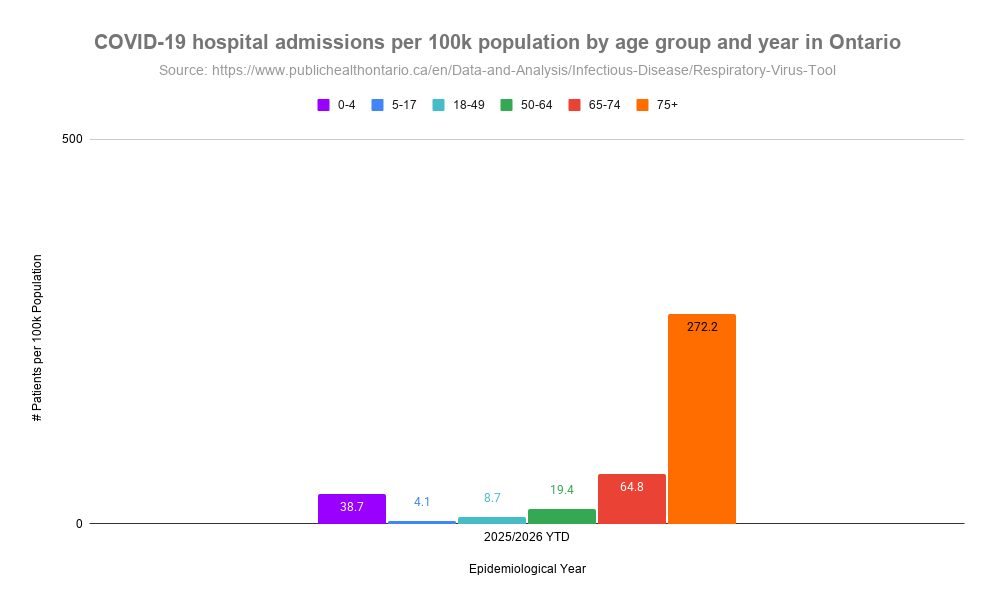
For this epidemiological year 2025/2026 so far, adults 75+ had the highest rate of COVID hospital admissions, followed by age 65-74 and then age 0-4 in third place. Young children 0-4 had hospitalization rates twice as high as fourth place group age 50-64. 3/ This side-by-side bar chart displays the rate of hospital admissions per 100,000 population in Ontario for the 2025/2026 year-to-date epidemiological year. The graph breaks down the data across six age groups, illustrating a clear progressive trend where hospital admission rates increase significantly with age, peaking sharply in the 75+ demographic except for children age 0-4 which have the third highest rate.
Read 12 tweets
Jun 1
*** Ontario Virus Update | June 1 ***

Hospitalizations due to COVID have decreased from 38 to 21 in the last update. Influenza hospitalizations decreased from 51 to 44 and RSV decreased from 20 to 18 so moving in the right direction but still not finished for the season yet. 1/ This stacked bar chart displays weekly new hospitalizations in Ontario specifically attributed to COVID-19, Influenza, and RSV. The data tracks the fluctuating volume of patients over time, highlighting seasonal surges and the relative contribution of each respiratory virus to the overall healthcare burden.
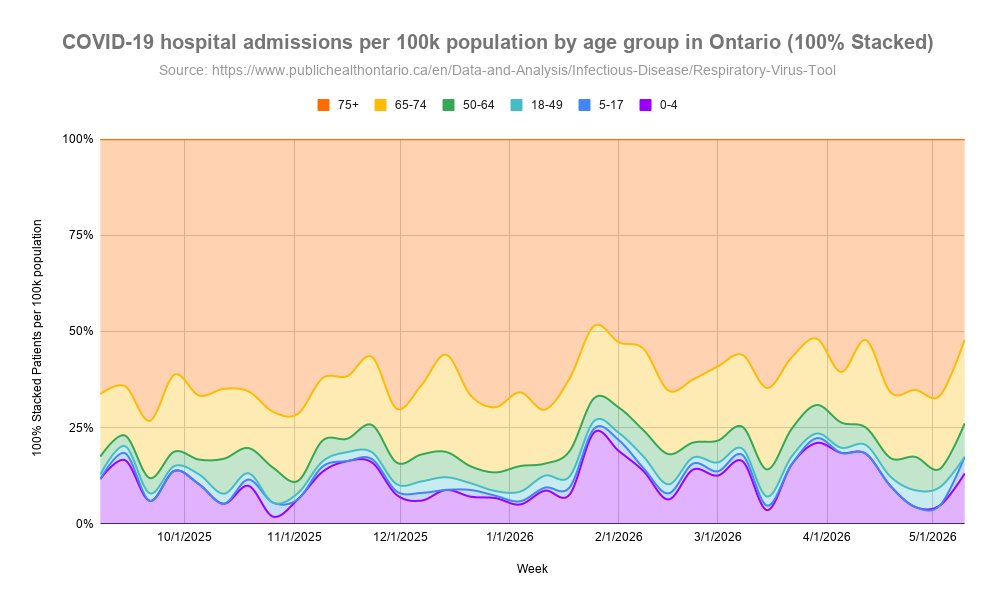
Looking at age groups, those age 75+ had the highest rates of hospitalization due to COVID but decreased since last update. Tied for second place are the 0-4 and 65-74 age groups. 2/ This 100% stacked area chart illustrates the weekly proportion of COVID-19 hospital admissions per 100,000 population in Ontario across different age groups. The graph visualizes how the relative distribution of hospitalizations shifts over time among demographics ranging from infants to seniors aged 75 and older.
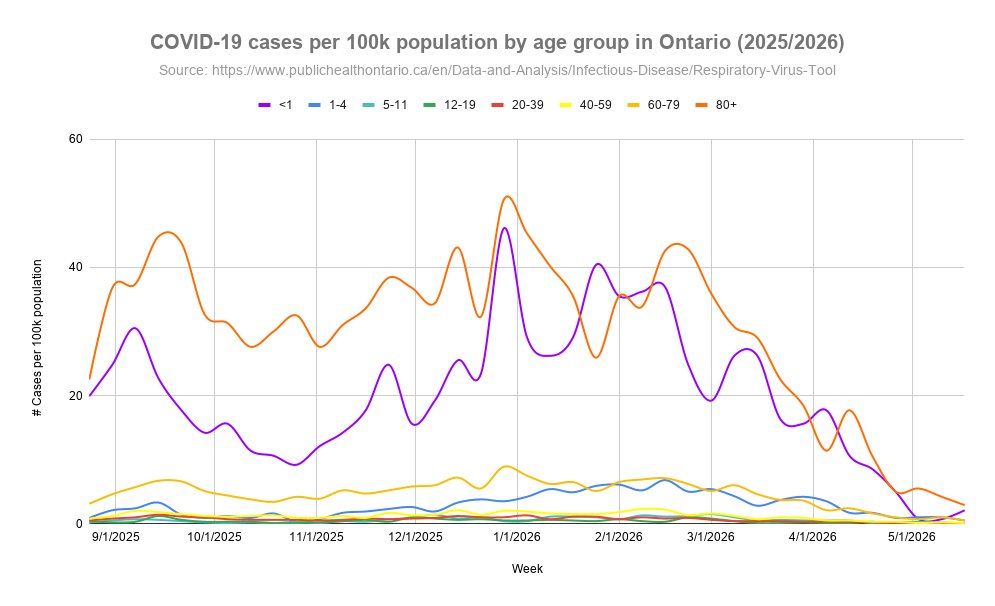
COVID case rates decreased across most age groups this past update except for age <1 which had a significant increase and almost matching the same levels as age 80+. The 1-4 and 60-79 age groups currently have the same rates. 3/ This multi-line graph tracks the weekly rate of COVID-19 cases per 100,000 population in Ontario, categorized by various age groups from infants to seniors aged 80 and older. The data trends highlight the fluctuations in infection rates across different demographics over the year.
Read 10 tweets
May 30
Filtering the air may help prevent your own infection from becoming more severe

If everyone in a household becomes infected with the same virus, does it help to isolate from each other and can you be a danger to yourself? Read on to find out...🧵1/

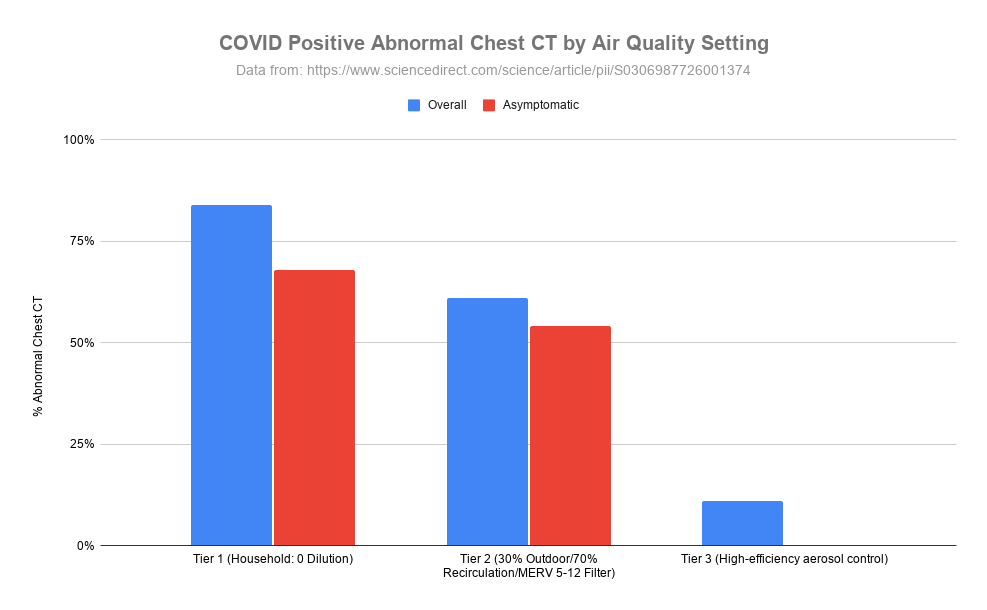
#AirQuality #IAQ #Ventilation This grouped bar chart, titled "COVID Positive Abnormal Chest CT by Air Quality Setting", displays the percentage of abnormal chest CT scans among COVID-positive patients across three different tiers of air quality control. The graph compares overall and asymptomatic cases, illustrating a clear downward trend in the percentage of abnormal scans as air filtration and ventilation efficiency improve from household levels to high-efficiency aerosol control.
An interesting hypothesis-generating study was published recently that asked if an infected person's condition can become even worse by re-inhaling their own virus particles ( ). 2/sciencedirect.com/science/articl…
Is a transition from a milder upper respiratory tract infection (runny nose, sore throat) to a more severe lower respiratory tract infection like pneumonia is significantly driven by the physical mechanism of inhaling virus containing aerosols deep into the lungs? 3/
Read 26 tweets
May 24
*** Ontario Virus Update | May 24 ***

Hospitalizations due to COVID have increased from 34 to 38 in the last update. Influenza hospitalizations decreased from 57 to 51 and RSV decreased from 33 to 20. 🧵1/

#Ontario #Virus #COVID #RSV #Influenza #Hospital This stacked bar chart displays weekly new hospitalizations in Ontario specifically attributed to COVID-19, Influenza, and RSV. The data tracks the fluctuating volume of patients over time, highlighting seasonal surges and the relative contribution of each respiratory virus to the overall healthcare burden.
Looking at age groups, those age 75+ had the highest rates of hospitalization due to COVID but decreased since last update. Second place is age 65-74 which increased, and third place is age 0-4 which also increased. 2/ This 100% stacked area chart illustrates the weekly proportion of COVID-19 hospital admissions per 100,000 population in Ontario across different age groups. The graph visualizes how the relative distribution of hospitalizations shifts over time among demographics ranging from infants to seniors aged 75 and older.
COVID case rates were fairly stable across age groups this past update except for age 80+ which had a significant decrease but still maintain the highest rates. The 0-4 and 60-79 age groups currently have similar rates. 3/ This multi-line graph tracks the weekly rate of COVID-19 cases per 100,000 population in Ontario, categorized by various age groups from infants to seniors aged 80 and older. The data trends highlight the fluctuations in infection rates across different demographics over the year.
Read 10 tweets
May 10
*** Ontario Variant Update | May 10 ***

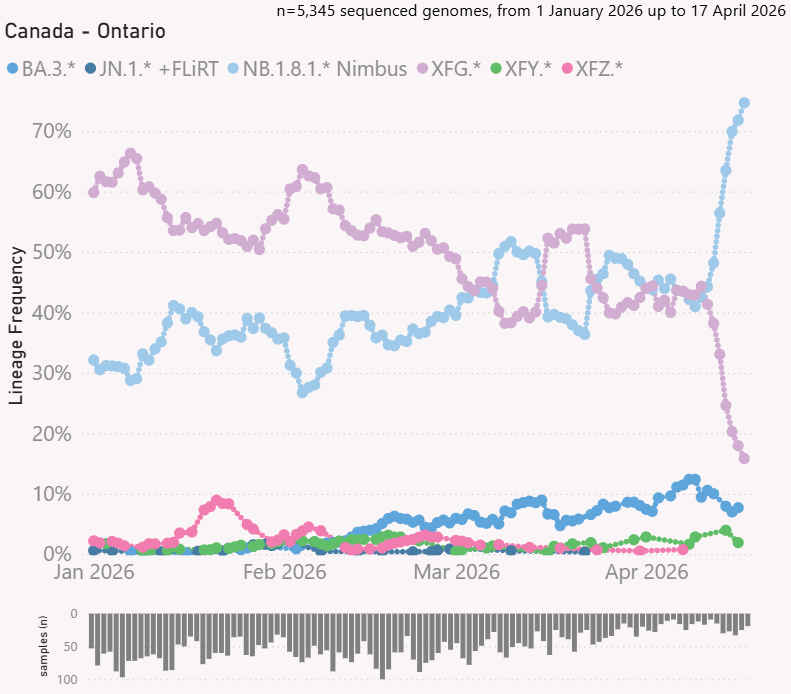
In Ontario, the NB.1.8.1.* "Nimbus" variant family shot to 74.7% of sequenced genomes from COVID tests while the XFG.* "Stratus" family dropped to 15.8% and the BA.3.2 "Cicada" family decreased below 10% again.🧵1/
#Ontario #COVID #Variant This multi-line chart tracks the lineage frequency of various COVID-19 variant families in Ontario over time, based on sequenced genome samples. The graph illustrates the changing prevalence of specific variant families, showing how different lineages compete and evolve as the dominant strains within the province.
Ontario released another month of sequencing data by age and we continue to see high ratios of Cicada in children with another 51 BA.3.2.2.* sequences out of 617 new sequences ( ). 2/publichealthontario.ca/-/media/docume…
With 126 Cicada sequences from 1,828 total, we see children still have the highest proportion which decreases after age 5-11 as age increases with significant drops from age 60+. 3/ This bar chart illustrates the percentage of the BA.3.2.* Cicada COVID-19 variant lineage among different age groups in Ontario over a designated time period. The graph visualizes the relative prevalence of the lineage across demographics, highlighting how the variant is distributed from young children to seniors aged 80 and older.
Read 11 tweets

Did Thread Reader help you today?

Support us! We are indie developers!


This site is made by just two indie developers on a laptop doing marketing, support and development! Read more about the story.

Become a Premium Member ($3/month or $30/year) and get exclusive features!

Become Premium

Don't want to be a Premium member but still want to support us?

Make a small donation by buying us coffee ($5) or help with server cost ($10)

Donate via Paypal

Or Donate anonymously using crypto!

Ethereum

0xfe58350B80634f60Fa6Dc149a72b4DFbc17D341E copy

Bitcoin

3ATGMxNzCUFzxpMCHL5sWSt4DVtS8UqXpi copy

Thank you for your support!

Follow Us!

:(