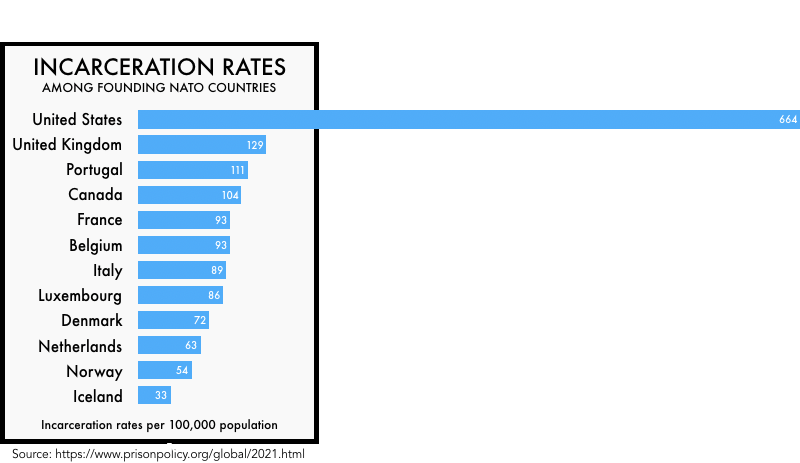
Have you ever wondered why America has such a high incarceration rate? If you weren't even aware of that fact, consider this graph from Prison Policy:
To understand why America is like this, consider that, when Stalin died, Beria released more than a million non-political prisoners and the result was a massive crime wave.
This is not the only instance of this happening in history. Plenty of places have done large-scale prisoner releases, and they nearly universally have the same effects wherever they happen: crime goes up.
One of my favorite examples comes from Italy.
On July 31st, 2006, the Italian Parliament passed the Collective Clemency Bill. This bill reduced the sentences of eligible inmates convicted prior to May 2nd, 2006 by three years, effective August 1st, 2006. As a result, thousands of inmates were released immediately. In fact, 83% of all releases through December, 2007, happened in August, 2006.
The pardon was motivated by the activism of the Catholic Church, including personal involvement from Pope John Paul II. The Catholics argued that prisons were overfilled, holding people in crowded conditions was inhumane, and a release was needed. They also had historical precedent on their side: after the second World War, there were regular collective pardons in Italy, but they stopped in 1992 after a parliamentary change, making the 2006 pardon the first of its kind in fourteen odd years.
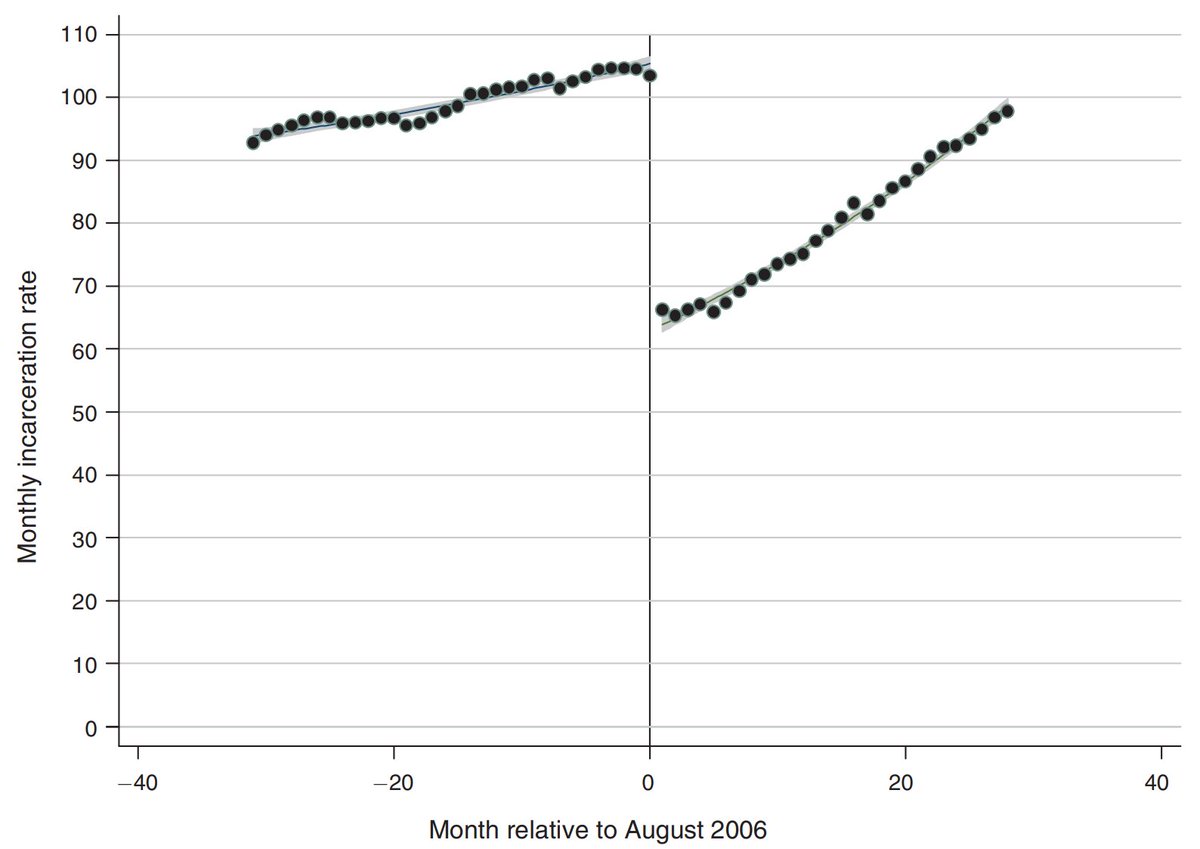
Researchers Buonanno & Raphael documented what happened when the pardon went into effect. First, take a look at the incarceration rates over time:
Prior to the pardon, incarceration rates were trending up fairly slowly.
Afterwards, they trended up at a much more rapid rate!
In fact, the incarceration rate converged back to roughly where the whole thing started after less than three years. By December 2008, it had reached a rate of 98 again, compared to 103 in August of 2006.
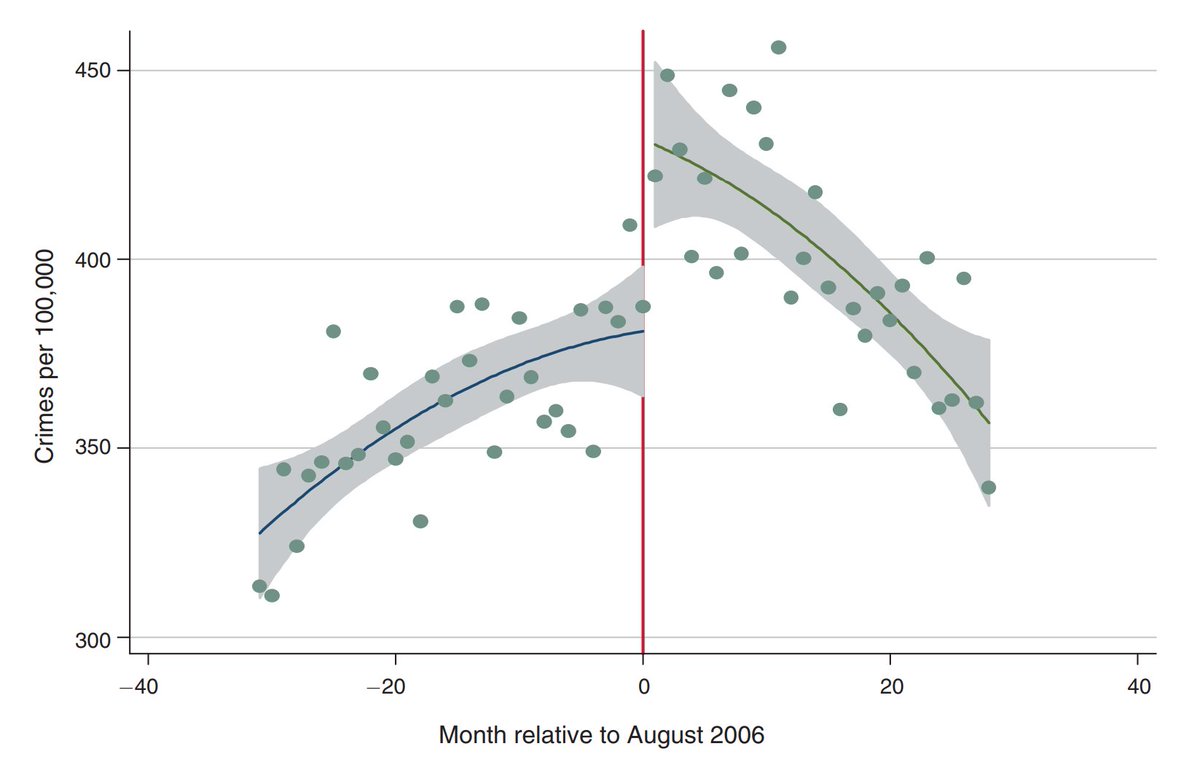
The reason why the incarceration rate rapidly returned to the level it was initially at isn't terribly shocking: it's because crime increased!
In response to a major increase in crime, police had to start arresting more people. Recidivists and those otherwise driven to crime by the release of so many criminals needed to be arrested or the crime spree would have carried on.
In other words, incarceration incapacitates criminals, and when you shock the incarceration rate by releasing tons of criminals from a state of being incapacitated, crime goes up until they're put back in jail.
Well, unless you're fine living with a higher crime rate. If you are, then the incarceration rate can remain at a lower level.
There's a tradeoff here: if country A has a population that tends to commit few crimes regardless of policy, they can have low incarceration rates. But if country B has a population that tends to commit many crimes regardless of policy, they'll have to settle for having higher incapacitation rates if they want to realize crime levels like country A.
The populations differ in terms of antecedents of crime, so the treatment of those populations has to differ if they're going to achieve the same results.
This clears up why America has such a high incarceration rate: it's because Americans are relatively violent people!
This also tells us why El Salvador's efforts have been such a success. But before being explicit about that, here's another result from Buonanno & Raphael.
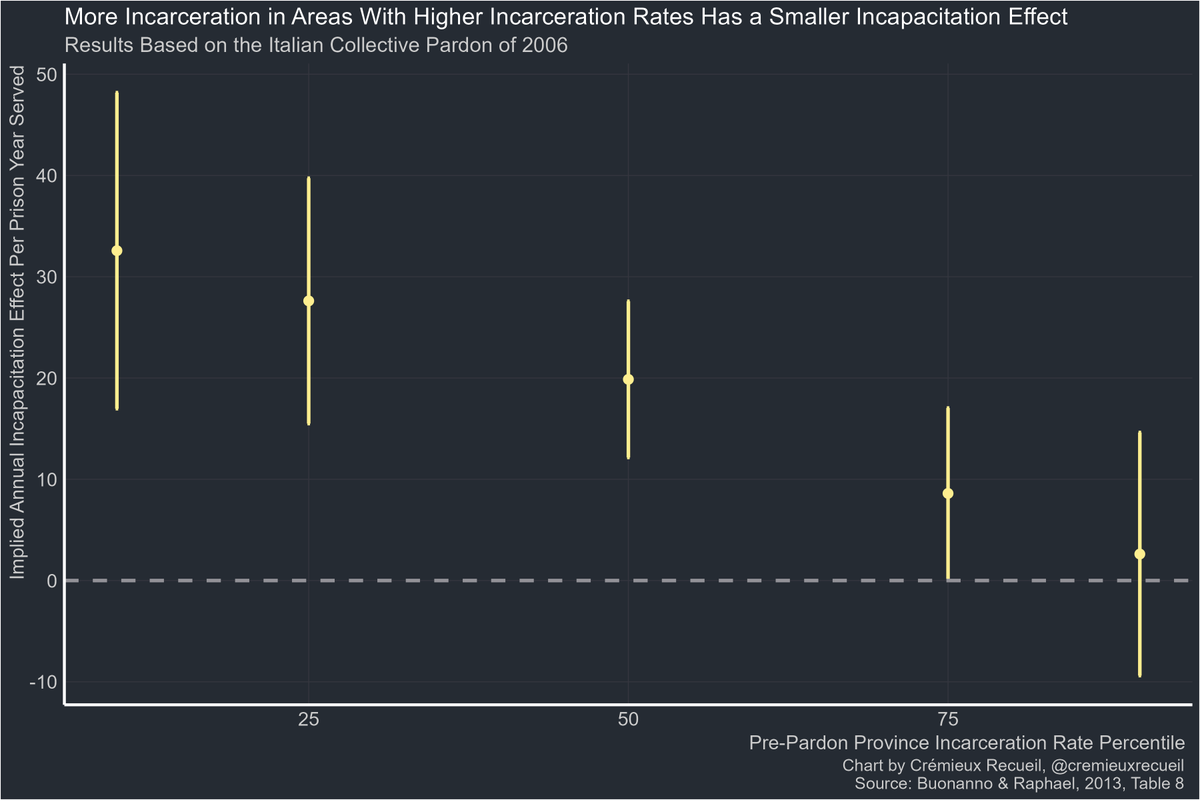
Leveraging cross-province differences in the numbers of people pardoned, they found that incapacitation effects on crime were larger when the province had a lower pre-pardon incarceration rate! Or in other words, there were diminishing returns to increased incarceration!
The reason for this is that the population is constantly in flux. There's growth, there's immigration and emigration, there's death—people come and go. There'll always be someone who is going to commit another crime. If we're lucky, there'll also always be someone there to catch them.
Some people commit more crimes than others. If you lock up all of the worst offenders, you can seriously reduce crime. For example,
- In Sweden, 1958-1980, a rigorously enforced three-strike law could have halved violent crime (x.com/cremieuxrecuei…). In this example, it was found that 1% of the Swedish population did 63% of their violent crimes.
- In America, the vast majority of people admitted to state prisons, 2009-2014, were repeat offenders (x.com/cremieuxrecuei…)
- In Chicago and Portland, homicide victims and offenders tend to have long rap sheets (x.com/cremieuxrecuei…, x.com/cremieuxrecuei…, x.com/cremieuxrecuei…, x.com/cremieuxrecuei…)
These are fairly universal findings! Crime is very concentrated: within regions, within cities, along streets, among a few people, within a few ages. The further down you go, the greater the concentration of crime perpetration in general.
The reason higher pre-pardon incarceration rates meant smaller incapacitation effects was because the worst offenders tended to be locked up already in those areas. Accordingly, if you lock up the marginal offender in a high incarceration area, you prevent fewer crimes from happening compared to if you lock up Vincenzo Megamurderer who has a rap sheet longer than a foot race.
And this replicates!
- Vollaard found that a 2001 law passed in the Netherlands that handed down ten times longer sentences to prolific offenders reduced rates of theft by 25%. This was subject to diminishing returns: as municipalities dipped deeper into the pool of repeat offenders in applying repeat offender sentence enhancements, the incapacitation effect got smaller.
- Johnson & Raphael found that between 1978 and 1990 in the U.S., each additional prison year served prevented 14 serious crimes. At the time, the average incarceration rate was 186 per 100,000. In the period 1991 through 2004, each additional prison year served prevented was just 3, and 2.6 of those being property crimes. In this period, the average incarceration rate was 396 per 100,000. America had hit the point of diminishing returns.
In elasticity terms, the Italian collective pardon revealed a crime-prison elasticity of -0.4, and with dynamic adjustment, they were as high as -0.66.
- Johnson & Raphael found crime-prison elasticities of -0.43 for property crime and -0.79 for violent crime for the 1978-1990 period.
- Levitt used prison overcrowding litigation as an instrument to estimate the crime-prison elasticity with data from the late-1970s through to the early-1990s, and he found elasticities of -0.38 to -0.42 for violent and -0.26 to -0.32 for property crime.
- A year after Buonanno & Raphael's study, Barbarino & Mastrobuoni published their own analysis of Italian collective pardons for the eight pardons laid out in the period 1962-1990. They found an elasticity of total crime ranging between -0.17 and -0.30.
- Buonanno et al. found that, in a comparison of the U.S. and Europe, the crime-prison elasticity was -0.40. They were able to do this estimation because, modern Europe at the time had developed higher property and violent crime rates than the U.S. (excluding homicide), so they exploited series data on the reversal of misfortunes that implied.
So back to El Salvador: they are on a path towards the lowest homicide rates in the western hemisphere. Some people claim this was true since 2015, but it's hard to make this case, when their reversion from that year's peak was consistent with regression to the mean, and regression to the mean does not tend to make things better than ever before. It was very likely the massive lockup of people who were confirmed criminals that has brought El Salvador this level of unprecedented peace.
So to put a pin in this: incarceration rates are endogenous! Different places have different incarceration rates because they have different underlying rates of crime and tolerance of it. They are in different equilibriums, which is why comparisons of incarceration and crime rates are often facially meaningless. To really understand their linkage requires causally informative research like this wonderful work on Italy's collective pardons.
Sources:
onlinelibrary.wiley.com/doi/abs/10.111…
journals.uchicago.edu/doi/abs/10.108…
jstor.org/stable/2946681
aeaweb.org/articles?id=10…
academic.oup.com/economicpolicy…
richardhanania.com/p/the-midwit-m…
jstor.org/stable/42920656
To understand why America is like this, consider that, when Stalin died, Beria released more than a million non-political prisoners and the result was a massive crime wave.
This is not the only instance of this happening in history. Plenty of places have done large-scale prisoner releases, and they nearly universally have the same effects wherever they happen: crime goes up.
One of my favorite examples comes from Italy.
On July 31st, 2006, the Italian Parliament passed the Collective Clemency Bill. This bill reduced the sentences of eligible inmates convicted prior to May 2nd, 2006 by three years, effective August 1st, 2006. As a result, thousands of inmates were released immediately. In fact, 83% of all releases through December, 2007, happened in August, 2006.
The pardon was motivated by the activism of the Catholic Church, including personal involvement from Pope John Paul II. The Catholics argued that prisons were overfilled, holding people in crowded conditions was inhumane, and a release was needed. They also had historical precedent on their side: after the second World War, there were regular collective pardons in Italy, but they stopped in 1992 after a parliamentary change, making the 2006 pardon the first of its kind in fourteen odd years.
Researchers Buonanno & Raphael documented what happened when the pardon went into effect. First, take a look at the incarceration rates over time:
Prior to the pardon, incarceration rates were trending up fairly slowly.
Afterwards, they trended up at a much more rapid rate!
In fact, the incarceration rate converged back to roughly where the whole thing started after less than three years. By December 2008, it had reached a rate of 98 again, compared to 103 in August of 2006.
The reason why the incarceration rate rapidly returned to the level it was initially at isn't terribly shocking: it's because crime increased!
In response to a major increase in crime, police had to start arresting more people. Recidivists and those otherwise driven to crime by the release of so many criminals needed to be arrested or the crime spree would have carried on.
In other words, incarceration incapacitates criminals, and when you shock the incarceration rate by releasing tons of criminals from a state of being incapacitated, crime goes up until they're put back in jail.
Well, unless you're fine living with a higher crime rate. If you are, then the incarceration rate can remain at a lower level.
There's a tradeoff here: if country A has a population that tends to commit few crimes regardless of policy, they can have low incarceration rates. But if country B has a population that tends to commit many crimes regardless of policy, they'll have to settle for having higher incapacitation rates if they want to realize crime levels like country A.
The populations differ in terms of antecedents of crime, so the treatment of those populations has to differ if they're going to achieve the same results.
This clears up why America has such a high incarceration rate: it's because Americans are relatively violent people!
This also tells us why El Salvador's efforts have been such a success. But before being explicit about that, here's another result from Buonanno & Raphael.
Leveraging cross-province differences in the numbers of people pardoned, they found that incapacitation effects on crime were larger when the province had a lower pre-pardon incarceration rate! Or in other words, there were diminishing returns to increased incarceration!
The reason for this is that the population is constantly in flux. There's growth, there's immigration and emigration, there's death—people come and go. There'll always be someone who is going to commit another crime. If we're lucky, there'll also always be someone there to catch them.
Some people commit more crimes than others. If you lock up all of the worst offenders, you can seriously reduce crime. For example,
- In Sweden, 1958-1980, a rigorously enforced three-strike law could have halved violent crime (x.com/cremieuxrecuei…). In this example, it was found that 1% of the Swedish population did 63% of their violent crimes.
- In America, the vast majority of people admitted to state prisons, 2009-2014, were repeat offenders (x.com/cremieuxrecuei…)
- In Chicago and Portland, homicide victims and offenders tend to have long rap sheets (x.com/cremieuxrecuei…, x.com/cremieuxrecuei…, x.com/cremieuxrecuei…, x.com/cremieuxrecuei…)
These are fairly universal findings! Crime is very concentrated: within regions, within cities, along streets, among a few people, within a few ages. The further down you go, the greater the concentration of crime perpetration in general.
The reason higher pre-pardon incarceration rates meant smaller incapacitation effects was because the worst offenders tended to be locked up already in those areas. Accordingly, if you lock up the marginal offender in a high incarceration area, you prevent fewer crimes from happening compared to if you lock up Vincenzo Megamurderer who has a rap sheet longer than a foot race.
And this replicates!
- Vollaard found that a 2001 law passed in the Netherlands that handed down ten times longer sentences to prolific offenders reduced rates of theft by 25%. This was subject to diminishing returns: as municipalities dipped deeper into the pool of repeat offenders in applying repeat offender sentence enhancements, the incapacitation effect got smaller.
- Johnson & Raphael found that between 1978 and 1990 in the U.S., each additional prison year served prevented 14 serious crimes. At the time, the average incarceration rate was 186 per 100,000. In the period 1991 through 2004, each additional prison year served prevented was just 3, and 2.6 of those being property crimes. In this period, the average incarceration rate was 396 per 100,000. America had hit the point of diminishing returns.
In elasticity terms, the Italian collective pardon revealed a crime-prison elasticity of -0.4, and with dynamic adjustment, they were as high as -0.66.
- Johnson & Raphael found crime-prison elasticities of -0.43 for property crime and -0.79 for violent crime for the 1978-1990 period.
- Levitt used prison overcrowding litigation as an instrument to estimate the crime-prison elasticity with data from the late-1970s through to the early-1990s, and he found elasticities of -0.38 to -0.42 for violent and -0.26 to -0.32 for property crime.
- A year after Buonanno & Raphael's study, Barbarino & Mastrobuoni published their own analysis of Italian collective pardons for the eight pardons laid out in the period 1962-1990. They found an elasticity of total crime ranging between -0.17 and -0.30.
- Buonanno et al. found that, in a comparison of the U.S. and Europe, the crime-prison elasticity was -0.40. They were able to do this estimation because, modern Europe at the time had developed higher property and violent crime rates than the U.S. (excluding homicide), so they exploited series data on the reversal of misfortunes that implied.
So back to El Salvador: they are on a path towards the lowest homicide rates in the western hemisphere. Some people claim this was true since 2015, but it's hard to make this case, when their reversion from that year's peak was consistent with regression to the mean, and regression to the mean does not tend to make things better than ever before. It was very likely the massive lockup of people who were confirmed criminals that has brought El Salvador this level of unprecedented peace.
So to put a pin in this: incarceration rates are endogenous! Different places have different incarceration rates because they have different underlying rates of crime and tolerance of it. They are in different equilibriums, which is why comparisons of incarceration and crime rates are often facially meaningless. To really understand their linkage requires causally informative research like this wonderful work on Italy's collective pardons.
Sources:
onlinelibrary.wiley.com/doi/abs/10.111…
journals.uchicago.edu/doi/abs/10.108…
jstor.org/stable/2946681
aeaweb.org/articles?id=10…
academic.oup.com/economicpolicy…
richardhanania.com/p/the-midwit-m…
jstor.org/stable/42920656
• • •
Missing some Tweet in this thread? You can try to
force a refresh