Read on Twitter
(1/30) Let's talk about Buk. 

(2/30) 'Buk' ('birch', pronounced more like 'book', not 'buck') is the successor to the famous Kub/Kvadrat ('Cube'/'Square') SAM family, the standard army/division-level SAM of the Warsaw Pact in the 1970-80s.
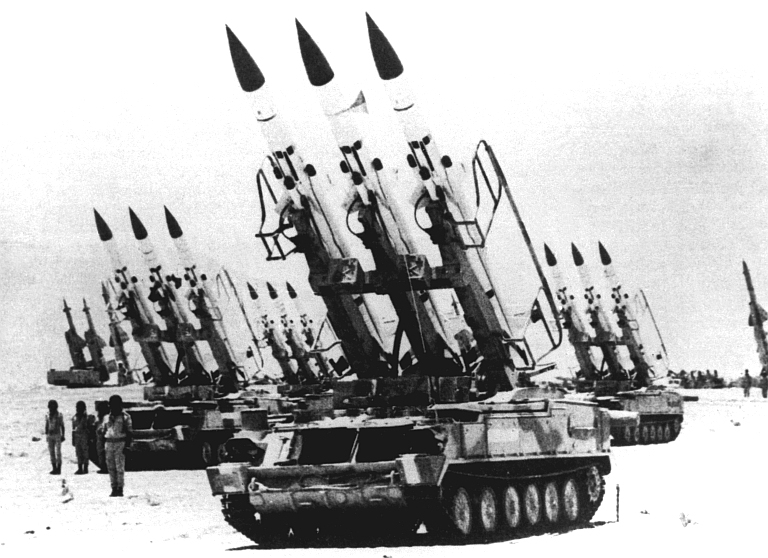
(3/30) The 3M9 missiles used by the Kub were the first Soviet SAMs with terminal continuous wave (CW) semi-active radar-homing (SARH). This means the missile homes in on CW radar signals reflected off the target from the 1S91 radar.
(4/30) Previous SAMs like the S-75 Dvina/Desna/Volkhov and S-125 Pechora/Neva used radio-command guidance, which was vulnerable to disruption of the command link. If this happened, the missile would go ballistic and almost certainly miss its target.
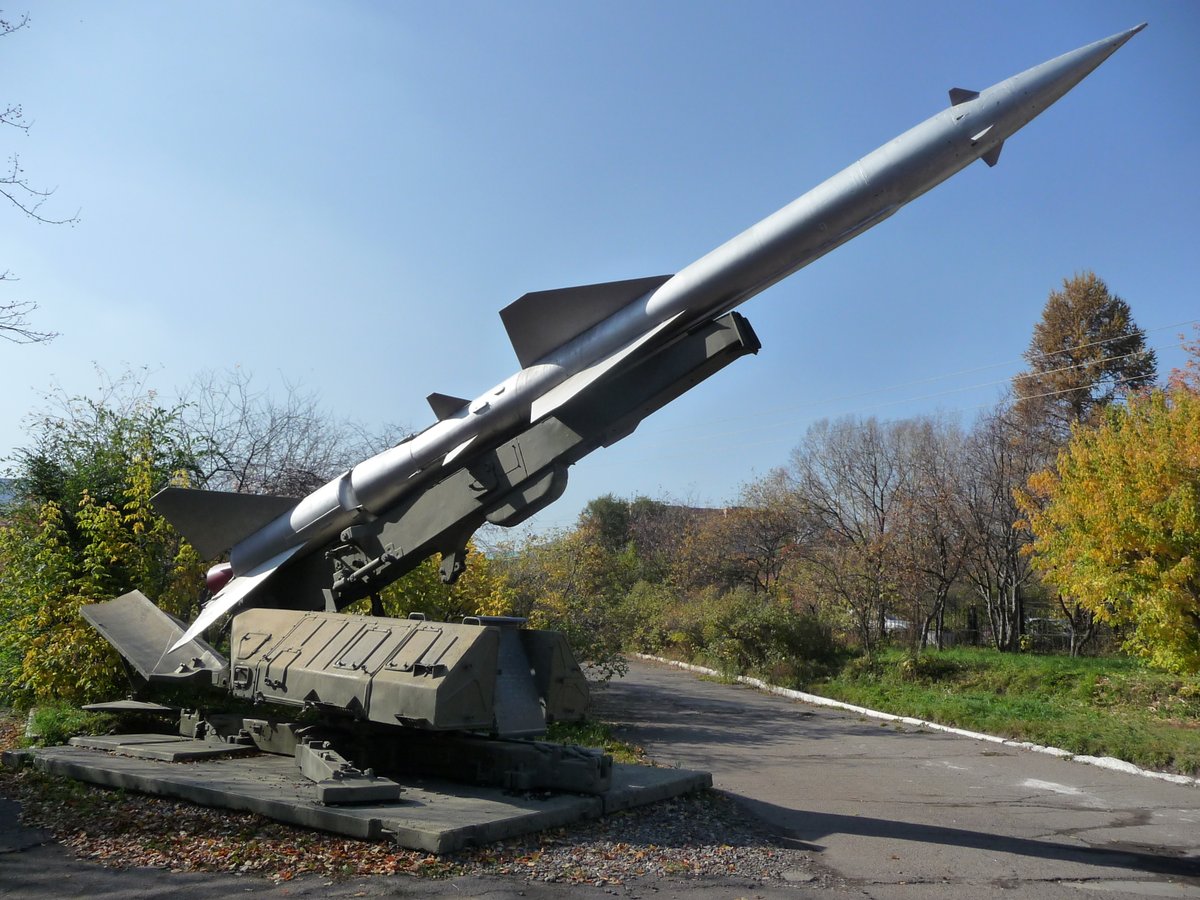

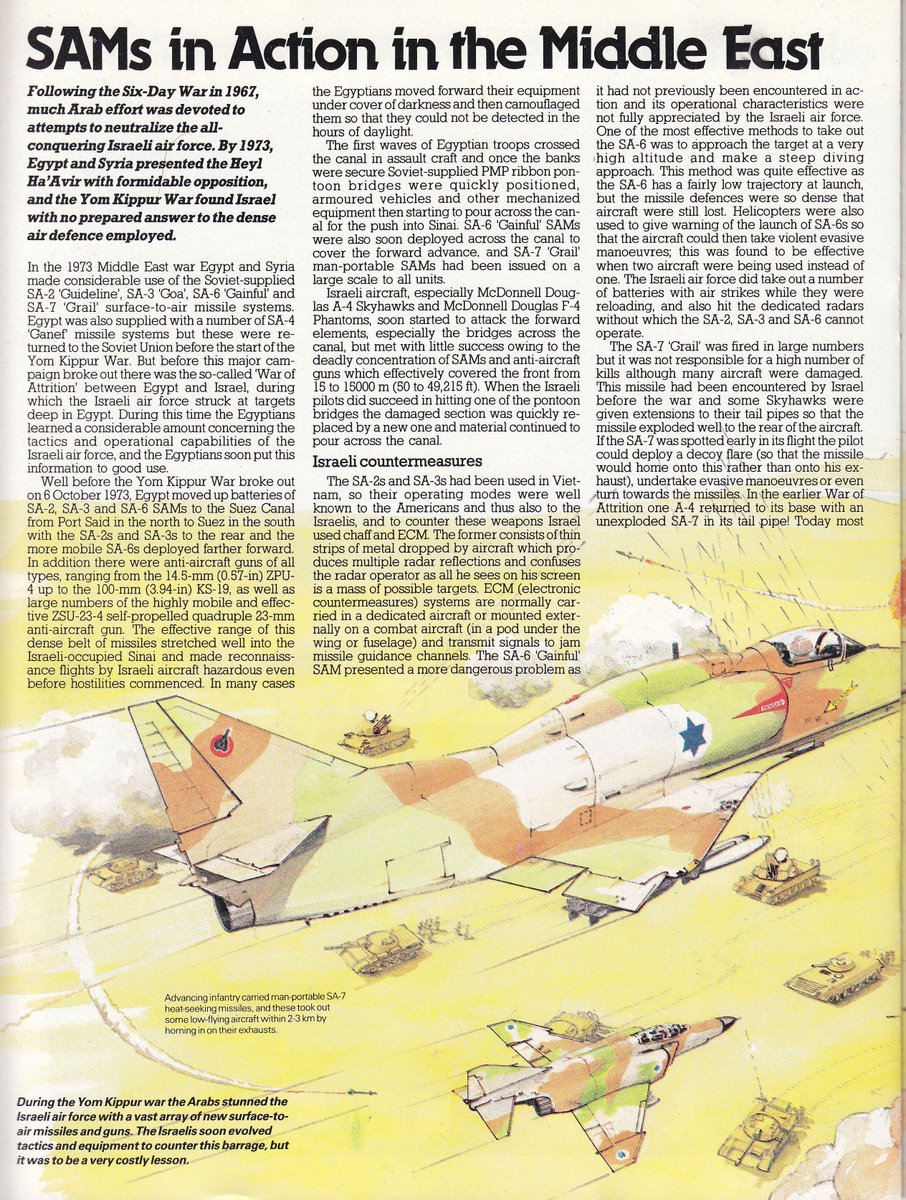
(5/30) This is what made the Kvadrat (export Kub) the most effective Arab SAM of the 1973 October War 50 years ago, for the Israelis at the time did not have a CW jammer effective against the Kvadrat. It was further complemented by the ZSU-23-4 Shilka and Strela-2 MANPADS.


(6/30) Development of the 9K37 Buk system began in 1972, led by chief designer Ardalion Rastov of Fazotron, who had also led work on the Kub. The design requirements were quite ambitious, and Rastov also wished to incorporate a radar into the Buk TEL, based on Egyptian feedback.


(7/30) To speed things up, development took place in 2 stages. The first stage, Buk-1, integrated the 9A38 TELAR and 9M38 missile into the existing Kub-M3 system. This was adopted in 1978 as Kub-M4. The 9A38 had only 3 rails and could also fire older 3M9 missiles.


(8/30) The full Buk system would not enter service until 1980. It consisted of the 9S470 mobile command post, 9S18 Kupol TAR, 9A310 TELAR, 9A39 transloader, and 9M38 missile. But even before that, work was already underway on the improved Buk-M1, which entered service in 1982.


(9/30) Carlo Kopp alleges the original Buk did not perform well against non-aircraft targets. Shirokorad gives the rated kill probabilities for Buk and Buk-M1, which shows a significant improvement for cruise missiles, but not against helicopters.
ausairpower.net/APA-9K37-Buk.h…
ausairpower.net/APA-9K37-Buk.h…


(10/30) All Buk/Buk-M1 vehicles (except for the original 9S18 Kupol radar) are based on the Metrovagonmash GM-569A chassis. They have the following indices: 569A (TELAR), 577A (transloader), 579A (command post), 567 (Kupol-M1 radar)


(11/30) The original Kupol radar was based on the '124' chassis, as used by the Krug SAM system (bottom left). It was not originally meant solely for Buk, but for divisional air defence as a whole. There are very few photos of it.


(12/30) The GM-569A chassis is powered by a 780 hp V-46-2S1 V-12 engine. It has a torsion bar suspension and a 4+4-speed hydromechanical transmission.


(13/30) The basic TELAR is equipped with the 9S35M1 target detection, tracking, and illumination radar for the 9M38M1 missiles. There is also a 9Sh38-3 electro-optical camera for passive target tracking. It is possible for a TELAR to engage targets by itself, without help.


(14/30) The 9S35 is a mechanically steered centimetric pulse Doppler radar with digital signal processing. It has a 1 antenna and 2 transmitters (pulse: target detection and tracking, CW: target illumination) There are 2 target tracking and 3 missile channels.

(15/30) A phased array radar was considered, which would have allowed engaging 4 targets at once, but in the 1970s this radar would have cost 1.5x the entire TELAR. Buk would not get this until Buk-M2, which finished development in 1988 but did not enter service until 2008.


(16/30) The TELAR can also provide illumination for missiles launched by the transloader. The latter does not have a radar of its own (similar to the transloader in the S-300V system) and needs a TELAR to engage targets. Both have 4 ready-use missiles.

(17/30) The 9M38(M1) is a single-stage missile. Unlike the earlier 3M9, there is no ramjet sustainer, it is entirely driven by the solid rocket motor and has a flight speed of 850 m/s and a range of ~30 km.


(18/30) The missile nose contains the 9E240 CW seeker, homing in on reflected CW radar signals from the TELAR by the method of proportional navigation in the terminal stage. This is preceded by an autonomous inertial flight stage of up to 24 s with radio command corrections.


(19/30) The 9N314M blast-fragmentation warhead weighs 70 kg, of which 33.5 kg is RDX/TNT explosive, and 34.5 kg is the pre-fragmented steel container body. It is detonated by a radio proximity fuse.


(20/30) The effect that this warhead had on the MH17 Boeing 777 is illustrated by Mayday/Air Crash Investigation.
(21/30) Because the TELAR's 9S35 mechanically steered radar antenna combines tracking and detection, it has a limited search sector due to its mounting location. Thus, the Kupol-M1 search radar is included in the complex. Each TELAR can be placed up to 10 km away


(22/30) The Kupol-M1's planar array electronically scans a sector of 30-40°. It can detect and identify air targets out to 120 km at altitudes between 30 m - 45 km. It also incorporates ECCM and anti-ARM features like a flicker (intermittent emission) mode.


(23/30) The 9S470M1 receives data from the Kupol-M1 or from a higher echelon system like Polyana-D4. It is capable of processing up to 46 targets within a 100 km radius and up to 20 km altitude and sending up to 6 to each TELAR.


(24/30) Each Buk battery consists of 2 TELARs and 1 transloader, and a single 9S470 and 9S18 controls 3 batteries. It takes 5 minutes for a TELAR to deploy/undeploy and the reaction time is about 15-20 s.
en.missilery.info/missile/bukm1
en.missilery.info/missile/bukm1


(25/30) In the Soviet and today's Russian army (I assume similar for Ukrainian), Buks are organised into SAM brigades under army and front-level control.

(26/30) Both Ukraine and Russia still use the Buk. Ukraine has older Buk-M1s, inherited from the USSR.
(27/30) Russia operates a mix of older Buk-M1s as well as smaller numbers of the more modern 9K317M/M2/M3 Buk-M1-2/M2/M3 systems. You can find more information about these newer systems on AusAirPower and .
Missilery.ru
ausairpower.net/APA-9K37-Buk.h…
en.missilery.info/missile/bukm3
Missilery.ru
ausairpower.net/APA-9K37-Buk.h…
en.missilery.info/missile/bukm3


(28/30) Most of you have probably known of Buk because of the MH17 shootdown. There really isn't much I can add about the incident. My thoughts as a Malaysian are: (1) Russia is responsible for providing the Buk to the separatists, (2) MH17 should not have been flying there.

(29/30) Buk has been and probably will remain an important component of both Russian and Ukrainian air defences. They key questions are how long the Ukrainian stocks will last (and the rumours about FrankenSAM and possible integration with different missiles).


(30/30) This video mostly describes the original Buk system from 1980, but it is a useful illustration.
(31/30) In terms of no. of divisions, Buk was second only to S-300P in the ZSU pre-2014.
https://twitter.com/ChungTzuW/status/1699203290922098709
(33/30) Ukrainian Buks are not often filmed in the war for obvious reasons (they are high priority targets); this is from pre-war.
(34/30) M-22 Uragan, the naval cousin of Buk.


'Beech', not 'birch'.
(35/30) CORRECTIONS:
1) Buk = Beech, not Birch (which is Beryoza).
2) I'm not sure if the mobile command post sends 6 targets to each TELAR or if it's 6 targets to all the batteries (so 1 to each TELAR). The book is not very clear on it.
1) Buk = Beech, not Birch (which is Beryoza).
2) I'm not sure if the mobile command post sends 6 targets to each TELAR or if it's 6 targets to all the batteries (so 1 to each TELAR). The book is not very clear on it.
(36/30) I think it's 6 targets for all 3 batteries, based on the video in #30.

(37/30) Also correction: the detection range is 45 km for targets at 30 m. The max altitude is not given.
https://twitter.com/ChungTzuW/status/1712562622997172661
(38/30) Buk in Finnish service by @SatunnaistaS
(39/30) Buk-M1-2 is supposedly rated to have capability against Lance-type TBMs and HARM-type ARMs with the 9M317M missile.


(40/30) It can also be used against surface targets.


• • •
Missing some Tweet in this thread? You can try to
force a refresh