
 Read on Twitter
🧵Immunoglobulins:
Here we will begin to look at B cells and Antibodies.
Here we will begin to look at B cells and Antibodies.
1/ Immunoglobulin means “Immune Protein”. This is what we call the proteins produced by the B cells. When these immunoglobulins are embedded into the B cell membrane, they are called the B cell receptor (BCR). 
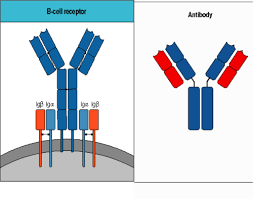
2/ When they are secreted out of the mature B cell, they are called Immunoglobulins or antibodies. The term Immunoglobulin is abbreviated as Ig.
3/ Antibodies are made up of four separate proteins connected by flexible disulfide bonds. They look a lot like a Y. They contain two long protein chains called the heavy chains.
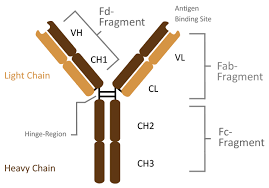
4/ These heavy chains will change as the immune response progresses in a process called class switching. The other two chains are called the light chains.
5/ At the tip of each chain, there are the antigen binding sites which are called the Function Antigen Binding (FAB) region of the antibody. This is the unique part of the antibody that binds to a pathogen.
6/ The rest of the antibody structure is called the Fragment Crystallizable (Fc) region. This is the section of the antibody that interacts with other cells of the immune system. The Fc portion of the antibody is covered up when it is not bound to an antigen.
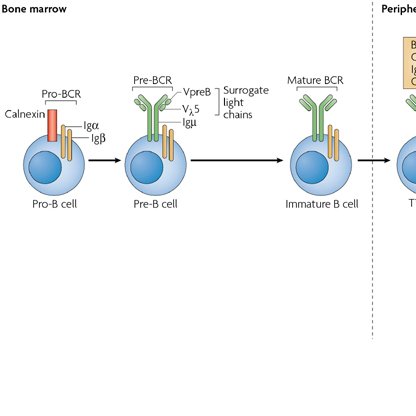
7/ B cells are born in the bone marrow. They are first called Pro-B cells as they select to go down the development path to become fully mature B cells. The only thing they will have is the Immunoglobulin alpha and beta chains that act as the co-receptors for the B cell receptor.
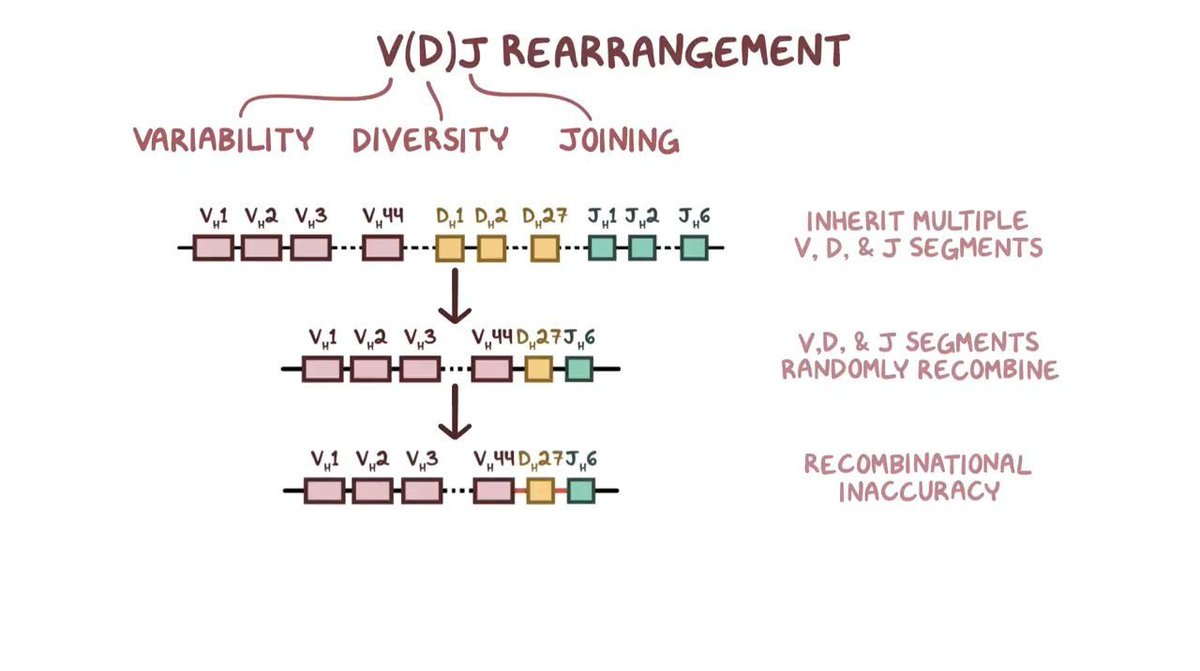
8/ These Ig-a and Ig-b are the exact same for every B cell. They are the first part of the B cell receptor complex. The first thing that will occur will be the recombination of the Heavy chain. We covered the process of recombination.
9/ The heavy chain will pick one of each VDJ genes and make the heavy chain's variable region. Once the variable region of the heavy chain is created, it will be attached to the constant region. The heavy chain can use two different constant regions from IgM and IgD.
10/ The difference between the two is just splice variants. That means equal amounts of both IgM and IgD isotypes will be expressed on that B cell with the exact same antigen binding region.
11/ Then the B cell will express these heavy chains on its surface with surrogate light chains. The surrogate light chains are just placeholders to ensure the B cell can express a B cell receptor.
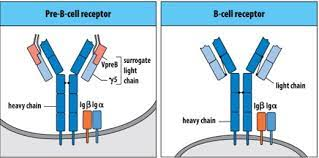
12/ Once that test is good, the B cell moves into the Pre-B cell stage. They will pull the receptors back in so they can do recombination with the VJ genes of the light chains.
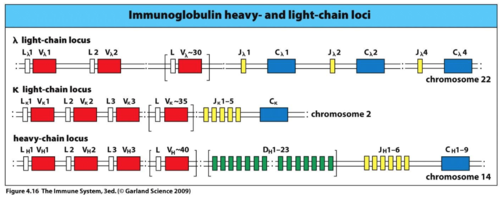
13/ There are two possible light chains with Lambda and Kappa. The B cell will try to make one good light chain. If that one fails, then it will try to form the other light chain.
14/ You usually end up with equal amounts of B cells having each type light chain. The 2 light chains actually have their own set of genes on different chromosomes with Kappa on chromosome 2 and Lambda on chromosome 22.
15/ Once the B cell receptor is fully constructed, it will be expressed on the cell surface and it will become an immature B cell. All B cell receptors are tested against self antigens in the bone marrow before they leave.

16/ This prevents self reactive B cells from getting into circulation. This process is not as extensive as with T cells. There are no special cells here expressing all proteins with the AIRE. They just get checked for whatever antigens are in the bone marrow.
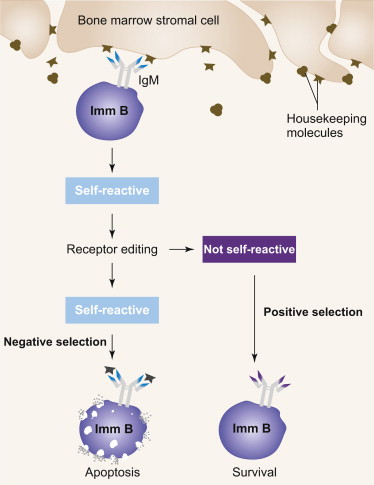
17/ Any B cells that are self reactive will be allowed to try to make a new receptor with their remaining gene segments. If they continue to fail, that B cell will undergo programmed cell death. This is called Central Tolerance.
18/ The immature B cell will leave the bone marrow and move into circulation. They will travel to the lymph nodes where they will assume their duties. They will act as both Antigen Presenting cells looking for antigens and Effector cells when they activate to become plasma cells.
• • •
Missing some Tweet in this thread? You can try to
force a refresh






