
1/ Randomly violent commanders, no armoured vehicles or artillery support, no training or uniforms, specialist troops being used as assault infantry: an interview with a wounded Russian soldier highights the problems experienced by Russian troops fighting in Ukraine. ⬇️ 

2/ Radio Free Europe has published a detailed interview with 41-year-old Dmitri Yashnikov from Cherepovets in Russia's Vologda Region. He has served with the 347th Motorised Rifle Regiment since being mobilised in September 2022 and was seriously injured in August 2023.
3/ Speaking from his home, where he is recuperating from a spinal injury, Yashnikov says:
4/ "We have one 'motoliga' [MT-LB] for the entire motorised rifle regiment, although every company should have at least some wheeled vehicles: Urals, KAMAZes, as well as any BMPs or APCs. We have none of this. But this does not embarrass anyone.

5/ "On 31 July, the remnants of our separate anti-tank platoon with five men and a separate anti-aircraft platoon were assigned to the sixth company of the second battalion of the 47th Tank Division.
6/ "We had just arrived and settled down when the order came that same evening that we were to pack up and leave for another place. No one explained where and why."
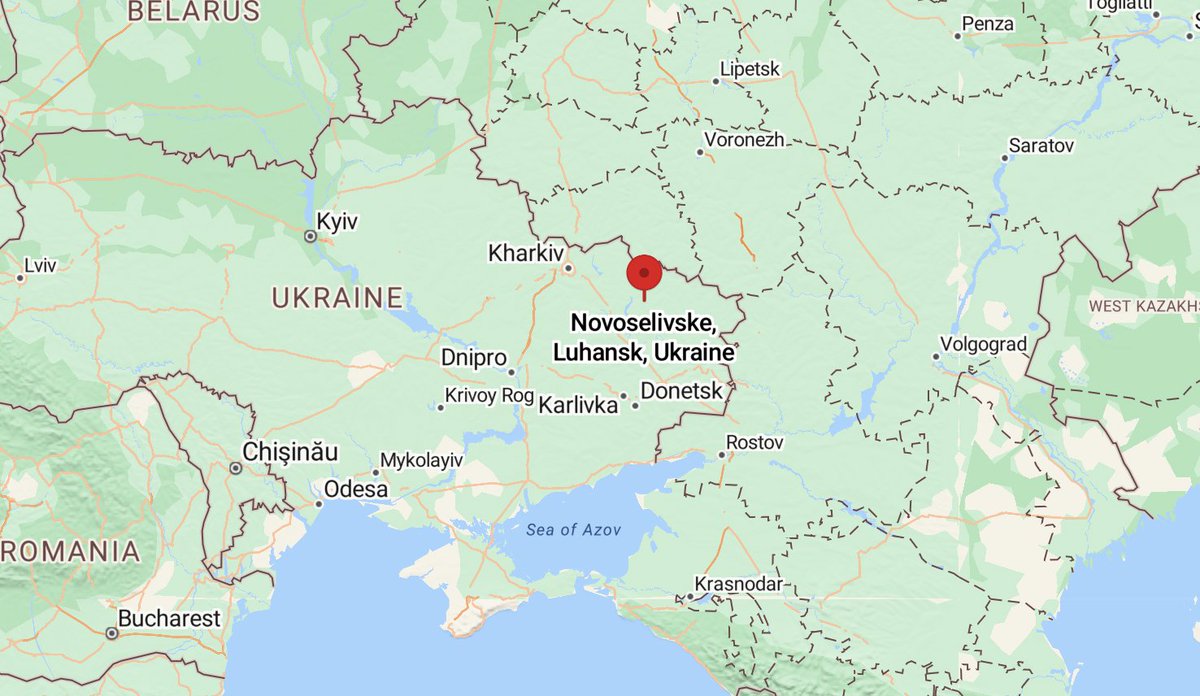
7/ The men were sent to storm the village of Novoselivske in the Luhansk region. On 2 August, they were told to go dig trenches, but the terrain was unsuitable for this and was clearly visible to the Armed Forces of Ukraine.
8/ "While we were getting to the place where we needed to dig in, we literally walked over the corpses of 'Storm-Z' [penal battalions manned by ex-convicts] . And Novoselivske was held by only a couple of machine gunners and the same number of mortars.
9/ "There were also constantly "birds" [drones] flying, and if they noticed us, there was a rain of mortars. And there are only three trees and grass in the area - there is nowhere to hide.
10/ "So you start digging a trench, and grenades are dropped on you from above. How can you dig in in such an atmosphere?"
11/ The men had no training before the assault. Their unit was mashed together from the remnants of other units, including specialists who had no idea about how to carry out an assault.
12/ "It was a mess there," Yashnikov says. "I'm an anti-tanker [ATGM operator], and the anti-aircraft gunners don't know how to attack or what to do. I am not sure at all if it was legal and where we were according to the documents, if there were any reconciliations.
13/ "I very much doubt it. The sixth company was the reserve of the 27th Assault Brigade, and as I understand it, the commander of the second battalion was sorry to give up his men and he gave us, the new arrivals, up instead. There were only three men from his company.
14/ "Literally three days later, we were left with nine people out of 20, the rest were all 300s [wounded]. Despite the fact that we have been mobilised for more than a year, this does not mean that we have adequate combat training for assaults.
15/ "We stood in the second line of defence for a year, that is, we were not in a shooting battle. Scouts may have gone somewhere and shot from afar, but an assault is when you see your enemy eye to eye.
16/ "We were objectively unprepared; we told the commanders: “Are out of your minds?” Perhaps there was nothing for us to refuse, because the officers understood that we were right.
17/ "But later they began to threaten that they would send us to Zaitseve for our refusal – this is part of a type of pressure chamber [a prison cell where the authorities create unbearable conditions for the inmates], like in a prison where they will beat you every day, …
18/ … and then take you to the very worst [places], like Bakhmut or Yahidne [near Bakhmut]. My colleague told me how a friend of his was held there for two weeks, and beaten, but then returned to the regiment."
19/ The capture of Novoselivske was announced prematurely, probably due to false reporting by Russian commanders – a frequent problem for the Russian army, which has on some occasions led to repeated assaults with heavy casualties, in attempts to turn false claims into reality.
20/ According to Yashnikov, "Back on July 24, there was information that the village had been taken by our side. The boys downloaded the video from the Internet and showed it, but now it has apparently been deleted.
21/ "Back in November 2022, we went there, took a couple of streets and left, and so all spring and summer Novoselivske passed back and forth.
22/ "And then there was news that they had completely taken it, but in fact this happened on 6–8 August [the capture was claimed by the Russian Ministry of Defence on 5 August] . Does anyone really think that the news will tell the truth?

23/ "Judging by TV, the Russian army is doing well. But in our area everything is as I told you."
24/ Only three weeks later, the regiment was sent to a new location elsewhere in the Luhansk region to support an assault by the 26th Tank Brigade. It was during this offensive that Yashnikov was injured on 25 August. He says "nobody told us anything" about their mission.
25/ "We stayed six days at the firing range, and then the order came again, according to which we had to go to hell for three days. The officers did not set any task before us. On the third day after our arrival we went to storm.
26/ "We reached the place where our soldiers were, sat in the dugout for literally ten minutes, because the "bird" was flying, and then a major with the call sign "Okolitsa" called me and five other people to attack.
27/ "We had just passed a crossroads when a machine gun fired at us. Everyone was wounded, including the major, except me. I don't know how he missed and didn't kill me, because the shooter was about 30 meters away."
28/ Yashnikov was spotted by a drone that evening, which resulted in a mortar strike that injured him badly:
"Shrapnel penetrated my sacrum. They took one [piece] out, but the other one's still in there. Now I can't have an MRI.
"Shrapnel penetrated my sacrum. They took one [piece] out, but the other one's still in there. Now I can't have an MRI.
29/ Plus I have one more piece of shrapnel in my thigh and my leg is still numb because a nerve was severed somewhere. My wife was first told that I was 200 [killed]. One of the two boys who ran on the offensive and was shot at by a machine gun was hospitalised.
30/ "He called his wife and told her that I was killed, and she told my wife that I had been killed. On 27 August, I called home from the hospital and said that I was alive, to which my wife said that they had already managed to bury me during this time."
31/ Yashnikov blames a lack of training and artillery support for his comrades' deaths:
32/ "There is not only no normal training, but also no help from artillerymen during assaults, because you just go out into a bare field and mortars or machine guns start firing at you, and there is nowhere to hide and no one to cover you. That's how they kill people.
33/ "If we fight like this, a lot of people will die ... There were dead anti-aircraft gunners in my anti-tank platoon. Commanders don't want to waste time on training – they just take them and throw them into the breach without any consideration."
34/ Officers treat the men with casual brutality, as Yashnikov notes.
"One day, my fellow anti-aircraft gunner with the call sign “Bear” ran into our commander of the 347th regiment. Instead of saying “good health” to the officer, he said “greetings”.
"One day, my fellow anti-aircraft gunner with the call sign “Bear” ran into our commander of the 347th regiment. Instead of saying “good health” to the officer, he said “greetings”.
35/ "So the regiment commander knocked out his teeth with a pistol. And such aggression on the part of an officer is not an isolated incident."
36/ By now, he says, the troops are exhausted by a year of fighting with no leave and want to go home.
"Nobody is eager to fight – everyone wants to go home. We've been stuck in this mess for a year now. Everyone is tired and wants to return to a peaceful life.
"Nobody is eager to fight – everyone wants to go home. We've been stuck in this mess for a year now. Everyone is tired and wants to return to a peaceful life.
37/ "From somewhere we find out that some regiment has gone home or on rotation, but we came in November, and we are still sitting here. In the hospital there were mobiks with me who had never been on leave.
38/ "I managed to go once this year, although they promised that they would let me go every six months. In September we were supposed to go on vacation for the second time. One batch of people went home, but the rest did not make it.
39/ "Now vacations have been closed again since 25 September by order of the commander. Most likely, because of these very same offensives.
40/ "The psychological state of our fellow soldiers sucks. Probably because of that people drink a lot, but I didn't drink. I had to digest the stress on my own."
41/ Yashnikov says he hopes he'll be discharged due to his injuries, but admits there is less chance of that now because of the army's need for manpower.
42/ If he goes back to fight on the front line, he says he'll "do it wisely. Not 'meat on meat', as it was in Novoselivske, but normally. My mother doesn't want to cry for me." /end
Source:
severreal.org/a/vse-hotyat-d…
Source:
severreal.org/a/vse-hotyat-d…
• • •
Missing some Tweet in this thread? You can try to
force a refresh





