Quick thread on Peter Turchin's meta-ethnic frontier theory, as laid out in chapter 4-5 of his 2004 book "Historical Dynamics."
The motivation behind the theory is a common one: to figure out the reasons why empires rise and fall. Turchin argues that the asabiya (which he defines as the capacity for collective action) of the core ethnic group of a polity is a key determinant of its survival and expansion. 

He explains asabiya, which often requires some level of sacrifice of one's (immediate) interests for those of the group, as the result of group selection. Group selection is maximized when intragroup (fitness) variation is low and intergroup (fitness) variation is high.
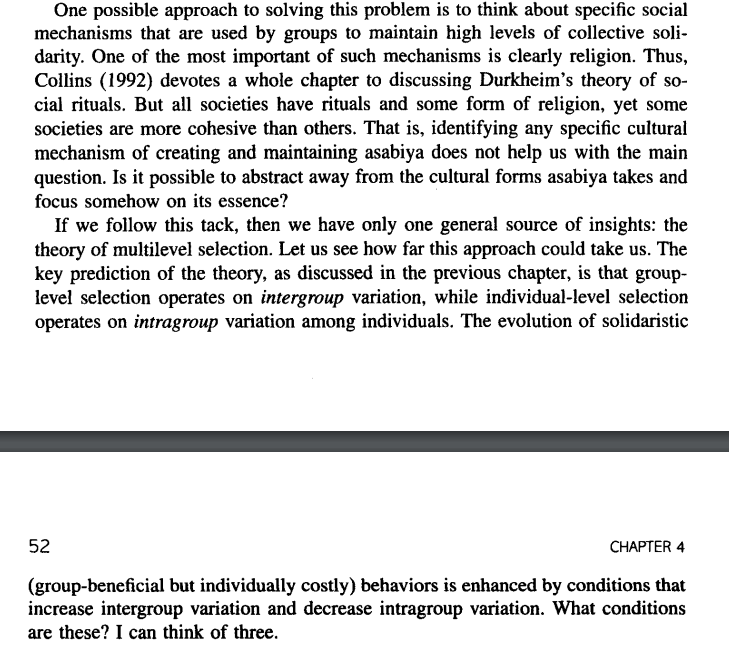
He comes up with three conditions (among agrarian polities) that maximize group selection:
1) Low population density, since low resources/person leads to high intragroup competition
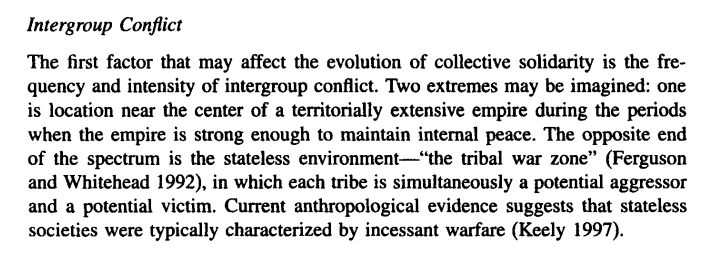
2) High intergroup conflict (frequency + intensity)
Both maximize *small* group competition.
1) Low population density, since low resources/person leads to high intragroup competition
2) High intergroup conflict (frequency + intensity)
Both maximize *small* group competition.

But Turchin wants to explain the creation of major empires, for which these are insufficient. So he adds (3) metaethnic fault lines (large ethnic differences between groups). Under these conditions, warfare across the line tends to be much more violent, and...
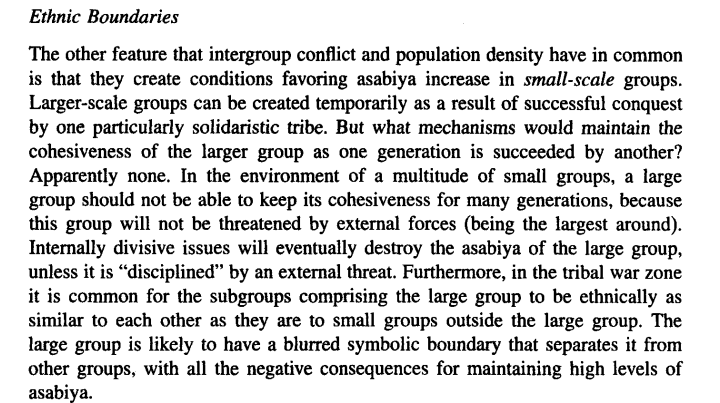

...small groups on both sides of the fault have good reason to band together and stick together.
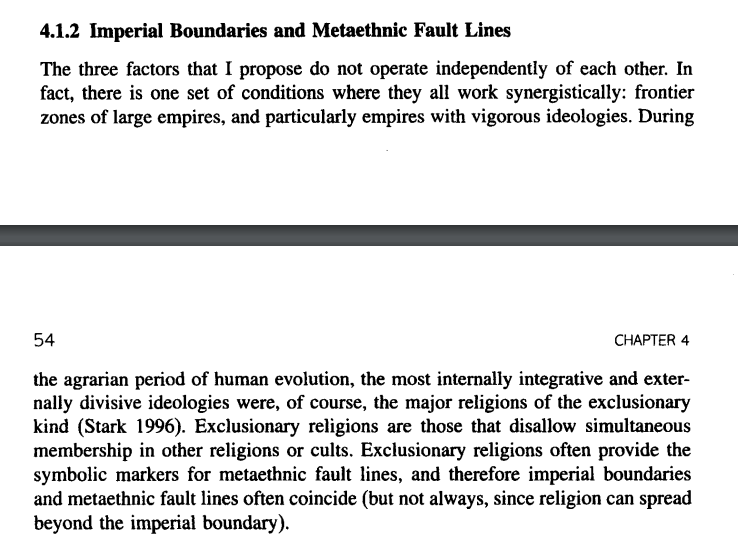
These conditions are maximized at the frontiers of large empires, particularly large empires with exclusionary ideologies (which increase ethnic distance).
These conditions are maximized at the frontiers of large empires, particularly large empires with exclusionary ideologies (which increase ethnic distance).
He adds, but doesn't spend much time on a few other mechanisms, such as leveling institutions (reduce intragroup fitness variation), imperial wealth-as-temptation-to-plunder, and recombination of genes/memes at metaethnic fault lines (increase intergroup variation)
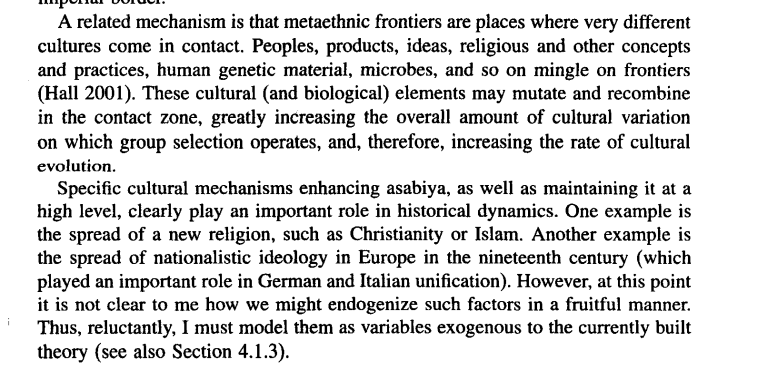

His explanation for the cycle of empires is as follows: metaethnic frontier => strong cultural evolution for asabiya. Eventually, a high asabiya winning ethnic group figures out a way to scale their asabiya up and becomes a new 'historical agent' [my words].

The new ethnic group assimilates similar groups nearby and rapidly expands in a (+) feedback loop. In the meantime, asabiya declines in the old imperial core, due to high population density + low intergroup conflict, allowing the new group to conquer and become a new empire.
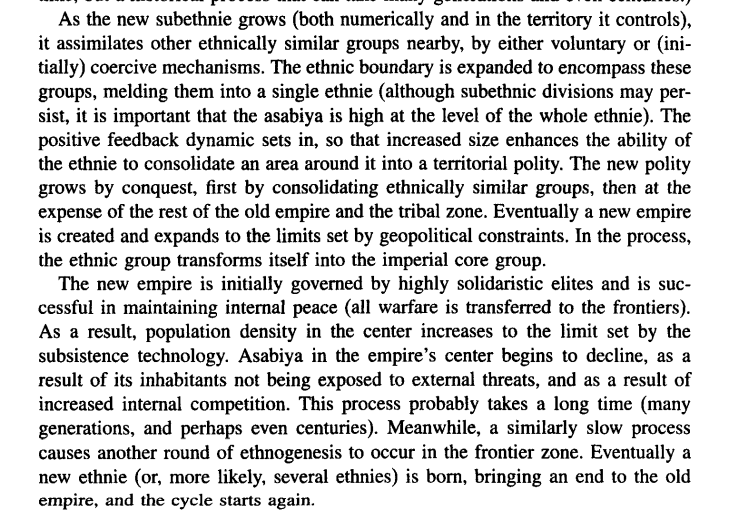
An important element of this theory is "scaling up structures": ways previously small groups scale solidarity to huge numbers of people, which is hard. He mentions religion, primogeniture, and "society-wide methods of male socialization" (that crosscut kin) as three mechanisms.


He notes that most groups in the metaethnic frontier crucible will disappear, being physically exterminated or swallowed up by more successful rivals, but some groups, by chance or design, will hit on the right combination of norms and structures to expand.

He then does something very few similar writers do, which is formalize his verbal model into a mathematical one using differential equations.
When combined with a crude space model, you get a chart of polity sizes that looks at least approximately realistic.
When combined with a crude space model, you get a chart of polity sizes that looks at least approximately realistic.

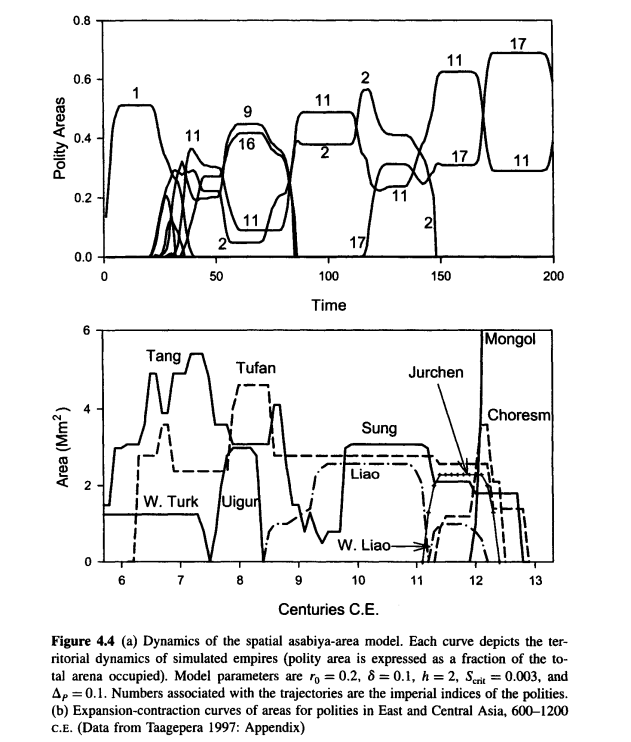
One other prediction made by the model is the "reflux effect": new empires initially expand into the still non-imperial hinterland further from the frontier, rather than attack the (still formidable) old empire head on, at first.

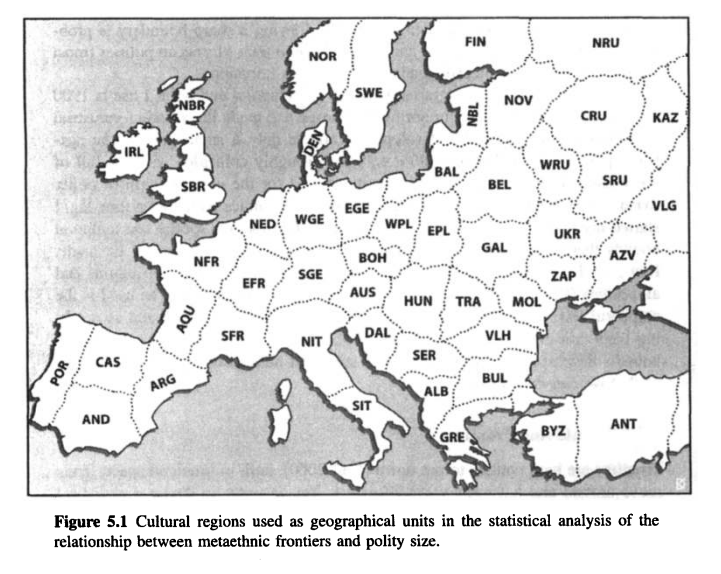
He then checks the model on the record of European history, 0-1900AD, on the grounds that it is well recorded. He finds strong agreement with his model; almost all major states came from cores formed in metaethnic frontiers.

To tie this in with JD Unwin for a moment, Turchin mentions, but does not elaborate on, monogamy as a leveling institution that helps with scaling up. This backs up other work suggesting monogamy is a group-selected trait.
gwern.net/doc/sociology/…
gwern.net/doc/sociology/…
Turchin is vague on whether the mechanism for group selection => asabiya is genetic or cultural. I think it is predominantly cultural, on the grounds that different racial groups copy each other's "scaling up mechanisms" all the time; think Meiji restoration.
As such, genetics should be treated as almost independent from asabiya. I'd note that there is a remarkably weak correlation between premodern military success and IQ or human capital in Eurasia.
Many scaling mechanisms that increase asabiya can have long-term dysgenic effects (think Islam) and many low asabiya societies (Turchin mentions the Low Countries and post-Roman Italy) are high human capital.
As such, the theory is complementary to eugenic/dysgenic theories of imperial rise and fall; these mechanisms can operate independently of each other.
Overall, metaethnic frontier theory did a great job formalizing and testing thoughts I (and many students of history) have had about the importance of group selection, frontiers, and blood wars. 10/10, would recommend.
• • •
Missing some Tweet in this thread? You can try to
force a refresh