Read on Twitter
In 1984, F.A. Hayek was asked who his favorite economist was. He named two.
The first was Nobel Prize winner George Stigler. The second, sadly, never got the recognition he deserved.
Here are 5 papers by the 🐐, Armen Alchian, and why you should read them today 👇
The first was Nobel Prize winner George Stigler. The second, sadly, never got the recognition he deserved.
Here are 5 papers by the 🐐, Armen Alchian, and why you should read them today 👇
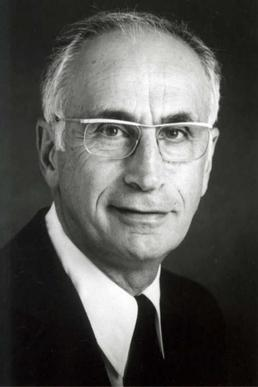
Most grad students today never hear the name Alchian. That's a shame!
He made foundational contributions to so many fields like property rights economics, the theory of the firm and monetary economics.
That's why he's the GOAT. economicforces.xyz/p/why-armen-al…
He made foundational contributions to so many fields like property rights economics, the theory of the firm and monetary economics.
That's why he's the GOAT. economicforces.xyz/p/why-armen-al…
#1 Production, Information Costs, and Economic Organization with Harold Demsetz
- Chosen as one of AER's Top 20 articles in its first 100 years.
- Anyone interested in IO, contract theory, or entrepreneurship needs to grapple with this paper. josephmahoney.web.illinois.edu/BA549_Fall%202…
- Chosen as one of AER's Top 20 articles in its first 100 years.
- Anyone interested in IO, contract theory, or entrepreneurship needs to grapple with this paper. josephmahoney.web.illinois.edu/BA549_Fall%202…
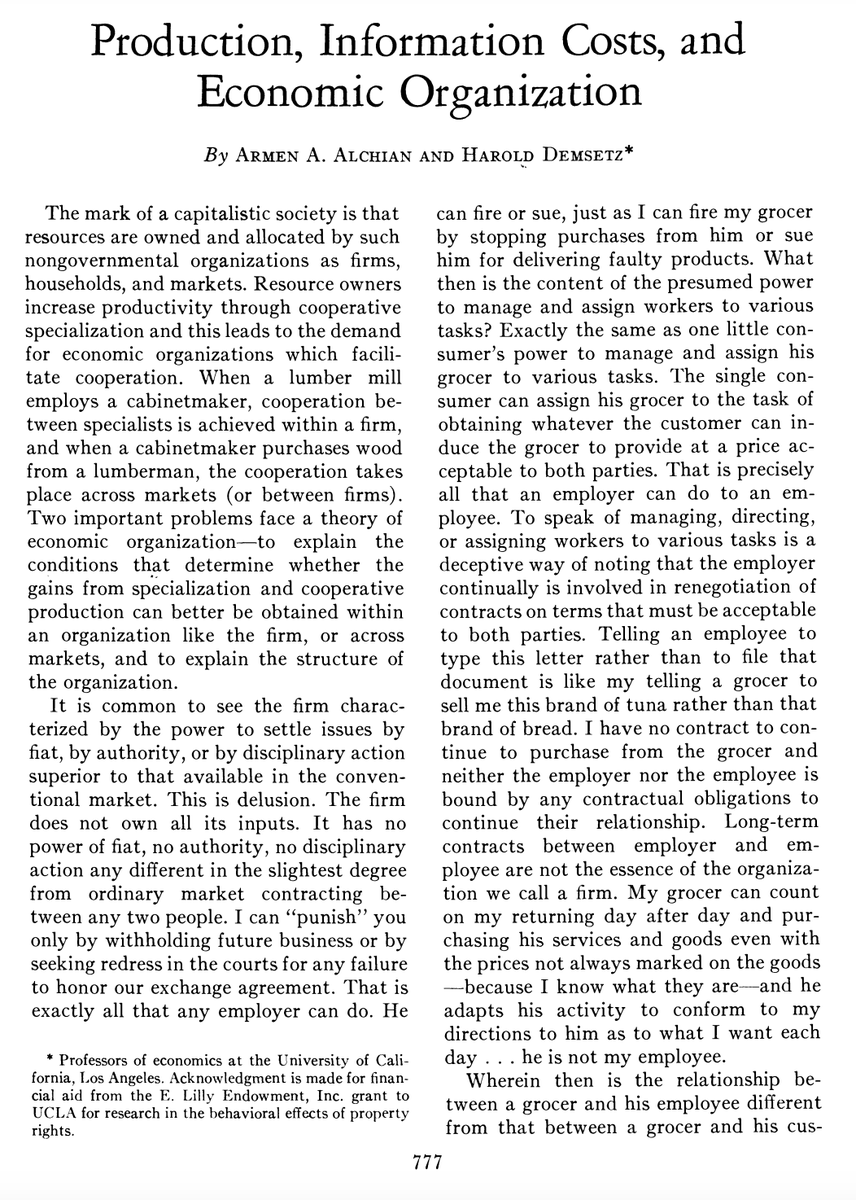
The big question: Why do firms exist?
The fundamental problem that Alchian and Demsetz point to is Hayekian. Information isn't free!
With team production, paying each worker their marginal product isnt straightforward. People will specialize in monitoring and metering workers
The fundamental problem that Alchian and Demsetz point to is Hayekian. Information isn't free!
With team production, paying each worker their marginal product isnt straightforward. People will specialize in monitoring and metering workers
#2 Vertical Integration, Appropriable Rents, and the Competitive Contracting Process with Klein and Crawford
- Q: Again, why do firms exist?
- A: Once workers and firms have invested in each other, there are rents to haggle over. josephmahoney.web.illinois.edu/BA549_Fall%202…
- Q: Again, why do firms exist?
- A: Once workers and firms have invested in each other, there are rents to haggle over. josephmahoney.web.illinois.edu/BA549_Fall%202…
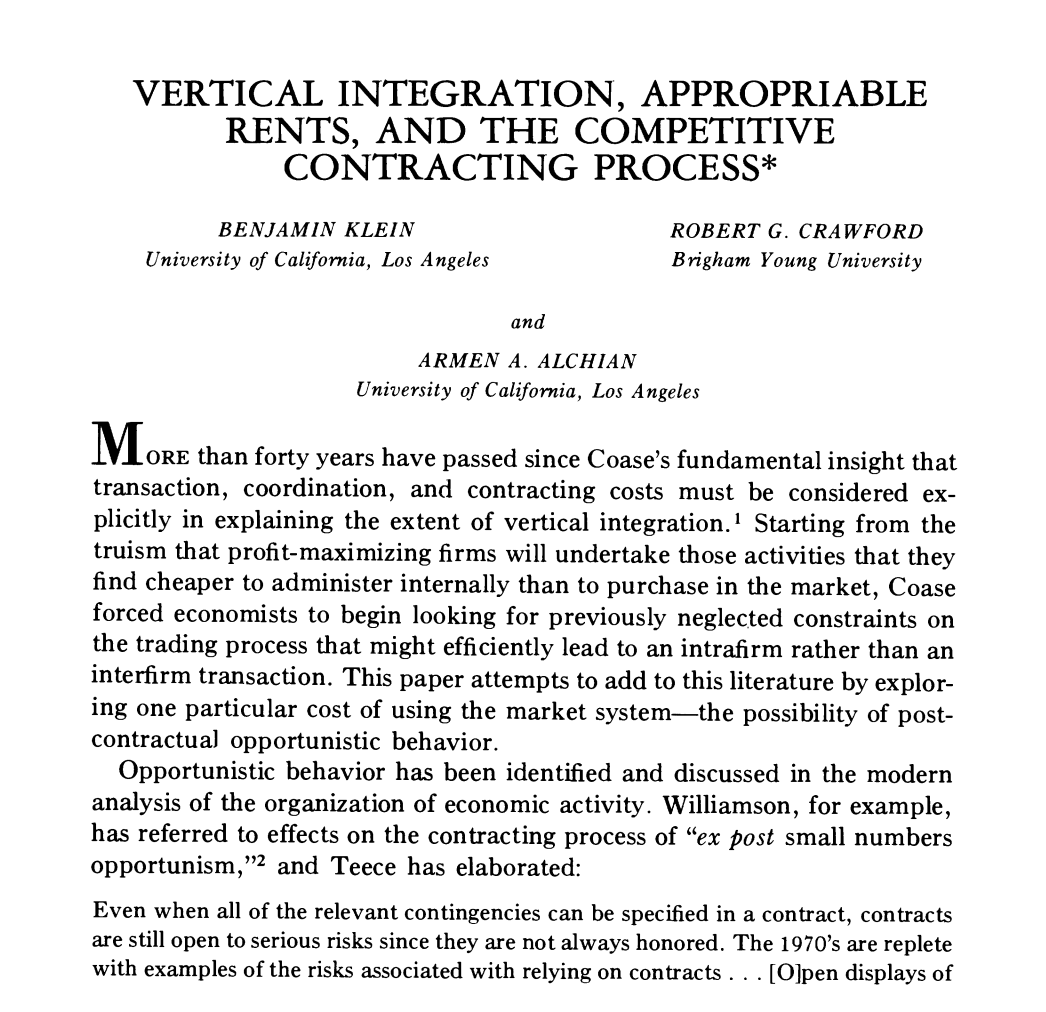
Haggling is destructive. So workers and firms have the incentive to find contractual workarounds.
The more investments are specific to a particular trading partner, the more likely we will see contracts tying the two sides more tightly together.
The more investments are specific to a particular trading partner, the more likely we will see contracts tying the two sides more tightly together.
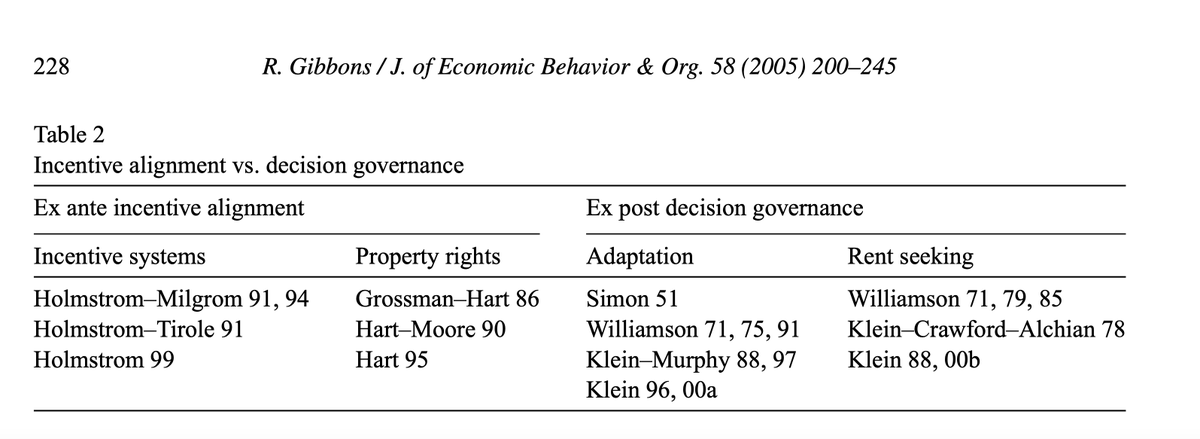
Bob Gibbons calls Klein, Crawford, and Alchian one of four formalizable theories of the firm. Every mechanism design course covers the models on the left.
We need to start building models of those on the right! masonlec.org/site/rte_uploa…
We need to start building models of those on the right! masonlec.org/site/rte_uploa…
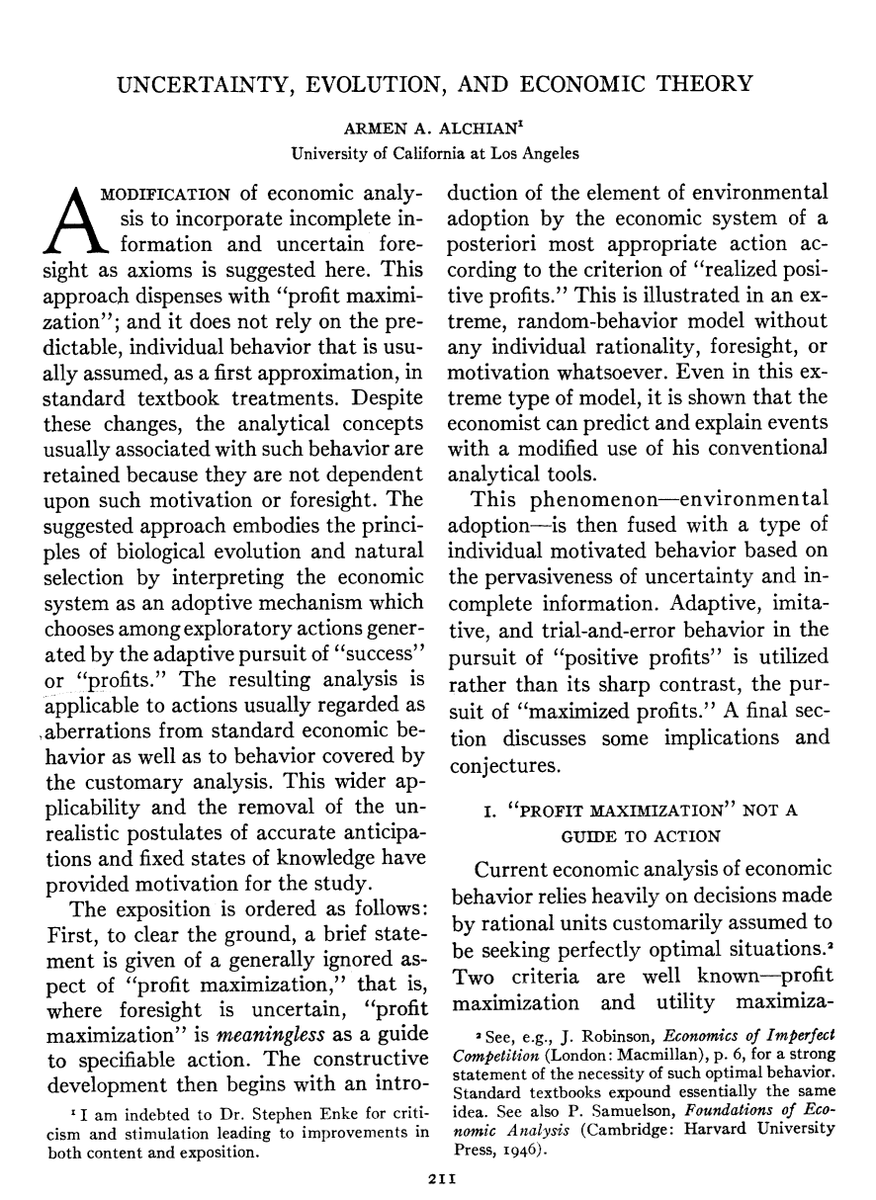
#3 Uncertainty, Evolution, and Economic Theory Do firms maximize profits?
That's not a well-posed question with uncertainty.
In fact, in many ways, it doesn't matter what people try to do. The profit system selects for firms that make positive profits jstor.org/stable/1827159
That's not a well-posed question with uncertainty.
In fact, in many ways, it doesn't matter what people try to do. The profit system selects for firms that make positive profits jstor.org/stable/1827159
From here, we can impose assumptions on costs that make sense.
For example, all else equal, executing the same task in less time is more costly. I summarized this paper in a newsletter a while back economicforces.xyz/p/costs-and-ou…
For example, all else equal, executing the same task in less time is more costly. I summarized this paper in a newsletter a while back economicforces.xyz/p/costs-and-ou…
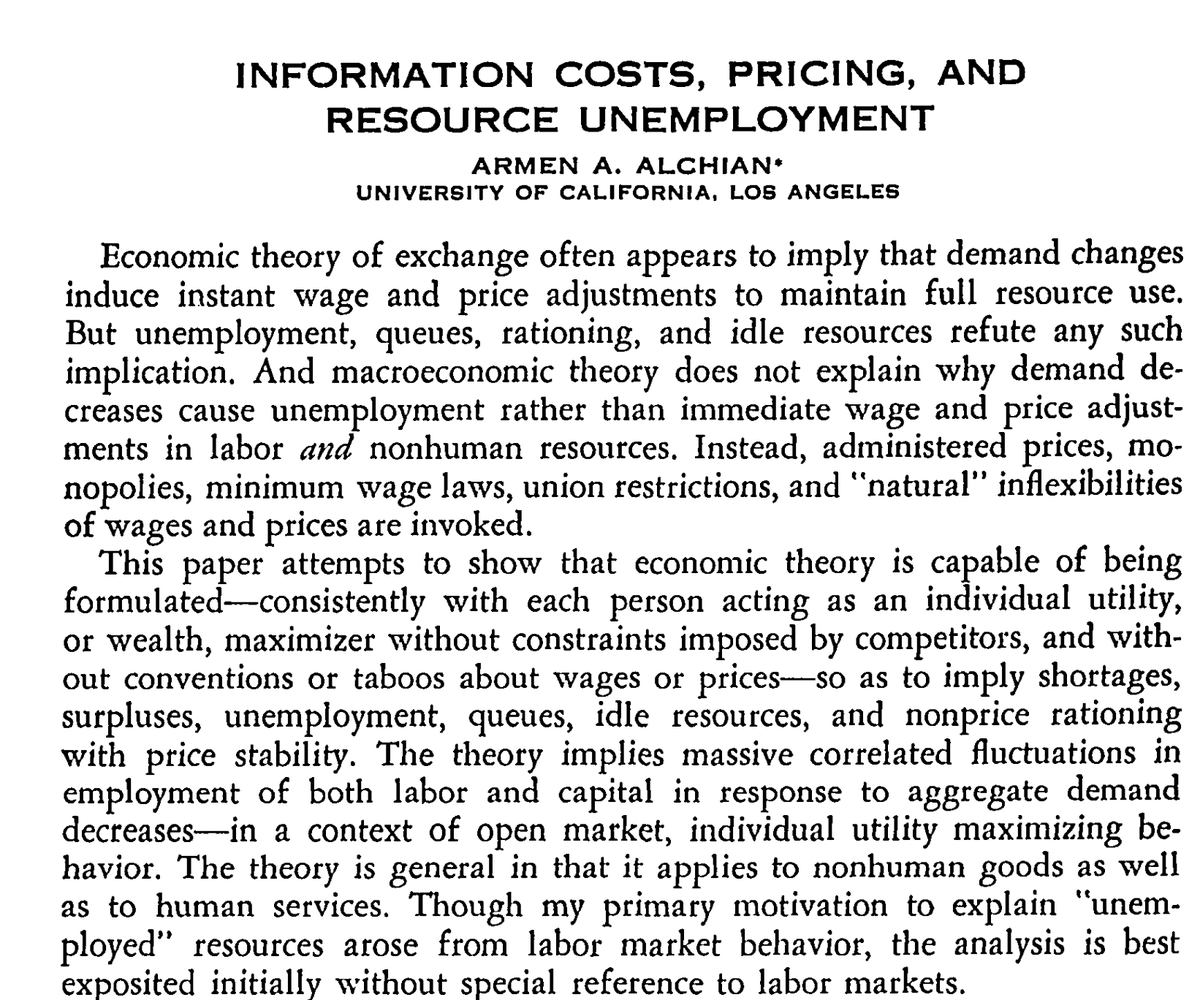
#4 Information Costs, Pricing, and Resource Unemployment
This 1969 paper was groundbreaking in applying information economics to the labor market, especially search theories.
This is true microfounded macro before it was cool.
onlinelibrary.wiley.com/doi/10.1111/j.…
This 1969 paper was groundbreaking in applying information economics to the labor market, especially search theories.
This is true microfounded macro before it was cool.
onlinelibrary.wiley.com/doi/10.1111/j.…
#5 Why Money?
Money arises not just to overcome double coincidence of wants, but due to information costs in assessing goods' attributes. Money has low costs.
jstor.org/stable/1992014
Money arises not just to overcome double coincidence of wants, but due to information costs in assessing goods' attributes. Money has low costs.
jstor.org/stable/1992014
Using money plus experts in goods reduces costs of assessing quality. Experts become specialist middlemen due to reputability. Explains unemployment too.
Again, microfounded (search) macro.
Again, microfounded (search) macro.
And just in terms of general badassness as an economist, no one surpasses Alchian.
He discovered the top-secret fuel material in the hydrogen bomb! How cool is that?! sciencedirect.com/science/articl…
He discovered the top-secret fuel material in the hydrogen bomb! How cool is that?! sciencedirect.com/science/articl…

That's why Alchian is the GOAT.
Check out my newsletter for more reasons why.
economicforces.xyz/p/why-armen-al…
Check out my newsletter for more reasons why.
economicforces.xyz/p/why-armen-al…
• • •
Missing some Tweet in this thread? You can try to
force a refresh