Read on Twitter
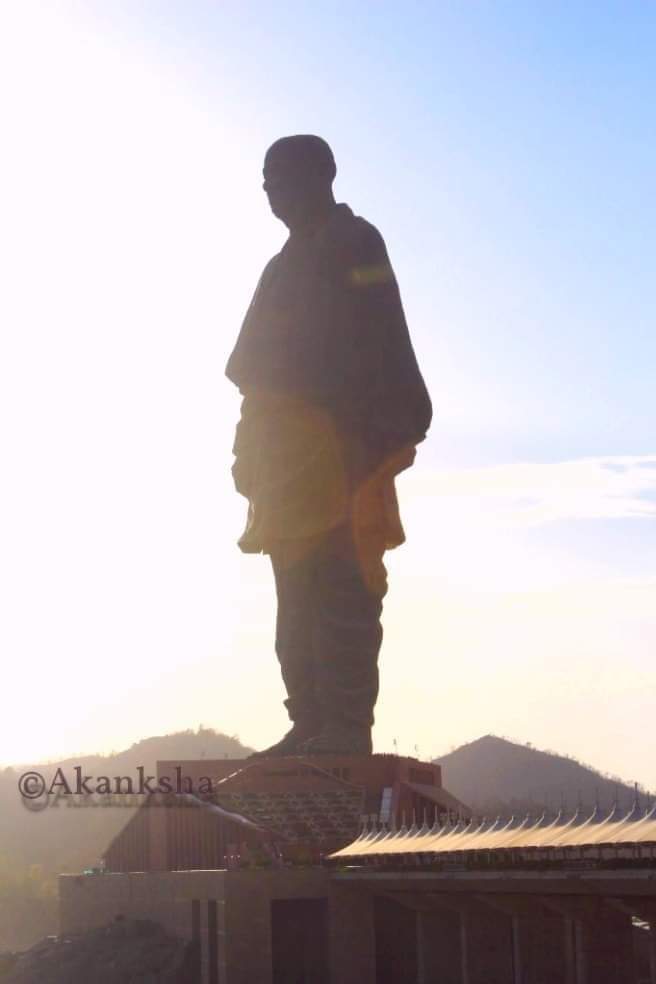
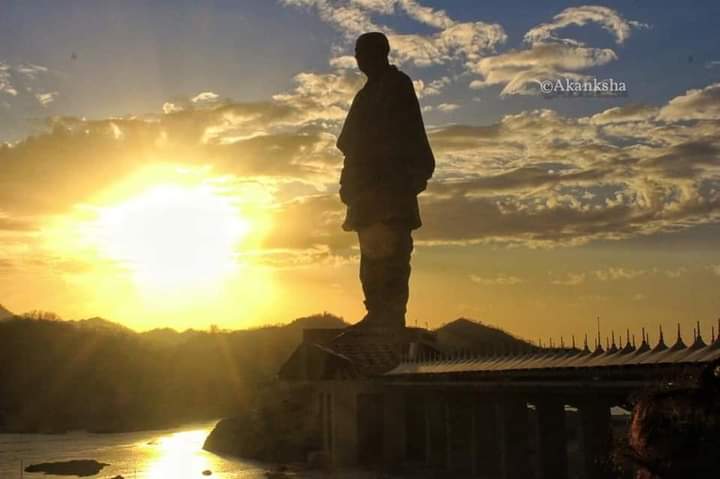
#StatueOfUnity
Iron Man of India, #SardarPatel Merged 553 Kingdoms for United India & Created Republic of India. India will remain indebted and gratitude to the vision,diplomacy and pragmatic approach of #SardarVallabhbhaiPate,who annexed 562 princely states with Union of India
+
Iron Man of India, #SardarPatel Merged 553 Kingdoms for United India & Created Republic of India. India will remain indebted and gratitude to the vision,diplomacy and pragmatic approach of #SardarVallabhbhaiPate,who annexed 562 princely states with Union of India
+

The princely state Hyderabad was brought under the Indian Union on 17Sep 1948, as Indian Army moved into Hyd in what was codenamed as 'Operation Polo'.
"One-Man Crusade Split India"
But, however the boundaries are drawn, there will be millions of Hindus in Pakistan and tens of
+
"One-Man Crusade Split India"
But, however the boundaries are drawn, there will be millions of Hindus in Pakistan and tens of
+
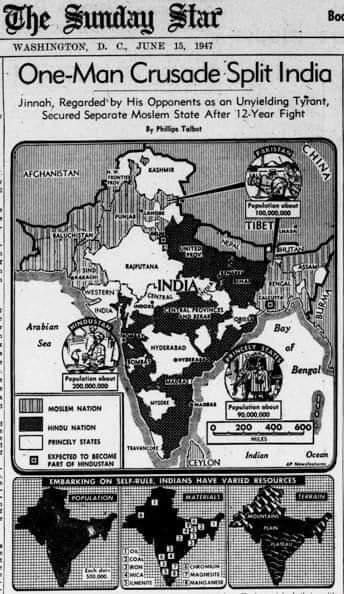
millions of Moslems outside it"
"If boundary disputes and other questions continue to agitate Hindu-Moslem feelings, therefore, both dominions will encounter big 5th columns within their borders"
"Meanwhile, rush, rush, rush is the order of the day.
+
"If boundary disputes and other questions continue to agitate Hindu-Moslem feelings, therefore, both dominions will encounter big 5th columns within their borders"
"Meanwhile, rush, rush, rush is the order of the day.
+
Viceroy Lord Mountbatten wants nothing to interfere with the turnover of power to the two Indian dominions by mid-August."
"And he hopes by keeping all factions busy they won't have time to mature their objections to his two-dominions-for-India plan"
+
"And he hopes by keeping all factions busy they won't have time to mature their objections to his two-dominions-for-India plan"
+
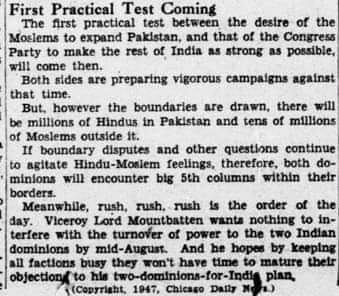
Yes. This was actually Jinnah's demand for his Pakistan. Look at this map, the british and Jinnah's patchwork of evil dreams ,the British actively ensured that the 500 odd Princely States stay different and totally isolated from India. As they never believed that India was one
+
+
nation. Sir John Strachey, the Finance Member in Viceroy’s Council used to say to his civil servant probationers that, “The first and most important thing to learn about India is that there is not and never was an India.”
And it was very much possible then
+
And it was very much possible then
+
given the Muslim League governments in Punjab and Bengal, and their dominance in muslim seats after 1946 Elections
By applying simple logic, if British began the conquest of India by defeating princely states like Marathas, Mysore, Nizam, Oudh and all,
+
By applying simple logic, if British began the conquest of India by defeating princely states like Marathas, Mysore, Nizam, Oudh and all,
+
how difficult was it to abolish princely states altogether and unite entire India into one single administrative unit? But they didn’t. They ensured the royal families continue ruling these kingdoms but as puppets of British.
+
+
The British always kept the Princely States in isolation from the 11 provinces directly ruled by British like Bombay, Madras, Bengal and so on. The princes were cultivated as loyal supporters of the British empire, hence ensuring that they remain divided from the rest of India.
+
+
Constitutionally, the Princely States were not part of British India nor were their citizens seen as British subjects. Parliament could not legislate on the Princely States. Only the Viceroy had the executive power to deal with them.
+
+
As early as 1825, Sir John Malcolm said , “I am decidedly of an opinion that tranquillity of our vast oriental possessions is involved in the preservation of native principalities. They are so obviously at our mercy…that their coexistence with our rule is
+
+
itself a source of political strength.”
Lord Mountstuart Elphinstone went a step ahead calling the Princely States as cess-pits to absorb all the miseries the British were bringing to India! After the Revolt of 1857, British realized the importance of Princely
+
Lord Mountstuart Elphinstone went a step ahead calling the Princely States as cess-pits to absorb all the miseries the British were bringing to India! After the Revolt of 1857, British realized the importance of Princely
+
States being loyal to them in times of conflict. They began cultivating relations with them. A powerless Council of Princes was set up in 1921 by Lord Chelmsford to “advice” Viceroy on certain matters. All this without giving any powers to them.
+
+
Come the decade of the 1920s, the entire demand was to create an All-India Federation which will consist of 11 British Provinces and all Princely States. Basically,it was a plan to set up a federal government at union level consisting of provinces as well as the Princely States
+
+
The British acceded to this demand in the Government of India Act 1935. But fundamentally being opposed to any unity among Indians, the British deliberately left the question of financial independence of Princely States and constitutional reforms in them, unsolved and pending.
+
+
As a result, no federation could be made. Moreover, Jinnah was opposed to it because such unity means Pakistan couldn’t be created. Being eternal patrons of Jinnah, the British abolished the All-India Federation in 1940 to appease Jinnah.
+
+
The last nail in the coffin was the decade of the 1940s when the British were negotiating their exit from India. Hasty deliberations took place in Cripps Mission (1942), Shimla Conference (1945) and Cabinet Mission (1946). The issue was that when the British had captured the
+
+
Princely States, treaties were signed with them to protect them provided the States accepted British Paramountcy over them. So what would happen to these treaties if the British left? The question was- Once the British leave, should their Paramountcy over Princely States
+
+
lapse or should they transfer it to the Independent Indian Government? If the latter happened, it would mean that the Princely States would be integrated with India. So the British deliberately said their Paramountcy over the States would lapse and they would be free to join
+
+
either India or Pakistan or stay independent! Do note that the British were not insistent in saying the Princely States should compulsorily be integrated into Independent India. This itself proves that the British never really wanted to unite India as one unit,
+
+
even when they were making it independent.
British created a recipe for disaster. And it did strike badly. The “great unitors” of India left in 1947 leaving India
After the interim government was sworn in July 1946, Patel became the Minister of State Affairs taking
+
British created a recipe for disaster. And it did strike badly. The “great unitors” of India left in 1947 leaving India
After the interim government was sworn in July 1946, Patel became the Minister of State Affairs taking
+
forward the tough task of integrating the Princely States into India (No Independence and No Pakistan). He used tactics of pressure and persuasion ensuring the integration of Princely States into India. The task was quite tough. Sardar’s deputy was V.P Menon who was sent for
+
+
negotiations. An Instrument of Accession was to be signed by prices surrendering their rights and a Standstill Agreement was signed to maintain status quo till a new constitution was promulgated. The princes were to be paid fat privy purses and could be sent as High
+
+
Commissioners and Ambassadors to foreign countries.
Some Princely States understood persuasion. At times, the pressure was applied. Fear for the future of the Hindu community drove Rajput states to India. Once, a heated discussion led to the Raja of Jodhpur
+
Some Princely States understood persuasion. At times, the pressure was applied. Fear for the future of the Hindu community drove Rajput states to India. Once, a heated discussion led to the Raja of Jodhpur
+
point his gun at V.P Menon.
The efforts of Travancore to become independent and seek recognition from United Nations were foiled. A plebiscite was taken in Junagarh leading to the fleeing of its Nawab to Pakistan.
+
The efforts of Travancore to become independent and seek recognition from United Nations were foiled. A plebiscite was taken in Junagarh leading to the fleeing of its Nawab to Pakistan.
+
Thankfully, Sardar Patel ensured that Jinnah got a moth eaten Pakistan.
By August 15, 1947, all except Hyderabad, Junagarh, and Kashmir acceded to India. Patel thereafter carried the three-fold process of assimilation, centralization, and unification of states.
+
By August 15, 1947, all except Hyderabad, Junagarh, and Kashmir acceded to India. Patel thereafter carried the three-fold process of assimilation, centralization, and unification of states.
+
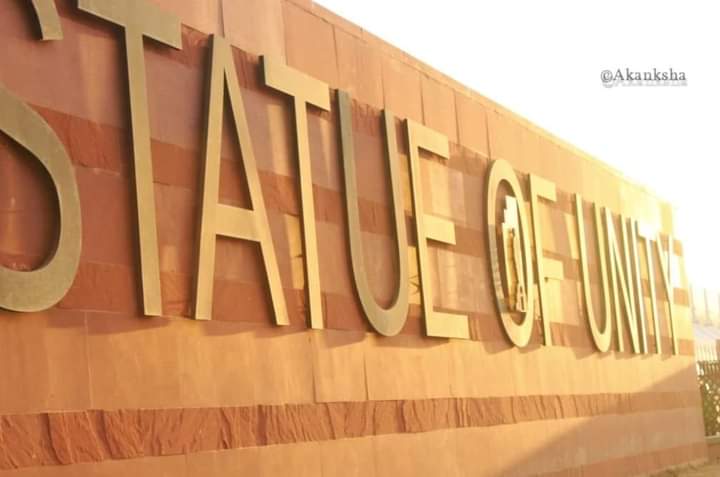
The states were amalgamated to form a union and that union was merged with the Union of India.
A crusader and stature of Unionized India Sardar Patel, after his demise A woman reached Pandit Jawaharlal Nehru with a bag and a copy. When the bag was opened,
+
A crusader and stature of Unionized India Sardar Patel, after his demise A woman reached Pandit Jawaharlal Nehru with a bag and a copy. When the bag was opened,
+
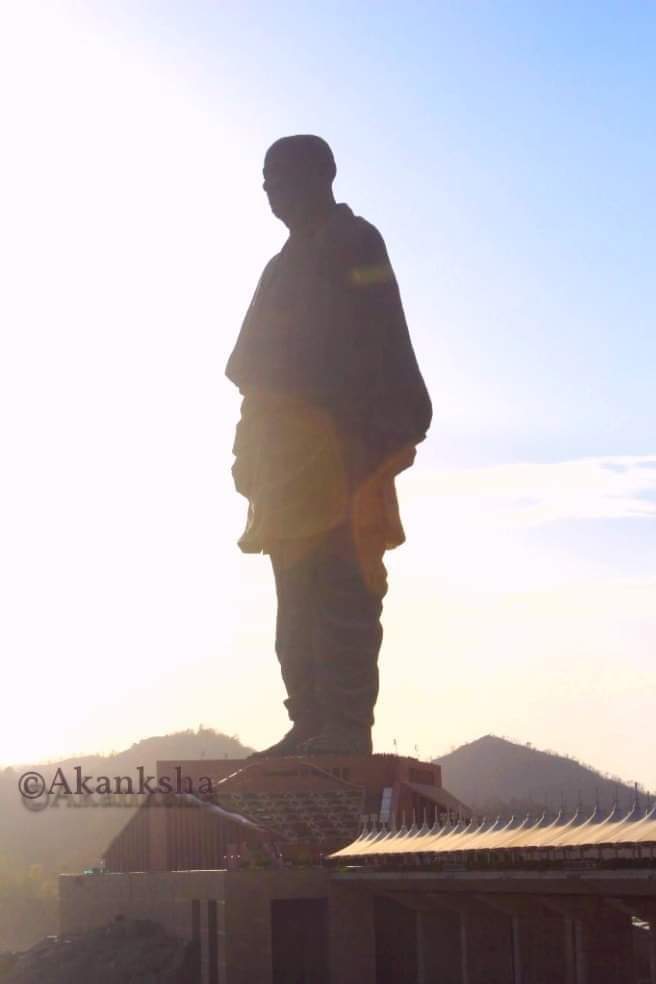
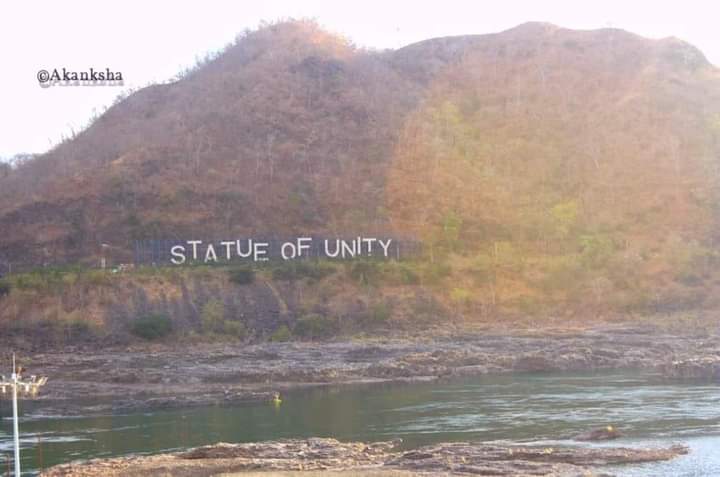
it contained Rs 35 lakh. The woman told that this copy and bag was given to her by her father at the time of her death and asked to hand it over to you. My father used to calculate this money and this money belongs to the Congress party.
+
+
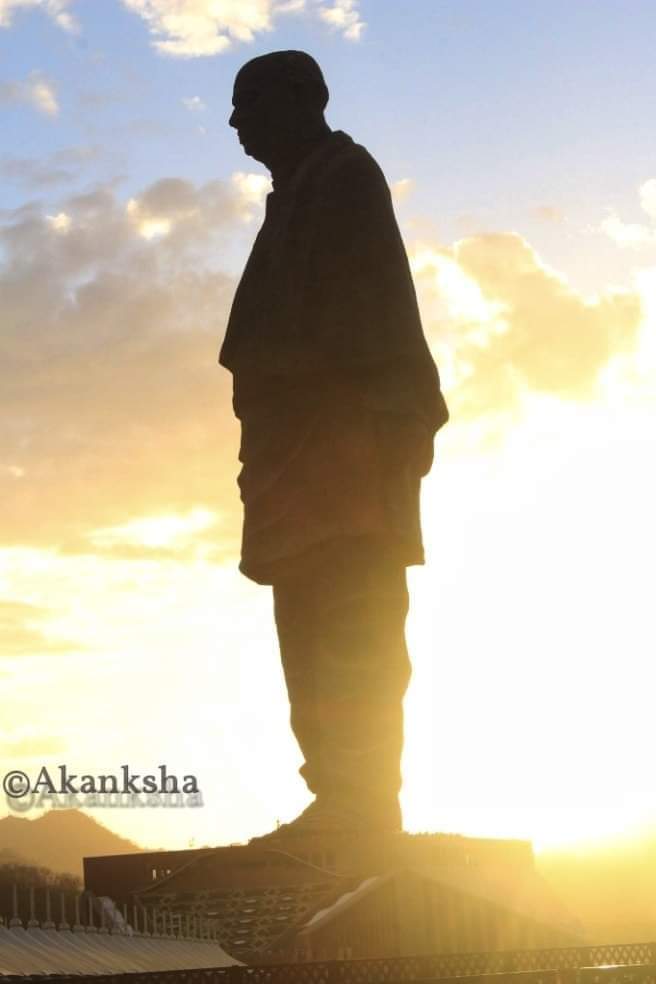
I didn't spend a single penny from it. The name of that woman was Maniven Patel, who was the daughter of late Vallabhbhai Patel.
• • •
Missing some Tweet in this thread? You can try to
force a refresh