Cory Clark Profile picture
Nov 10 6 tweets 2 min read Twitter logo Read on Twitter
1. New meta-analysis of 85 studies testing gender bias in hiring practices & forecasting surveys asking scientists & laypeople to predict the results found:

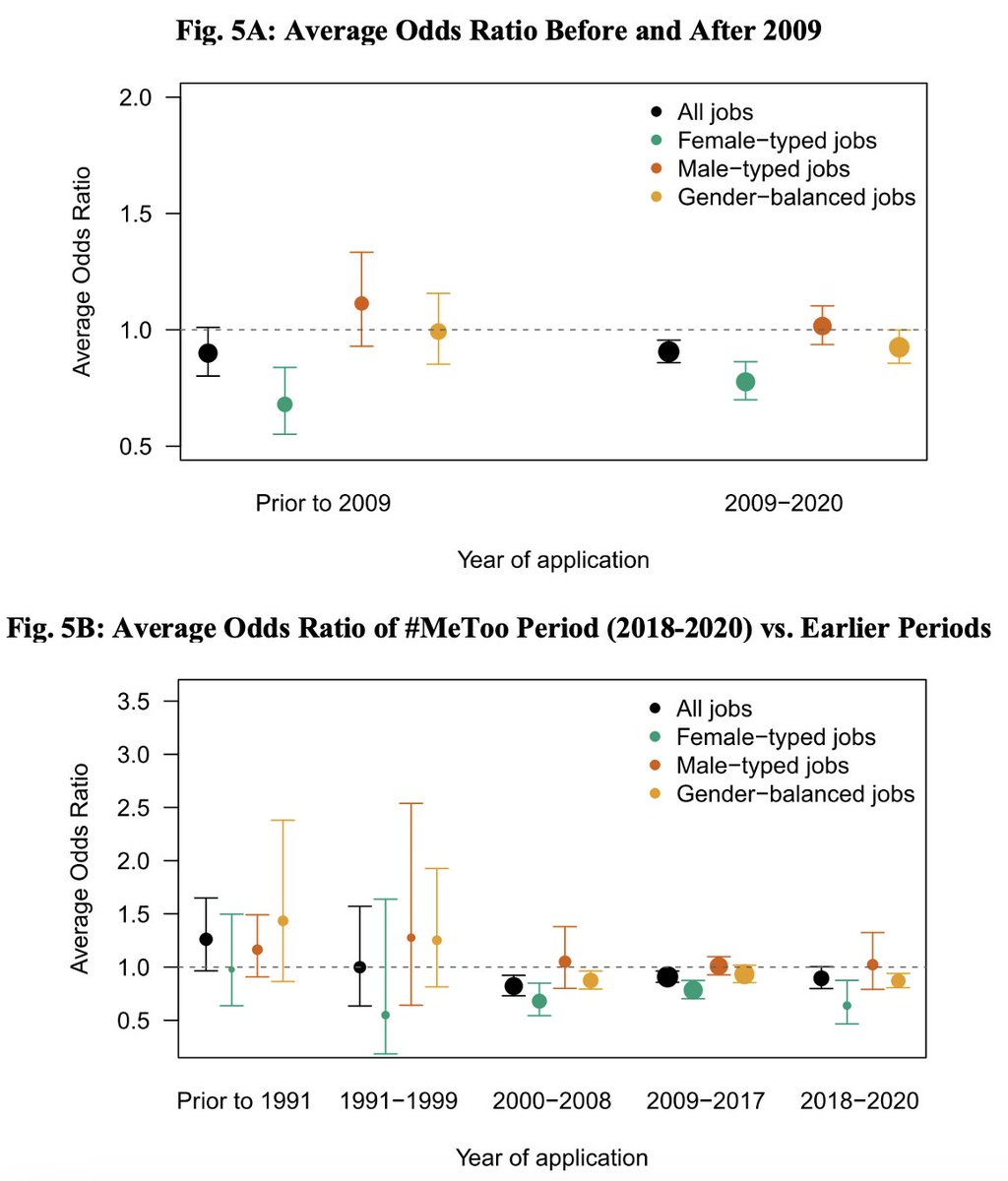
-Post-2009, hiring biases favor females
-Scientists & laypeople wildly overestimate gender bias
sciencedirect.com/science/articl…
2. This meta included 44 years of field audit studies (in which carefully-matched female & male job applications are sent to real orgs) testing for gender biases in callback rates for female-
stereotypical, gender neutral, & male-stereotypical jobs
3. For male-typed jobs, males used to be favored & now no gender bias is observed

For gender neutral jobs, males used to be favored & now females are

For female-typed jobs, females were & are still favored

(ORs<1 = females favored)
Image
Image
4. Both academics & everyday people correctly anticipated that pro-male bias has been decreasing over time, but they also drastically overestimated pro-male bias in male-typed & gender-neutral jobs. Indeed, for later years, they had the direction backward: women are now favored. Image
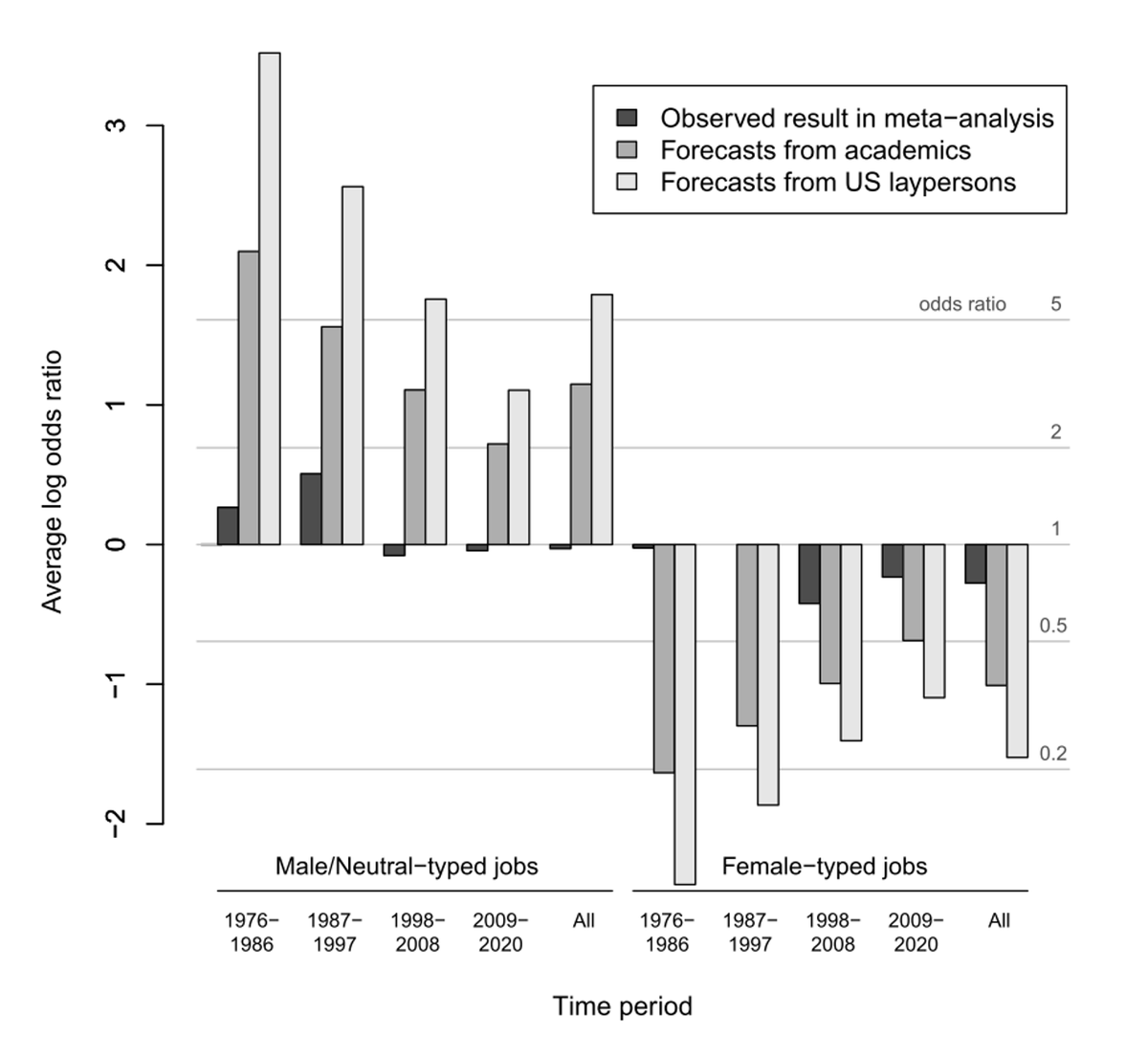
5. Both academics & everyday people also drastically overestimated pro-female bias in female-typed jobs. And they anticipated that this bias has also been decreasing over time, but it does not appear to be. Women always were and still are favored for these jobs.
6. Check out this massively impressive piece of work here led by the formidable @michaelschaerer: sciencedirect.com/science/articl…

• • •

Missing some Tweet in this thread? You can try to force a refresh

 

Keep Current with Cory Clark

Cory Clark Profile picture

Stay in touch and get notified when new unrolls are available from this author!

Read all threads

This Thread may be Removed Anytime!

PDF

Twitter may remove this content at anytime! Save it as PDF for later use!

Try unrolling a thread yourself!

how to unroll video
  1. Follow @ThreadReaderApp to mention us!

  2. From a Twitter thread mention us with a keyword "unroll"
@threadreaderapp unroll

Practice here first or read more on our help page!

More from @ImHardcory

Jun 1
1. Science journals have begun adding moral criteria to their pub guidelines, stating they might reject or retract potentially harmful papers.

In 2 studies, Maja Graso @irakresh @PTetlock & I found that people systematically overestimate scientific harms:
journals.sagepub.com/doi/abs/10.117…
2. Subjects read summaries of 6 potentially controversial findings (e.g., that female mentees benefit when they have more male than female mentors). One group reported whether they support various behavioral reactions. The other estimated the % of people who support each reaction
3. People consistently overestimated support for all harmful reactions (e.g., "Discourage young females from approaching female mentors") & underestimated support for all helpful reactions (e.g., "Invest in programs that help women develop as mentors.") Image
Read 6 tweets
Apr 14
1. Even when ideologies align, people distrust politicized institutions:

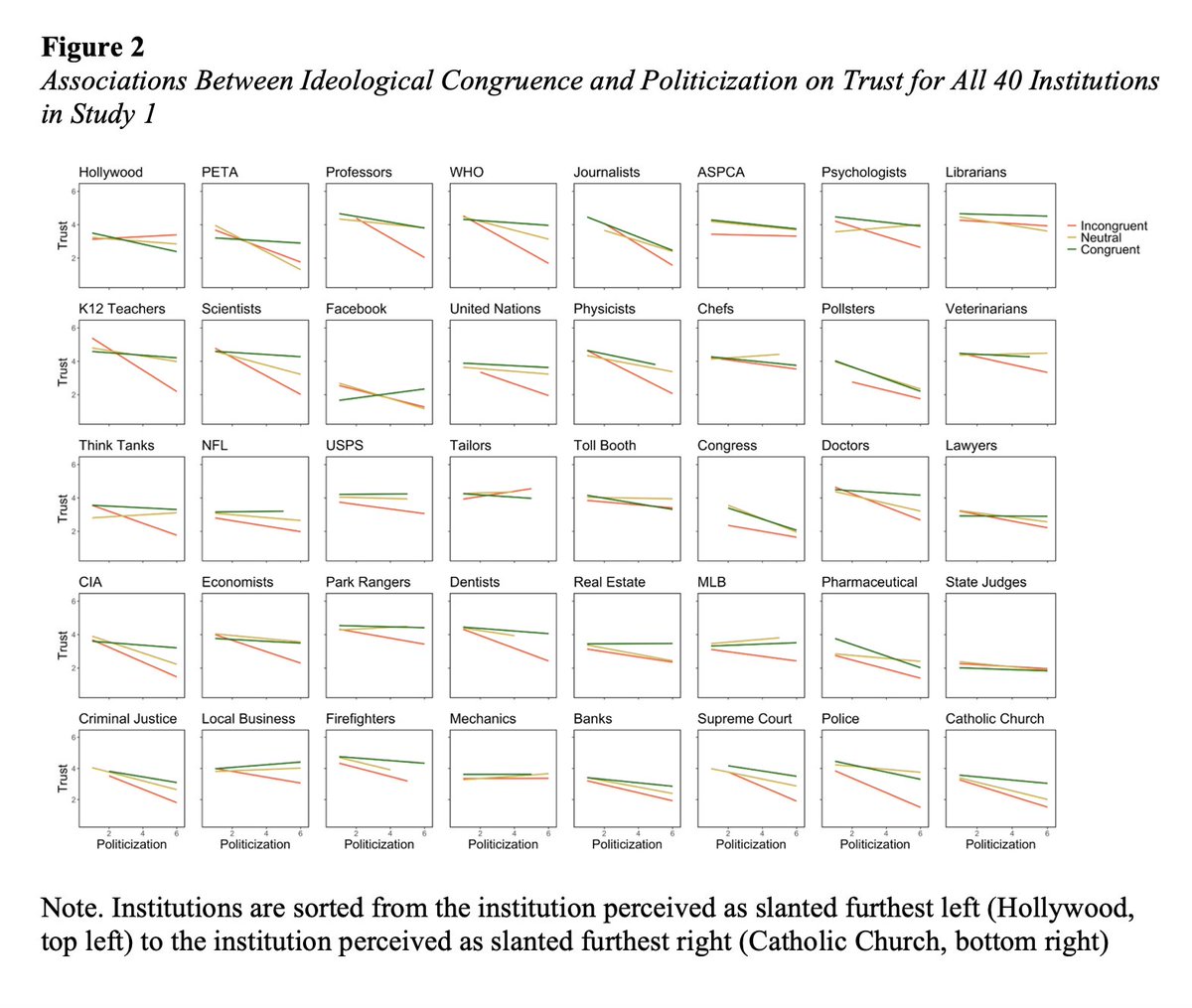
In 3 studies & across 40 institutions, @calvinisch2 @JimACEverett @azimshariff & I find evidence that perceived politicization is strongly associated with lower trust in institutions
https://t.co/aYts6O1h1Qpsyarxiv.com/sfubr
Image
2. This was observed on an individual difference level: When people perceived institutions as politicized, they trusted them less.

& This was observed between institutions: Institutions perceived as the most politicized were also the least trusted, with a large effect, r = -0.76 Image
3. This pattern was observed even when participants shared the perceived ideology of the institution. For example, even left-leaning participants tended to trust left-leaning institutions less if they perceived them as politicized. Image
Read 7 tweets
Oct 8, 2022
1. Academia increasingly prioritizes equity and works to ensure scholarship does not offend or pose risks to vulnerable groups. @EPoe187 and I contend that these shifting priorities are caused, in part, by the growing proportion of women in academia:
quillette.com/2022/10/08/sex…
2. A few points of evidence:
Over the past few decades, women increasingly earn higher proportions of doctoral degrees and faculty positions in higher education ImageImage
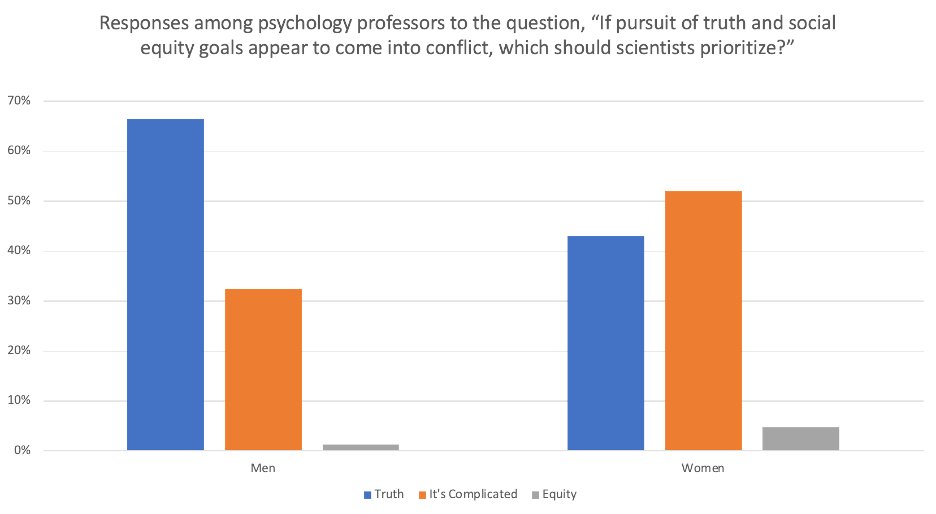
3. Across numerous surveys, women (compared to men) report lower support for academic freedom and pursuit of truth and higher support for various moral priorities related to equity, emotional well-being, and social justice ImageImage
Read 6 tweets
Feb 6, 2022
1. Science often contradicts other science. When this happens, disputant scholars tend to work separately, designing their own new studies to launch at their opponents. These new studies rarely persuade the other side, and contradictory claims live in on for years or decades.
2. On rare occasions, scholars swallow their pride and put their theories at real risk by working with their intellectual opponents. These are called Adversarial Collaborations (term coined by Danny Kahneman), and @PTetlock and I have been working hard to normalize them.
3. In two weeks, we will be presenting preliminary results of three of our adversarial collaborations (ACs) at #SPSP2022. All of our data collections are still underway, so we have no idea how the results will turn out. Care to predict the findings?
Read 10 tweets
Feb 11, 2021
1. In my new chapter w/@natehoneycutt & @PsychRabble, we argue that scientists might actually be humans. And that as humans, scientists might be vulnerable to the same kinds of errors, biases, & motivations that they so often study in non-scientist humans:
researchgate.net/publication/34… Image
2. We suggest that scientists might occasionally engage in motivated research: Their own human desires might influence how they familiarize themselves with data, collect and analyze observations, draw and describe conclusions, and evaluate their peers' research. Image
3. Of the sciences, the social sciences might be *most* vulnerable to motivated research: Messy/ambiguous data environment + human and moral concerns. Image
Read 5 tweets
Jan 24, 2021
1. A sneak peak at yet unpublished meta-analyses on whether there is gender bias in academic science in six domains: letters of recommendation, tenure-track hiring, journal acceptances, grant funding, salary, and teaching ratings:

journals.sagepub.com/doi/full/10.11…
2. In teaching evaluations, female instructors are rated lower than male instructors by both male and female students. So some evidence of gender bias there (although it would be helpful to know whether this finding holds up when gender is experimentally manipulated).
3. The 18% gender salary gap shrinks to 4% controlling for type of institution, discipline, and years of experience. This 4% does not control for the fact that men publish more, so the apples to apples gap might be smaller than that.
Read 6 tweets

Did Thread Reader help you today?

Support us! We are indie developers!


This site is made by just two indie developers on a laptop doing marketing, support and development! Read more about the story.

Become a Premium Member ($3/month or $30/year) and get exclusive features!

Become Premium

Don't want to be a Premium member but still want to support us?

Make a small donation by buying us coffee ($5) or help with server cost ($10)

Donate via Paypal

Or Donate anonymously using crypto!

Ethereum

0xfe58350B80634f60Fa6Dc149a72b4DFbc17D341E copy

Bitcoin

3ATGMxNzCUFzxpMCHL5sWSt4DVtS8UqXpi copy

Thank you for your support!

Follow Us on Twitter!

:(