Read on Twitter
Ericsson in billion-dollar battle over secret database in the US
Telecom giant Ericsson is about to become the administrator of a critical part of the US telephone system. But with an aggressive and extensive lobbying campaign in Washington.
🧵>>

Telecom giant Ericsson is about to become the administrator of a critical part of the US telephone system. But with an aggressive and extensive lobbying campaign in Washington.
🧵>>
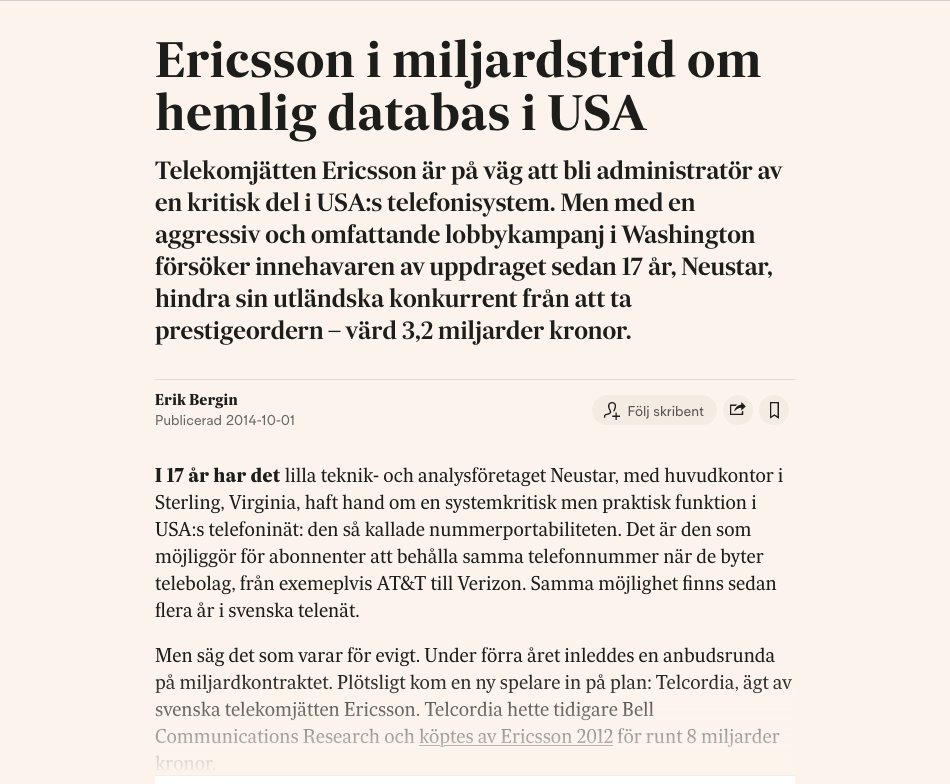
The holder of the assignment for 17 years, Neustar, is trying to prevent its foreign competitor from taking the prestigious order - worth SEK 3.2 billion.
For 17 years, the small technology and analytics company Neustar.
>>
For 17 years, the small technology and analytics company Neustar.
>>
Neustar headquartered in Sterling, Virginia, has been in charge of a system-critical but practical feature of the US telephone network: the so-called number portability.
>>
>>
It is the one that enables subscribers to keep the same phone number when they change carriers, from eg AT&T to Verizon. The same option has been available in Swedish telecommunications networks for several years.
>>
>>
Last year, a tender was launched for the billion dollar contract. Suddenly a new player entered: Telcordia, owned by by the Swedish telecom giant Ericsson. Telcordia was previously called Bell Communications research and was bought by Ericsson in 2012 for SEK 8 billion.
>>
>>
Iconective
iconectiv is a supplier of network planning and network management services to telecommunications providers. Known as Bellcore after its establishment in the United States in 1983 as part of the break-up of the Bell System
>>
iconectiv is a supplier of network planning and network management services to telecommunications providers. Known as Bellcore after its establishment in the United States in 1983 as part of the break-up of the Bell System
>>

the company's name changed to Telcordia Technologies after a change of ownership in 1996. The business was acquired by Ericsson in 2012, then restructured and rebranded as iconectiv in 2013.
Ericsson acquired Telcordia
On June 14, 2011, Ericsson announced that it would buy the American telecommunication research and development company Telcordia for £1.15 billion.
>>
On June 14, 2011, Ericsson announced that it would buy the American telecommunication research and development company Telcordia for £1.15 billion.
>>
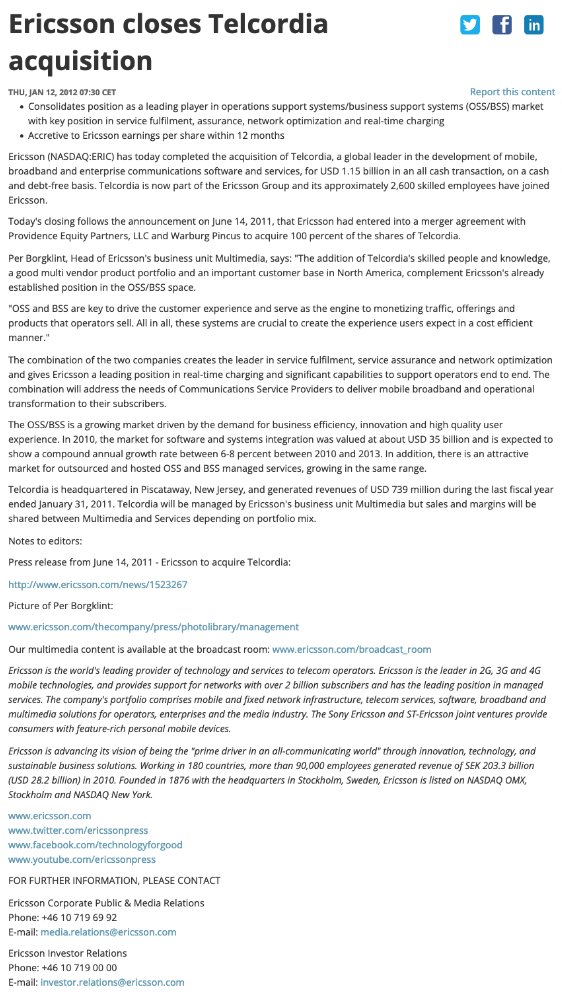
The acquisition officially closed on January 12, 2012, with the company folded into Ericsson’s Multimedia unit, now called Support Solutions.
One of the reasons Ericsson bought Telcordia is that Ericsson sees Operations support systems..
>>
One of the reasons Ericsson bought Telcordia is that Ericsson sees Operations support systems..
>>
(OSS) and business support systems (BSS) as key growth areas and wants to strengthen its position within OSS/BSS transformation and mobile broadband support systems.
>>
>>
In a press release, Hans Vestberg, President and Chief Executive Officer, Ericsson, said: "The importance of operations and business support systems will continue to grow as more and more devices are connected, services become mobile..
>>
>>

..and new business models for mobile broadband are introduced. In this context, Telcordia brings very skilled people and knowledge, a large business in North America and other markets, as well as a good multi vendor product portfolio."
>>
>>
In October, 2012, Applied Communication Sciences relocated its headquarters toBasking Bridge, New Jersey, where it occupies the former AT&T Wireless headquarters building.
>>
>>
Telcordia was a chief architect of the telecommunications system in the U.S. Its software products were designed to solve communications problems, support complex operations missions and system interoperability issues.
>>
>>
Telcordia developed many of the technologies that have revolutionized communications, including the ability to make three-way and toll-free phone call.
Another invention from Telcordia is the Multipurpose Internet Mail Extensions (MIME) standard.
>>
Another invention from Telcordia is the Multipurpose Internet Mail Extensions (MIME) standard.
>>
MIME standard that is today used globally to send multimedia e-mail attachments, including photos, documents and audio files. The company also wrote proposed generic requirements (GRs) for telecommunications industry hardware and offers consulting and testing to these GRs.
>>
>>
Over the years, Telcordia research generated more than 1800 patents.............
#Ericsson
#Ericsson
@Vltra_MK @cgz_cgz @Biz_Shrink
• • •
Missing some Tweet in this thread? You can try to
force a refresh