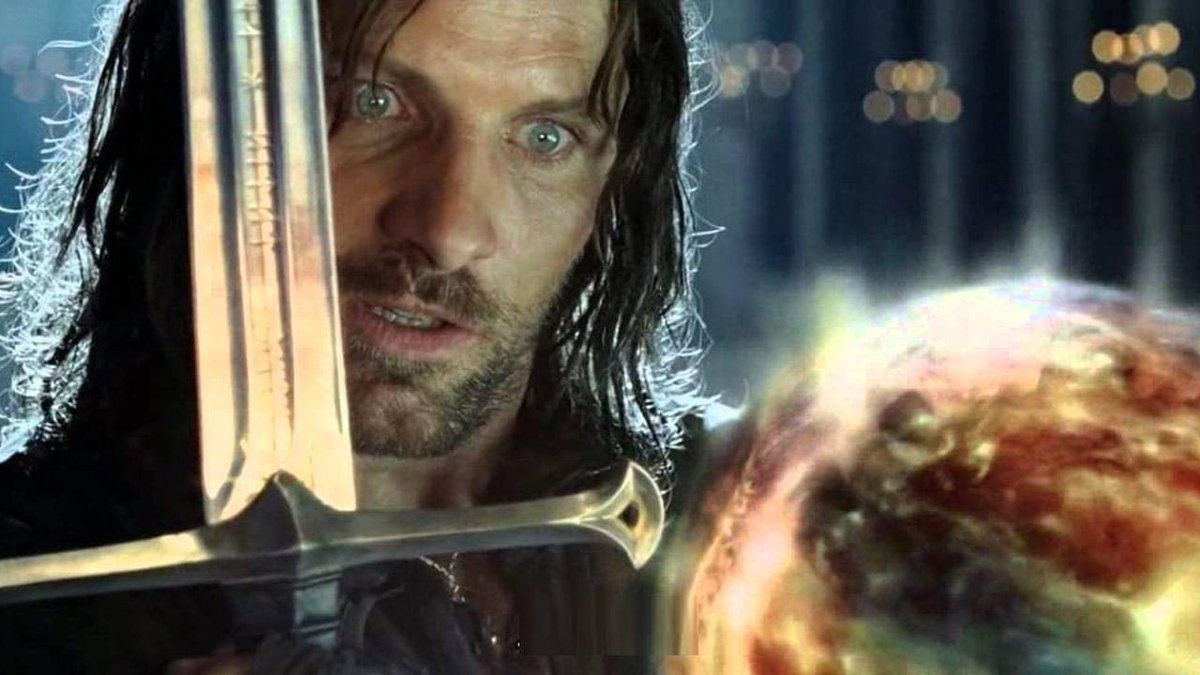
The difference between book-Aragorn and movie-Aragorn is most apparent in the depiction of his encounter with Sauron in the Palantir.
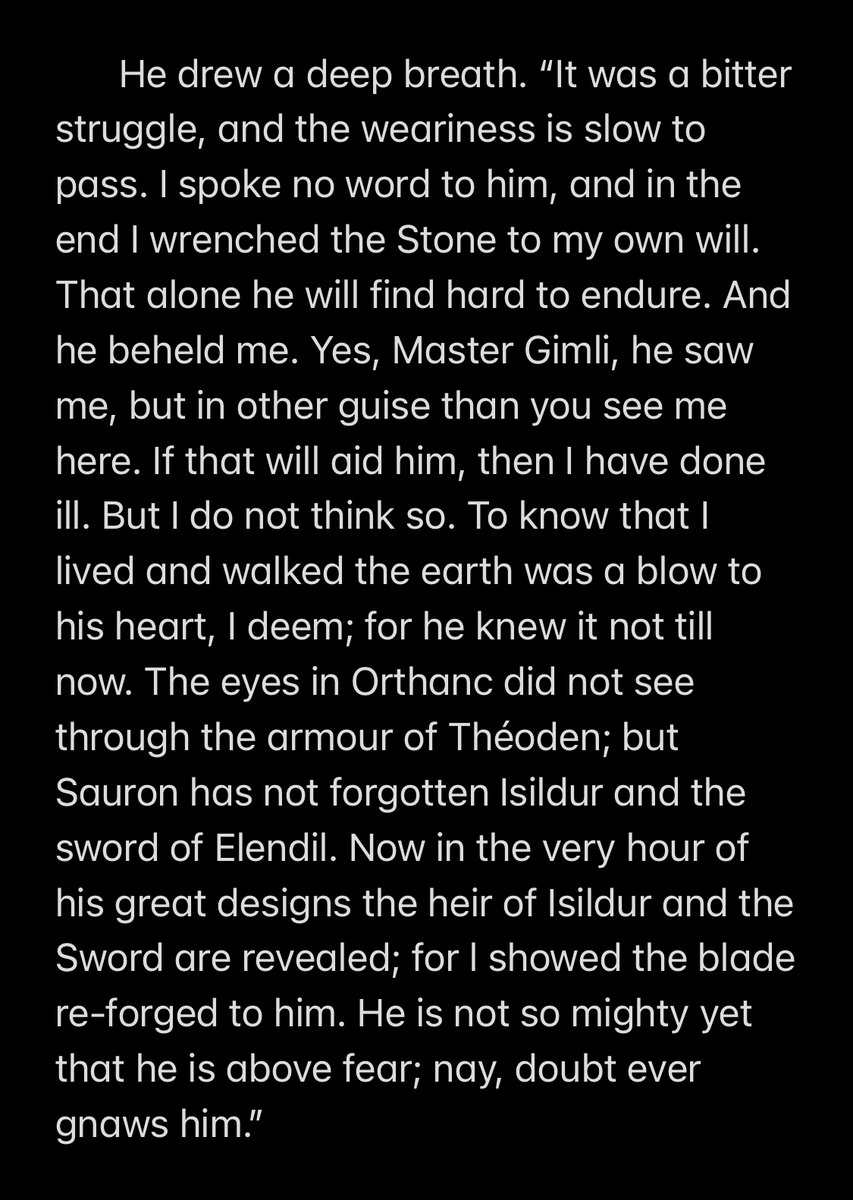
Here's Tolkien:
Perhaps no passage in a book has ever charged me up the way the way that one did. This was an expression of greatness, and I loved it more than I can say.
“To know that I lived and walked the earth was a blow to his heart.” Next-level thumos!
When Gimli rebukes him for doing this—implying that it was ill-advised and beyond his capacity—Aragorn tells his friend, “You forget to whom you speak.” Incredible response, incredible man.
He has been waiting his whole life for this, and he is man enough for the great moment.
It's not simply bravado that prompts Aragorn (though that might not have been the worst thing either—moralistic scolds won't understand.) His decision has strategic effects. Panicked by the showdown, Sauron makes an unforced error shortly thereafter by attacking Gondor too soon.
What do Jackson and the screenwriters do with this absolutely crucial scene?
The theatrical cut deletes it altogether.
That’s pretty bad, but it gets worse...
In an extended cut the scene is altered so that Sauron basically bitchslaps Aragorn with a vision of Arwen suffering—which causes him to stagger back and drop the Stone of Orthanc in defeat.
Cmon! Like I said, Jackson and his team are owed a debt of gratitude for brining LotR to the screen as well as they did. But these changes are so incredibly unnecessary—demoralizing even.
We don’t need to see emo-Aragorn second-guessing himself like some contemporary democratic soul. We need to see the Aragorn who "wrenches the Stone to his will."
Tolkien's hero is magnanimous to the bone, and this is the virtue we most need to rediscover right now, with so much of modern life being specifically designed to demean and discourage us.
A man who feels the call—and answers it—is precisely what the doctor ordered.
• • •
Missing some Tweet in this thread? You can try to
force a refresh

October 10, 732—Charles Martel and an army of Franks halt and turn back the Umayyad invasion at the Battle of Tours.
Isidore of Beja on the Frankish infantry:
“Firmly they stood, one close to another, forming as it were a bulwark of ice.”
Denis the Chronicler on the leader of the Franks:
"He fought as fiercely as the hungry wolf falls upon the stag. By the grace of Our Lord, he wrought a great slaughter on the enemies of Christian faith. Then was he first called 'Martel,' for as a hammer of iron ... even so he dashed and smote in the battle all his enemies."
“The Spanish Muslims were fully aware of who Charles Martel was and what he had done to their aspirations. Indeed, Muslims in Spain had learned from their defeat that the Franks were not a sedentary people served by mercenary garrison troops, nor were they a barbarian horde. They, too, were empire builders, and the Frankish host was made up of very well trained citizen volunteers who possessed arms, armor, and tactics superior to those of the Muslims. Indeed, when the Muslims tried to invade Gaul again in 735, Charles Martel and his Frank gave them another beating, so severe that Muslim forces never ventured very far north again. Forty years later, Martel's grandson joined the long process of driving them from Spain.”
Stark also highlights a good lesson to be drawn from the battle.
“Late in the afternoon, as the Arab chronicler reported, many Muslims became ‘fearful for the safety of the spoil which they had stored in their tents, and a false cry arose in their ranks that some of the enemy were plundering the camp; whereupon several squadrons of the Muslim horseman rode off to protect their tents.’ To other units appeared to be a retreat, and it soon became one, during which the Franks unleashed their own heavily armored cavalry to inflict severe casualties on the fleeing Muslims; at least 10,000 of them died that afternoon.”
On September 8, 1157, the third son of Henry II and Eleanor of Aquitaine was born: Richard the Lionheart. One of the all-timers.
“Richard was a complex character," wrote Rodney Stark. "As a soldier he was little short of mad, incredibly reckless and foolhardy, but as a commander he was intelligent, cautious, and calculating. He would risk his own life with complete nonchalance, but nothing could persuade him to endanger his troops more than was absolutely necessary. Troops adore such a commander.”
That gap in the Pyrenees is called Roland’s Breach—legend has it that Charlemagne’s most famous knight cut the rock away in the final moments of his life. 🧵
Roland was the medieval Achilles and the last survivor of Charlemagne’s rearguard at the Battle of Roncevaux Pass, where they were treacherously ambushed. As the end neared, he dreaded the seeming inevitability that his sword Durendal would fall into Saracen hands.
He could not allow such a thing to happen.
This was no ordinary sword—made in Heaven and given by an angel to Charlemagne, who then gave it to his nephew and champion. So Roland tried to break the sword by striking against the Pyrenees.
You know St George killed a dragon, but do you know what the dragon was about?
It wasn’t just a random mythological creature, much less one of those nice dragons who will carry riders on his back. It was a venom-spewing devourer of children.🧵
Long before George arrived, the men of Silene decided to do something about the fearsome beast in their country, so they assembled and marched off. But when they were face to face with the monster their hearts gave out, the Golden Legend reports. They fled.
And the cost of their cowardice would be steep. The narrative continues: "And when he came nigh the city he envenomed the people with his breath, and therefore the people of the city gave to him every day two sheep for to feed him, because he should do no harm to the people.”
One of the unsung heroes of the third Crusade was a priest who dove from the battlements of the Jaffa into the sea and swam to Richard the Lionheart’s galley with a cry for help.🧵
Richard had been in Acre making preparations to return to England to deal with the urgent business there (traitors trying to take his kingdom). The Crusade was over, he thought, a brilliant but doomed campaign which he planned to return to after taking back his own kingdom.
Then he heard about Saladin’s surprise attack against Jaffa.
He sailed back to Jaffa and arrived thinking that it was too late; Saracen banners had been raised and the city appeared to have been taken.
A pattern you recognize when reading history is that we can count on being outnumbered. The enemy is so often legion.
One of the greatest mechanisms for maximizing this numerical superiority was the janissary program of the Ottoman Turks. 🧵
This thread will get dark, but a note of hope emerges at the end (as always).
Turkish for “new soldier,” janissaries were elite infantrymen unleashed against the enemies of the Ottomans, like the Christian people of the Balkans.
What made the corps truly devastating was the origin of these soldiers: they were taken from Christian families as boys, indoctrinated in Ottoman ways, and then turned loose against their own people!