Gang crime. It's talked about a lot, but it's not as major as people generally think. Nevertheless, it still matters, and its existence practically gives law enforcement a cheat-code for reducing crime rates.
In the case of New York, they were able to reduce crime by huge amounts by taking down gangs. This has replicated in totally different cultural contexts.
Consider Barcelona. Latin gangs arrived in the city in 2002, and by 2012, they had at least 2,500 known members. That's prolific growth for a pretty major problem.
In 2012, Barcelona organized a specialized gang targeting unit to police Latin gangs. The effect of this unit's sweeps on crime was large.
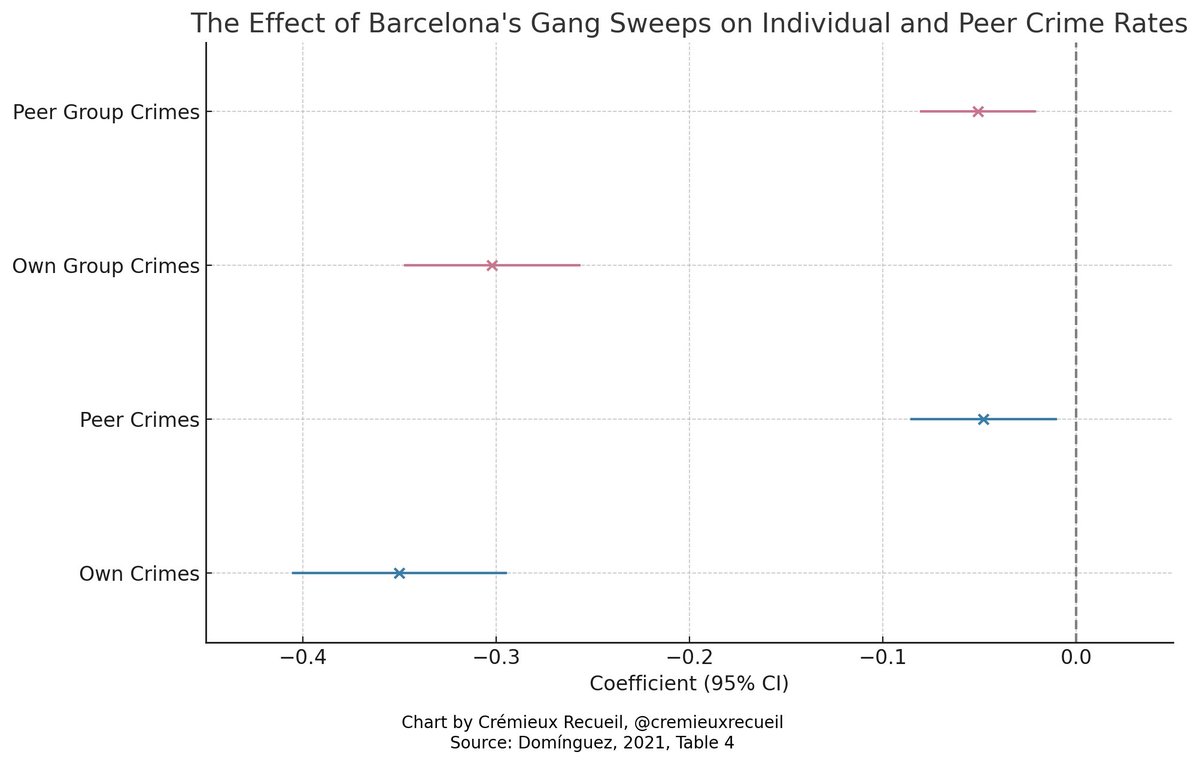
When individuals were arrested, their participation in individual-level and group (i.e., generally gang) crimes went down substantially. Overall, the odds of committing any crime were nearly halved (-44%), but that wasn't all: individuals who were peers of arrested criminals also saw reductions in the probability they committed a crime (-12%).
To place this into clearer terms, when someone was arrested in a gang sweep, their subsequent numbers of crimes committed went down by 95% in total and 99% for group crimes. For their peers, the number of crimes went down by 26% in total and nearly halved for group crimes (-43%).
This effort reveals something important about precision policing of gangs: because their members are connected and they influence the communities around them through recruitment, harassment, encouragement of criminal offending, and other means, knocking out a gang member stops more than just that gang member from committing crimes. Knocking out gangs causes knock-on effects, where crime for others falls too.
This sort of precision policing also clearly works. Just look at the network structure of gangs before and after the sweeps took place:
Even more importantly, if central players in gang networks are targeted specifically, there are likely to be greater reductions in crime in total because these central players have larger peer effects on the probability of committing a crime.
So, which crimes declined? It might seem like peer effects should be on things that require organization, and which are lucrative for peers to work together to achieve, like robbing a store or bank, setting up illegal gambling venues, etc. But that thought is wrong: the significant effects were on vandalism, violent crimes resulting in injuries to other persons, and arson.
In other words, gang activity is senseless.
We're lucky that precision policing works.
Source:
ieb.ub.edu/wp-content/upl…
In the case of New York, they were able to reduce crime by huge amounts by taking down gangs. This has replicated in totally different cultural contexts.
Consider Barcelona. Latin gangs arrived in the city in 2002, and by 2012, they had at least 2,500 known members. That's prolific growth for a pretty major problem.
In 2012, Barcelona organized a specialized gang targeting unit to police Latin gangs. The effect of this unit's sweeps on crime was large.
When individuals were arrested, their participation in individual-level and group (i.e., generally gang) crimes went down substantially. Overall, the odds of committing any crime were nearly halved (-44%), but that wasn't all: individuals who were peers of arrested criminals also saw reductions in the probability they committed a crime (-12%).
To place this into clearer terms, when someone was arrested in a gang sweep, their subsequent numbers of crimes committed went down by 95% in total and 99% for group crimes. For their peers, the number of crimes went down by 26% in total and nearly halved for group crimes (-43%).
This effort reveals something important about precision policing of gangs: because their members are connected and they influence the communities around them through recruitment, harassment, encouragement of criminal offending, and other means, knocking out a gang member stops more than just that gang member from committing crimes. Knocking out gangs causes knock-on effects, where crime for others falls too.
This sort of precision policing also clearly works. Just look at the network structure of gangs before and after the sweeps took place:
Even more importantly, if central players in gang networks are targeted specifically, there are likely to be greater reductions in crime in total because these central players have larger peer effects on the probability of committing a crime.
So, which crimes declined? It might seem like peer effects should be on things that require organization, and which are lucrative for peers to work together to achieve, like robbing a store or bank, setting up illegal gambling venues, etc. But that thought is wrong: the significant effects were on vandalism, violent crimes resulting in injuries to other persons, and arson.
In other words, gang activity is senseless.
We're lucky that precision policing works.
Source:
ieb.ub.edu/wp-content/upl…


• • •
Missing some Tweet in this thread? You can try to
force a refresh