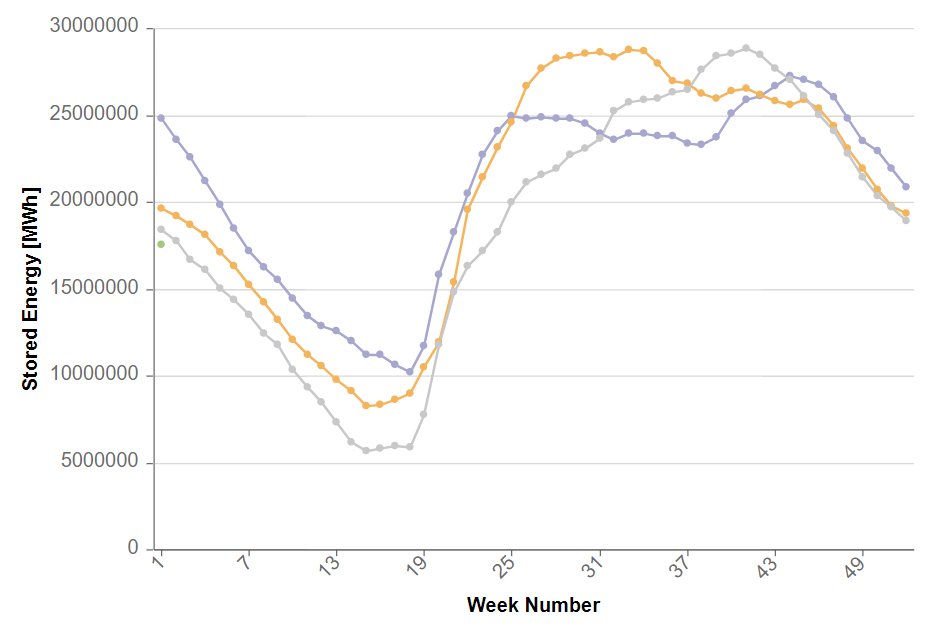
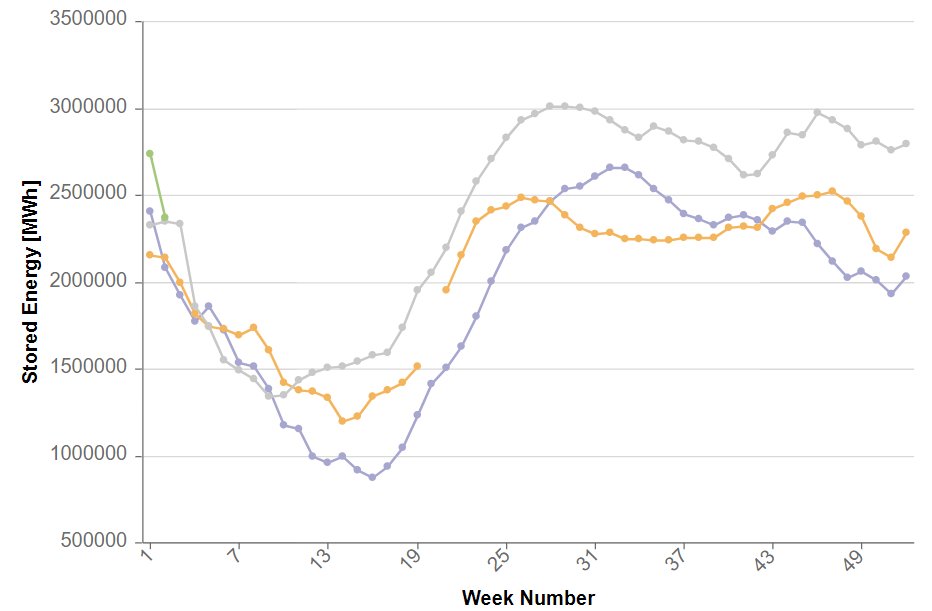
Nordics have a great advantage for their power grids: they possess (extremely) large energy storage.
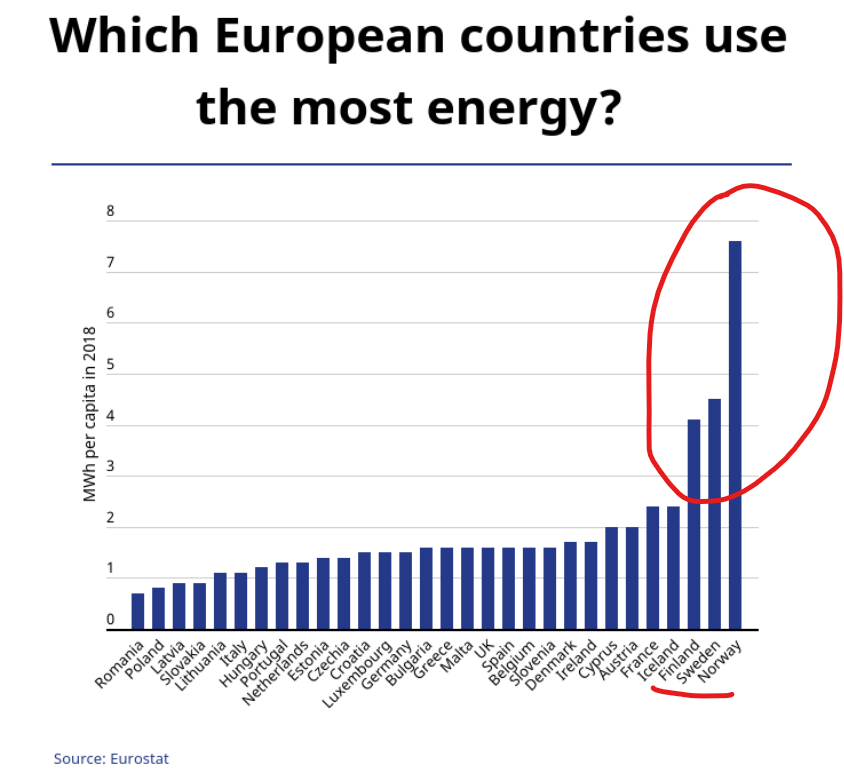
The number 1 is Norway as the country can store 75.7 TWh in its water dams for electricity. That's 14 MWh per capita (a PowerWall has 1000 less energy).
1/6
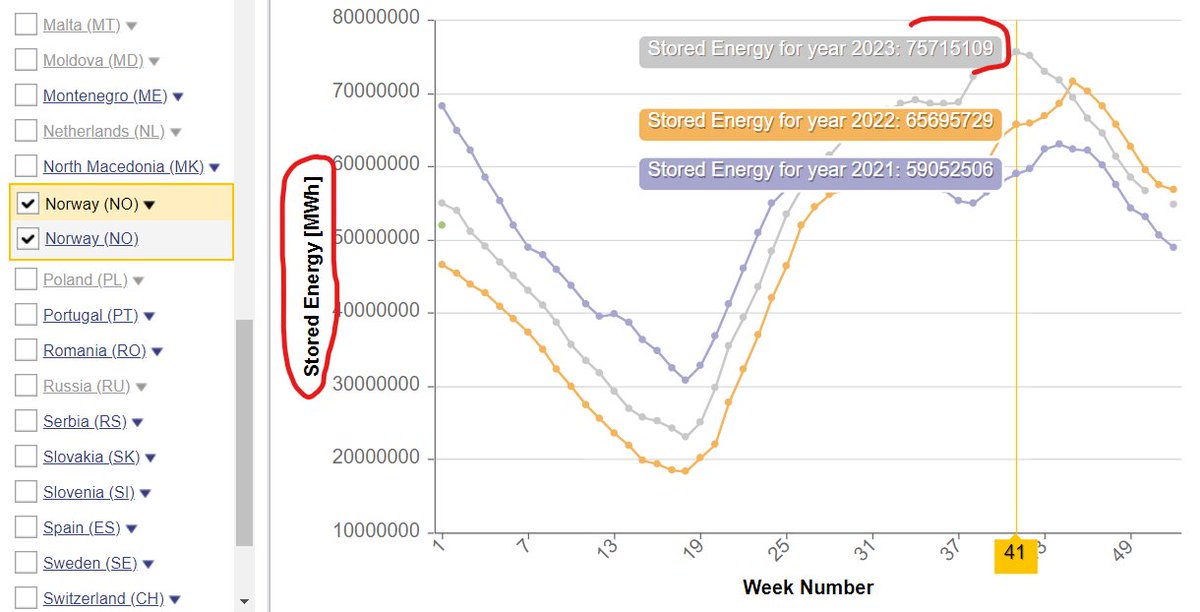
Sweden has also very important water reserves, with 28.8 TWh (max value, of course, never fully used), or 2.7 MWh per capita.
2/6
For comparison, France has only 3 TWh, or only 0.06 MWh per capita. Germany has even less.
3/6
This level of high reserves makes electricity a commodity that is "more stable" as these reserves serve as a buffer.
It is also much more adapted for incorporating wind and solar energy without relying on fossil fuel as a backup.
Also, much easier to electrify everything
4/6
This region could serve (more than today) as a buffer for the broader European network.
I doubt that we will have any other solution with a comparable scale (several tens of TWh) for long-term storage of electricity in the coming decade or even the next one.
5/6
Interestingly, another country has also quite some reserves compared to the size of its power system in the Southern part of Europe.
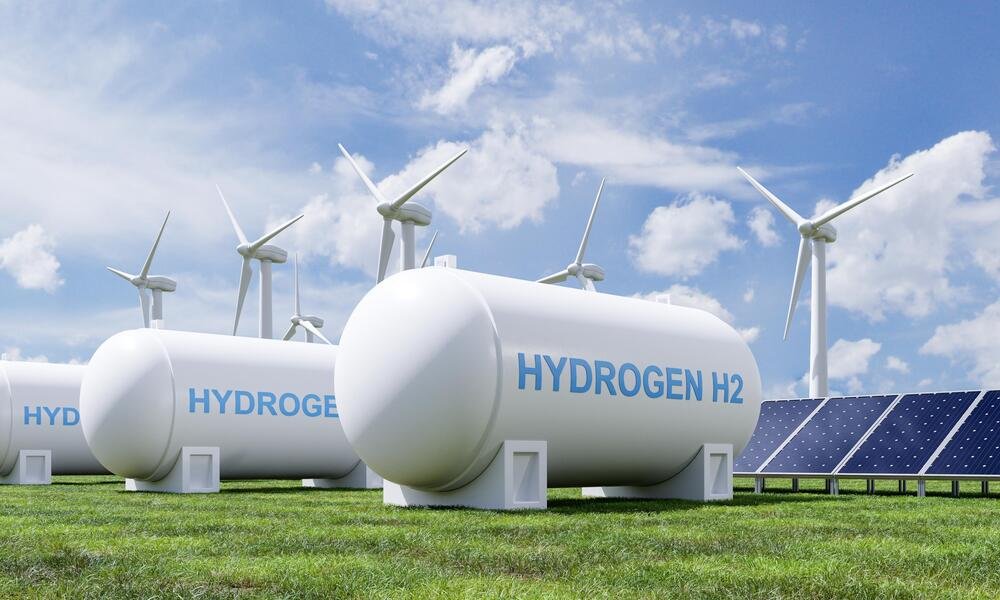
Green hydrogen production in Europe, the conditions, and the somehow surprising exception of the "green grid".
Let's review 🧵.
First, green H2 = production of H2 with electrolysis using green energy.
The problem? We have to define what is green.
1/11
Green means that three conditions must be fulfilled.
1. Additionality (=must be new renewables). 2. Temporal correlation (=must be renewables on an hourly basis). 3. Locational correlation (=must be same bidding zone).
2/11
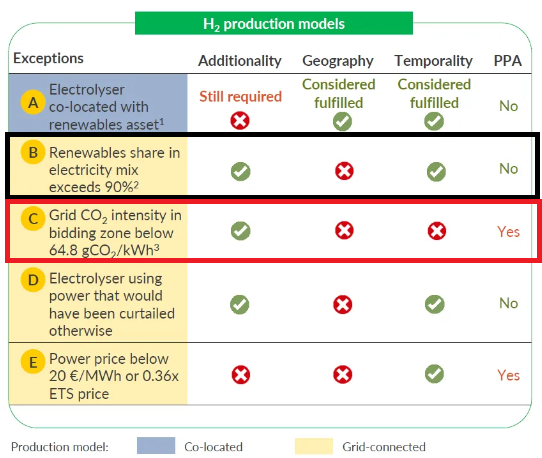
Of course, with any rule, you also have exceptions. Table here from @AuroraER_Oxford.
Black box: if in a bidding zone, RES's share is above 90%, then, temporal correlation and additionality do not matter.
Contract-for-differences (CfD) and (commercial) power purchase agreements (PPA) are both encouraged by the EU.
They are not the same obviously but are they complementary or in competition?
Probably a bit of both.
1/7
CfD are a mechanism guaranteeing a fixed revenues to a renewable operator and are the result of an auction organized by a public entity.
PPA are an agreement for selling energy to a fixed price to a buyer.
2/7
For a renewable developer, the result is similar : I sell my energy at a fixed price, removing the market price risk.
But for CfD, a public entity is the one taking over the price risk and for a PPA, it is a private entity (except if the buyer is a public one, see after).
3/7
Some highlights of the latest report on Australia grids via the Quarterly Energy Dynamics (Q3 - 2023) Thread🧵
This report is extremely interesting for all people interested in understanding the impacts of high renewables, as Australia is a leading country for that matter
1/11
First precision point: Australia has one large interconnected grid called NEM (Western parts) and uses a zonal pricing model (5 bidding zones).
Somehow very similar to Europe for that matter.
Penetration of RES differs largely between zones.
2/11
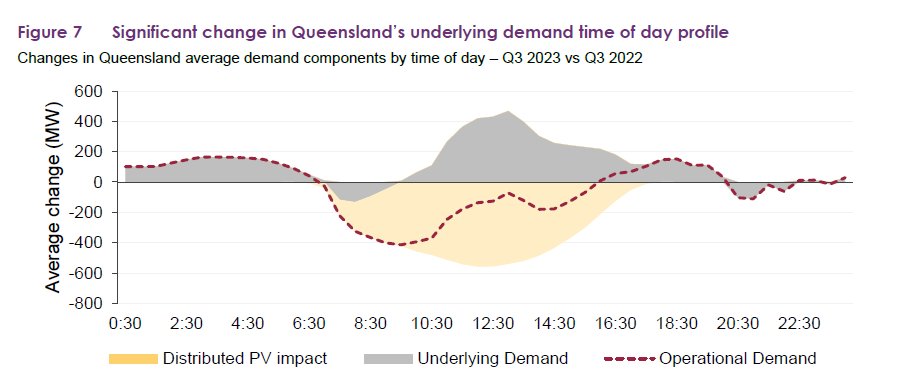
First graph:distributed PV and increased load in Queensland
We see that demand increases much more during the day. Still, the impact of distributed PV and increased load is: more load when no solar, very large decreased demand early morning, and limited impact at noon
3/11
I have just read this scientific article. Any thoughts on it?
In the abstract: If warming reaches or exceeds 2 °C, mainly richer humans will be responsible for killing roughly 1 billion mainly poorer humans through anthropogenic global warming.
(1/4) mdpi.com/1996-1073/16/1…
And it recommends, as Energy Policy, the following (my selection from a long list): 1) ban the extraction of all fossil fuels 2) undercut fossil fuel regimes by giving renewable energy technologies to their citizens.
2/4
3) make mass purchases of energy conservation or renewable energy technologies, and make them freely available to all citizens. 4) ban the sale of fossil fuel vehicles or even ban all cars. 5) ban natural gas stoves or even boilers.
3/4