Ibn Jurayj’s Hidden Source on Mutʿa 🧵
When a companion called Ismāʿīl b. al-Faḍl al-Hāshimī asks Jaʿfar b. Muḥammad al-Ṣādiq (d. 148) about Mutʿa (temporary marriage) the latter instructs him to seek out Ibn Jurayj (d. 150) because ‘he has knowledge about it’.
When a companion called Ismāʿīl b. al-Faḍl al-Hāshimī asks Jaʿfar b. Muḥammad al-Ṣādiq (d. 148) about Mutʿa (temporary marriage) the latter instructs him to seek out Ibn Jurayj (d. 150) because ‘he has knowledge about it’.
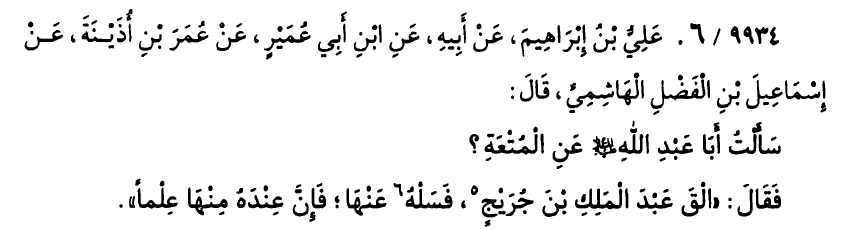
Ismāʿīl does seek out Ibn Jurayj and the latter dictates to him a number of Hadith affirming Mutʿa’s permissibility before providing specific rulings on how it is to be performed, for e.g. there is no restriction to the number of partners who can be contracted at the same time.
When Ismāʿīl reports back what he had learnt to al-Ṣādiq the Imam confirms its veracity.
But from whom did Ibn Jurayj attain this knowledge?
Ibn Jurayj was a student of the Meccan school, that is, he primarily took knowledge from his teacher ʿAṭāʾ (who taught in Mecca), with ʿAṭāʾ primarily taking from the companion Ibn ʿAbbās (who came to reside in Mecca).
And Ibn ʿAbbās is known to have maintained the continued permissibility of Mutʿa.
Thus we find Ibn Jurayj narrating the anecdote of his teacher ʿAṭāʾ first coming to hear of something called Mutʿa and seeking confirmation about its permissibility from Ibn ʿAbbās.
Despite the confirmation that he receives from Ibn Abbas, ʿAṭāʾ’s heart was not satisfied until he heard the same from the senior companion Jābir b. ʿAbdallāh al-Anṣārī who was visiting Mecca at the time.

So ʿAṭāʾ could have been the source of Ibn Jurayj’s knowledge.
Yet when Ibn Jurayj asked ʿAṭāʾ about specific rulings concerning Mutʿa, for e.g. whether a man can contract Mutʿa with more than four women at the same time? The latter did not have answers since as he admits - he did not ask his Aṣḥāb i.e. teachers about these details.

Clearly the source of these specific rulings which Ibn Jurayj provided to Ismāʿīl was not ʿAṭāʾ but some other authority.
The only other authority whom Ibn Jurayj cites on the topic of Mutʿa is found in the following report:
Ibn Jurayj: ‘The one I deem truthful’ reported to me that ʿAlī said in Kufa, “If an opinion of ʿUmar b. al-Khaṭṭāb [or: an opinion of Ibn al-Khaṭṭāb] had not preceded me I would have ruled to permit Mutʿa, then no one would have committed adultery except someone wretched!”

But as can be seen, Ibn Jurayj chooses not to name his source here. The only clue we have as to his identity is the fact that this source quotes ʿAlī directly without giving any intermediary.
We seem to have run into a brick-wall.
We seem to have run into a brick-wall.
Then I came across the following report in the Twelver corpus which has al-Bāqir attributing these same words to ʿAlī.

This is also corroborated in the early Aṣl of ʿĀṣim b. Ḥumayd.

Thus I propose that Ibn Jurayj’s hidden source whom he deems ‘truthful’ is none other than Abū Jaʿfar Muḥammad b. ʿAlī al-Bāqir (explaining the reason Ibn Jurayj chose to anonymize him is beyond the purview of this thread).
And this seems to be confirmed by the following report which has al-Ṣādiq asking Ibn Jurayj what he had heard about Mutʿa from his father.

To sum up, al-Ṣādiq directed Ismāʿīl to go to Ibn Jurayj because he knew that the latter had taken detailed and authentic knowledge about Mutʿa from al-Bāqir.
Now maintaining the permissibility of Mutʿa was certainly a controversial position, and we have evidence that ʿAṭāʾ applied Taqiyya about it at least once for fear that ‘the Medinans would curse him’.

His student, Ibn Jurayj, on the other hand, was very open about it and his view on Mutʿa became notorious, even causing some narrators to abandon him because of it.
Jarīr b. ʿAbd al-Ḥamīd (d. 188) is quoted as saying that he chose not to narrate anything from Ibn Jurayj even though he met him because, “He left to his sons (the names of) 60 women (with whom he had performed Mutʿa) and said: Do not marry them for they are your mothers!”

Al-Shāfiʿī (d. 204), who studied with Ibn Jurayj’s principal student Muslim b. Khālid al-Zanjī (d. 180), is quoted as saying, “Ibn Jurayj made Mutʿa with 90 (var. 70) women, to the extent that he would apply ounces of sesame oil in the nights to aid him with intercourse!”

However, Ibn Jurayj was too big for any criticism against him - even from the likes of the Medinan Mālik b. Anas who used the expression ‘collector of fire-wood by night’ for him - to stick, and his reports are voluminous across the six books.
For more, read this article on my blog: wherein I had proposed that al-Ṣādiq could be the unnamed source and which should now be corrected in light of these findings.shiiticstudies.com/2019/06/09/the…
• • •
Missing some Tweet in this thread? You can try to
force a refresh