A dozen more sequences of this JN.1 + K444R + Y453F just dropped. All from Brazil, all collected in 2024. 12/13 are from the Brazilian state of Bahia, but those 12 sequences come from 11 different cities. This has the potential to be a big deal.
BA.2.86 had extremely high ACE2 affinity, but as you can see in @yunlong_cao's tweet below, JN.1's S:L455S, while a crucial antibody-evasion mutation, squandered pretty much all the extra ACE2 affinity of BA.2.86 (higher = weaker ACE2 binding). 2/4
By itself, lower ACE2 binding probably isn't a huge detriment, but it left JN.1 with little room to evolve further RBD mutations, which nearly always reduce ACE2. This is probably why JN.1's RBD has remained virtually unchanged since its emergence. 3/4
Y453F has granted huge increases in ACE2 binding in previous variants, so it likely will do the same for JN.1. This could give JN.1 the mutational flexibility it has so far lacked, opening the door to further spike mutations. Stay tuned. 4/4 github.com/cov-lineages/p…
@yousitonmyspot I think the bigger story is the possibility of further RBD mutations due to the incr. ACE2 binding from Y453F. That probably gives JN.1 much more room to maneuver.
OTOH, Y453F has caused instability in some previous lineages, so it may impose a cost as well. Too soon to say.
• • •
Missing some Tweet in this thread? You can try to
force a refresh

Another fantastic preprint on BA.3.2's propensity for children, this time from @yunlong_cao & co.
They not only confirm the findings of David Ho's lab (that kids have ~0 antibody response to BA.3.2) but dig into the details of exactly why kids are so vulnerable to BA.3.2.
1. Kids vaccinated before being infected have robust antibodies against BA.3.2
2. Unvaxed adults much more vulnerable to BA.3.2, esp. compared to mRNA-vaxed adults.
Read @yunlong_cao's 🧵 & very readable paper for details. 2/4
There's still one major paradox here I can't wrap my head around: countries with the highest vaccination rates & the lowest proportion of children appear—very low sequencing makes hard conclusions difficult—to have the highest proportion of BA.3.2. 3/4
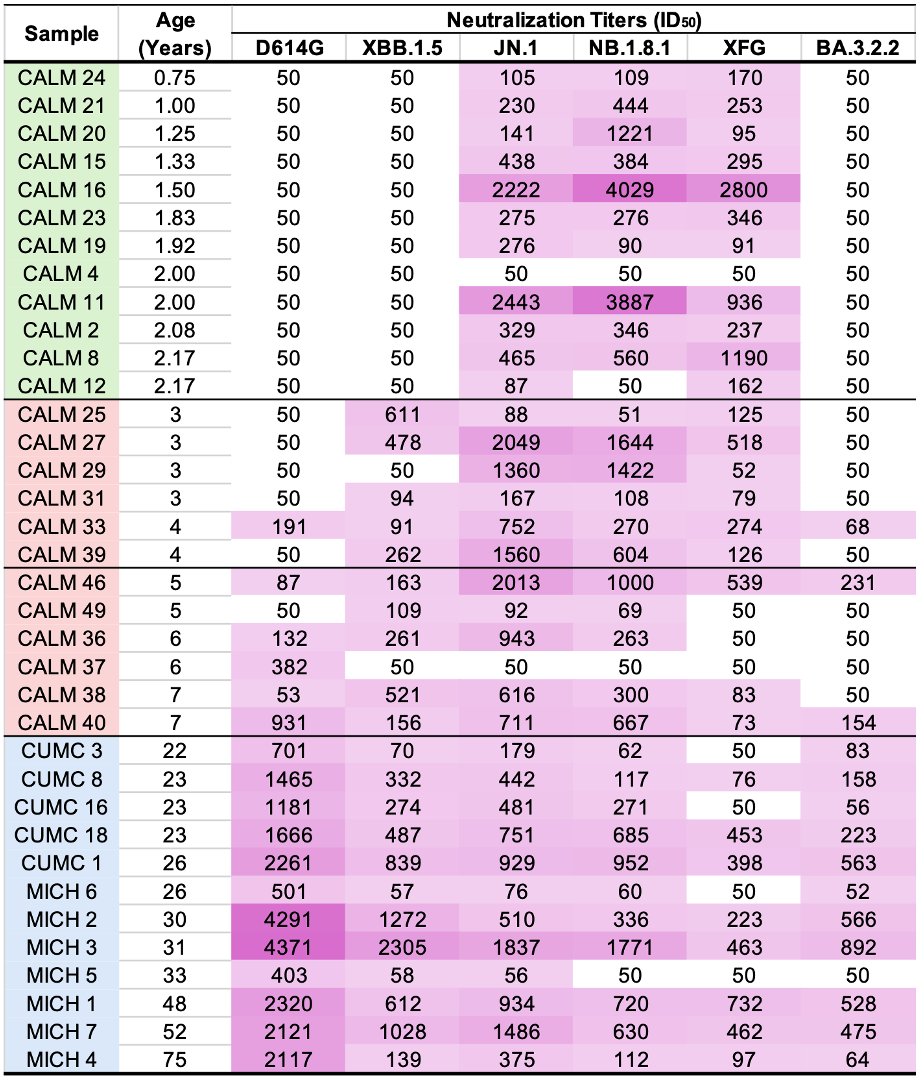
New data from David Ho's lab showing that while adults & kids have ~equal antibody responses to XFG & NB.1.8.1, children have essentially no neutralizing antibodies to BA.3.2.
This seems to largely solve the BA.3.2 + kids mystery. 1/14
If you've missed the story about how BA.3.2 (a novel, divergent saltation variant) is hugely overrepresented in sequences from children, this was my original (very quick) analysis, which subsequent data extended & confirmed. 2/
More details from this preprint. 50 is the limit of detection (i.e. zero). Nearly all kids under 7 had no detectable nAbs to BA.3.2, despite robust nAb titers against NB.1.8.1 & XFG.
I've tried to make sense of BA.3.2's penchant for kids by considering its unique spike: more compact, more closed, & more antibody-evasive than any other variant.
But I think another feature of BA.3.2 is responsible: its wholesale deletion of ORF7a, ORF7b, & ORF8 (∆ORF78).
2/
∆ORF78 is rare but not unheard of; it was in several late XBB variants (GW.5.1.1, FW.1.1, GE.1.2, etc) & a few branches of other variants. I've long thought these late XBB had an advantage in some population subsector, but I didn't suspect kids. 3/
I suspect that the number of people continuously infected since 2020 or 2021 is much larger than we realize. It's impossible to prove, but there are case studies where a chronically infected person gets infected by a new variant, which drives out the original virus...
2/16
...which consequently leaves no trace that the person was chronically infected before the super-infecting variant—took over.
Why then are some Cryptic WW variants resistant to being outcompeted by newer variants?
3/16
While the final outcome for BA.3.2 is uncertain, its unique characteristics—extensively remodeled spike NTD & SD1/SD2, novel S2 muts, & total deletion of ORF7a/7b/8—make it the best candidate for co-dominance we've seen, which could mark a new era in SARS-2 evolution. 1/
Very proud to be a co-author on this comprehensive preprint on the novel, growing saltation lineage BA.3.2, together with @Tuliodna, Darren Martin, Dikeledi Kekana, and lead author @graemedor. 1/9
I would normally write a summary 🧵 of the BA.3.2 mutational analysis here, but as much of my contribution parallels my previous BA.3.2 threads I'll just link to those here, w/brief descriptions of each.