Ilkka Rauvola Profile picture
Feb 6, 2024 12 tweets 4 min read Read on X
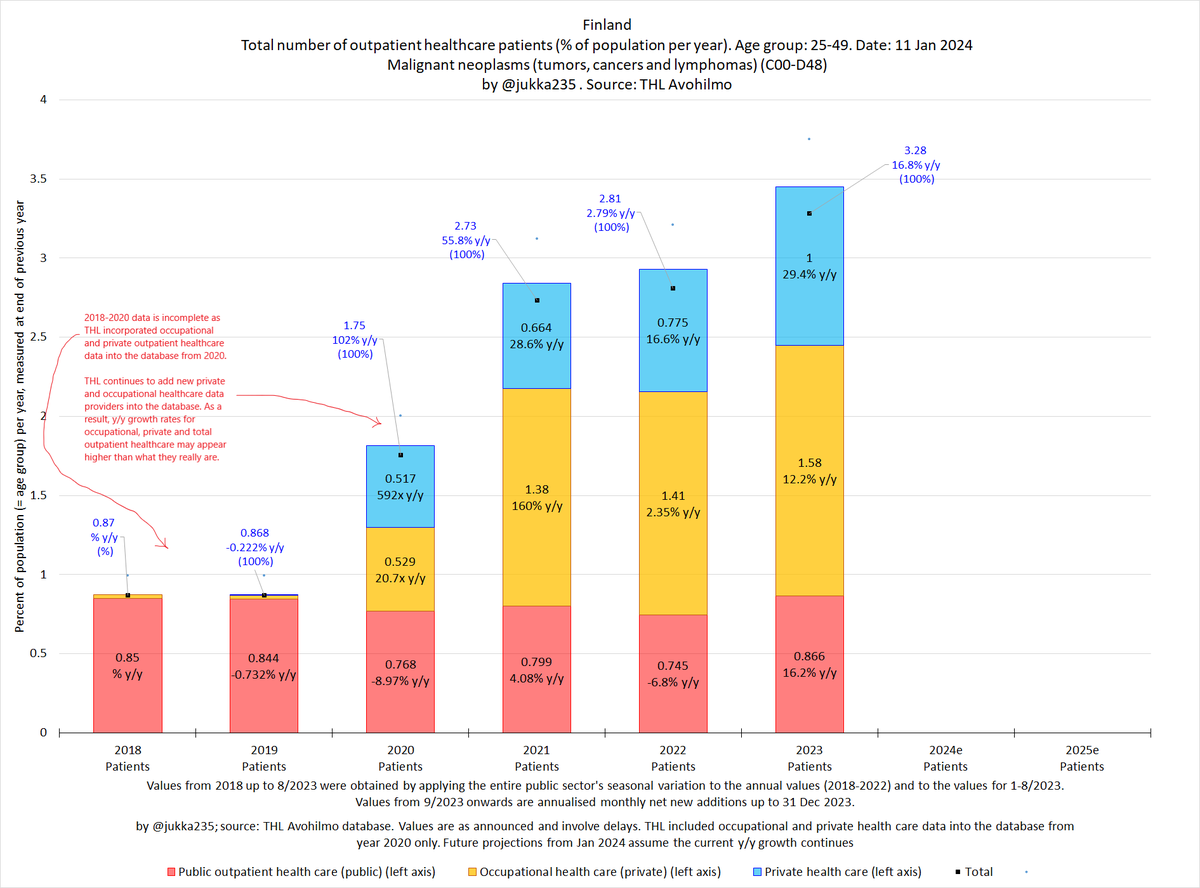
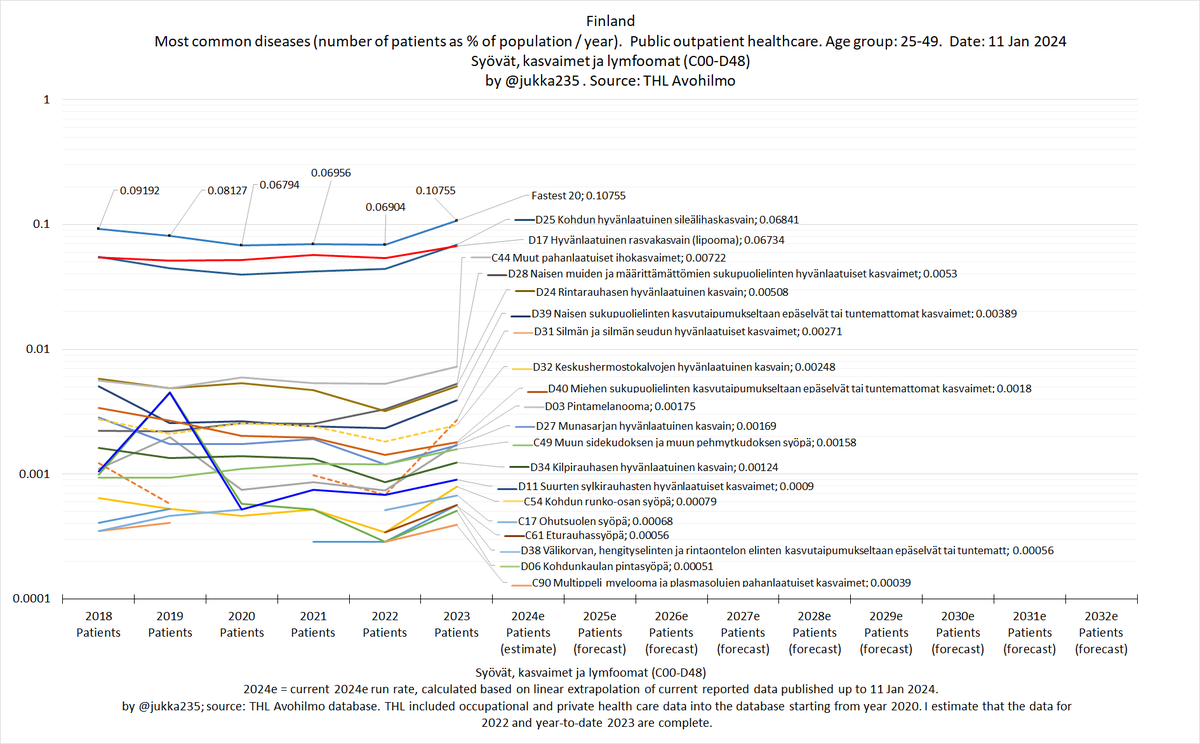
25-49 year olds: Malignant neoplasms (tumors, cancers and lymphomas) (C00-D48)
1/x Image
25-49 -vuotiaat: syövät, kasvaimet ja lymfoomat (C00-D48)
2/x Image
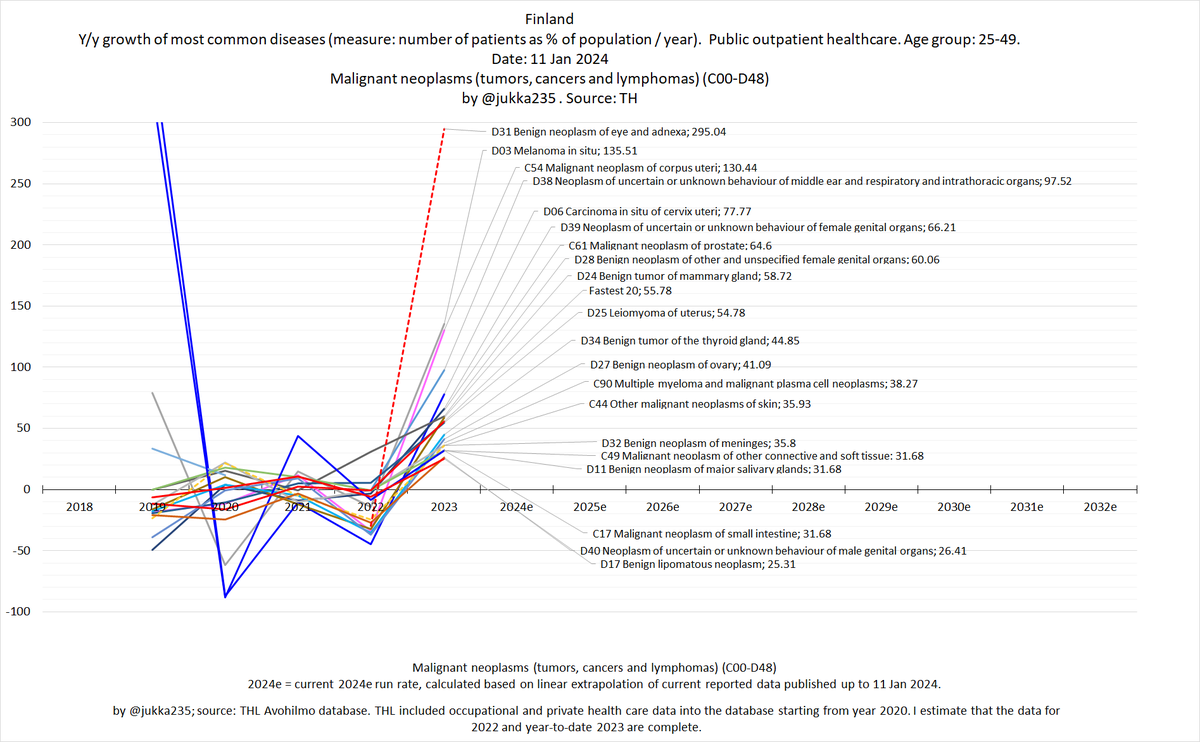
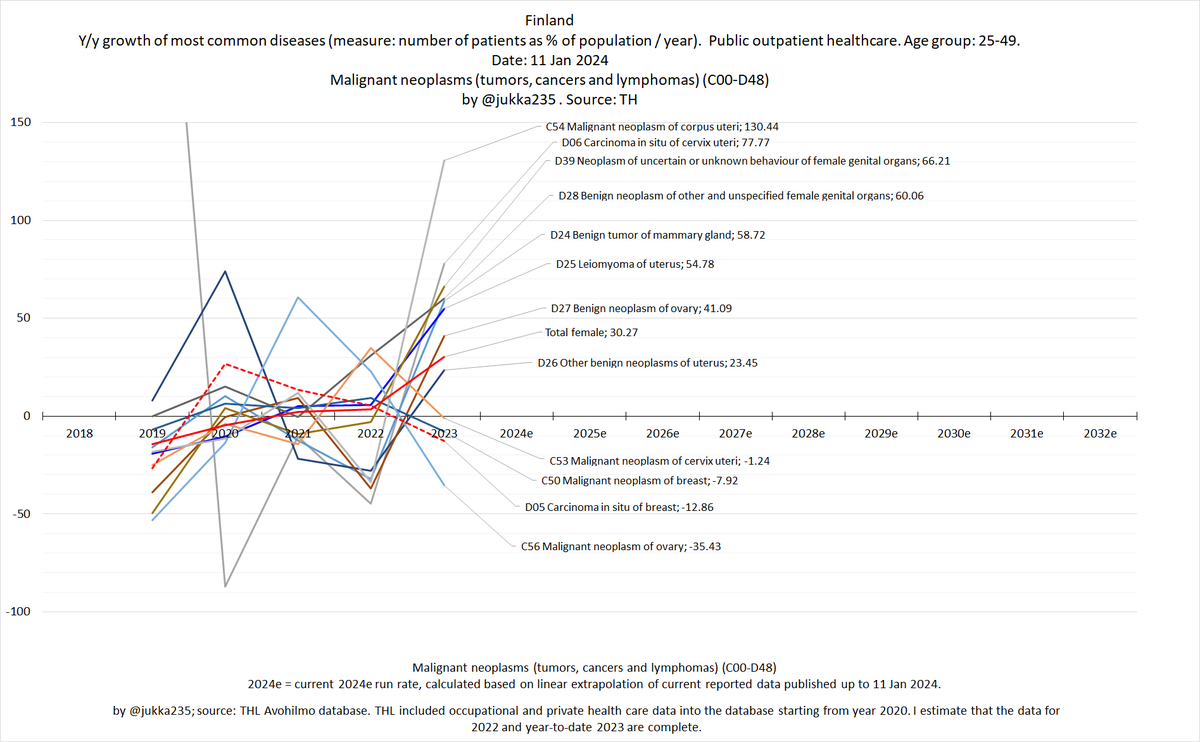
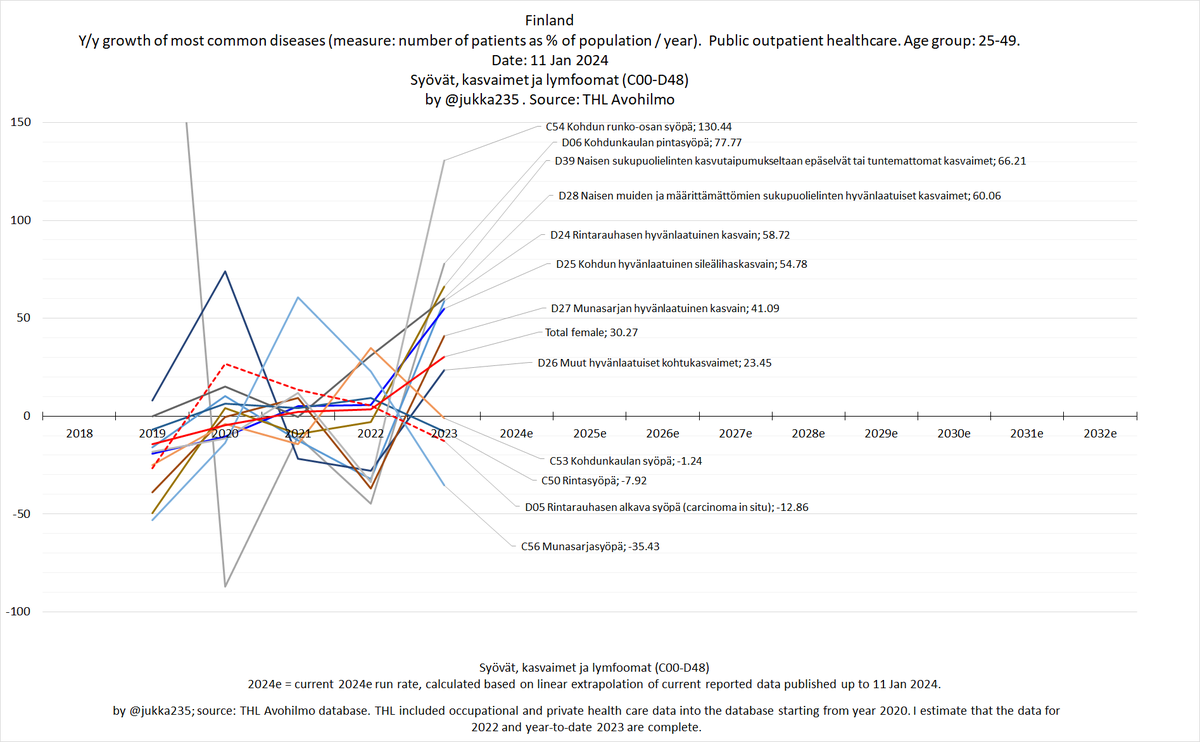
These are the 20 cancers, tumors, and lymphomas experiencing the fastest y/y patient growth in 2023. Together, they account for 12 percent of the total patient count. There is a significant representation of cancers and tumors affecting the female genital region.
3/x Image
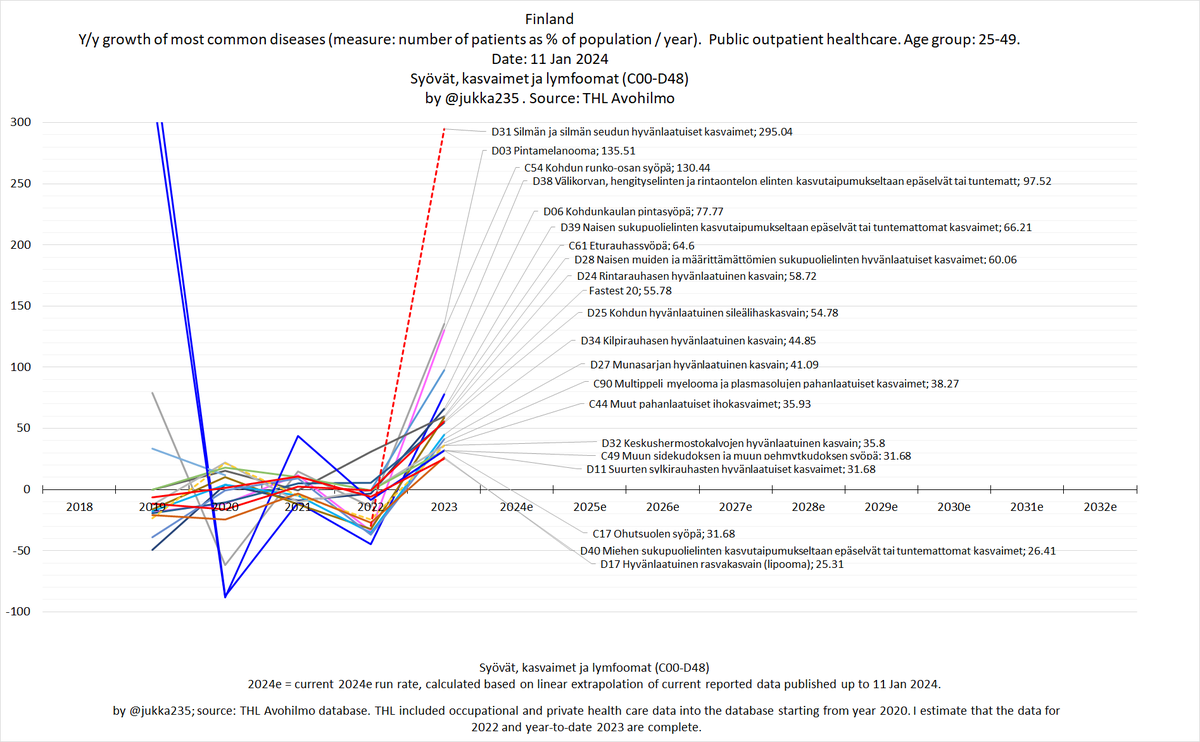
Tässä ovat 20 nopeimmin vuosittain kasvavaa syöpää, kasvainta ja lymfoomaa vuonna 2023. Ne muodostavat noin 12 prosenttia kokonaispotilasmäärästä. Naisten sukuelinten alueen syövillä ja kasvaimilla on merkittävä edustus.
4/x Image
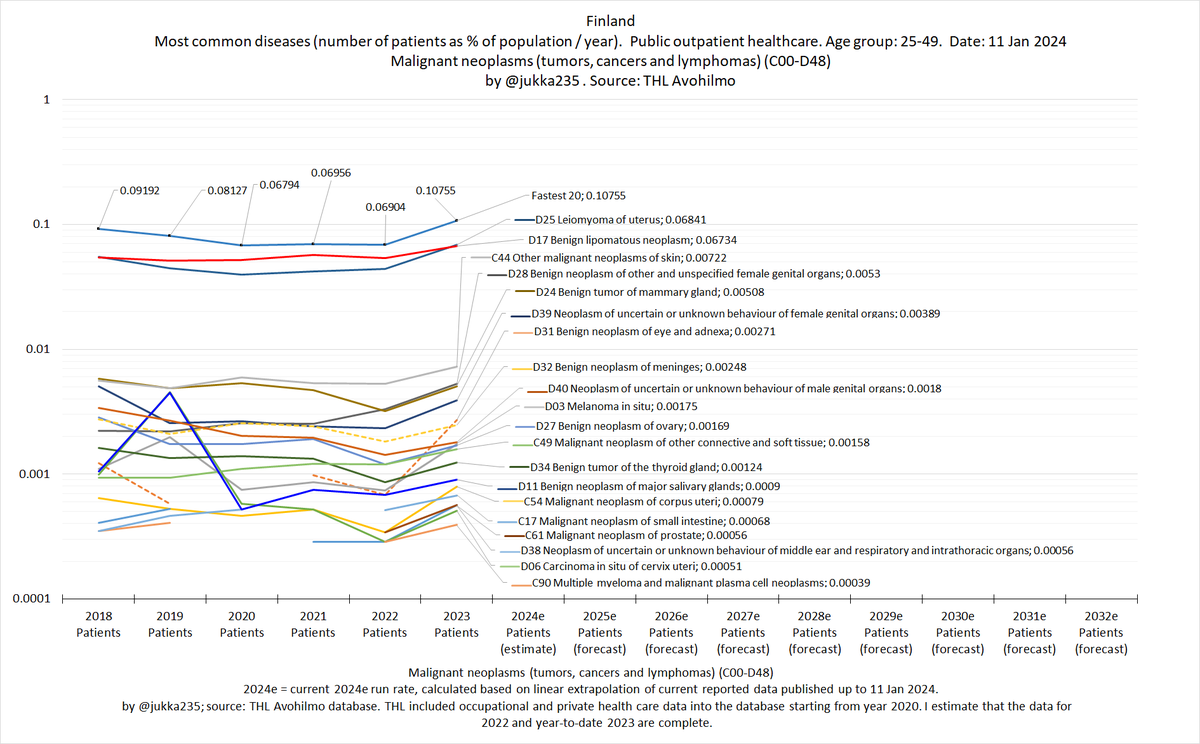
The 20 fastest growing cancers, tumors and lymphomas affect 0.1 percent of 25-49 year population. Weighted average y/y patient growth rate in 2023 is 56 percent per year (= 9 times in five years).
5/x Image
20 nopeimmin kasvavaa syöpää, kasvainta ja lymfoomaa vaikuttavat 0.1 prosenttiin 25–49-vuotiaiden väestöstä. Painotettu keskimääräinen v/v potilasmäärän kasvuvauhti vuonna 2023 on 56 prosenttia vuodessa (= 9-kertaistuu viidessä vuodessa).
6/x Image
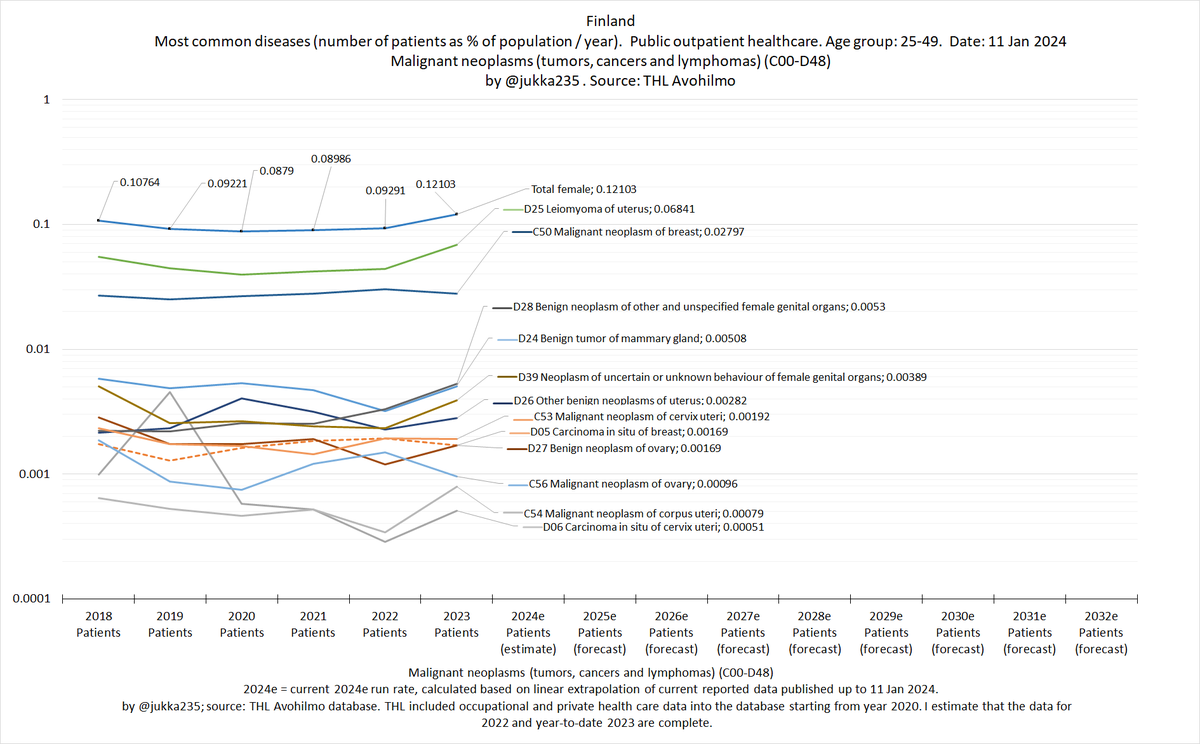
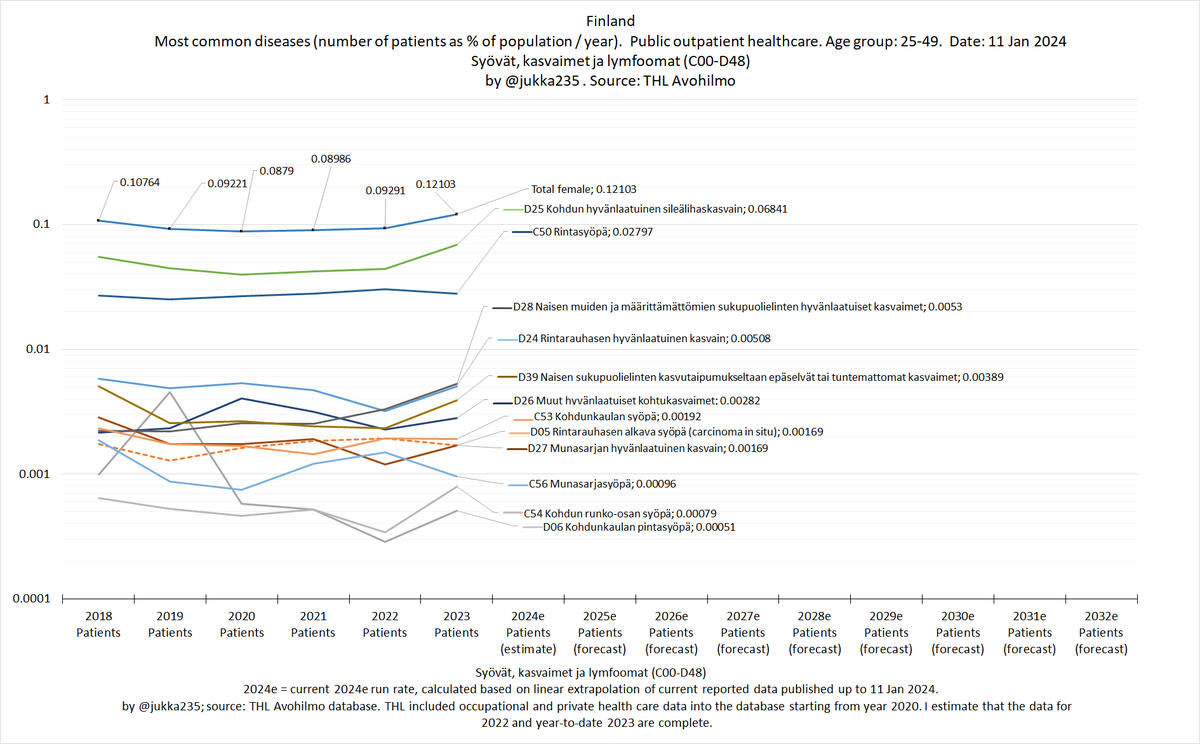
Next, let us review cancers, tumor and lymphomas in the female genital areas. In public outpatient healthcare, most of them have started to show significant y/y patient growth in 2023 (total y/y patient growth rate is 30 percent).
7/x Image
Katsotaan seuraavaksi naisen sukupuolielinten alueiden syöpiä ja kasvaimia. Julkisessa avoterveydenhuollossa useimmat niistä ovat alkaneet osoittaa merkittävää v/v potilasmäärän kasvua vuonna 2023. Keskimääräinen kasvuvauhti vuonna 2023 on 30 prosenttia.
8/x Image
Cancers and tumors in female genital areas affect roughly 0.24 percent of 25-49 year old female population. The figure is growing 30 percent annually (= 10 times in ln(10)/ln(1.3) = 9 years). These figures include public outpatient healthcare only.
9/x Image
Naisten sukuelinten alueen syövät ja kasvaimet vaikuttavat noin 0.24 prosenttiin 25–49-vuotiaasta naisväestöstä. Luku kasvaa 30 prosenttia vuosittain (= 10-kertaistuu ln(10)/ln(1.3) = 9 vuodessa). Yksityinen ja työterveyshoito puuttuvat näistä luvuista.
10/x Image
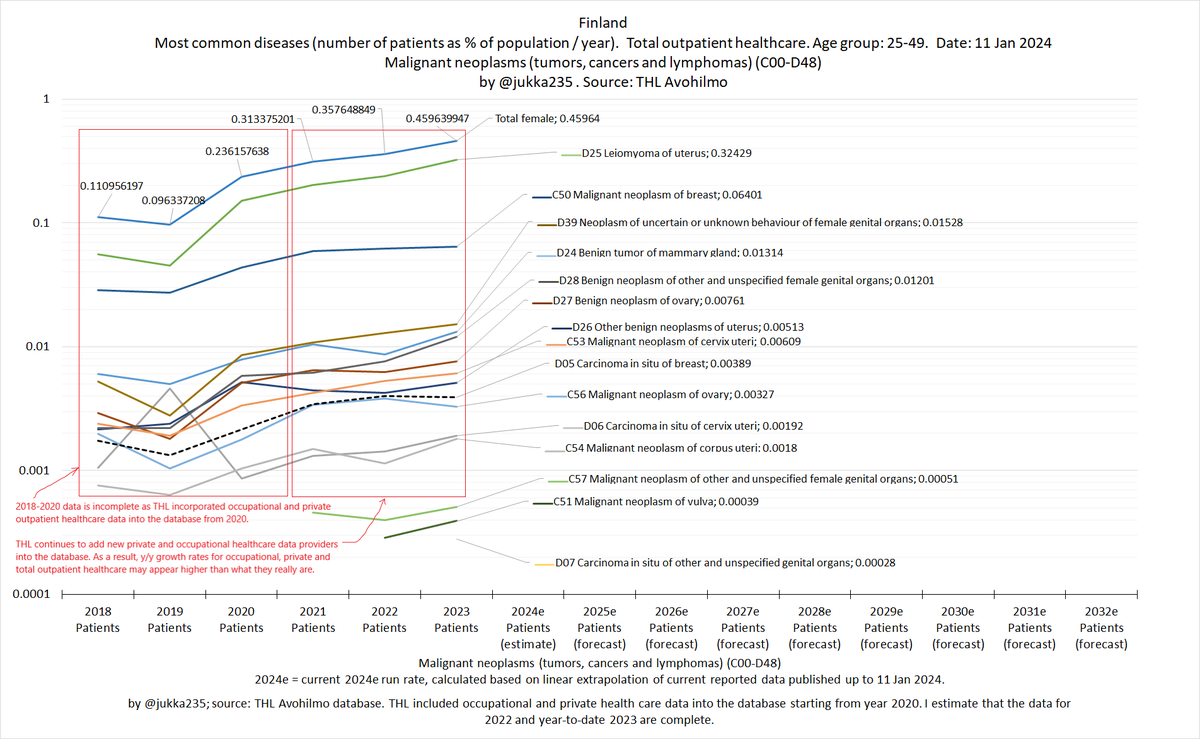
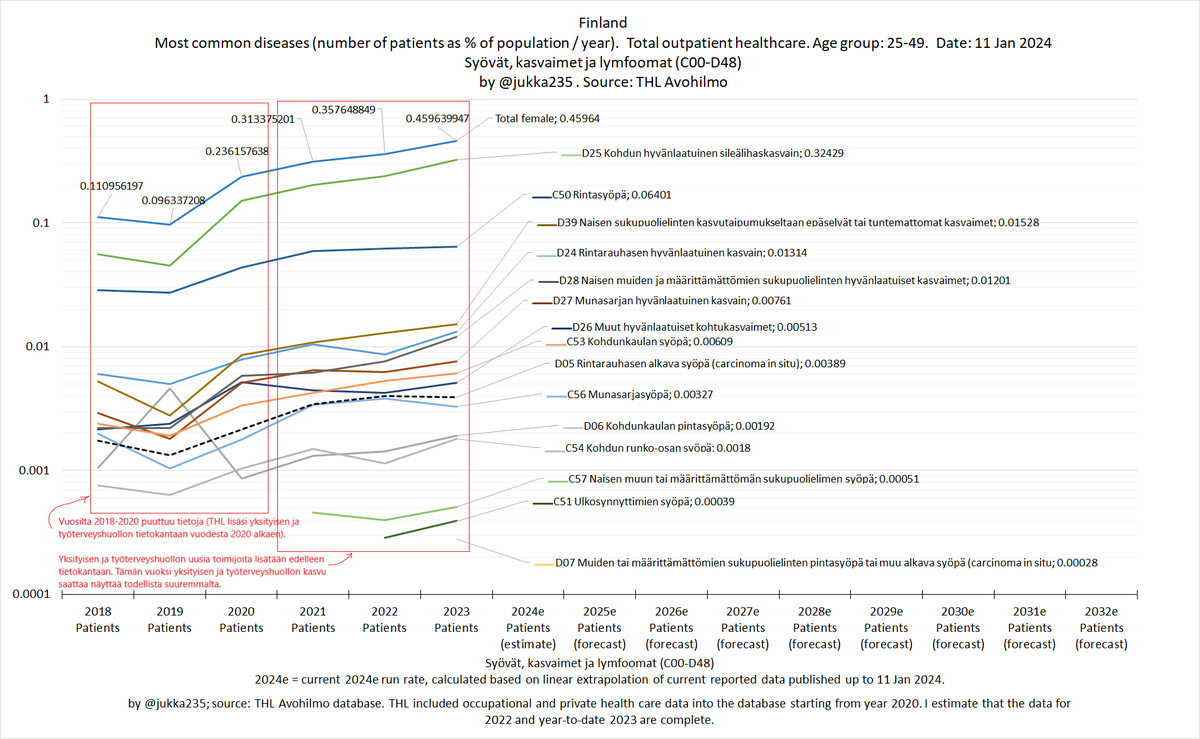
In total outpatient healthcare, cancers and tumors in the female genital area affect roughly 0.459x2 = 0.92 percent of 25-49 year old females, and the figure is growing 28.5 percent annually (10 times in ln(10)/ln(1.285) = 9 years).
11/x Image
Koko avoterveydenhuollossa naisten sukuelinten alueen syövät ja kasvaimet vaikuttavat noin 0.459x2 = 0.92 prosenttiin 25–49-vuotiaista naisista, ja määrä kasvaa 28.5 prosenttia vuosittain (eli 10-kertaistuu ln(10)/ln(1.285) = 9 vuodessa).
12/x Image

• • •

Missing some Tweet in this thread? You can try to force a refresh

 

Keep Current with Ilkka Rauvola

Ilkka Rauvola Profile picture

Stay in touch and get notified when new unrolls are available from this author!

Read all threads

This Thread may be Removed Anytime!

PDF

Twitter may remove this content at anytime! Save it as PDF for later use!

Try unrolling a thread yourself!

how to unroll video
  1. Follow @ThreadReaderApp to mention us!

  2. From a Twitter thread mention us with a keyword "unroll"
@threadreaderapp unroll

Practice here first or read more on our help page!

More from @jukka235

Jan 14
This is an important moment.

After more than five years of silence, mainstream media has begun to acknowledge that C19 can harm T cells, and to discuss the consequences that follow. @fitterhappierAJ was one of the first, if not the first, to talk about this.
1/x
Dr. Leonardi has provided a significant amount of direction for me. In particular, he has been interviewed in some excellent articles that have withstood the test of time. Here is one of them.
2/x

thetyee.ca/Analysis/2022/…
We have seen it all.
- in 2020, they said that our health systems are so robust that this disease wouldn't come here
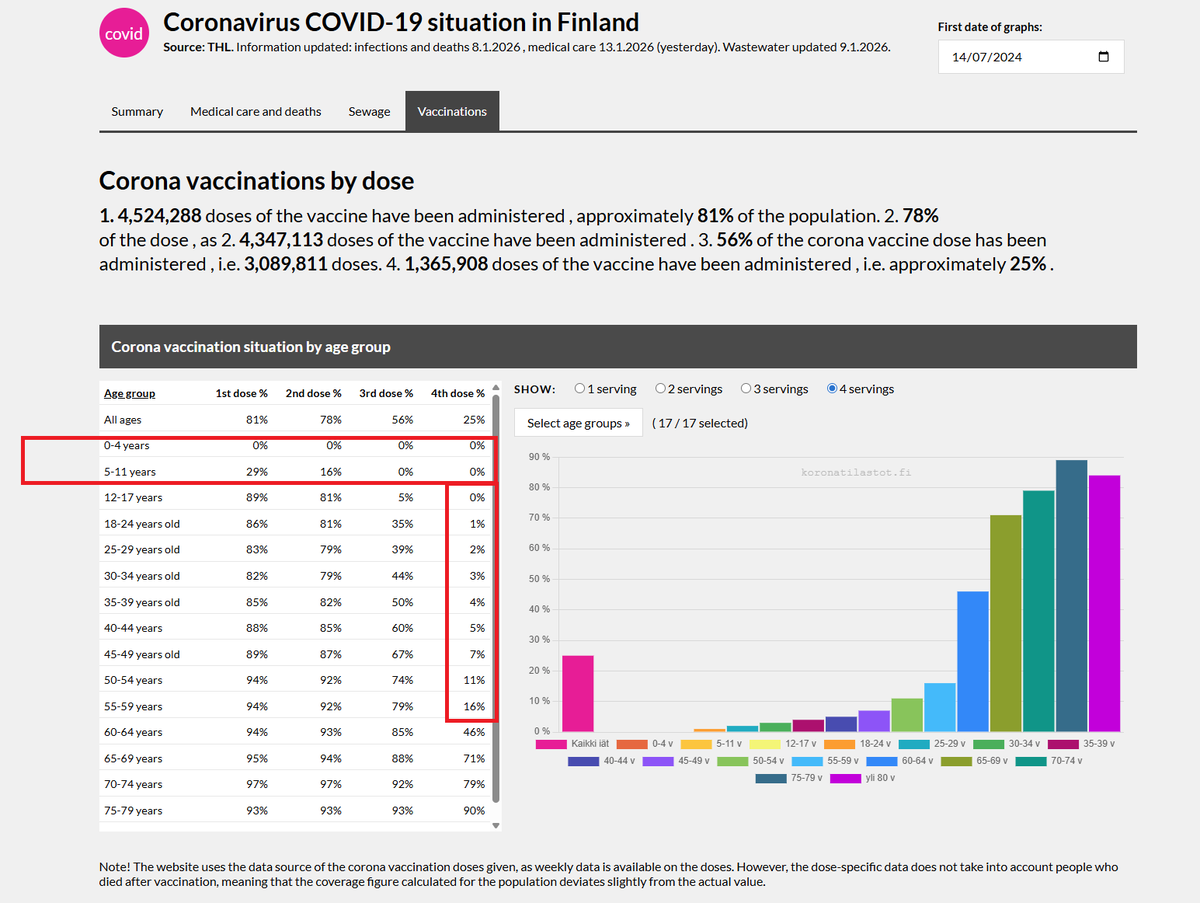
- then they wanted them infected. C19 was de facto allowed to spread in schools. Only a small fraction of <12 year olds received ...
3/x

koronatilastot.fi/fi/rokotukset/Image
Read 8 tweets
Jan 9
Something is causing injuries among young children.
1/x Image
Something changed in 2022. Before that, the numbers were generally falling. Wonder what it could be.
2/x Image
After 2022, 1-6 year olds have overtaken a total of three other age groups (50-64, 15-24 and 65-74 year olds), and are now clearly above the total population average. All injuries (S00-S99).
3/x Image
Read 6 tweets
Jan 9
Developmental delays and disorders (F80-F89).
1/x Image
Between 2020 and 2025e, the number of patients with developmental delay or disorder diagnoses grew at an average annual rate of 21.6% (10x in 11.8 years). The fastest patient growth was seen in pervasive developmental disorders, incl. autism and Asperger syndrome (F84).
2/x Image
Image
Among total population, number of patients with developmental delay or disorder diagnoses is up 2.6 times since 2020. All disorders are showing continued significant patient growth.
3/x Image
Image
Read 11 tweets
Dec 23, 2025
Finland's epidemic 23 Dec 2025: amount of virus in wastewater appears to have risen above the first Omicron wave. Post-Omicron baseline is permanently higher than pre-Omicron; repeated waves are showing no diminishing.
1/x Image
Post-Omicron baseline is permanently higher than pre-Omicron
- before late 2021, levels were mostly 10³–10⁴.
- from 2022 onward, even troughs sit around 10⁵, or 10-100x higher
- C19 has become endemic
- constant background transmission, even outside waves
2/x Image
Repeated large waves in 2023–2024, not diminishing. Notable peaks:
- Apr 2023
- Nov 2023 (highest for the entire pandemic)
- Dec 2024

These peaks are:
- comparable to or higher than Omicron 2022
- evidence against a simple “each wave gets smaller” narrative
3/x Image
Read 21 tweets
Nov 30, 2025
Congenital malformations, deformations and chromosomal abnormalities. For 1-6 year olds,
- the condition showing largest increase since 2022 is Down's syndrome (Q90)
- the condition showing fastest growth since 2022 is Congenital malformations of great arteries (Q25)
1/x Image
Image
1-6 year olds / chromosomal abnormalities (Q90-Q99).
- Down's syndrome (Q90): average patient growth (2022-2025e) 14% per year = 10x in 18 years)
- fastest growing condition: other sex chromosome abnormalities, male phenotype (Q98), up 150% in 2025e
2/x Image
Image
Image
<1 year olds / chromosomal abnormalities (Q90-Q99):
- Down's syndrome (Q90) is the most frequent diagnosis
3/x Image
Image
Read 9 tweets
Nov 11, 2025
Intellectual disabilities (F70-F79): <1 year olds are leading in terms of y/y growth. Ten percent of <1 year olds will have an intellectual disability diagnosis in 14 year's time (2039), if current growth rates continue.
1/x Image
The rise in intellectual disability among <1 year olds also shows in number of diagnoses: up roughly 11 times in 4 years. Also note the rise among 1-6 year olds.
2/x Image
7-14 and 15-24 year olds are showing the highest levels of intellectual disability. If current growth rates continue, 5 percent of 7-14 and 15-24 year olds will have an intellectual disability diagnosis by 2048 (24 years from now).
3/x Image
Read 6 tweets

Did Thread Reader help you today?

Support us! We are indie developers!


This site is made by just two indie developers on a laptop doing marketing, support and development! Read more about the story.

Become a Premium Member ($3/month or $30/year) and get exclusive features!

Become Premium

Don't want to be a Premium member but still want to support us?

Make a small donation by buying us coffee ($5) or help with server cost ($10)

Donate via Paypal

Or Donate anonymously using crypto!

Ethereum

0xfe58350B80634f60Fa6Dc149a72b4DFbc17D341E copy

Bitcoin

3ATGMxNzCUFzxpMCHL5sWSt4DVtS8UqXpi copy

Thank you for your support!

Follow Us!

:(