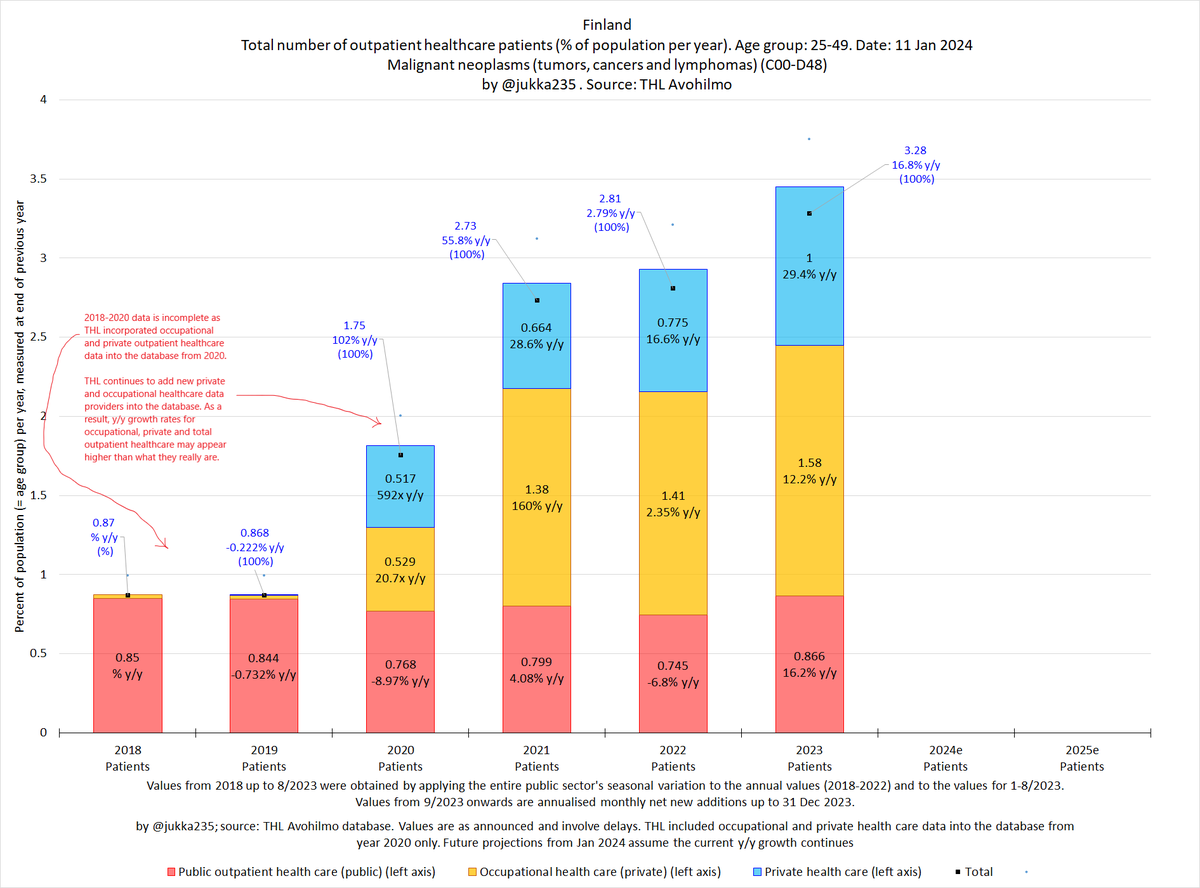
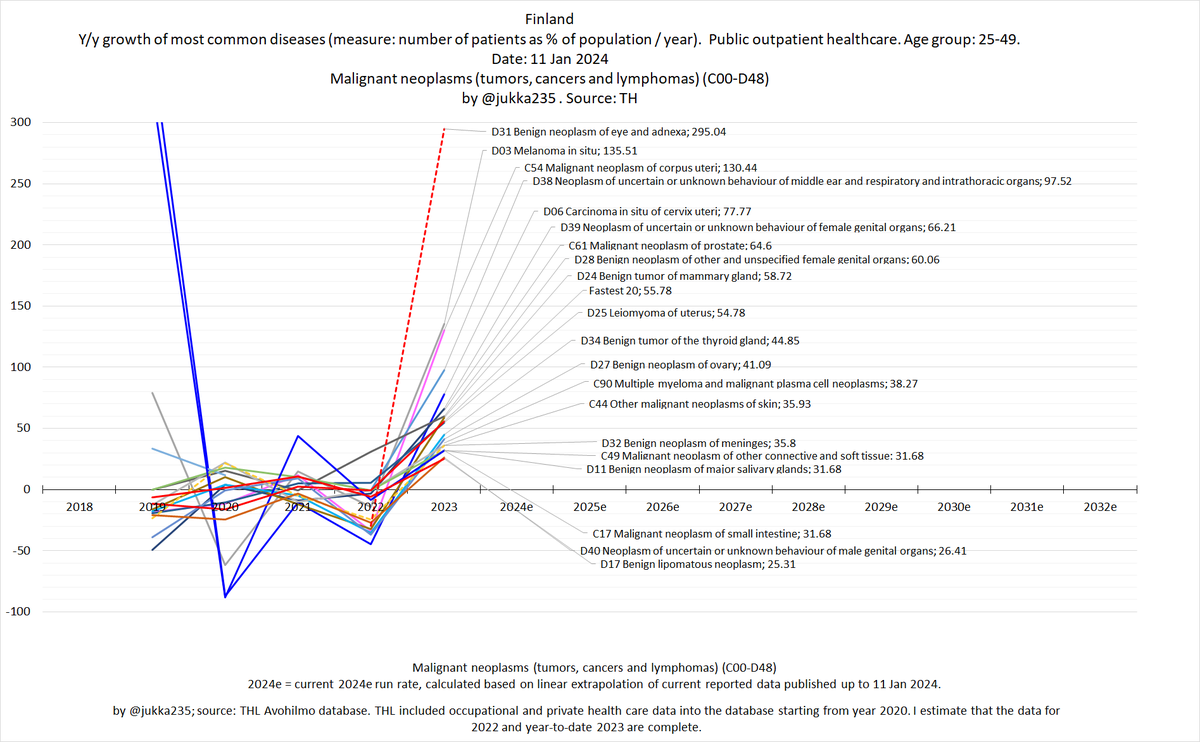
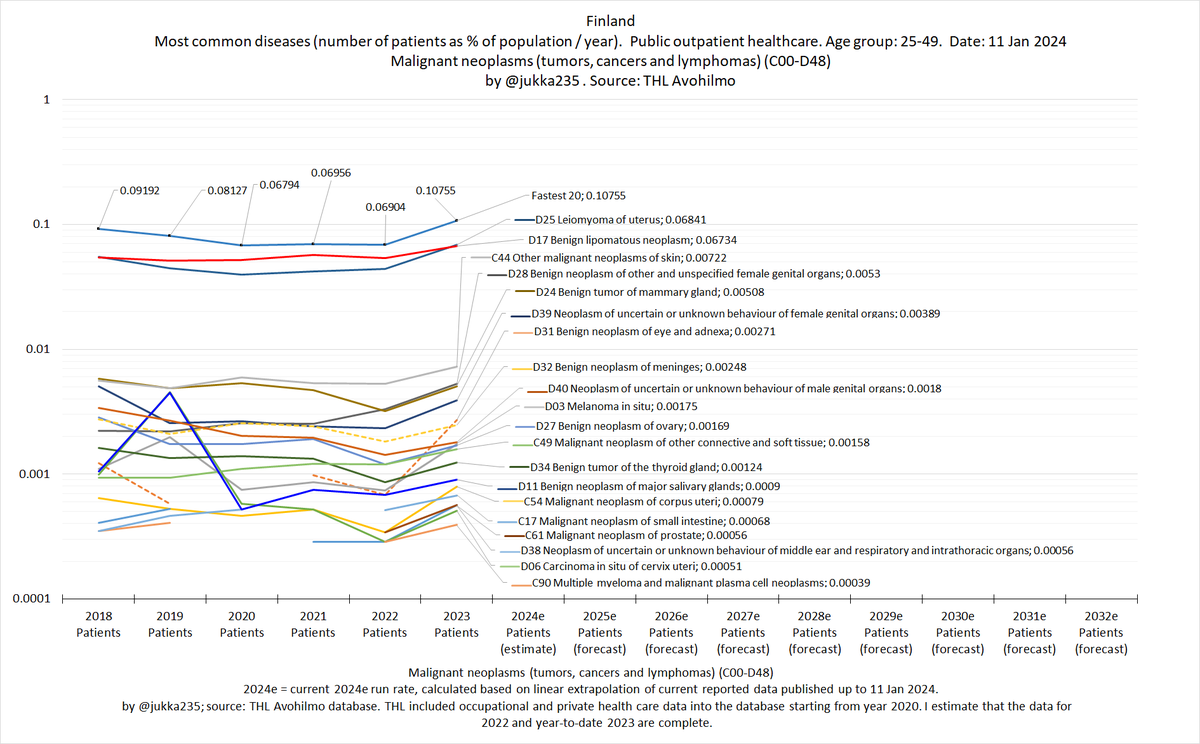
25-49 year olds: Malignant neoplasms (tumors, cancers and lymphomas) (C00-D48) 1/x
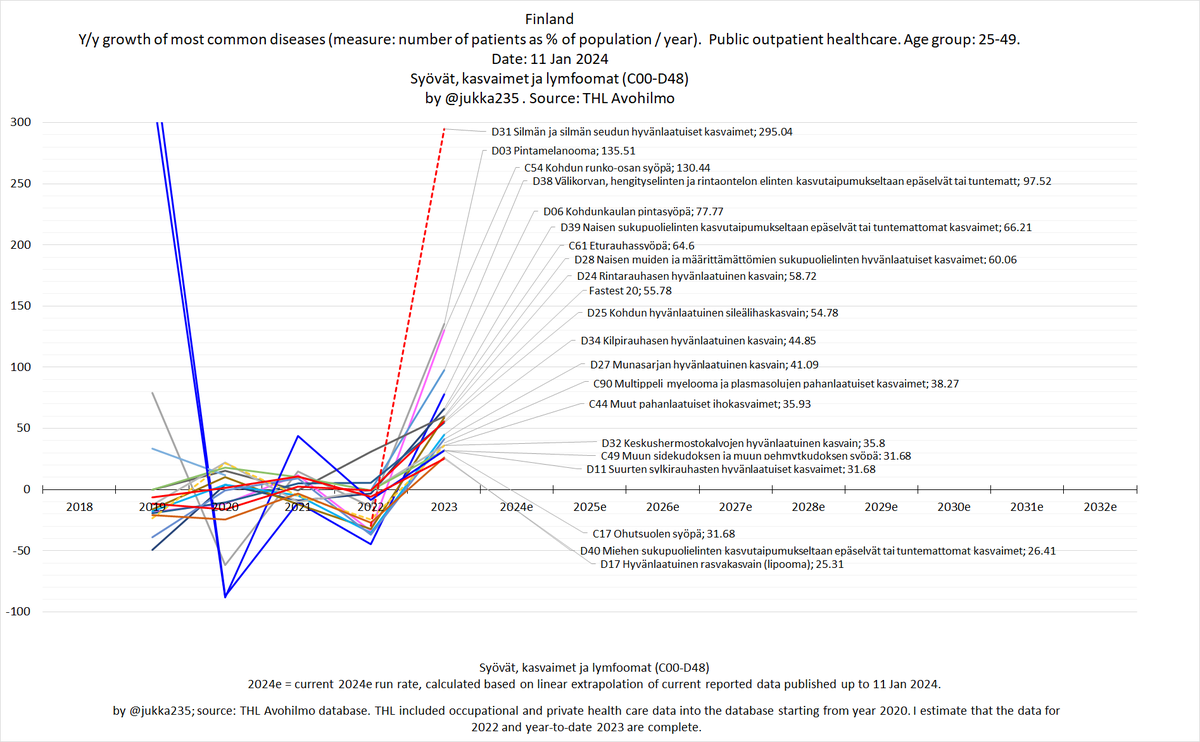
25-49 -vuotiaat: syövät, kasvaimet ja lymfoomat (C00-D48) 2/x
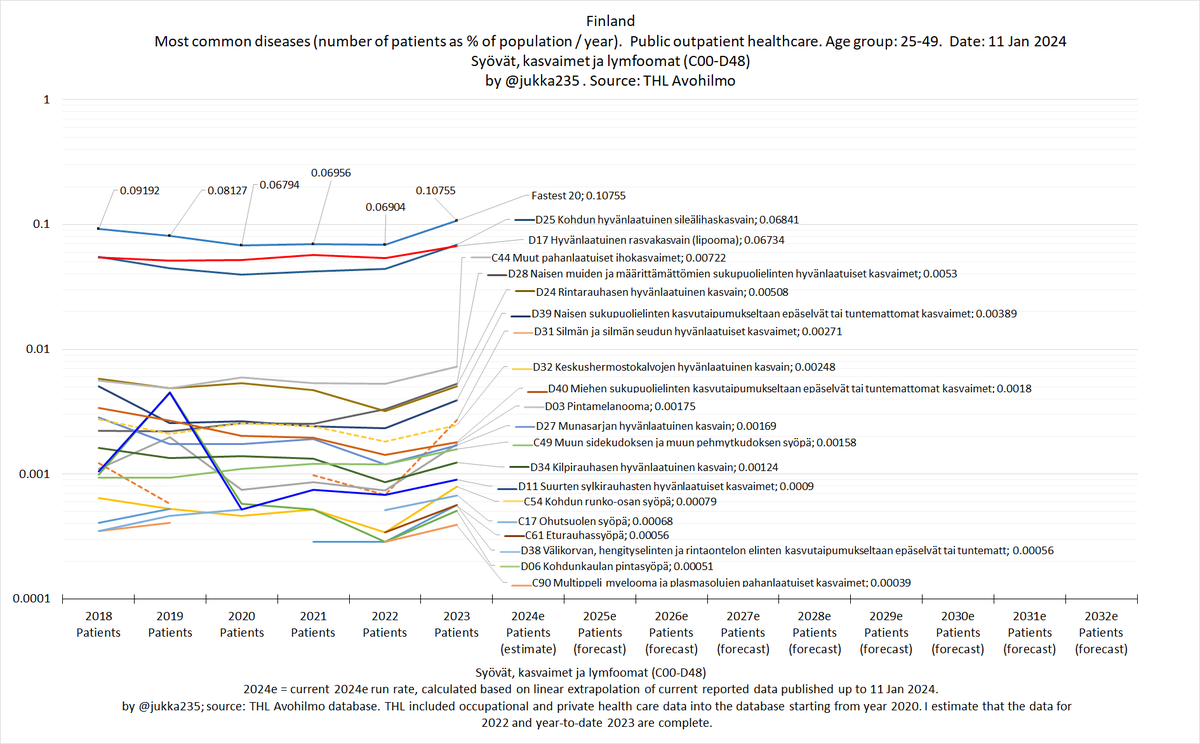
These are the 20 cancers, tumors, and lymphomas experiencing the fastest y/y patient growth in 2023. Together, they account for 12 percent of the total patient count. There is a significant representation of cancers and tumors affecting the female genital region. 3/x
Tässä ovat 20 nopeimmin vuosittain kasvavaa syöpää, kasvainta ja lymfoomaa vuonna 2023. Ne muodostavat noin 12 prosenttia kokonaispotilasmäärästä. Naisten sukuelinten alueen syövillä ja kasvaimilla on merkittävä edustus. 4/x
The 20 fastest growing cancers, tumors and lymphomas affect 0.1 percent of 25-49 year population. Weighted average y/y patient growth rate in 2023 is 56 percent per year (= 9 times in five years). 5/x
20 nopeimmin kasvavaa syöpää, kasvainta ja lymfoomaa vaikuttavat 0.1 prosenttiin 25–49-vuotiaiden väestöstä. Painotettu keskimääräinen v/v potilasmäärän kasvuvauhti vuonna 2023 on 56 prosenttia vuodessa (= 9-kertaistuu viidessä vuodessa). 6/x
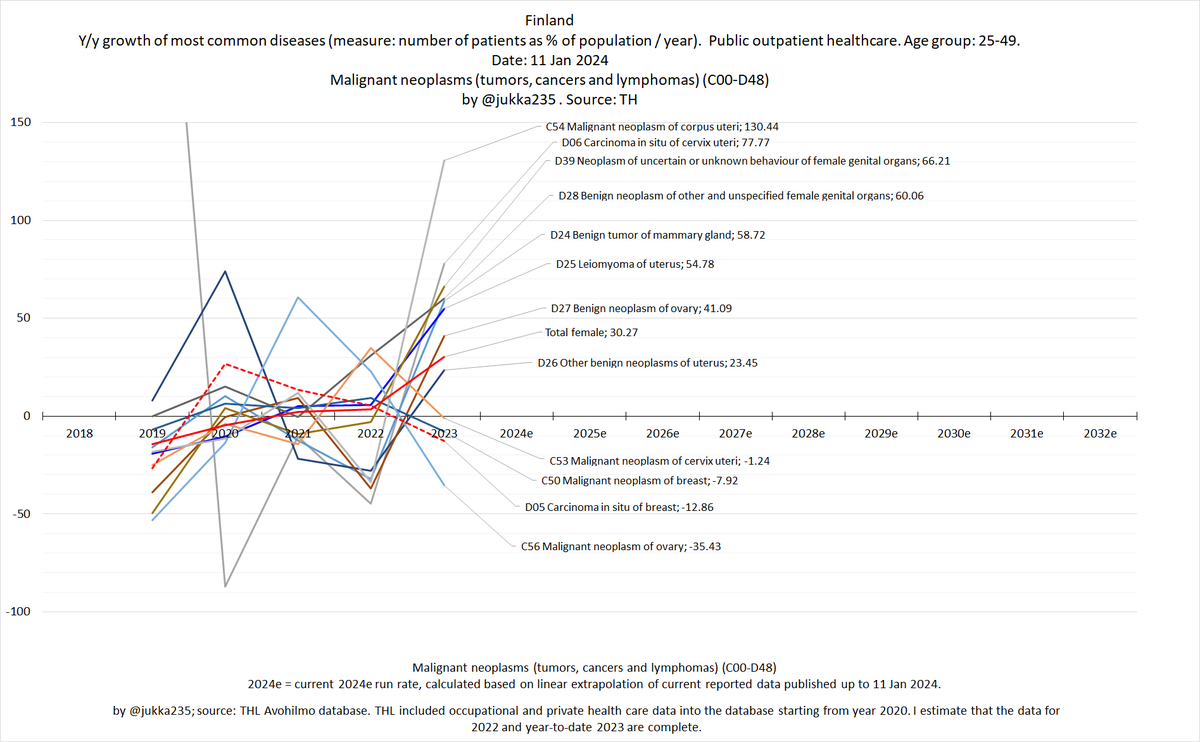
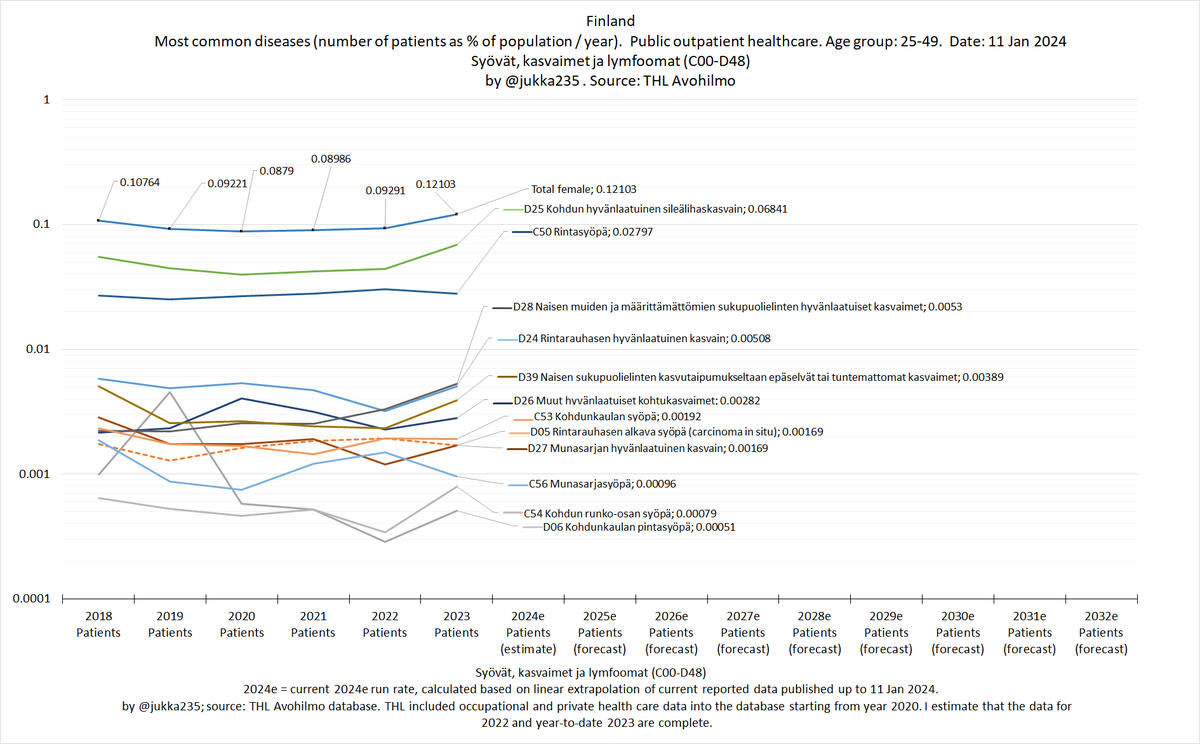
Next, let us review cancers, tumor and lymphomas in the female genital areas. In public outpatient healthcare, most of them have started to show significant y/y patient growth in 2023 (total y/y patient growth rate is 30 percent). 7/x
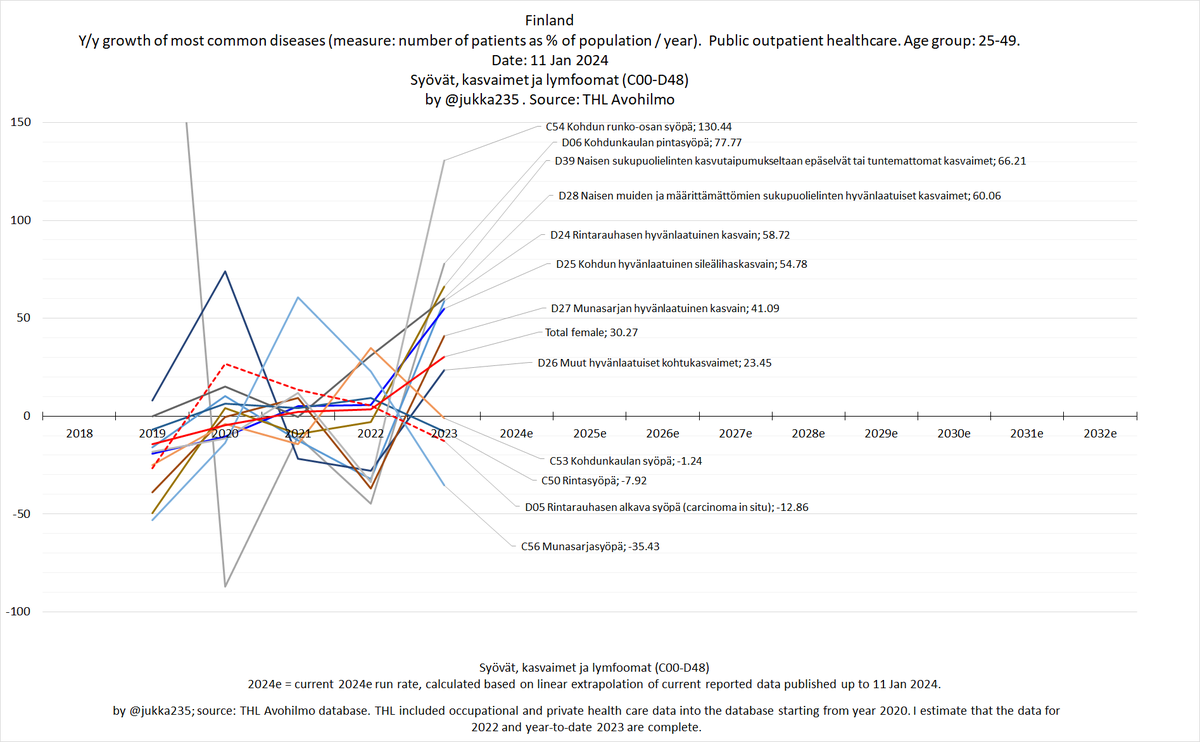
Katsotaan seuraavaksi naisen sukupuolielinten alueiden syöpiä ja kasvaimia. Julkisessa avoterveydenhuollossa useimmat niistä ovat alkaneet osoittaa merkittävää v/v potilasmäärän kasvua vuonna 2023. Keskimääräinen kasvuvauhti vuonna 2023 on 30 prosenttia. 8/x
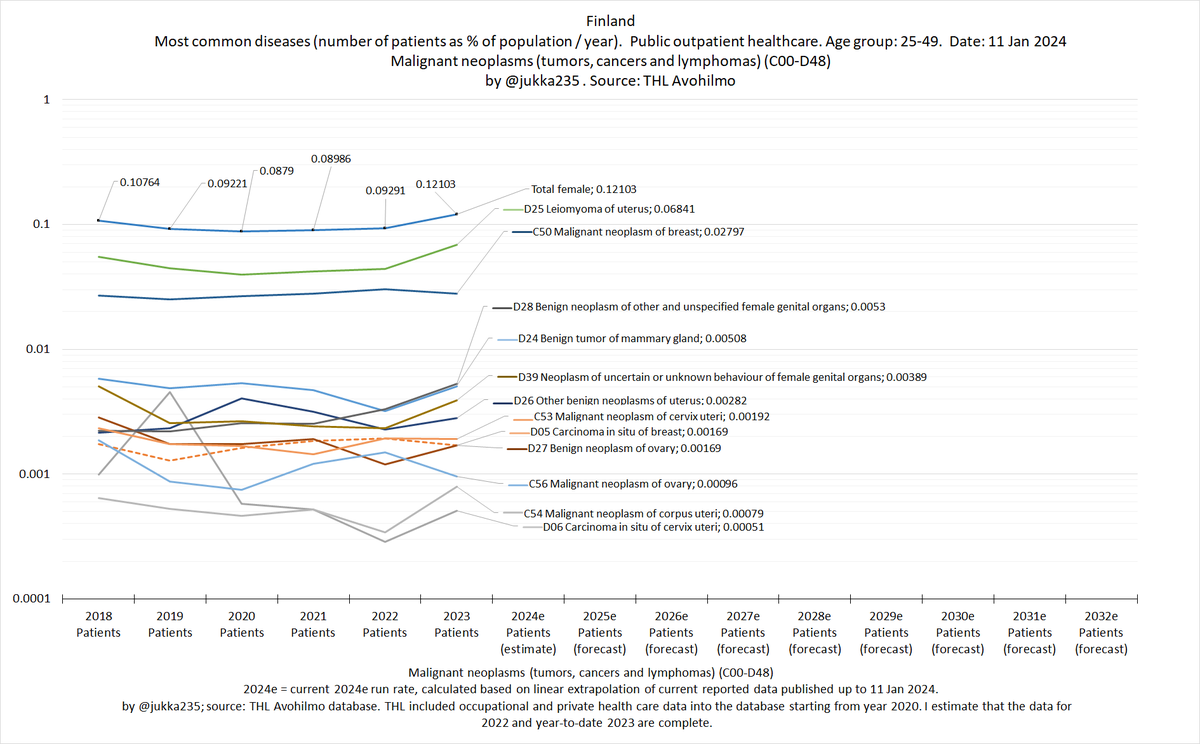
Cancers and tumors in female genital areas affect roughly 0.24 percent of 25-49 year old female population. The figure is growing 30 percent annually (= 10 times in ln(10)/ln(1.3) = 9 years). These figures include public outpatient healthcare only. 9/x
Naisten sukuelinten alueen syövät ja kasvaimet vaikuttavat noin 0.24 prosenttiin 25–49-vuotiaasta naisväestöstä. Luku kasvaa 30 prosenttia vuosittain (= 10-kertaistuu ln(10)/ln(1.3) = 9 vuodessa). Yksityinen ja työterveyshoito puuttuvat näistä luvuista. 10/x
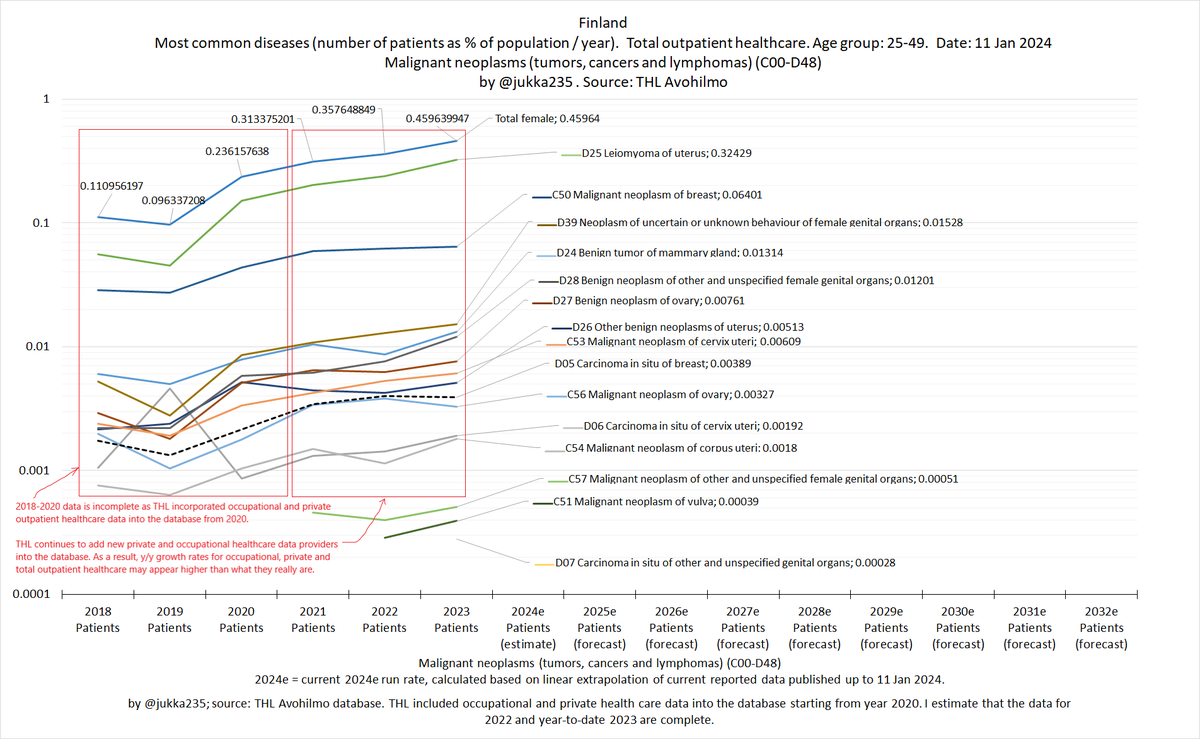
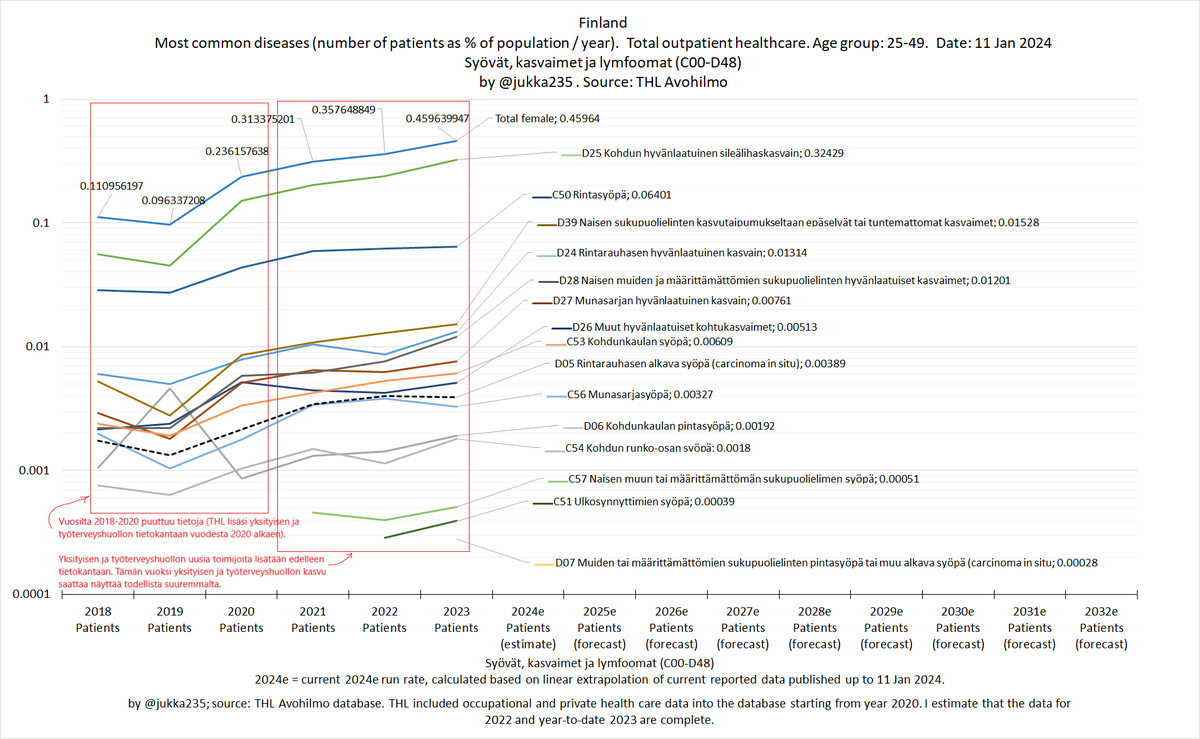
In total outpatient healthcare, cancers and tumors in the female genital area affect roughly 0.459x2 = 0.92 percent of 25-49 year old females, and the figure is growing 28.5 percent annually (10 times in ln(10)/ln(1.285) = 9 years). 11/x
Koko avoterveydenhuollossa naisten sukuelinten alueen syövät ja kasvaimet vaikuttavat noin 0.459x2 = 0.92 prosenttiin 25–49-vuotiaista naisista, ja määrä kasvaa 28.5 prosenttia vuosittain (eli 10-kertaistuu ln(10)/ln(1.285) = 9 vuodessa). 12/x
• • •
Missing some Tweet in this thread? You can try to
force a refresh

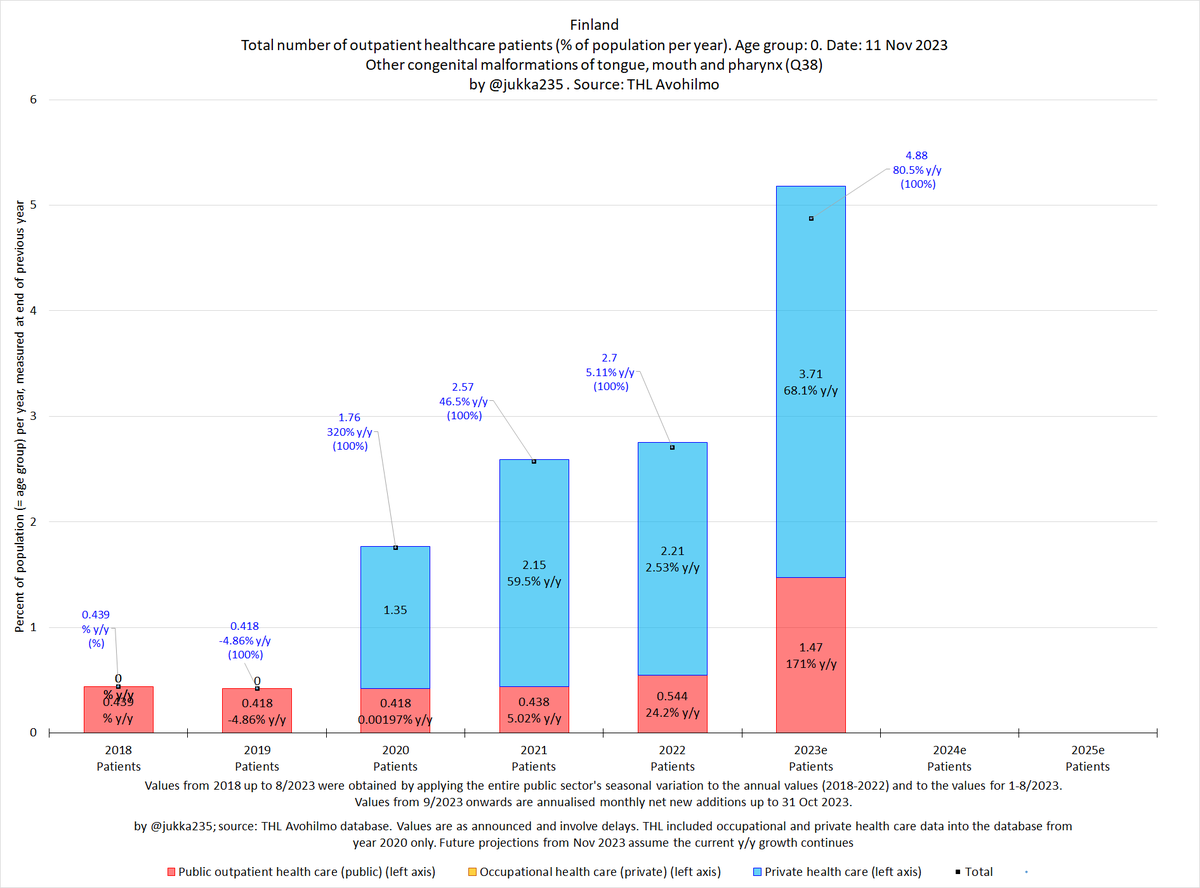
In 2023, roughly 1 in every 13 babies in Finland was born with at least one malformation, deformation, or chromosomal abnormality (Q00-Q99). The number of <1 year old patients is increasing at a rate of 75 percent annually (16 times over five years).
Vuonna 2023 joka kolmannellatoista alle 1-vuotiaalla oli epämuodostuma, epämuotoisuus tai kromosomipoikkeama (Q00-Q99). Potilasmäärä kasvaa 75 prosenttia vuodessa (16-kertaistuu viidessä vuodessa). 2/x
Foremost among malformations among <1 year olds is Other congenital malformations of tongue, mouth and pharynx (Q38), representing 62% of total <1 year old patients with Q00-Q99 diagnosis. 3/x
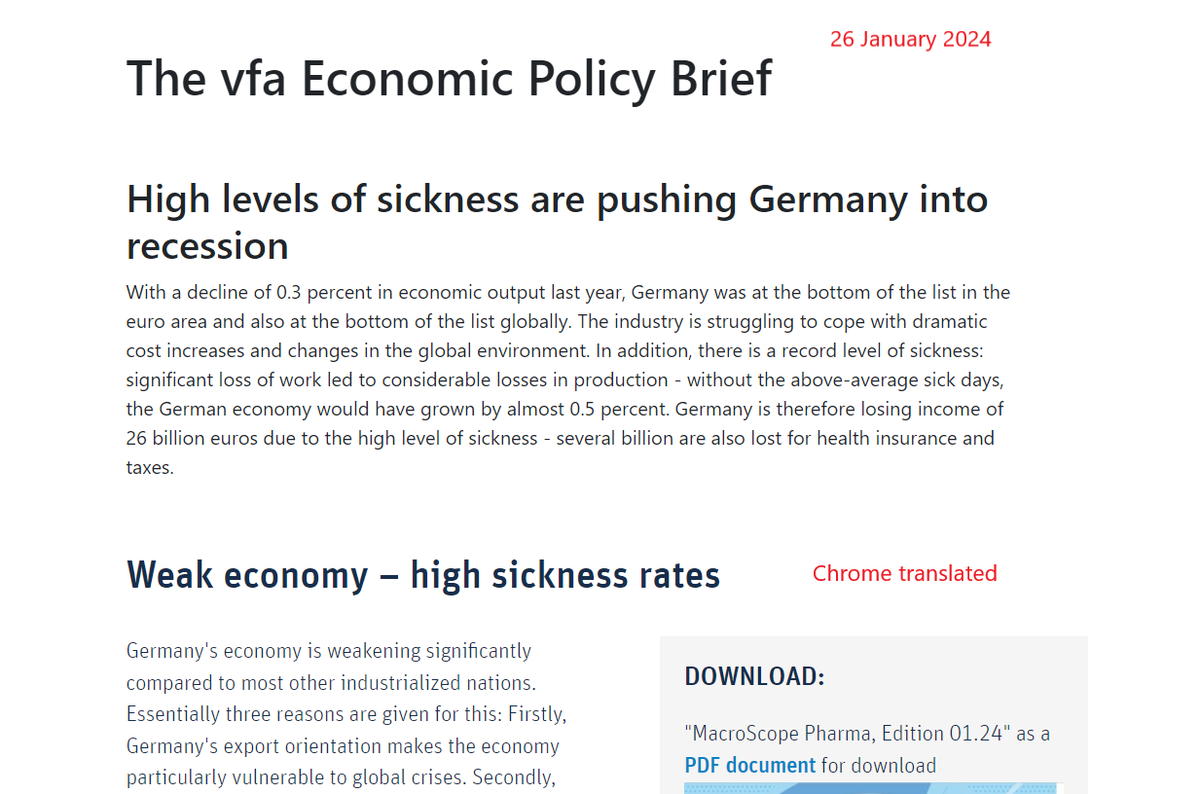
Germany's VFA says that the increasing number of absences is a key reason for the economic downturn. VFA's estimate (0.8% of GDP) is slightly higher than Finland's recession (0.5% of GDP in 2023 and expected 0.2% in 2024, with a negative outlook). 1/x
Saksan VFA:n mukaan kasvava poissaolojen määrä on keskeinen syy nykyiseen taloudelliseen lamaan. VFA:n arvio poissaolojen kasvun vaikutuksesta (0.8% BKT:stä) on hieman suurempi kuin Suomen nykyinen lama (0.5% vuonna 2023 ja 0.2% vuonna 2024, ja syvenemässä). 2/x
LC has powerfully struck the economy, both in Germany and in Finland, in my view. While VFA does not blame LC out loud (blaming "flu" and "other respiratory diseases"), VFA does recommend investments in health and preventative measures. 3/x
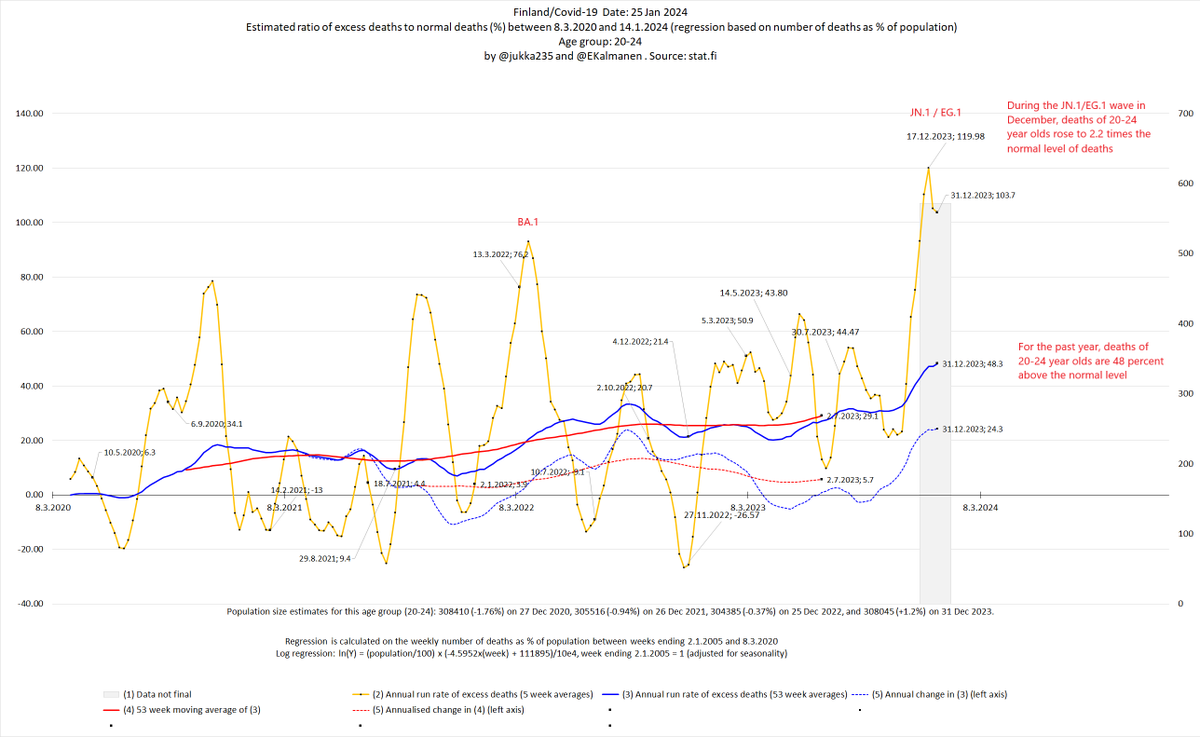
Finland's epidemic 25 Jan 2024: during the recent JN.1/EG.1 wave in December, deaths among 20-24 year olds rose to 2.2 times above the normal level. Over the past year, deaths among 20-24 year olds have been 48 percent higher than normal. 1/x
Suomen epidemia 25.1.2024: joulukuun JN.1/EG.1-aallon aikana 20-24-vuotiaiden kuolleisuus nousi 2.2 kertaa normaalia korkeammalle. Viimeisen vuoden aikana 20-24 -vuotiaiden kuolemien määrä on ollut 48 prosenttia korkeampi kuin normaalisti. 2/x
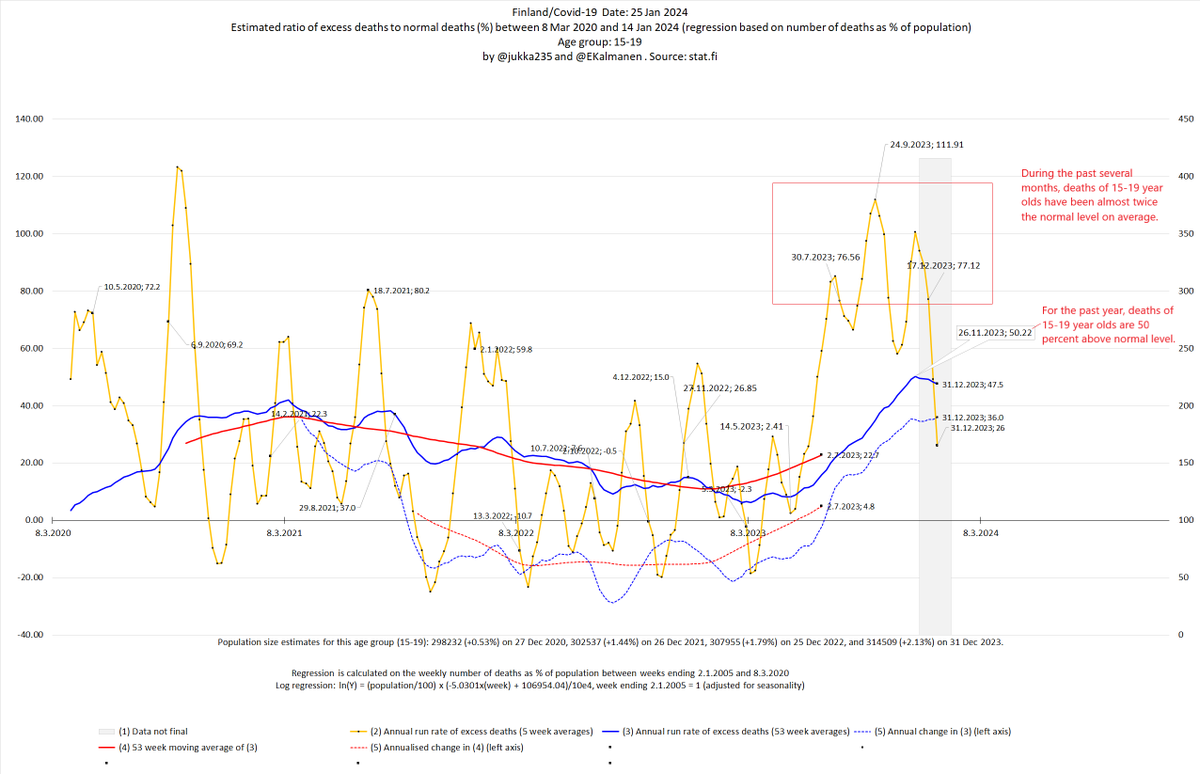
During the past several months, deaths among 15-19 year olds have risen to almost twice the normal level. As a result, over the past year deaths among 15-19 year olds have been 50 percent higher than normal. 3/x
United Kingdom: economic inactivity due to long term sickness now amounts to approximately 1.5 percent of all 16-64 year olds, and is increasing at a rate of 0.45 percentage points per year. The rate of change is increasing. 1/x
Iso-Britannia: pitkäaikaisista sairauksista johtuva taloudellinen passiivisuus vastaa nyt noin 1.5 prosenttia kaikista 16-64-vuotiaista, ja kasvaa 0.45 prosenttiyksikön vuosivauhtia. Muutoksen vauhti on kiihtymässä. 2/x
Sources: 1) Economic inactivity: Office of National Statistics, UK (ONS)
2) Population estimates:
Population estimates: (choose "Analysis of population estimates tool for UK")
Finland's epidemic 4 Jan 2024: meaningful exponential growth has started in key categories:
- reproduction related diseases
- malformations and deformations
- diseases among newborns
if allowed to continue, this could have serious, and very broad, consequences. 1/x
Suomen epidemia 4.1.2024: merkittävä exponentiaalinen kasvu on alkanut tärkeissä kategorioissa:
- lisääntymiseen liittyvät taudit
- epämuodostumat
- vastasyntyneiden sairaudet
jos näiden tautien kasvu jatkuu, seuraukset voivat olla vakavia ja todella laaja-alaisia. 2/x
The exponential growth of key diseases impacting human reproduction could lead to a substantial decline in childbirth rates, starting in 3 to 5 years from today, if current trends continue. 3/x
Finland's epidemic 3 Jan 2024: meaningful exponential growth has started in key categories:
- reproduction related diseases
- malformations and deformations
- celebral palsy (CP)
if allowed to continue, this could have serious, and very broad, consequences. 1/x
Suomen epidemia 3.1.2024: merkittävä exponentiaalinen kasvu on alkanut tärkeissä kategorioissa:
- lisääntymiseen liittyvät taudit
- epämuodostumat
- CP-oireyhtymä
jos näiden tautien kasvu jatkuu, seuraukset voivat olla vakavia ja todella laaja-alaisia. 2/x
The exponential growth of key diseases impacting human reproduction could lead to a substantial decline in childbirth rates, starting in 3 to 5 years from today, if current trends continue. 3/x