Arthur Schlesinger dismissed studies of soldiers' World War II experiences as demonstration of common sense.
Perhaps he was correct. Consider the following findings:
"Better educated soldiers suffered more adjustment problems than less educated soldiers. (Intellectuals were less prepared for battle stresses than street-smart people.)"
"Southern soldiers coped better with the hot South Sea Island climate than Northern soldiers. (Southerners are more accustomed to hot weather.)"
"White privates were more eager to be promoted to noncommissioned officers than Black privates. (Years of oppression take a toll on achievement motivation.)"
How many of those findings did you predict in advance?
Perhaps he was correct. Consider the following findings:
"Better educated soldiers suffered more adjustment problems than less educated soldiers. (Intellectuals were less prepared for battle stresses than street-smart people.)"
"Southern soldiers coped better with the hot South Sea Island climate than Northern soldiers. (Southerners are more accustomed to hot weather.)"
"White privates were more eager to be promoted to noncommissioned officers than Black privates. (Years of oppression take a toll on achievement motivation.)"
How many of those findings did you predict in advance?
If you voted, skip to the next post to see the answer key.

Each statement was "common sense," and they were all wrong.
If they had been stated in reverse and given new explanations, they would have still been called "common sense."
If they had been stated in reverse and given new explanations, they would have still been called "common sense."
What's "common sense" is the domain of "Didn't we already know this?" and "Isn't this obvious?"
It's the domain of questions that people probably didn't predict, but will claim they would have. That's why predictions are so much more valuable than post hoc explanations.
It's the domain of questions that people probably didn't predict, but will claim they would have. That's why predictions are so much more valuable than post hoc explanations.
People are infamously bad at actually predicting things or describing changes, and similarly infamously likely to state they knew what would happen or did happen all along.
For example, teachers don't know how much they have learned:
For example, teachers don't know how much they have learned:
https://x.com/cremieuxrecueil/status/1690538597521215488
People don't know if they're eating more or less:
https://x.com/cremieuxrecueil/status/1659459655830061057
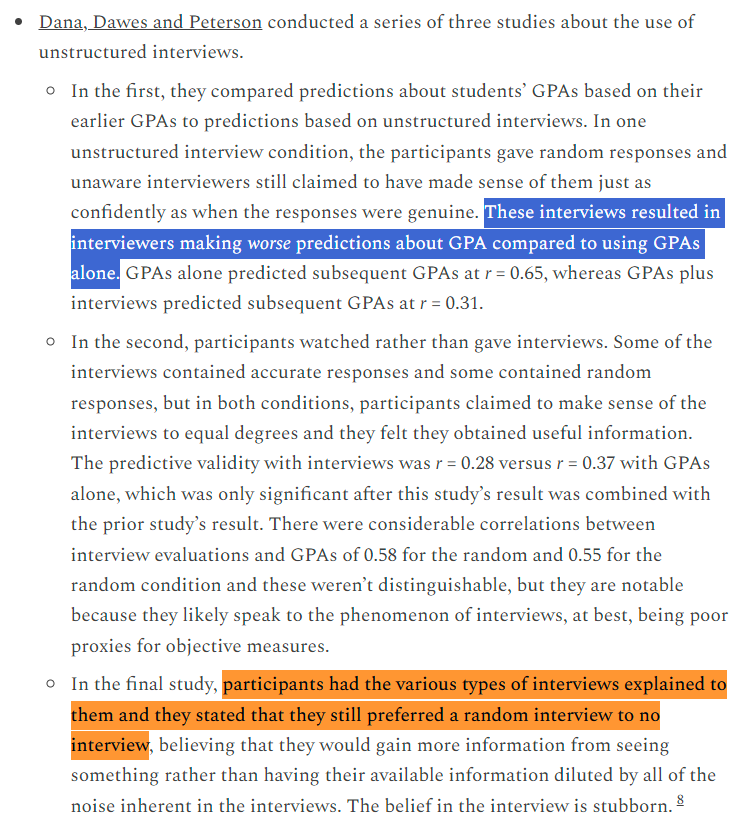
More, useless information can make predictions worse, but people still want more information: cremieux.xyz/p/bias-in-admi…
I have often explained what can be regarded as obvious concepts to those with statistical acumen.
But though there are trivial proofs aplenty undergirding these concepts, people still struggle with them.
Here's an example about combining distributions:
But though there are trivial proofs aplenty undergirding these concepts, people still struggle with them.
Here's an example about combining distributions:
https://x.com/cremieuxrecueil/status/1733600038339641548
Here's another, on the issue of scaling:
https://x.com/cremieuxrecueil/status/1753491107680243873
And here's another, on the issue of comparing pass rates and standardized group differences:
https://x.com/cremieuxrecueil/status/1740123837906239673
Some people have even posited empirical "riddles," where some finding seems inconsistent with some other finding, but close inspection reveals there's no issue at all.
For example, Israeli PISA performance is not mysterious: aporiamagazine.com/p/pinpointing-…
For example, Israeli PISA performance is not mysterious: aporiamagazine.com/p/pinpointing-…

What's obvious to me may not be obvious to you. What's obvious in hindsight might not be correct at all.
"Obviousness?" and "common sense" are a scourge on discussion in many domains because many phenomena are less self-evident than they might feel in a given moment.
"Obviousness?" and "common sense" are a scourge on discussion in many domains because many phenomena are less self-evident than they might feel in a given moment.
And sometimes you do have to show evidence for the "obvious." Being a human who cares about others can require it.
The OP questions and this observation came from lesswrong.com/posts/WnheMGAk…
The original study is academic.oup.com/poq/article-ab…
The OP questions and this observation came from lesswrong.com/posts/WnheMGAk…
The original study is academic.oup.com/poq/article-ab…
• • •
Missing some Tweet in this thread? You can try to
force a refresh