These maps are interesting. Given the pre-existing differences between the East and West, however, we cannot simply "eyeball" the effects of the GDR regime, though some of the variation is likely causal.
Here are some of my favourite works that help us think carefully ... 1/11
about the GDR regime's effects.
1. I've pointed to this great paper so many times that I feel like a broken record, but this by @essobecker, @LukasMergele, and @Woessmann is essential reading 2/11
2. This by Kern and Hainmueller is an absolute classic and leverages the variation generated in large part by the topography of the valley of the unaware ("Tal der Ahnungslosen") around Dreseden.
3/11cambridge.org/core/journals/…
3. Bursztyn and Cantoni's paper use a similar identification strategy, but look at a different outcome, i.e. consumption, rather than attitudes.
4/11direct.mit.edu/rest/article-a…
4. Another great paper is this @JEEA_News piece by Lichter, Löffler, and @Sigginho. They use within-GDR differences in spying intensity to examine the effects on trust and, more broadly, social capital.
5/11academic.oup.com/jeea/article/1…
5. For non-German readers, let me note that imo Jens Gieseke's (@zzfpotsdam) history of the Stasi is unrivalled. English translation here
6/11amazon.co.uk/History-Stasi-…
Recently, a number of papers have come out that analyse the (i) process of privatisation (via the Treuhand) and (ii) effects of privatisation on economic and political outcomes.
6. This🧵and the related paper are absolute must-reads. 7/11
7. Then, there is this interesting working paper by @ufukakcigit and co-authors.
8/11nber.org/papers/w31645
8. This paper by @BachmannRudi et al. sheds light on the role of monopsony in creating productivity differences between East and West German firms.
9/11papers.ssrn.com/sol3/papers.cf…
9. On the political effects of privatisation, see the work by Hennicke, @anselmhager, @krause_we, and @LukasMergele
10/11osf.io/preprints/osf/…
10. @HansLueders has a new paper in @World_Pol, where he shows that the economic uncertainty associated with East Germany's democratisation has long-lasting effects, with East Germans responding more strongly to present economic uncertainty. 11/END
muse.jhu.edu/pub/1/article/…
Addendum: See this🧵of mine for some more general thoughts on the "workings" of autocracies:
@threadreaderapp unroll

• • •

Missing some Tweet in this thread? You can try to force a refresh

 

Keep Current with Jacob Edenhofer 🇪🇺 🇺🇦

Jacob Edenhofer 🇪🇺 🇺🇦 Profile picture

Stay in touch and get notified when new unrolls are available from this author!

Read all threads

This Thread may be Removed Anytime!

PDF

Twitter may remove this content at anytime! Save it as PDF for later use!

Try unrolling a thread yourself!

how to unroll video
  1. Follow @ThreadReaderApp to mention us!

  2. From a Twitter thread mention us with a keyword "unroll"
@threadreaderapp unroll

Practice here first or read more on our help page!

More from @edenhofer_jacob

Jan 18
Very interesting result! What struck me most: nobody picked “depends”. I think that’s the right answer, but the question is, of course, "on what". To answer this, let's start with some general thoughts about the role of voters and interst groups in policymaking.
Simplifying crudely, think of both as "principals" that can impose political losses on a policymaker when (s)he deviates from their "bliss point", their ideal.
In climate policy, two forces change which constraint binds as decarbonisation deepens:
1. Rising marginal adjustment
costs as stringency increases (low-hanging fruit are reaped).
2. Cost incidence visibility / attribution: whether households/voters experience costs as direct, frequent, and clearly attributable to some climate policy (e.g. a carbon tax).
Now add an empirical
Read 21 tweets
Jan 9
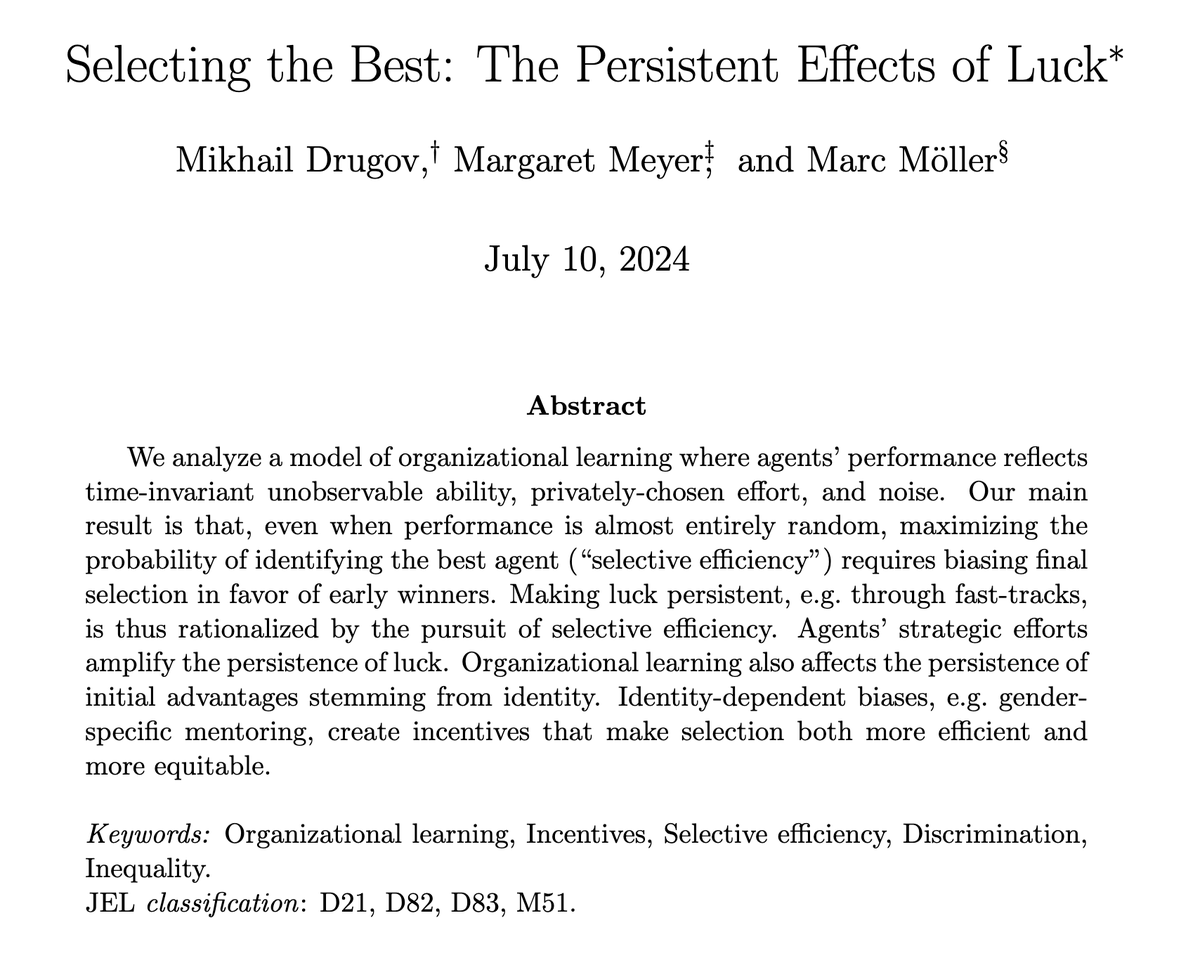
A deep paper -- that popped into my head as I was perusing @sndurlauf's recent essay on meritocracy. The paper raises a broader question: how to be meritocratic when there is uncertainty about the relative weights of luck and effort in individuals' production function? One Image
approach is axiomatic, which sometimes allows us to disentangle luck and effort. Roemer as well as @PaulHufe, @APeichl, and Kanbur are wonderful examples in that regard. Often, however, we don't have enough (or the right) data for this to work,
tse-fr.eu/sites/default/…
especially in our day-to-day interactions. So, what if this uncertainty cannot be resolved?
Three tentative pol econ thoughts on this.
1. I'd argue that uncertainty about luck/effort resembles Cappelen et al's "second-order" fairness preferences
academic.oup.com/restud/article…Image
Read 15 tweets
Jan 2
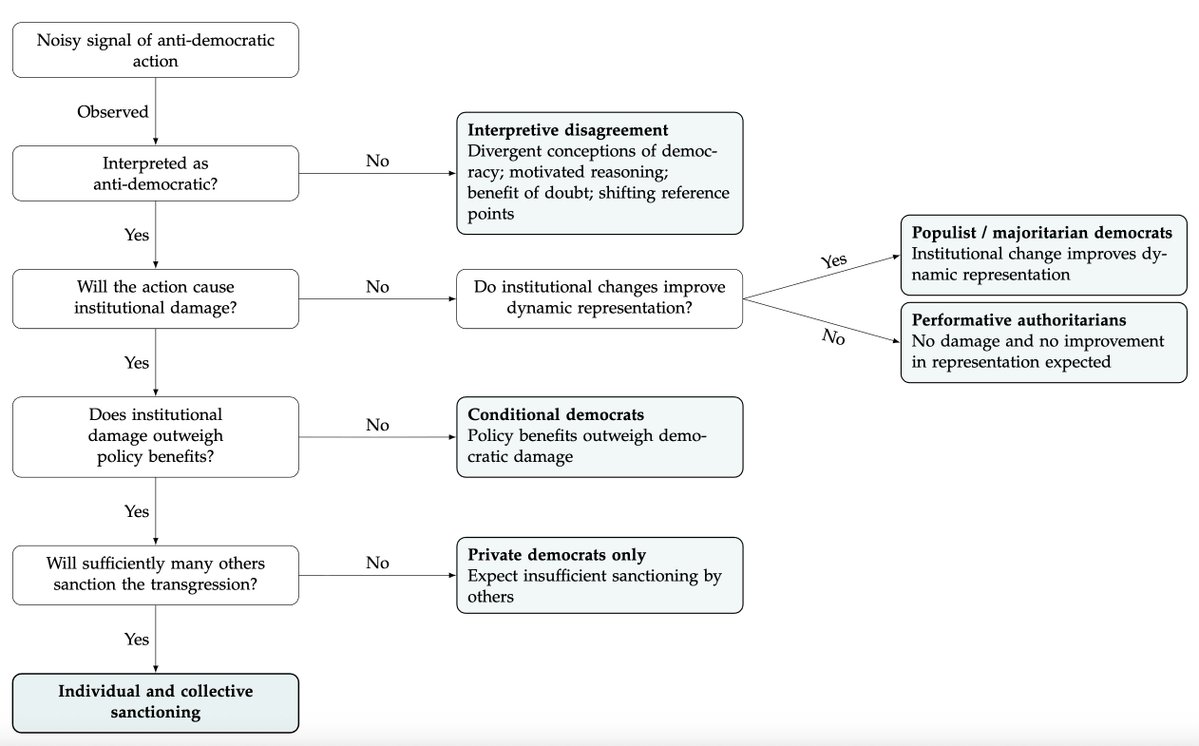
By way of preparing for teaching and making sense of current events, I spent today trying to synthesise the demand-side literature on democratic backsliding (see figure below). The starting point of most of this literature is simple: Do voters punish politicians who violate Image
democratic norms, or do they tolerate them when other considerations (policy, identity, partisanship) are at stake? Since the seminal contribution by Graham & Svolik (2020), this is often framed as a trade-off between democracy and policy. The figure seeks
cambridge.org/core/journals/…
to add nuance by unpacking the 'chain' of democratic sanctioning and, in doing so, to also identify different failure modes.
1. Citizens don’t observe “violations” directly. They observe actions whose implications are uncertain and contested. Everything that follows depends on
Read 23 tweets
Dec 29, 2025
Here are my favourite papers on climate policy and politics this year (in no particular order). Let me know what other papers and books you've found insightful.
1. Ascari, Guido, Andrea Colciago, Timo Haber, and Stefan Wöhrmüller. 2025. ‘Inequality along the European Green Transition*’. @EJ_RES. doi.org/10.1093/ej/uea…
2. Calvacanti, Tiago, Zeina Hasna, and Cezar Santos. 2025. ‘Climate Change Mitigation Policies: Aggregate and Distributional Effects’. @EJ_RES. 135(668): 1341–87. doi.org/10.1093/ej/uea…
Read 21 tweets
Dec 16, 2025
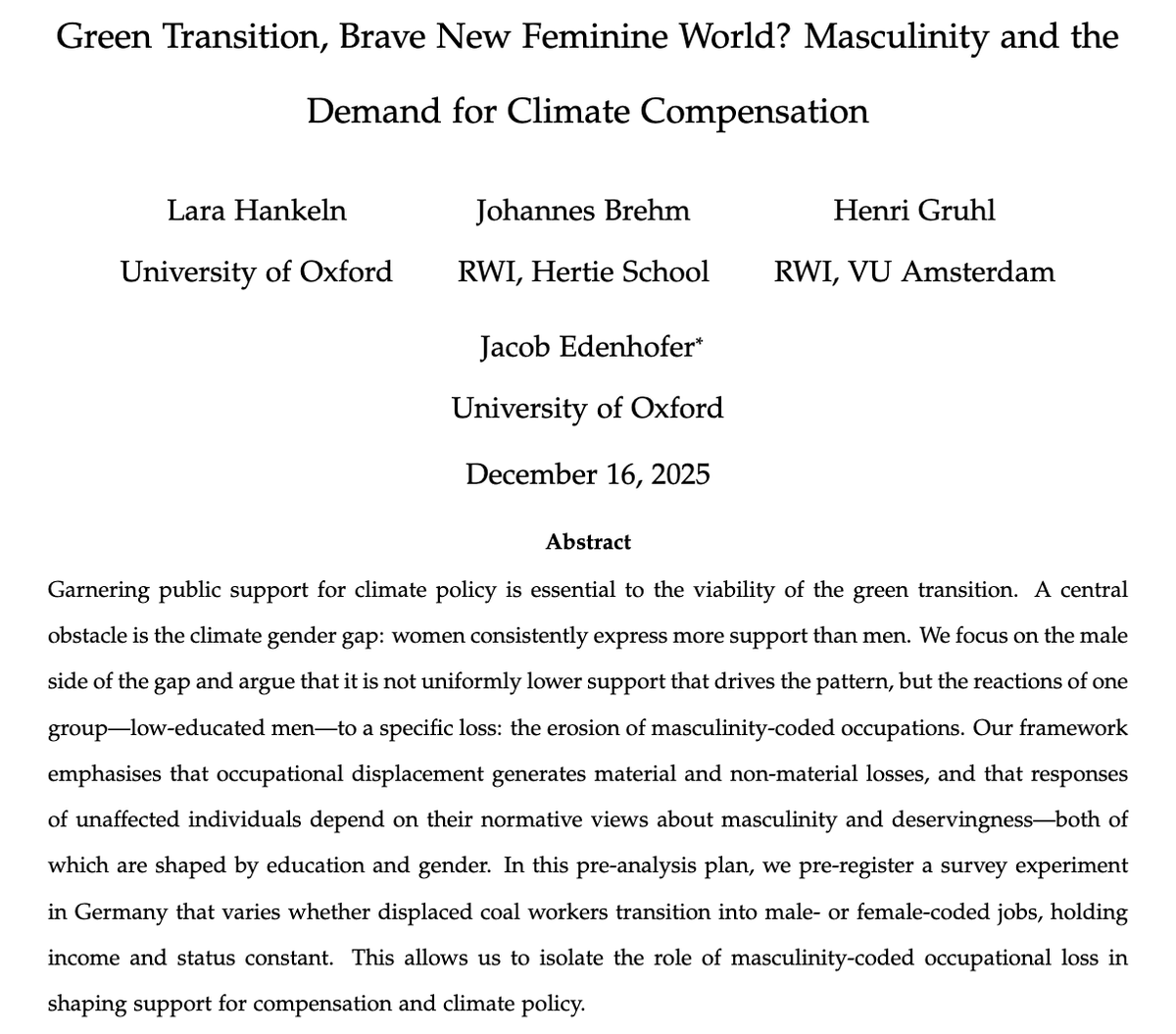
Excited to have just finished this pre-analysis plan (PAP) with Lara, @johannesbrehm, and Henri -- it will be interesting to see which, if any, of our predictions will be borne out by the data. More on that in the new year. In the meanwhile, let me tell you about our theory. Image
Two observations constitute our starting point:
1⃣A well-established stylised empirical fact on climate public opinion is women express greater support for climate policy than men.
➡️What is less clear is which groups drive this gap, especially on
osf.io/9usd2/files/ms…
the male side (see also the cool work by Amelia Malpas in the non-climate context), and among the unaffected, those not directly exposed to climate-induced job losses.
2⃣Much of the literature focuses on those (in)directly affected by the adverse
ameliamalpas.com
Read 16 tweets
Dec 11, 2025
Recently, I have been thinking about the political economy of policy advice. Below are my thoughts; I'd be curious to hear what "practitioners" think about these. Let's start by thinking about the demand for and supply in the market for policy advice.
Policymakers rely on expert advice because it serves two purposes.
1⃣ Expertise can lead to better policies or implementation by providing an evidence-based overview of the costs and benefits of different policy instruments or objectives.
2⃣Expertise can provide legitimation.
Expert statements (e.g. in interviews) can help policymakers justify their preferred positions to coalition partners, interest groups, or attentive elites. The relative weight of these functions depends on the institutional and political environment in which policymakers operate.
Read 27 tweets

Did Thread Reader help you today?

Support us! We are indie developers!


This site is made by just two indie developers on a laptop doing marketing, support and development! Read more about the story.

Become a Premium Member ($3/month or $30/year) and get exclusive features!

Become Premium

Don't want to be a Premium member but still want to support us?

Make a small donation by buying us coffee ($5) or help with server cost ($10)

Donate via Paypal

Or Donate anonymously using crypto!

Ethereum

0xfe58350B80634f60Fa6Dc149a72b4DFbc17D341E copy

Bitcoin

3ATGMxNzCUFzxpMCHL5sWSt4DVtS8UqXpi copy

Thank you for your support!

Follow Us!

:(