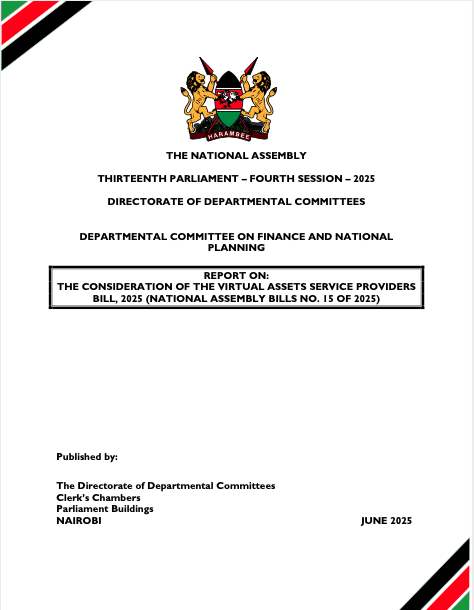
As we all get consumed by the US$/Kes exchange, the National Assembly Committee Report on the Affordable Housing Bill 2023 is out & I think we all need to pay close attention.
A number of proposals to amend the Bill have been thrown out, 10.0% deposit has been shelved.
A 🧵
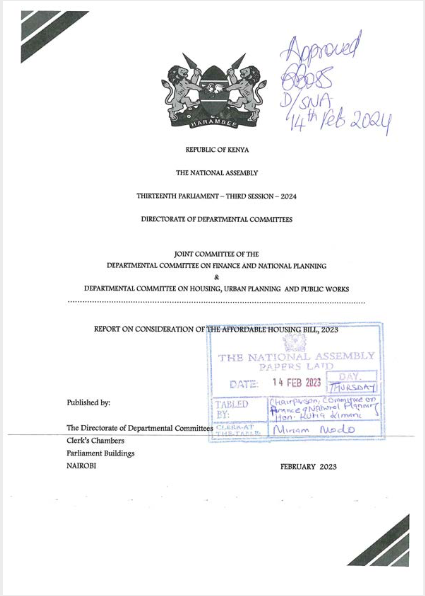
First, if you want context on the Affordable Housing Bill 2023 & its proposals in response to the 3-judge bench judgement which pronounced the levy to be unconstitutional, see quoted thread below
The committee:
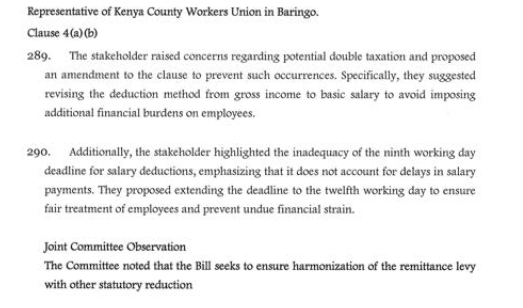
· Has rejected the proposal to amend Sec4 to provide that deductions be pegged on basic as opposed to gross salary
· Has rejected the proposal to extend the window for remittance from the 9th to the 12th working day
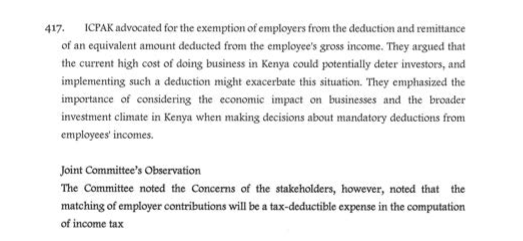
The Committee rejected the proposal to do away Sec5 of the Bill which provides for the mandatory requirement that employers match their employees' contribution with 1.5%. The Committee says the fact that the matching is tax deductible should be sufficient
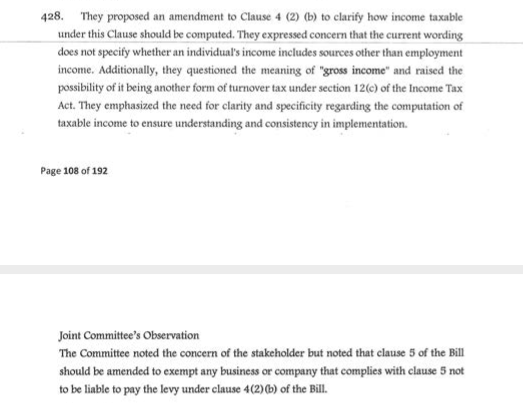
The Committee has endorsed a proposal to clean up the potential conflict between Sec4(2b) targeting non-payslip Kenyans & Sec5 which provides for employer matching. An amendment to be made exempting any business compliant with Sec5 from the obligations of 4(2b)
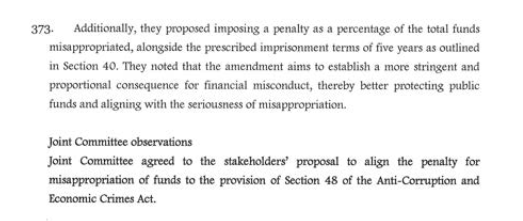
The Committee has endorsed the proposal to amend Sec40 (cii) the penalty imposed on persons who misappropriate the affordable housing levy funds from the fine not exceeding Kes 10.0M or jail term not exceeding 5 years to align with Sec48 of the Anti-Corruption Act
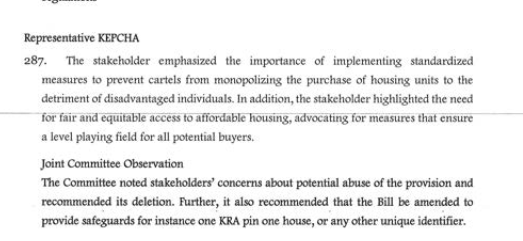
The committee proposes Sec30(2c) of the bill be amended to provide that housing units be allocated pegged on one KRA pin per house (or any other suitable unique identifier).
I am lost, isn't allocation based on consolidated household income? How will couple's incomes be mapped?
The Committee:
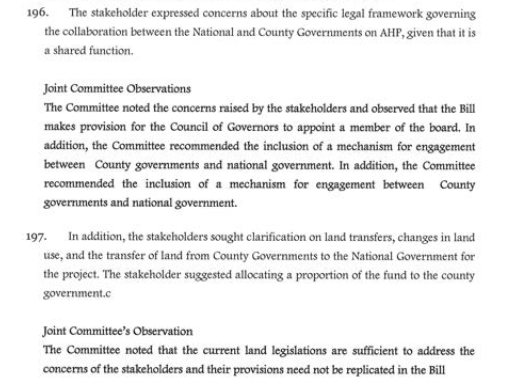
· Has thrown out concerns regarding collaboration between National & County govts. They argue the Bill provides for the Council of Governors to appoint a member to the Affordable Housing Board
· Has thrown out concerns regarding transfer of land
The committee has proposed that Sec31(2a) recommending the 10.0% mandatory deposit for one to be deemed eligible for the affordable housing units be dropped & guidelines be provided in the regulations
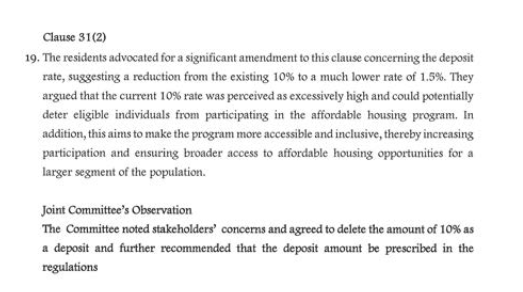
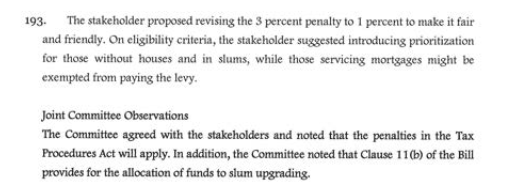
The Committee has recommended that Sec7 of the bill be amended to scale down the 3.0% penalty (of the unpaid amount) for one falling into arrears on remittance to the fund. Tax Procedures Act penalty will apply. The accrued penalties to be for slum upgrading
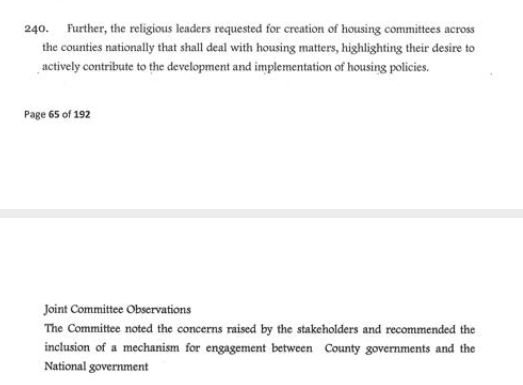
The Committee is proposing the Bill provides for the set up of 47 Housing Committees (one for each county) to provide a framework for engagement between National & County governments on matters housing.
Is this really necessary?
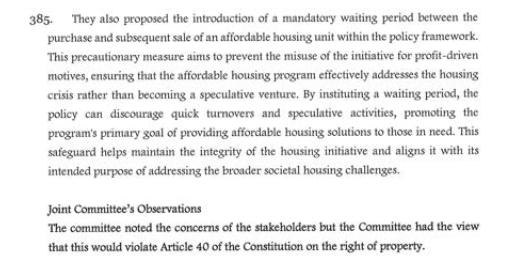
There was a proposal for provision of a mandatory waiting period between the purchase & sale of an affordable housing unit to address the risk of quick turnover & speculative ventures, it has been shot down by the Committee. I am a little surprised by this one
Finally
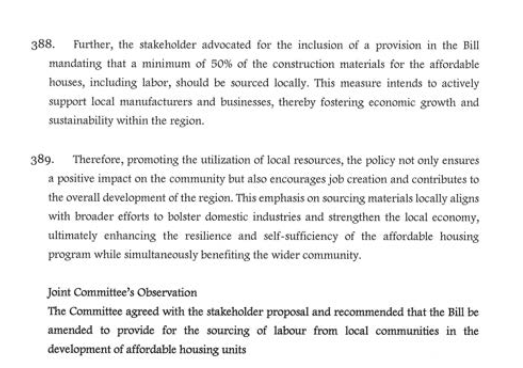
The committee has endorsed the proposal to have at least 50.0% of all material used in affordable housing, including labour, be sourced from local communities.
I just hope there will be standardisation of product.
• • •
Missing some Tweet in this thread? You can try to
force a refresh

I had the pleasure of moderating the 10th edition of the Economic Forum convened by @NCBABankKenya & the take outs were huge.
The key note was delivered by the Chairperson of the President's Council of Economic Advisors, Dr. David Ndii.
Here's what stood out for me.
A🧵
Are we still expecting a successor programme with the IMF following the premature termination of the US$3.6 billion arrangement in March this year?
I don't think so.
Here's the state of play:
· There's no consensus within government on whether Kenya needs a successor programme or not
· The government's focus as of now is on securing investment grade ratings with a view of enhancing access to the commercial market & steadily move away from multilateral financing
· It appears the points of divergence between the government & IMF are many, including the ongoing securitisation
· Dr. Ndii argues that GOK & IMF are not aligned because IMF is too much "demand side focused"
· Dr. Ndii seems to suggest that Kenya's engagement with the Fund for a programme will now be limited to something left for shock occurrences
Musings:
· When Kenya published its 2025/26 Borrowing Plan (which includes a debt-for-food swap; a Sustainability Linked Bond & UAE financing), I argued that it was a signal that talks with the IMF were as good as dead. I now believe that even more
· I am not surprised by this stance. Based on the SDR quota gobbled up by the recently terminated programme, by my math Kenya had just ~ US$400.0 million worth of space for a new programme anyway
· This, in my view, equally means that the government has slow pedalled, & possibly disengaged, from talks with the World Bank for the delayed US$750.0 million DOP
· The preemptive return to market to buyback the US$1.0 billion 7.25% 2028 Eurobond Note four weeks ago, amidst an IMF Mission to Nairobi, was a clear signal of this intent
Is the US$/Kes "too stable" as we are told the IMF has argued in its latest mission to Kenya?
Dr. Ndii makes a few points that stood out in my view:
· His argument is anchored on the view that exchange rates, in the short-run typically, from time to time will have volatility/wild swings that are not in line with the underlying macroeconomic fundamentals (hence his reference to the Dornbusch Overshooting Model)
· He goes further to argue that this is what we saw with the US$/Kes in 2023/early 2024 as the markets appeared to price in the expectation of Kenya defaulting on the US$2.0 billion Eurobond (what he is saying is that in that period US$/Kes overshot away from its long-term path hence the slide to 160 units to the US$)
· He further says that the job of policy makers is "to be pragmatic" & asks whether it would be in the economy's best interest to see the Kes overshooting in the reverse direction (what he is asking is whether it would be of any economic value to see the kes strengthening as rapidly as we saw it losing value when it roiled to 160 to the US$)
The Auditor General's Special Report on Government Digital Payments Platform (eCitizen) is out!
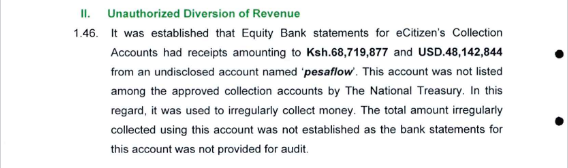
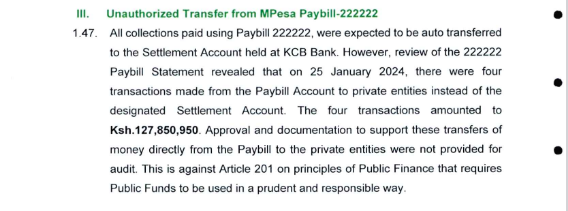
Some heavy revelations here including the unearthing of diversion of funds from the mandatory 222222 Paybill for payment of government services to private accounts & the irregular collection of Convenience Fees totalling Kes 1.807 billion
A 🧵
· Equity Bank statements for eCitizen's Collection
Accounts had receipts amounting to Kes 68,719,877 & US$48,142,844 from an undisclosed account named 'pesaflow'
· This account was not listed among the approved collection accounts by The National Treasury & it was used to irregularly collect money
· All collections paid using Paybill 222222, were expected to be auto transferred to the Settlement Account held at KCB Bank
· However, review of the 222222 Paybill Statement revealed that on 25th January 2024, shows there were four transactions made from the Paybill Account to private entities instead of the designated Settlement Account.
· The four transactions amounted to Kes 127,850,950
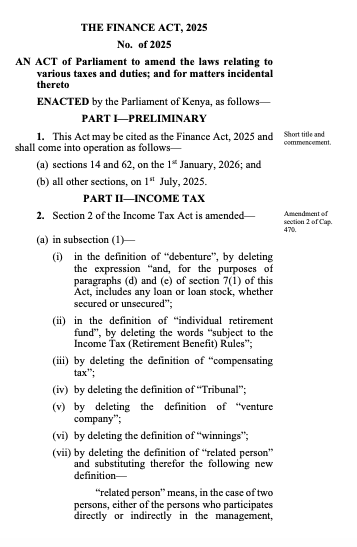
I have finally gotten a hold of & read through the Vellum of Finance Bill 2025.
A quick 🧵 on what we are seeing so far, bearing in mind that the ultimate truth lies with the Act that will be gazetted.
First off,
· The Bill was signed into law on June 26th alongside the Appropriations Bill
· The Bill was signed into law with 4 days left to the statutory sunset date of June 30th
· The Vellum retains the position that we shall only have 2 effective dates, July 1st, 2025 & Jan 1st, 2026
· Only 2 provisions have been deferred to take effect on Jan 1st, 2026
· The first provision taking effect on Jan 1st, 2026 is the kicking in of Advance Pricing Agreements
· The second provision taking effect on Jan 1st, 2026 is the doubling of the proportion of collections from Import Declaration Fees (from the current 10.0% to 20.0%) that is paid into a Fund established & managed in accordance with the Public Finance Management Act
· Everything else in the Bill is slated to take effect on July 1st, 2025
The big positive changes that I know we are all very keen on & certainly welcome:
· The initial Clause 52 of Finance Bill 2025 which sought to repeal Section 59A(1B) of the Tax Procedures Act & grant KRA powers to access trade secrets & personal data upon systems integration has been dropped. It is not there in the Vellum
· The initial Clause 42(v) of Finance Bill 2025 which sought to amend the Tax Procedures Act & allow KRA to issue agency notices despite a taxpayer having appealed against an assessment has also been dropped. It is not there in the Vellum
· Thankfully, the Vellum also appears to have done away with Finance Bill 2025's proposal to do away with the window for offset of Withholding VAT against future tax liabilities
· Deletion of these three clauses from the Vellum is consistent with the resolution we saw during the Committee of the Whole House
This week has been heavy from a Public Finance standpoint.
Here's where things stand as of now:
Finance Bill 2025
· Finance Bill 2025 sailed through the Committee of the Whole House
· The next thing we expect to see is the Vellum (cleaned up version following the clause-by-clause amendments) after which it heads for the President's assent
· Remember June 30th is the sunset date by which it must be signed because virtually all proposed measures, except just two, are effective July 1st
· The Bill tabled by National Treasury targeted Kes 30.0 billion worth of additional revenue in 2025/26, by the time the National Assembly Finance & Planning Committee was tabling its report with proposed amendments, this had been scaled down to Kes 24.0 billion
· Total revenue target for 2025/26 is Kes 3.321 trillion
1/4
Appropriation Bill 2025
· Appropriation Bill 2025 sailed through the Committee of the Whole House in a pretty fast fashion
· Just like Finance Bill, the next thing we expect to see is the Vellum (cleaned up version following the clause-by-clause amendments) after which it heads for the President's assent
· Again just like Finance Bill, June 30th is the sunset date by which it must be signed because the financial year 2025/26 kicks off on July 1st & there'll be spending
· Size of 2025/26 budget is Kes 4.291 trillion, deficit is projected at Kes 933.2 billion (4.85% of GDP) with GOK looking to borrow Kes 635.5 billion from the domestic market & Kes 287.7 billion from the external market
2/4
Mediated Division of Revenue Bill 2025
· The National Assembly adopted the Mediation Committee on the Division of Revenue Bill 2025
· This means the National Assembly approved the mediated version of the Division of Revenue Bill 2025
· As a result, the 2025/26 Equitable Share allocation for counties will now be Kes 415.0 billion
· It's a compromise, higher than the Kes 405.0 billion that the National Assembly had proposed & lower than the Kes 460.0 billion that the Senate had proposed
· This compromise pushed the 2025/26 higher than projected during the presentation of the Budget Speech on June 12th
· The documents were tabled in the House on Wednesday just before the Finance Bill '25 Committee of the Whole House (see quoted tweet)
· On the whole, there's a Kes 25.03 billion increase in the size of the budget (i.e. Supp. III vs Supp. II), if you compare Supp. III vs the baseline we can see a Kes 22.44 billion increase
· If you then do the math, 2024/25 budget size now stands at Kes 4.032 trillion
· Ordinary revenue target for 2024/25 have been revised downward again, the target is now Kes 2.496 trillion, down from Kes 2.581 trillion
1/4
Who are the biggest winners in Supp. Budget III 2024/25?
The top 5:
· State House - The budget is earmarked for a 44.21% increase (+ Kes 3.698 billion).
National Treasury says this increase is necessitated by the need to cater for shortfall on operations & maintenance expenses
· State Dept. for Social Protection - The budget is earmarked for a 35.27% increase (+ Kes 12.46 billion).
National Treasury says this increase is necessitated by the need for additional funds for the Inua Jamii (Cash Transfer) Programme
· State Dept. for Mining - The budget is earmarked for a 19.65% increase (+ Kes 312.3 million)
National Treasury says this increase is necessitated by additional Appropriations in Aid & surrender of excess provision for compensation of employees.
· State Dept. for ICT & Digital Economy - The budget is earmarked for an 18.20% increase (+ Kes 2.19 billion)
National Treasury says this increase is necessitated by an increase of Capital expenditure
· State Dept. for Water & Sanitation - The budget is earmarked for an 11.58% increase (+ Kes 3.45 billion)
National Treasury says that this increase is necessitated by adjustment on Development partner-funded projects
2/4
Who are the biggest losers in Supp. Budget III?
The biggest 5 proposed budget cuts:
· State Dept. for Economic Planning - The budget is earmarked for a 16.15% cut ( - Kes 12.03 billion)
National Treasury says this cut is on account of reduction in provision for personnel emoluments to reflect the actual requirement, reallocation of funds, while the change in Capital expenditure is on account of rationalisation of expenditure due to low absorption
· Office of the Controller of Budget - The budget is earmarked for a 9.94% cut ( - Kes 70.0 million)
National Treasury says the cut is on account of realignment of the budget to cater for operations & maintenance, reallocation of funds, and reduction in provision for personnel emoluments to reflect the actual requirement
· State Dept. for Blue Economy & Fisheries - The budget is earmarked for a 9.45% cut ( - Kes 1.21 billion)
National Treasury says this cut is on account of rationalisation of the Personnel Emolument budgetary provision to reflect the State Department's actual PE requirement & austerity measures affecting Capital expenditures
· State Dept. for Youth & Creative Economy - The budget is earmarked for an 8.64% cut ( - Kes 307.8 million
National Treasury says the slash is on account of reduction of donor commitments & a reduction in personnel emoluments
· State Dept. for Irrigation - The budget is earmarked for a 5.7% cut ( - Kes 1.188 billion)
National Treasury says the cut has been necessitated by the demands for budget rationalisation
3/4