Shay Boloor Profile picture
Feb 25, 2024 8 tweets 4 min read Read on X
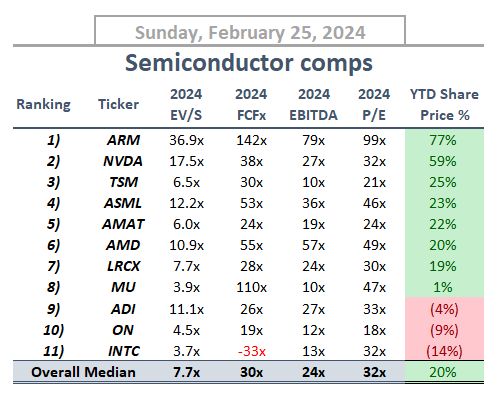
$NVDA is the clear frontrunner in the AI Gold Rush, leading with its H100 GPU that sets high standards for AI computation and sparking anticipation for the H200.

Let's also examine other key players who hold clear leadership positions in the new digital economy ⤵️
$INTC progress in AI accelerators & $AMD's MI300 chip launch are challenging $NVDA dominance in the GPU market.

AMD's chip merges CPU & GPU capabilities to excel in computing & AI tasks, while Intel's investments in AI-specific hardware aim to carve a niche in this market. Image
$ASML EUV lithography & $AMAT material engineering are essential for enabling the mass production of ultra-small, efficient chips critical for AI applications -- crucial to sustaining Moore's Law in the semiconductor industry.

Image
Image
As the world's largest semiconductor foundry, $TSM advanced fabrication processes, along with $LRCX etch & deposition systems, play a crucial for producing AI chips.

This facilitates the rapid evolution of AI technologies through chip scaling & complexity reduction.
Image
Image
$KLAC, $AVGO & $MRVL provide essential AI ecosystem infrastructure, with KLA ensuring chip quality, Broadcom enhancing AI system data flow, and Marvell supporting the computing demands of AI with advanced storage and networking. Image
$ARM energy-efficient CPUs & $ADI precision analog chips are crucial for AI's proliferation into mobile and IoT devices, balancing low-power use with high performance and enabling AI's adoption across various platforms, from smartphones to industrial sensors.
Image
Image
$MU memory solutions & $ON power/sensing technologies are vital for AI's data management, enabling efficient processing and storage to meet the demands of complex AI computations.
Image
Image
To review ⤵️

• Hardware Foundation | $NVDA leads with AI chips, challenged by $AMD & $INTC.

• Chip Innovation | $ASML & $AMAT chip making, supported by $TSM & $LRCX.

• AI Infrastructure | $KLAC, $AVGO, $MRVL

• Design Efficiency | $ARM & $ADI

• Data Mgmt | $MU & $ONImage

• • •

Missing some Tweet in this thread? You can try to force a refresh

 

Keep Current with Shay Boloor

Shay Boloor Profile picture

Stay in touch and get notified when new unrolls are available from this author!

Read all threads

This Thread may be Removed Anytime!

PDF

Twitter may remove this content at anytime! Save it as PDF for later use!

Try unrolling a thread yourself!

how to unroll video
  1. Follow @ThreadReaderApp to mention us!

  2. From a Twitter thread mention us with a keyword "unroll"
@threadreaderapp unroll

Practice here first or read more on our help page!

More from @StockSavvyShay

Aug 23
MY THOUGHTS AHEAD OF NVIDIA EARNINGS

$NVDA has become the gravity point of this entire market. That’s why next week’s earnings aren’t just about one company -- they’re about whether the AI cycle still has the strength to carry $QQQ & $SPY higher.

The stock has already returned 15x since the 2022 bottom & that kind of run naturally invites the “bubble” label. The real question now is whether the fundamentals can keep matching the price.

Here’s what I’ll be watching 👇🧵Image
1. What the Bears Are Getting Wrong

The way I’m looking at $NVDA heading into earnings is less about whether they “beat” and more about whether they continue to prove that the demand side of this AI cycle is as durable as bulls believe -- and that the supply bottleneck remains on their side, not the customer’s.

Bears will tell you that Nvidia has become the railroad of the 1880s: overbuilt, over-owned, and destined to underperform once the tracks are laid. They’ll argue that hyperscaler capex can’t keep compounding at this pace forever, that margins at 75% are unsustainable once $AMZN, $MSFT, $GOOGL & $META accelerate their own silicon, and that China’s reluctance to commit to H20 orders underscores just how dangerous Nvidia’s geopolitical positioning is.

They’ll even go further and point to the law of large numbers: $4T in market cap on a business that may generate just over $200B in revenue next year is stretched, and no chip company has stayed on top forever -- $INTC and $CSCO are both cautionary tales of leadership that looked unshakable until it wasn’t.Image
2. Why Nvidia Will Remain the AI Engine

But this is where the business specifics matter. $NVDA isn’t just selling chips. They’ve embedded themselves into the hyperscaler operating model with CUDA as the de facto standard, with InfiniBand and NVLink holding together the networking layer of the biggest AI factories ever built, and with software subscriptions layered across their stack.

When $MSFT or $META decides to build a $150B data center that consumes more power than NYC, they aren’t shopping for GPUs à la carte -- they’re buying a vertically integrated system that only Nvidia is currently capable of delivering at scale. Even when in-house chips are announced, they’re not displacing Nvidia but supplementing it, because the reality is there simply isn’t enough supply. That’s why the company continues to guide for supply constraints well into 2026.

The other bear pushback is around the idea that this is a bubble -- that AI spending has already overshot returns, that most enterprises are not seeing profitability from AI deployments, and that a political or social backlash could force governments to throttle expansion. And yes, those risks are real. The MIT report showing 95% of corporate AI pilots failing to produce measurable returns has been circulating widely, and Sam Altman himself has admitted we’re in a bubble-like environment. But the nuance is critical: failures at the corporate edge don’t change the capex math at the top.

The Mag Seven are not spending hundreds of billions to run AI pilots -- they are scaling foundational infra that will underpin robotics, enterprise applications, healthcare, and next-generation automation for decades. For them, Nvidia’s efficiency per watt is the single most important factor, because power, not chips, is the limiting resource. That’s why even at $35K per GPU, Nvidia remains the lowest cost option in terms of revenue per watt, and why hyperscalers have signed 20-year nuclear contracts just to guarantee power to run Nvidia hardware.Image
Read 4 tweets
Jul 13
5 STOCKS BUILDING THE INFRASTRUCTURE OF TOMORROW

A handful of companies are quietly laying the foundation for what’s next. The markets they’re targeting are massive. The missions? Real.

Here are the five I’m watching -- let’s get into it 👇
5. $OKLO | Oklo

AI’s Power Stack Won’t Run on Wind

If AI is the compute layer of the new economy, energy is its constraint. Data centers are devouring power. Grid capacity is strained. And intermittent renewables can’t keep up.

That’s where Oklo steps in.

Forget the image of a giant cooling tower in the desert. Oklo is building small-scale, fast-reactor nuclear systems that can be deployed directly next to the nodes of demand: hyperscale data centers, military bases, remote industrial sites. This isn’t a utility. It’s a power appliance -- modular, dispatchable, and built for an always-on AI era.

The Aurora design is already in front of the NRC. The Idaho National Lab site is live. And with DoD partnerships already locked in, Oklo isn’t just building clean power -- they’re building strategic infrastructure.

But make no mistake -- it’s early, and the stock isn’t cheap. The revenue timelines are still years out, and nuclear development is notoriously slow-moving.

Still, the inevitability is real. AI won’t scale without local, stable, high-density energy. The grid won’t be enough. And when the demand surge hits, Oklo’s reactors won’t just be viable -- they’ll be essential.Image
4. $ACHR | Archer Aviation

Aerial Mobility Is the Next Battlefield

eVTOL isn’t about flying taxis anymore. It’s about tactical logistics in contested airspace.

Archer’s FAA certification process is well ahead of peers. But more importantly, they’re years ahead in defense integration. Through AFWERX and direct DoD engagement, Archer is building dual-use mobility platforms: low-footprint, battery-native aircraft that can launch from a parking lot and move personnel or payloads in silence.

This isn’t speculation -- the Air Force is funding integration now. And in a future where ISR, comms, and autonomy all rely on agile movement -- especially in urban or denied environments -- Archer becomes the hardware layer that unlocks software dominance.

If $PLTR helps you see, Archer helps you move.Image
Read 7 tweets
Jun 15
FUTURUM AI FIFTEEN REVEAL

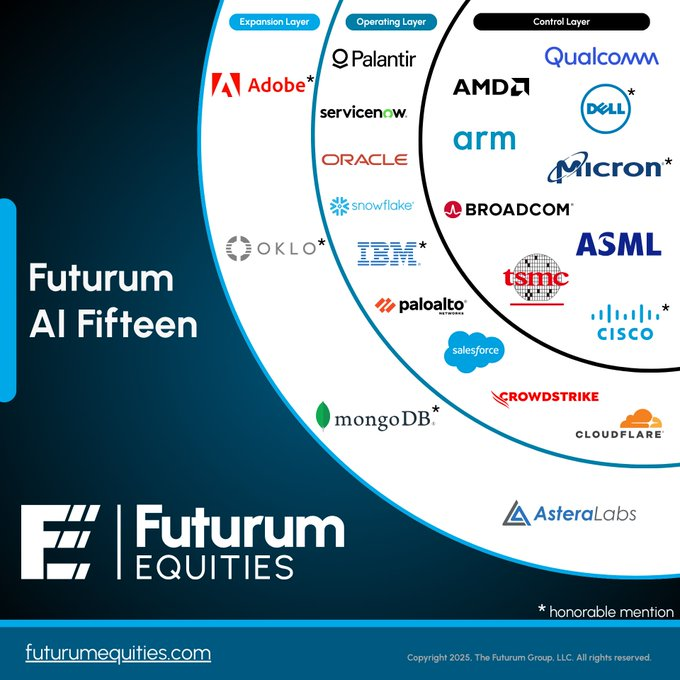
We built the Futurum AI Fifteen -- a curated list of non-Mag 7 companies we believe are gaining critical leverage in AI infrastructure.

Ranked by our proprietary AIRometer Score -- here are the top 15 👇Image
15. $ALAB | Astera Labs

AIRometer Score | 6.5

 Solving the AI Bottleneck for Scalable InferenceImage
14. $QCOM | Qualcomm

AIRometer Score | 6.8

The Edge Enabler of the AI EconomyImage
Read 17 tweets
Mar 2
The Bonsai segment of my portfolio is reserved for companies with an ABSOLUTE MONOPLY in their niche.

These are the early-stage secular growth leaders with no real competition -- here are the five that qualify 🧐

1. $PLTR | Palantir

The Operating System of AI

Palantir belongs in my Bonsai portfolio because it holds an absolute monopoly in AI-driven intelligence for defense and enterprise, operating in a category where no real competitors exist at scale. Unlike traditional software firms that compete on features or pricing, Palantir has built an unshakable position by embedding itself into the most sensitive operations of the U.S. government and the world's largest enterprises. It doesn’t just sell software -- it provides the entire intelligence backbone for decision-making in environments where failure isn’t an option.

The Pentagon’s reliance on Palantir isn’t theoretical -- it’s already integrated into mission-critical programs like Project Maven (AI-powered battlefield intelligence), TITAN (real-time combat decision-making), and Space Force’s satellite analytics. These aren’t pilot projects -- they are the core infrastructure for modern warfare. Legacy defense contractors like $LMT & $RTX simply do not have the software capabilities to compete in this new era of AI-driven defense. When the Pentagon needs scalable, cost-efficient intelligence solutions, there is no alternative to Palantir -- a dynamic that strengthens as budgets tighten.

This same dominance extends beyond defense. Palantir’s AI platform, AIP, is creating a monopoly in enterprise AI decision-making, much like how $NVDA locked up AI computing with CUDA. Businesses struggle to integrate AI into their workflows because there’s no standardized infrastructure -- Palantir has solved that by becoming the default operating system for AI deployment. Just as CUDA entrenched NVIDIA’s GPUs in AI workloads, AIP is embedding itself into Fortune 500 companies and government agencies, making switching costs prohibitive. The result? Palantir is quietly monopolizing the AI-driven intelligence layer of the economy, turning its contracts into long-term, high-margin revenue streams with virtually no competition.

Wall Street still treats Palantir like a legacy defense contractor rather than recognizing its unique position as the only AI intelligence provider at scale. This isn’t a company fighting for market share -- it’s a company that owns the market outright. Investors undervalued NVIDIA for years until CUDA’s dominance became undeniable. The same is happening now with Palantir. The AI-driven future of defense, enterprise intelligence, and government operations has already begun, and Palantir isn’t just leading the way -- it’s the only player that matters.Image
2. $AMZN | Amazon

The Ecosystem Powering the Digital Age

Amazon belongs in my Bonsai portfolio because it has built a monopoly across multiple industries, controlling e-commerce, cloud computing, AI infrastructure, and digital advertising with no real challenger that can match its vertical integration. It doesn’t just dominate markets -- it reshapes them, dictating the future of logistics, enterprise AI, and digital commerce while competitors are forced to adapt to its moves.

AWS alone is a trillion-dollar empire, serving as the backbone of modern cloud computing. With 31% global market share, it’s not just leading -- it’s defining the category. $MSFT and $GOOGL continue to battle for relevance, but AWS holds the largest enterprise cloud workloads, locking in customers with infrastructure that becomes exponentially harder to leave the deeper they integrate. But Amazon isn’t just maintaining its cloud dominance -- it’s expanding it into AI infrastructure, a space where hyperscalers are fighting for control. AWS’s in-house AI chips, like Trainium2 and Inferentia, are already disrupting $NVDA grip on AI computing by offering enterprises a cheaper, more efficient alternative to expensive GPUs. This is where the real battle for AI dominance will be won -- not just in model development, but in controlling the cost structure of AI itself. Amazon is positioning itself to own the economics of AI computing, giving businesses an unavoidable incentive to build on its cloud.

Beyond AWS, Amazon has turned its e-commerce operation into a logistics monopoly that no competitor can replicate. With over 38% of U.S. e-commerce market share, it is larger than its next nine competitors combined. But Amazon isn’t just an online retailer -- it has built a self-reinforcing flywheel where fulfillment centers, robotics, AI-powered logistics, and Prime’s subscription model create a system that no other retailer can match. Its 1,500+ fulfillment centers enable industry-best same-day and next-day delivery, while its AI-driven warehouse automation cuts costs at scale in ways that competitors can’t replicate. Every improvement Amazon makes in logistics and AI-driven efficiency further widens the gap between itself and the rest of the retail industry.

At the same time, Amazon has quietly monopolized digital advertising in a way that even $GOOGL and $META struggle to counter. Its $14B in quarterly ad revenue is growing faster than YouTube’s entire ad business, and with first-party shopper data that neither Google nor Meta can access, Amazon’s advertising network has an unmatched advantage in targeting, conversion, and closed-loop attribution. While traditional advertisers rely on external signals, Amazon owns the full customer journey, from browsing behavior to purchase history, making its ad network increasingly indispensable for brands.

Despite short-term market concerns over profit growth guidance, Amazon’s strategic positioning is undeniable. It is the only company with an AI infrastructure stack that spans cloud, chips, and enterprise software. It is the only retailer that can deliver near-instantaneous e-commerce at scale. It is the only digital advertiser that has full insight into purchase intent and transaction data. Amazon doesn’t just have a competitive advantage -- it has a multi-industry monopoly that continues to expand. When AI, cloud, logistics, and advertising all converge, Amazon isn’t just participating -- it’s the one company everyone else depends on.Image
3. $TSLA | Tesla

The AI Network for Mobility & Robotics

Tesla belongs in my Bonsai portfolio because it has built an unmatched monopoly at the intersection of AI, autonomy, energy, and mobility. While the market still treats it as an automaker, Tesla has quietly become the first AI-native infrastructure company, shaping the physical world the way cloud giants reshaped digital landscapes. It owns the entire stack -- self-driving AI, vertically integrated EV production, battery technology, energy infrastructure, and software ecosystems that extend beyond transportation. No competitor can replicate this level of control, and no company is positioned to displace it.

The true foundation of Tesla’s monopoly isn’t just its fleet or battery innovations -- it’s data, and Tesla owns more of it than anyone else. Every mile driven, every edge case encountered, every split-second decision made by Tesla’s neural network is proprietary intelligence that compounds exponentially. Legacy automakers and emerging EV players can build competitive hardware, but they can’t replicate Tesla’s AI engine, because they don’t have the data to train it. The industry is converging toward an autonomous future, but Tesla is the only company with an end-to-end closed-loop system that continually improves itself at a planetary scale.

Dojo, Tesla’s in-house AI supercomputer, accelerates this gap. Instead of relying on third-party cloud providers, Tesla has built the world’s most advanced neural network training system, capable of condensing years of learning into weeks. It doesn’t just make Tesla’s self-driving tech better -- it makes it unbeatable. Unlike competitors that license software or rely on external partners, Tesla is executing a strategy that ensures its AI is not just superior today, but unassailable in the long term. The result is a self-learning fleet, powered by proprietary hardware and software, with a data monopoly that compounds exponentially every time a Tesla is driven.

Beyond autonomy, Tesla is monopolizing the next era of energy infrastructure. Its energy division isn’t just selling batteries -- it’s creating a self-regulating, AI-powered power grid that will replace legacy utilities. Tesla isn’t waiting for governments or regulators to solve energy inefficiencies; it is already deploying decentralized, AI-managed storage solutions that predict demand, allocate power, and autonomously redistribute energy. Just as Tesla is eliminating human error in driving, it is doing the same for energy management. The future grid isn’t centrally controlled -- it’s self-optimizing, and Tesla is the only company positioned to own that transition.

Yet, despite this clear trajectory, the market remains fixated on EV production delays, China’s pricing war, and quarter-to-quarter fluctuations. But Tesla’s advantage isn’t dictated by short-term demand cycles -- it’s structural. The brand is cultural ubiquity, not just product sales. No other automaker has turned its vehicles into an ecosystem, where software updates redefine ownership experiences, and where autonomy, energy, and robotics converge into a singular AI-driven platform. Tesla isn’t just expanding its reach -- it’s rewriting the infrastructure of how energy and transportation function at scale.

Competitors can attempt to undercut pricing, push aggressive EV expansion, or tout self-driving breakthroughs, but they all share one fundamental weakness: they do not own their systems end to end. They rely on third-party chips, external AI models, and fragmented software stacks. Tesla’s vertical integration is its greatest strategic weapon -- no licensing, no dependencies, just absolute control. As autonomy, AI, and energy disruption accelerate, Tesla is not just leading the revolution -- it is the revolution.Image
Read 6 tweets
Jan 5
Eric Schmidt, former CEO of $GOOGL, explains how the rise of Agentic AI is poised to transform enterprise productivity by replacing fragmented systems with unified, streamlined intelligence.

Here are my top 8 picks to capitalize on this shift 👇

1. $CRM | Salesforce

Agentic AI heralds an evolution in enterprise software architecture. It isn’t about patchwork improvements -- it’s about weaving entirely new fabric. These systems operate in real time, pulling data seamlessly from legacy archives, live streams, and unstructured reservoirs, while shedding the burden of manual oversight.

For giants like Saleforce, already entrenched in productivity and CRM dominance -- this moment represents the chance to transform their lead into an impenetrable fortress of Agentic AI-driven innovation.Image
2. $NVDA | NVIDIA

But Agentic AI doesn’t just consume data -- it devours compute power, and this is where NVIDIA ascends. Known as the gold standard in AI GPUs, Nvidia is positioned to be the backbone of this transformation. Its hardware is critical for training and deploying the sophisticated models that Agentic AI relies upon. Yet Nvidia’s advantage doesn’t end there -- its software suite, epitomized by the CUDA platform, provides enterprises with a complete toolkit for AI implementation.

As organizations scale their Agentic AI ambitions, Nvidia will stand at the center of the compute ecosystem -- ensuring it captures outsized benefits from the surge.Image
Read 10 tweets
Dec 25, 2024
I hold 20 stocks in my growth portfolio.

Let’s analyze the competitive moats of each holding, the rationale behind each investment & how they rank based on position sizing 🧐

1. $PLTR | Palantir
• Portfolio Percentage | 11%
• Industry | Big Data Analytics

From Data Chaos to Clarity: The Palantir Way

Palantir doesn’t just process data -- it orchestrates it. With enterprises drowning in an ocean of siloed information, Palantir’s Foundry platform emerges as the lifeboat, harmonizing disparate datasets into a cohesive, actionable symphony. But the innovation doesn’t stop there. Apollo, Palantir’s deployment engine, pushes the boundaries of possibility by enabling software deployment across secure, isolated systems, where others fear to tread.

Anchored in its legacy of high-stakes government contracts, Palantir has proven its mettle in some of the most demanding scenarios imaginable. Yet, its gaze is firmly set on the private sector, where industries like healthcare, finance, and energy are ripe for transformation through predictive analytics and AI-powered insights.

While critics harp on its valuation and reliance on government revenue, Palantir’s story is one of relentless evolution. As AI becomes the cornerstone of modern enterprise, Palantir is poised to emerge not merely as a participant but as the architect of this new operating system.Image
2. $TSLA | Tesla

• Portfolio Percentage | 11%
• Industry | Energy, EV, Robotics, AI, Software

Tesla’s Expanding Universe: Beyond Cars

Tesla’s dominance in the EV market is indisputable, but to call it merely an automaker is to miss the larger picture. Its innovations in battery technology, manufacturing, and autonomous driving software like FSD have redefined mobility.

However, the story doesn’t end on the road. Tesla’s energy division -- encompassing solar panels, Powerwall storage systems, and grid-scale solutions -- is positioning the company as a leader in the global energy transition. Add to that its vision for AI-driven autonomous fleets, and Tesla’s growth narrative expands to encompass entirely new industries.

Detractors often highlight lofty valuations and intensifying competition, yet Tesla’s ability to scale production while retaining healthy margins sets it apart. Also don't count out Optimus turning into more of a reality than a sci-fi dream.Image
3. $AMZN | Amazon

• Portfolio Percentage | 9%
• Industry | E-Commerce, Cloud Computing, Logistics, Robitics

An Unstoppable Force of Innovation

Amazon’s moat is built on its unique flywheel -- an interconnected model where each business segment strengthens the others, driving compounding growth. At the center of this flywheel is AWS, which generates over 70% of the company’s operating income, reinvested into innovation across e-commerce, logistics, AI, and robotics.

The synergy between Amazon’s e-commerce and cloud segments is crucial -- data from its vast retail operations feeds into AWS development, enhancing its cloud services. In return, AWS drives efficiency in e-commerce through AI-powered recommendations, optimized logistics, and improved inventory management, making Amazon’s moat exceptionally resilient.

Amazon’s focus on robotics is set to elevate its flywheel to the next level. With hundreds of thousands of robots currently handling sorting, packing, and moving tasks in fulfillment centers, efficiency and labor costs have already improved. As more advanced AI-driven robotics are deployed, the company will automate more complex roles like item picking and retrieval, reducing dependency on human labor, cutting errors, and accelerating fulfillment -- leading to significant cost savings and margin expansion.Image
Read 23 tweets

Did Thread Reader help you today?

Support us! We are indie developers!


This site is made by just two indie developers on a laptop doing marketing, support and development! Read more about the story.

Become a Premium Member ($3/month or $30/year) and get exclusive features!

Become Premium

Don't want to be a Premium member but still want to support us?

Make a small donation by buying us coffee ($5) or help with server cost ($10)

Donate via Paypal

Or Donate anonymously using crypto!

Ethereum

0xfe58350B80634f60Fa6Dc149a72b4DFbc17D341E copy

Bitcoin

3ATGMxNzCUFzxpMCHL5sWSt4DVtS8UqXpi copy

Thank you for your support!

Follow Us!

:(