COVID + THE BRAIN 🧠
There’s been a flurry of new studies published in recent weeks about Covid’s detrimental impact on the brain.
This is the aspect of Covid which concerns me most, but which many people seem to be blissfully unaware of.
So let’s dig into what we know… 🧵
There’s been a flurry of new studies published in recent weeks about Covid’s detrimental impact on the brain.
This is the aspect of Covid which concerns me most, but which many people seem to be blissfully unaware of.
So let’s dig into what we know… 🧵
It’s important to note that this is not new news… we’ve known about Covid’s impact on the brain for a long time.
1. This article from Dr @zalaly provides an excellent summary of the mounting evidence about how Covid leaves its mark on the brain.
🔗 theconversation.com/mounting-resea…
1. This article from Dr @zalaly provides an excellent summary of the mounting evidence about how Covid leaves its mark on the brain.
🔗 theconversation.com/mounting-resea…

2. This is one of the new studies published this week (29 Feb 2024).
Researchers found that those with Long Covid had measurable memory & cognitive deficits equivalent to a difference of 6 IQ points which lasted for a year or more after infection.
🔗 amp.theguardian.com/society/2024/f…
Researchers found that those with Long Covid had measurable memory & cognitive deficits equivalent to a difference of 6 IQ points which lasted for a year or more after infection.
🔗 amp.theguardian.com/society/2024/f…

(2. Continued)
Here is a key chart from that study 👇🏻.
The drop in Global Cognitive Score of -0.42 for those with Long Covid is equivalent to losing 6 IQ points.
You can read the full peer-reviewed paper in the New England Journal of Medicine here:
🔗 nejm.org/doi/pdf/10.105…
Here is a key chart from that study 👇🏻.
The drop in Global Cognitive Score of -0.42 for those with Long Covid is equivalent to losing 6 IQ points.
You can read the full peer-reviewed paper in the New England Journal of Medicine here:
🔗 nejm.org/doi/pdf/10.105…

(2. Continued)
The findings of this important study on Covid’s measurable impact on the brain were also discussed on Newsnight this week.
Victoria Derbyshire interviewed Prof Adam Hampshire (@ProfHampshire), the lead author of the study.
The findings of this important study on Covid’s measurable impact on the brain were also discussed on Newsnight this week.
Victoria Derbyshire interviewed Prof Adam Hampshire (@ProfHampshire), the lead author of the study.
https://twitter.com/implausibleblog/status/1762989824141676877
3. In another study published in the NEJM this week, researchers reviewed data from over 100k participants in Norway’s nationwide Covid Study.
They found that participants’ memory function was worse after a positive Covid test than after a negative test.
nejm.org/doi/10.1056/NE…
They found that participants’ memory function was worse after a positive Covid test than after a negative test.
nejm.org/doi/10.1056/NE…

4. This systematic review (published 27 Feb 2024) found that 44% of children with post-Covid neurological symptoms had abnormal neuroimaging findings, eg. ADEM-like lesions, encephalitic pattern, myelitis, transient splenial lesions & other anomalies.
🔗 nature.com/articles/s4159… x.com/vipintukur/sta…
🔗 nature.com/articles/s4159… x.com/vipintukur/sta…

5. Another recent study (published 22 Feb 2024) used dynamic contrast-enhanced MRI scans to demonstrate how Covid can disrupt the blood brain barrier, the shield that protects the nervous system making it ‘leaky’.
🔗 nature.com/articles/s4159…
🔗 nature.com/articles/s4159…

(5. Continued)
“Blood brain barrier disruption” may sound rather complex so here’s a brilliant video from @LolaGerms which helps explain the findings of that paper and translates exactly what it all means for you and your brain 🧠
“Blood brain barrier disruption” may sound rather complex so here’s a brilliant video from @LolaGerms which helps explain the findings of that paper and translates exactly what it all means for you and your brain 🧠
https://twitter.com/1goodtern/status/1762444679310627259
6. This article was published on 1 February 2024 in the British Medical Journal (BMJ).
It reviews some of the latest research on cognitive problems following Covid infection and includes some impactful quotes from patient members of the LOCOMOTION study.
bmj.com/content/384/bm…
It reviews some of the latest research on cognitive problems following Covid infection and includes some impactful quotes from patient members of the LOCOMOTION study.
bmj.com/content/384/bm…

7. In this SciAm article (published Feb 2023), @SutherlandPhD discusses the various long-term neurological aspects of Covid.
She spent a year compiling evidence from an ever-increasing mountain of sources to write this detailed feature.
🔗 scientificamerican.com/article/long-c… x.com/SutherlandPhD/…
She spent a year compiling evidence from an ever-increasing mountain of sources to write this detailed feature.
🔗 scientificamerican.com/article/long-c… x.com/SutherlandPhD/…

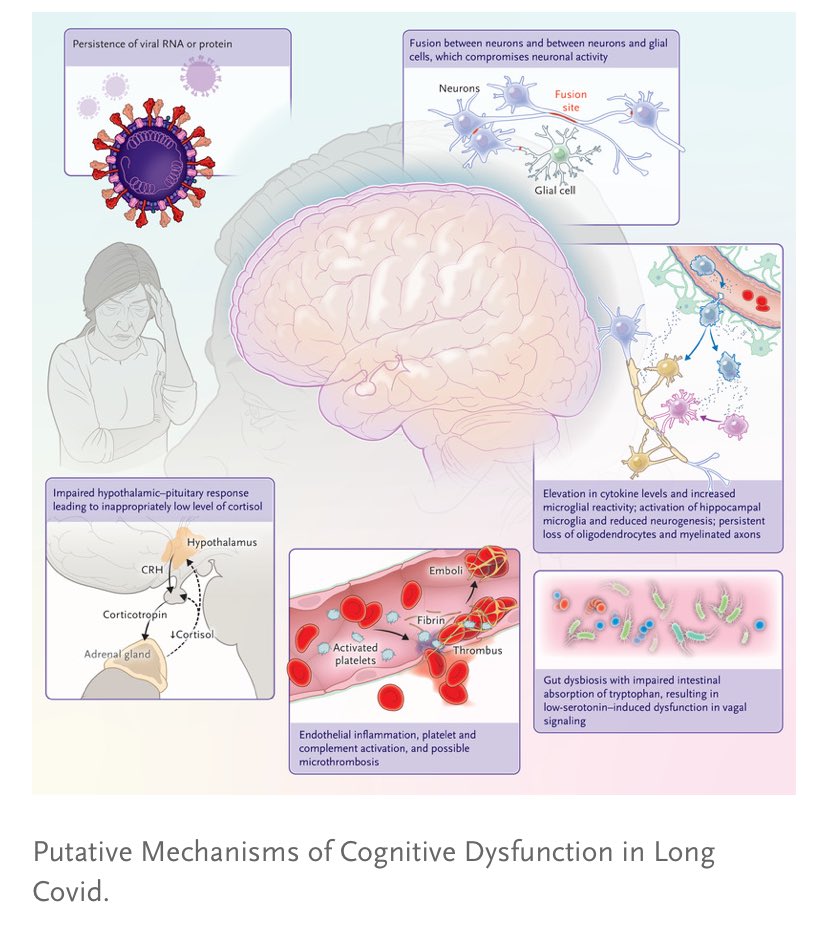
8. This study (published July 2022) from @michelle_monje & @VirusesImmunity reviews how Covid can affect the brain and discusses possible neurobiological mechanisms which may be causing the cognitive symptoms experienced by Long Covid patients.
🔗 cell.com/cell/fulltext/… x.com/michelle_monje…
🔗 cell.com/cell/fulltext/… x.com/michelle_monje…

9. Here’s one of the authors of that study, Stanford neurologist @michelle_monje, describing how even mild Covid infections may lead to lingering problems with the brain, including brain fog, memory lapses and difficulties focusing.
Full video here:
🔗
Full video here:
🔗
10. This fascinating study from Brazil (published June 2022) found that 1 in 4 participants who had experienced a mild Covid infection demonstrated persistent cognitive deficits.
🔗 nature.com/articles/s4138…
🔗 nature.com/articles/s4138…

(10. Continued)
One of the tests in this study required participants to copy a complex geometric figure in order to evaluate cognitive functions such as fine-motor coordination, concentration, visuospatial perception & spatial orientation.
25% failed this test.
One of the tests in this study required participants to copy a complex geometric figure in order to evaluate cognitive functions such as fine-motor coordination, concentration, visuospatial perception & spatial orientation.
25% failed this test.

(10. Continued)
When researchers compared the results of brain scans with the drawings, it became evident that participants who had drawn the bad copies had increased volume of white matter on their MRIs, likely due to inflammation caused by Covid.
🔗 brainfacts.org/diseases-and-d…
When researchers compared the results of brain scans with the drawings, it became evident that participants who had drawn the bad copies had increased volume of white matter on their MRIs, likely due to inflammation caused by Covid.
🔗 brainfacts.org/diseases-and-d…

11. This study (published May 2022) was led by a team of scientists from Cambridge University & Imperial College London.
The study showed that the lasting cognitive impacts of Covid could be equivalent to 20 years of ageing and losing 10 IQ points.
🔗 imperial.ac.uk/news/236034/la…
The study showed that the lasting cognitive impacts of Covid could be equivalent to 20 years of ageing and losing 10 IQ points.
🔗 imperial.ac.uk/news/236034/la…

12. In this study (March 2022), researchers from Oxford Uni analysed MRI brain scans taken BEFORE & AFTER Covid infection from participants in the UK Biobank study.
Scans revealed that even mild Covid is associated with brain structure alterations.
🔗 nature.com/articles/s4158
Scans revealed that even mild Covid is associated with brain structure alterations.
🔗 nature.com/articles/s4158

(12. Continued)
This article in the Guardian reviewed the findings of that Oxford Uni Biobank study.
“Those who tested positive for Covid had greater overall brain shrinkage and more grey matter shrinkage, particularly in areas linked to smell”.
amp.theguardian.com/world/2022/mar…
This article in the Guardian reviewed the findings of that Oxford Uni Biobank study.
“Those who tested positive for Covid had greater overall brain shrinkage and more grey matter shrinkage, particularly in areas linked to smell”.
amp.theguardian.com/world/2022/mar…

13. This study from Canada (published in May 2023) found elevated levels of inflammation in the brains of people with Long Covid.
Researchers found that inflammation was present even in the brains of those who experienced a mild Covid infection.
🔗 watermark.silverchair.com/jamapsychiatry…
Researchers found that inflammation was present even in the brains of those who experienced a mild Covid infection.
🔗 watermark.silverchair.com/jamapsychiatry…

14. This article in Science discusses the putative neuropathogenic consequences of Covid 
“Maladies such as impaired concentration, headache, sensory disturbances, depression, and even psychosis may persist for months after infection.”
🔗 science.org/doi/10.1126/sc…
“Maladies such as impaired concentration, headache, sensory disturbances, depression, and even psychosis may persist for months after infection.”
🔗 science.org/doi/10.1126/sc…

15. In this study (published June 2023), researchers at The University of Queensland showed how Covid infection can cause brain cells to fuse, initiating malfunctions that lead to chronic neurological symptoms.
🔗 science.org/doi/10.1126/sc…
🔗 science.org/doi/10.1126/sc…

(15. Continued)
In the video below, the authors of the paper explain more about how their study was conducted using ‘mini brains’ created from stem cells to mimic the cells in the brain.
“In 10% of experimental conditions, neuronal activity completely stopped.”
In the video below, the authors of the paper explain more about how their study was conducted using ‘mini brains’ created from stem cells to mimic the cells in the brain.
“In 10% of experimental conditions, neuronal activity completely stopped.”
16. The scary thing is that we’ve known about Covid’s ability to fuse brain cells for years.
This video from 2021 shows Covid cells (in red) invading the brain of a bat. After being infected, the brain cells begin to fuse with nearby cells until the entire mass bursts and dies.
This video from 2021 shows Covid cells (in red) invading the brain of a bat. After being infected, the brain cells begin to fuse with nearby cells until the entire mass bursts and dies.
https://twitter.com/nytimes/status/1429543930010521604
17. This video, also from 2021, was created by researchers at the Pasteur Institute in Paris.
Again it shows how the Covid virus can cause infected cells fuse with neighbouring cells, forming large multi-nucleated cells.
🔗 nanolive.ch/sars-cov-2-cov…
Again it shows how the Covid virus can cause infected cells fuse with neighbouring cells, forming large multi-nucleated cells.
🔗 nanolive.ch/sars-cov-2-cov…
18. This video actually dates back to before the Covid era (2018). In it, Jarred Younger PhD provides a detailed explanation of how inflammatory responses within your brain can cause symptoms like depression, anxiety, fatigue & cognitive dysfunction.
https://twitter.com/inkblue01/status/1753777586470330874
19. This huge study (published in Sept 2022) by Dr @zalaly analysed the neurologic outcomes of Covid infection at 1 year of 150k people vs 11m controls.
Results showed that those infected with Covid had a significantly higher risk of brain disorders.
🔗 nature.com/articles/s4159…
Results showed that those infected with Covid had a significantly higher risk of brain disorders.
🔗 nature.com/articles/s4159…

@zalaly 20. This is a succinct summary from the Editor in Chief of the Harvard Health Letter (published March 2023):
“When the pandemic started in early 2020, doctors didn't know much yet about COVID & did not think it affected the brain. Boy, were we WRONG!”
🔗 health.harvard.edu/mind-and-mood/…
“When the pandemic started in early 2020, doctors didn't know much yet about COVID & did not think it affected the brain. Boy, were we WRONG!”
🔗 health.harvard.edu/mind-and-mood/…

21. This study (Oct 2022) used high-res microscopy to investigate Covid’s effect on the brain in monkeys.
7 days post-infection, SARS-CoV-2 was detected in the olfactory cortex & connected areas, accompanied by neuroinflammation & neuronal damage.
🔗 sciencedirect.com/science/articl… x.com/DaniBeckman/st…
7 days post-infection, SARS-CoV-2 was detected in the olfactory cortex & connected areas, accompanied by neuroinflammation & neuronal damage.
🔗 sciencedirect.com/science/articl… x.com/DaniBeckman/st…

22. The study below (published in May 2022) investigated mental health symptoms amongst children suffering from Long Covid.
54.7% of children diagnosed with Long Covid had AT LEAST 3 mental health issues reported by their parents.
🔗 futuremedicine.com/doi/epub/10.22…
54.7% of children diagnosed with Long Covid had AT LEAST 3 mental health issues reported by their parents.
🔗 futuremedicine.com/doi/epub/10.22…

23. A state-of-the-art narrative review (published Feb 2024) provides a summary of our current knowledge about Long Covid in children.
Below I’ve zoomed in on the section which describes the linkages between Covid & mental health issues in children.
🔗 publications.aap.org/pediatrics/art…
Below I’ve zoomed in on the section which describes the linkages between Covid & mental health issues in children.
🔗 publications.aap.org/pediatrics/art…

24. Data from the US Census Bureau (Nov 2023) shows that more Americans (esp. adults aged 20-50) now have problems remembering, concentrating or making decisions than at any time in the last 15 years.
Researchers think Long Covid is a major cause.
🔗 nytimes.com/2023/11/13/ups…
Researchers think Long Covid is a major cause.
🔗 nytimes.com/2023/11/13/ups…

25. In this study (published Nov 2020), researchers studied linkages between Covid infection & onset of mental health issues.
▪️1 in 5 developed mental illness within 90 days of Covid infection
▪️Anxiety, depression & insomnia were most common issues
🔗 reuters.com/article/idUSKB…
▪️1 in 5 developed mental illness within 90 days of Covid infection
▪️Anxiety, depression & insomnia were most common issues
🔗 reuters.com/article/idUSKB…

26. An online survey of over 2,000 respondents conducted in the UK in April 2022 found:
▪️Over half (52%) of respondents said their memory had become worse over the past 2 years.
▪️61% said they now lose their train of thought up to 10 times a day.
🔗 futureyouhealth.com/knowledge-cent…
▪️Over half (52%) of respondents said their memory had become worse over the past 2 years.
▪️61% said they now lose their train of thought up to 10 times a day.
🔗 futureyouhealth.com/knowledge-cent…

27. This article provides a fascinating insight into current research being conducted by neurologists which explores the striking similarities between Long Covid and post-concussion syndrome (‘Long Concussion’).
(Links to studies are in the article).
bbc.com/future/article…
(Links to studies are in the article).
bbc.com/future/article…

28. This excellent article in Bloomberg reviews the latest research into the profound impacts Covid can have on the brain, and explains why scientists are warning that it may be responsible for a wave of dementia.
bloomberg.com/news/features/…
(Paywall free: archive.ph/2P3V5)
bloomberg.com/news/features/…
(Paywall free: archive.ph/2P3V5)

29. This study is the UK’s largest study to date on the long-term impact of Covid infection on the brain.
Findings showed that, 1 year post-infection, cognitive deficits in hospitalised Covid patients were equivalent to 20 years of normal brain aging.
nature.com/articles/s4159… x.com/_brendan95/sta…
Findings showed that, 1 year post-infection, cognitive deficits in hospitalised Covid patients were equivalent to 20 years of normal brain aging.
nature.com/articles/s4159… x.com/_brendan95/sta…

30. New research from the University of Kentucky (Aug 2024) shows compelling evidence that the cognitive impairments observed in Long Covid patients share striking similarities with those seen in Alzheimer’s disease and related dementias.
research.uky.edu/news/uk-resear…
research.uky.edu/news/uk-resear…

31. In this Italian study (Oct 2024), researchers used MRI scans & cognitive tests to examine brain structure & cognition in adolescents & young adults after mild Covid infection. They identified significant structural & functional changes in the brain.
news-medical.net/news/20241003/…
news-medical.net/news/20241003/…

32. In this study (Aug 2024), researchers found that Covid patients who presented with anosmia (loss/change in sense of smell) during initial infection had behavioural, functional and structural brain alterations, including loss of white matter integrity.
nature.com/articles/s4159…
nature.com/articles/s4159…

33. In this New Zealand study (Mar 2025), scientists studied the impact of COVID infections on the cognitive performance of university undergraduate students.
37% of undergrads exhibited impaired cognition for up to 17 months following. COVID infection.
sciencedirect.com/science/articl…
37% of undergrads exhibited impaired cognition for up to 17 months following. COVID infection.
sciencedirect.com/science/articl…

• • •
Missing some Tweet in this thread? You can try to
force a refresh