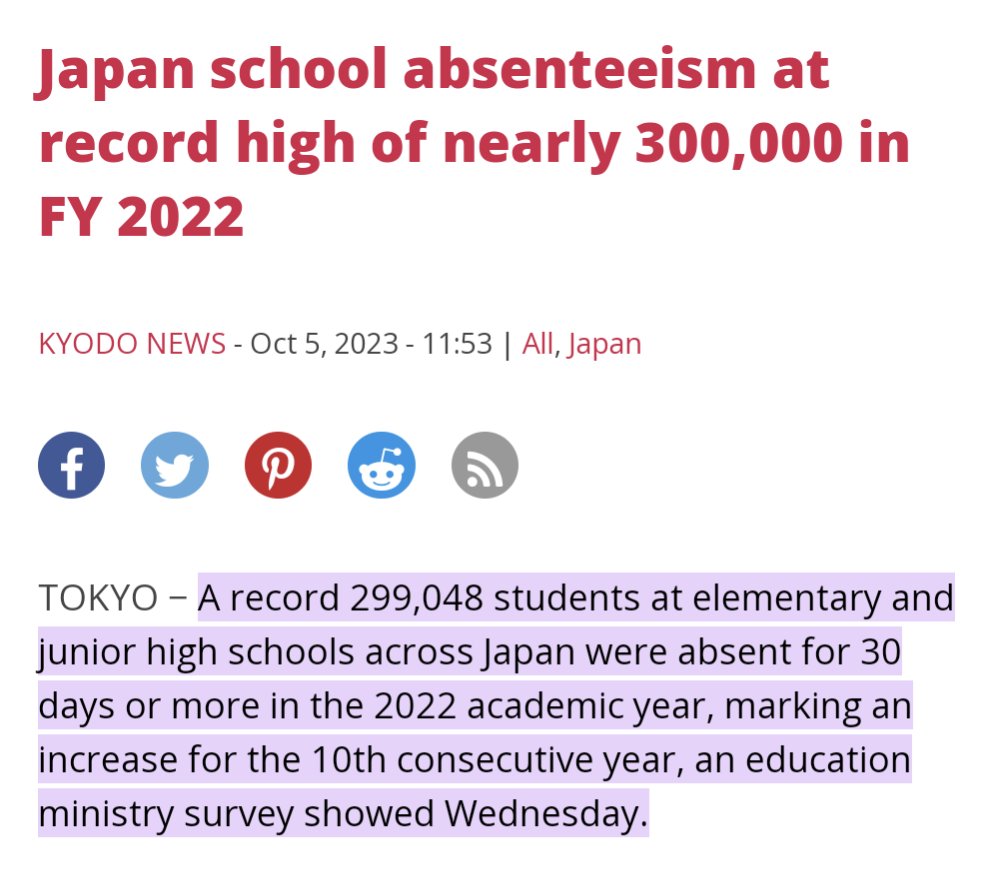
As the number of adults with long COVID has led to the labor shortage, the number of kids with long COVID has led to a student shortage. There's been plenty of coverage about "chronic absenteeism" in US schools. But this is not just an American problem. It is global:
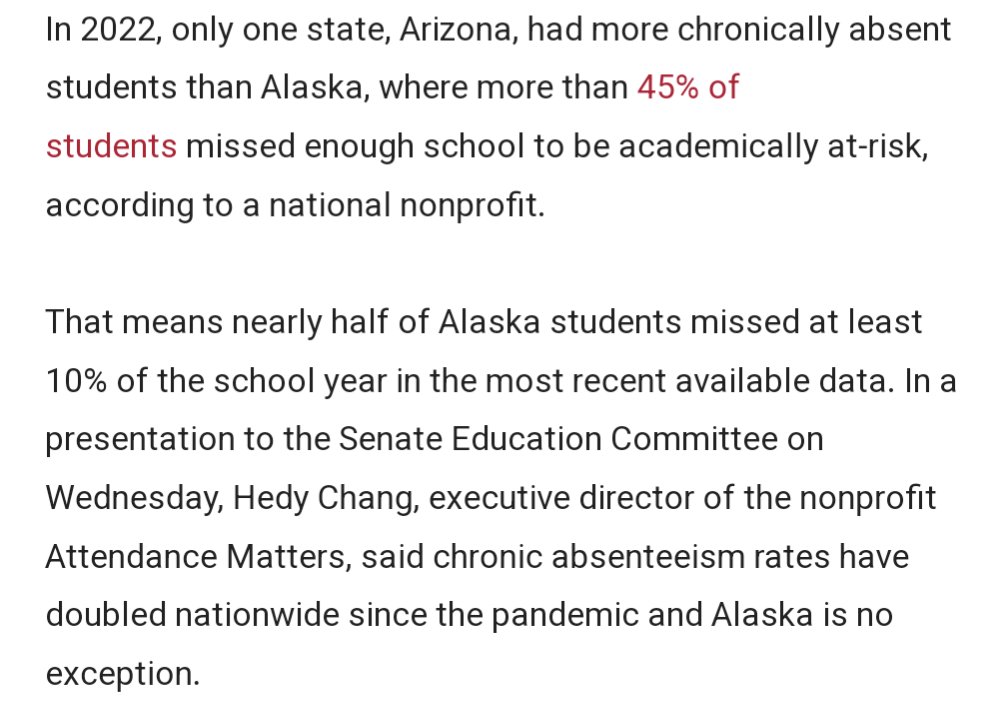
In the US, students have been missing class far more often in recent years. Some states are worse than others. In Alaska, about half of all students are missing 1 out of every 10 school days
For the country as a whole, the number of kids defined as "chronically absent" has doubled since before the pandemic:
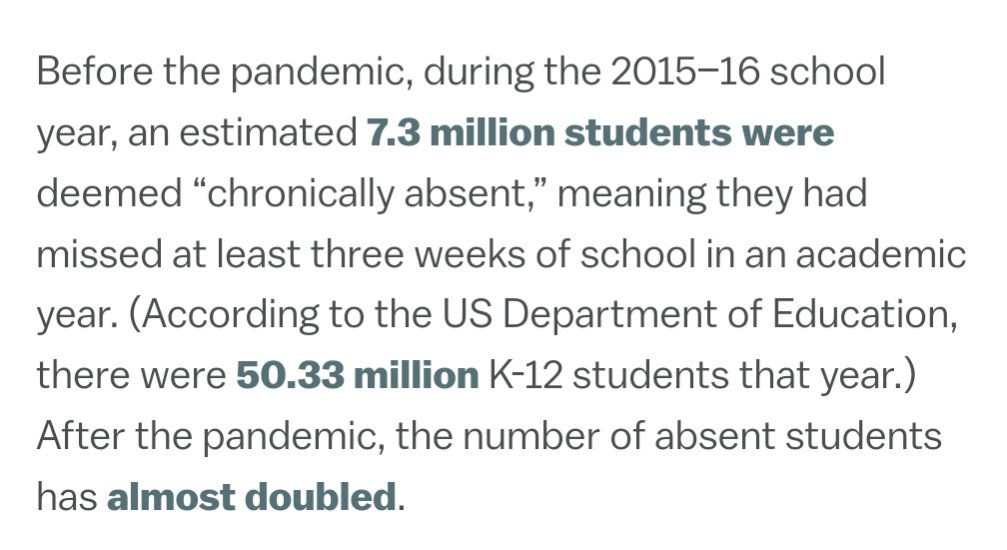
It seems rather obvious that this is caused by COVID, but the press is seemingly aligned in trying to obscure this. Take this vox article where they cite a myriad of reasons, including the ever popular post-2020 euphemism "illness"
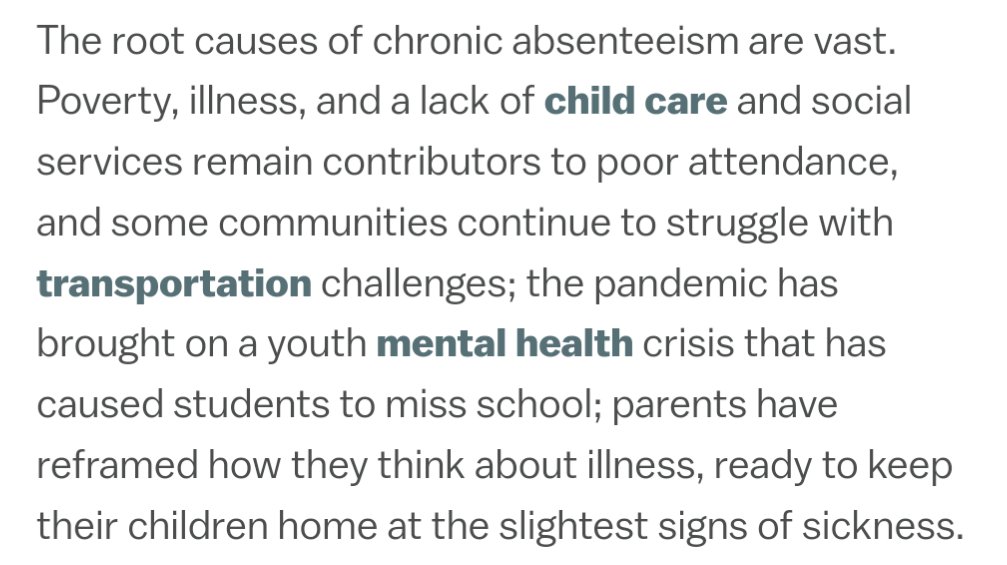
I'm sure other factors play some role, but how could the transportation and social services systems change so dramatically that it prevented kids from going to school not just in every American state, but most of the developed world?
Japan:
The UK:
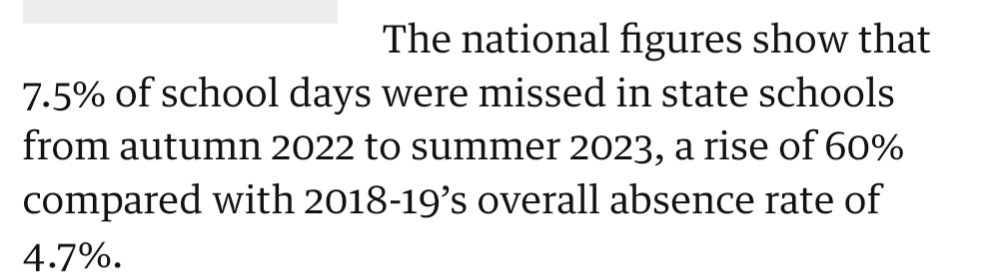
Switzerland:

Belgium:
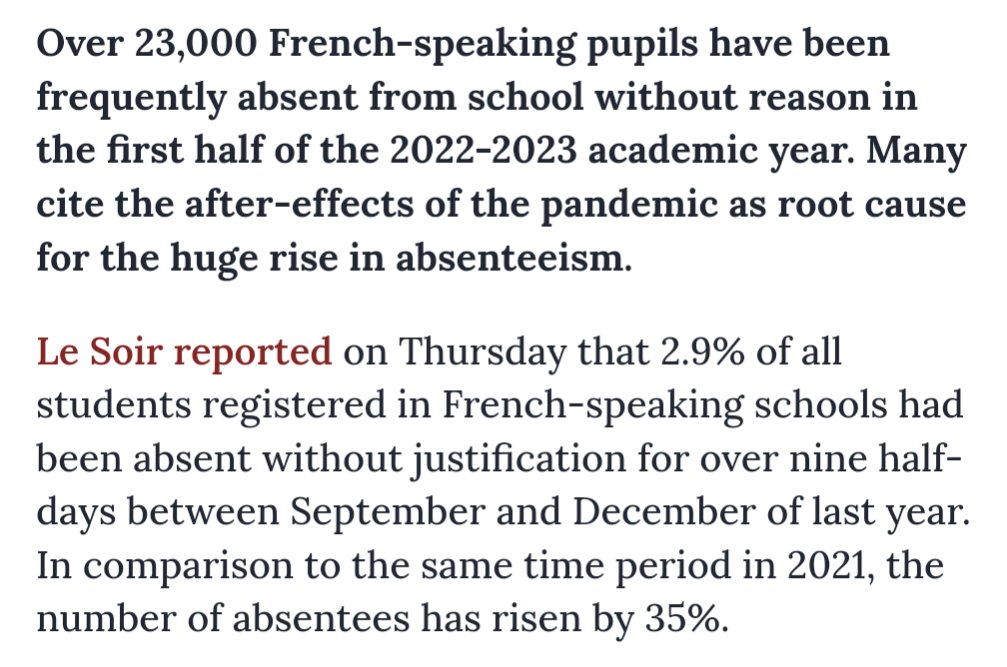
Was it the lockdowns? Well then, how do you explain Sweden? The poster child of avoiding pandemic closures
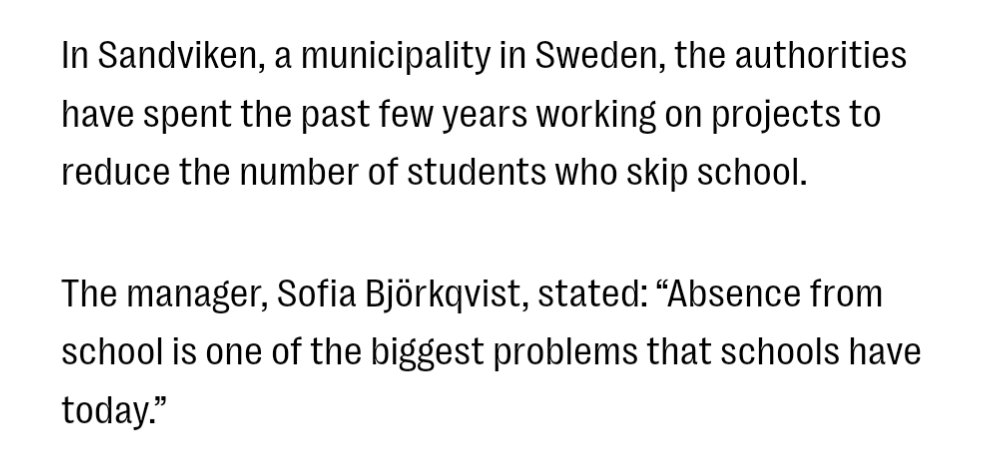
Canada:
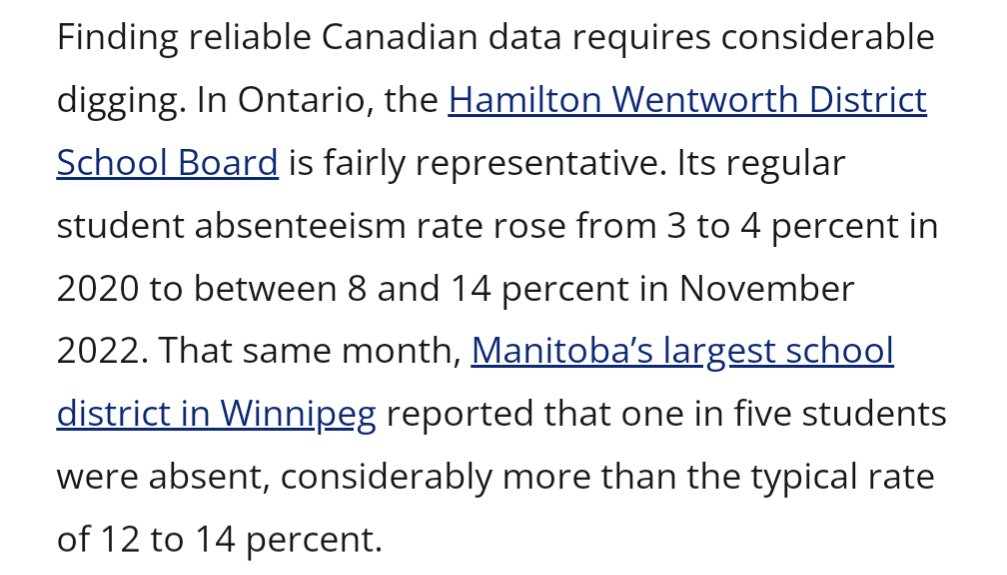
It's estimated that about 6 million kids in the US alone currently have some degree of long COVID:
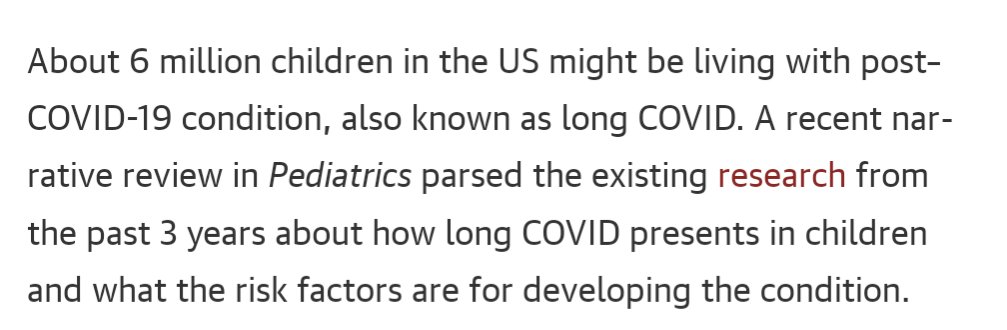
According to the CDC, there are about 3x more adults with long COVID than there are kids with it. But that's been enough to have an impact on the labor force. Millions of Americans are currently out of work because of a COVID disability:
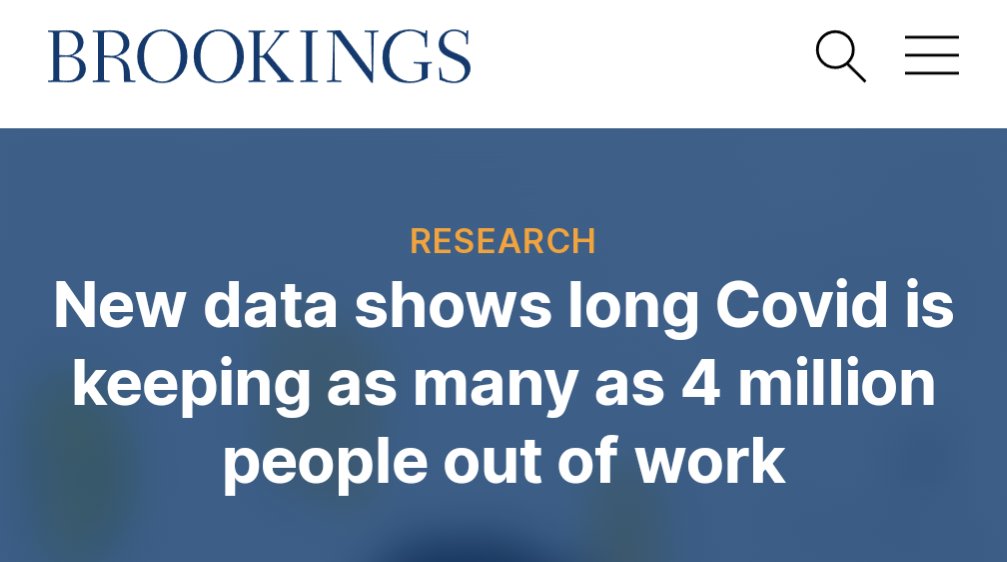
Most kids don't work in developed economies. Instead they go to school. So, if millions of them are sick, you wouldn't expect to see that impact on the labor force, but you would expect to see it in school attendance. And, as outlined here, that's exactly what we're seeing
If school attendance rates improve, that might be a sign that long COVID is gradually disappearing as a problem. But if it's not, and if it remains a global phenomenon, I think you need a better excuse than transportation
People have responded to my thread with observations from other countries I did not mention: Norway, Ireland, New Zealand, the Netherlands, etc. I guess the better question is: where is this not occurring?
• • •
Missing some Tweet in this thread? You can try to
force a refresh

I know someone in a stroke recovery support group. Been hearing about a lot of young people who had a stroke during or after a COVID infection. This is why I get upset when people equate Long COVID to fatigue, PEM, or other similar symptoms. It's a form of minimization
Your trials that measure fatigue as the primary endpoint are a joke. Show me a trial that looks for a reduction in CVD events in the year after a COVID infection. We know the probability is elevated for a long time.
Also, I don't mean this to say your fatigue or your PEM doesn't matter or isn't disabling. If this is you, you are the person I am talking about. It's not like "there are heart attack people and there are fatigue people" - everyone with LC is at higher risk for CVD events
I'm at the point now where it's been well over 6 months since I've felt 95% recovered from Long COVID. But now I realize there's another aspect to this illness: The fear of reinfection. I understood intellectually that reinfections are dangerous, but
It doesn't really sink in fully until you're feeling like your old self for a while and realize on a very gut level that this isn't over and won't be over anytime in the foreseeable future.
When you're very sick, you only wish you could feel better. But then you feel better, and you realize your life just can't go back to the way it once was. You know too much.
Long COVID shares similarities with other chronic illnesses, and other post-viral syndromes, but on a society-wide basis it's more devastating because of how much more common it is:
I have a fairly large family and have known many friends, classmates, coworkers etc over the course of my life. Before COVID, I knew of exactly one person with Chronic Lyme, one person with fibromyalgia, and literally no one with ME/CFS, CIRS, GWI, etc.
But I now know about a dozen family members, friends, and coworkers that have or had some version of Long COVID. All people I knew for years before 2020. And I seem to hear of someone in my extended circle developing it at least every few months
Well, it's been about 4 months now since I've consistently felt 90-95% recovered from Long COVID.
A lot of people talk about what helped them recover, but here's some things that DIDN'T help me recover:
Reducing stress - the last 4 months have included some of the most stressful days of my life.
Back in May my wife suffered from 4 strokes. The surgeon woke me up in the middle of the night to tell me that she was about to die, and that they needed to do emergency brain surgery.
I spent the next few hours alone, completely stressed and terrified, wondering what I was going to say to my daughter if my wife died.
The evidence for Long COVID is simply overwhelming. There are now thousands of studies, validated biomarkers, reports and surveys from millions of people from virtually every country going back since the pandemic began. And yet, still widespread denial and gaslighting - why?
It's because the reality of the situation is far too horrible for most people to seriously contemplate. The best evidence says somewhere between 1 and 10 and 1 in 3 people suffer from Long COVID symptoms, at least in some form, including children.
These symptoms can and often are, completely disabling. While I often write about my own attempts at treatment, there are no formally approved treatments - there is no way to even reliably treat the symptoms.
I went to the Stanford Chronic Fatigue Syndrome Clinic today. If you're in California, and you have Long COVID, and you're unable or unwilling to pay for a private doctor, it's probably your best option for finding treatment:
My expectations going in were low based on some of the reviews people left on the helpforlongcovid website, but I was pleasantly surprised. They prescribe several treatments, order blood work, and were willing to work with me to try to get other treatments I'm curious about
I would contrast this with Long COVID clinics I've been to, including Stanford, which only offers a couple treatments, doesn't really care about blood work, and the appointments basically consist of a long interview with not much offered, as if they are just collecting data