Thread 🧵
𝙂𝙊𝘿 𝙋𝘼𝙍𝙏𝙄𝘾𝙇𝙀:
Everything in the universe is made up of particles; some have mass and some don't. But what causes some particles to have mass while others do not? The Higgs Boson, or God particle, is responsible for the mass of matter.
𝙂𝙊𝘿 𝙋𝘼𝙍𝙏𝙄𝘾𝙇𝙀:
Everything in the universe is made up of particles; some have mass and some don't. But what causes some particles to have mass while others do not? The Higgs Boson, or God particle, is responsible for the mass of matter.

𝘿𝙄𝙎𝘾𝙊𝙑𝙀𝙍𝙔:
The Higgs boson was theorized in 1960 by Peter Higgs and five other scientists as a particle responsible for the mass of matter. While it was not discovered until 2012, the Higgs boson was first experienced practically at the Large Hadron Collider (LHC).
The Higgs boson was theorized in 1960 by Peter Higgs and five other scientists as a particle responsible for the mass of matter. While it was not discovered until 2012, the Higgs boson was first experienced practically at the Large Hadron Collider (LHC).

𝙇𝘼𝙍𝙂𝙀 𝙃𝘼𝘿𝙍𝙊𝙉 𝘾𝙊𝙇𝙇𝙄𝘿𝙀𝙍:
It is the largest particle accelerator in the world, consisting of a 27km-long ring. The LHC is basically used to collide hadrons (particles made up of quarks). It accelerates particles at very high speeds using powerful magnets.
It is the largest particle accelerator in the world, consisting of a 27km-long ring. The LHC is basically used to collide hadrons (particles made up of quarks). It accelerates particles at very high speeds using powerful magnets.

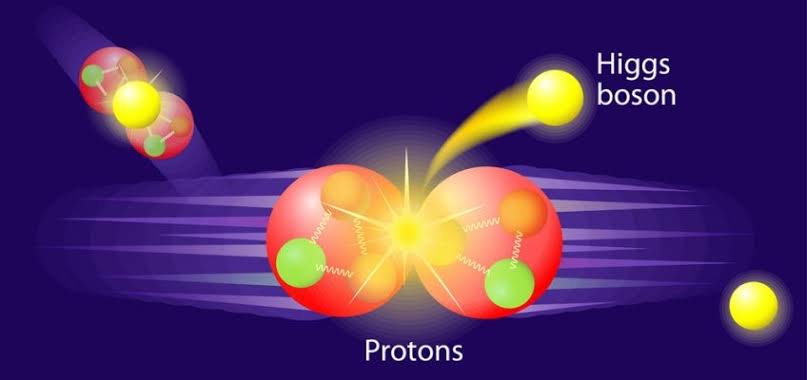
On 4th July 2012 scientists fired protons into the collider traveling in opposite directions. Magnets accelerated the protons to 99.9999991% of the speed of light. Protons are made up of three quarks. Quarks inside protons collide with enough energy to create the suspected Higgs.
𝙃𝙄𝙂𝙂𝙎 𝙁𝙄𝙀𝙇𝘿:
Particles gain mass by interacting with the Higgs field; they do not have mass of their own. The stronger a particle interacts with the Higgs field, the more mass it gains. For example, photons do not interact with this field and therefore have no mass.
Particles gain mass by interacting with the Higgs field; they do not have mass of their own. The stronger a particle interacts with the Higgs field, the more mass it gains. For example, photons do not interact with this field and therefore have no mass.
𝙃𝙊𝙒 𝙋𝘼𝙍𝙏𝙄𝘾𝙇𝙀𝙎 𝙂𝘼𝙄𝙉 𝙈𝘼𝙎𝙎:
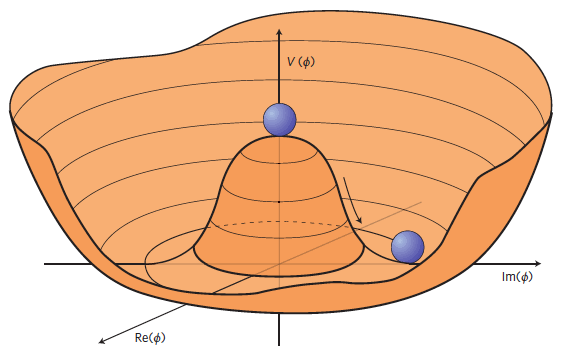
The Higgs field is like a sea through which particles move. When particles interact with this field they experience resistance, slowing them down and giving them energy, which behaves as mass, according to Einstein's equation E = mc².
The Higgs field is like a sea through which particles move. When particles interact with this field they experience resistance, slowing them down and giving them energy, which behaves as mass, according to Einstein's equation E = mc².

𝙊𝙍𝙄𝙂𝙄𝙉 𝙊𝙁 𝙏𝙃𝙀 𝙉𝘼𝙈𝙀:
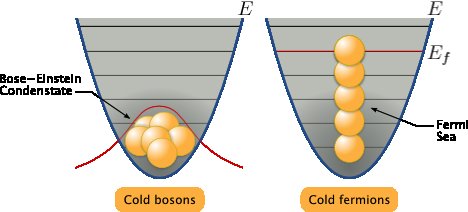
The Higgs Boson was discovered by Peter Higgs. It is a boson, means it obeys Bose-Einstein Statistics, where two particles can occupy the same quantum state, unlike fermions, which obey Fermi-Dirac Statistics and the Pauli exclusion principle.
The Higgs Boson was discovered by Peter Higgs. It is a boson, means it obeys Bose-Einstein Statistics, where two particles can occupy the same quantum state, unlike fermions, which obey Fermi-Dirac Statistics and the Pauli exclusion principle.
The nickname “God particle” originated from the title of the book “The God Particle: If the Universe is the Answer, What is the Question?” by physicist Leon Lederman. The Higgs gained this nickname because it was believed to be the last piece of the standard model of particles.

𝙋𝙍𝙊𝙋𝙀𝙍𝙏𝙄𝙀𝙎:
The Higgs particle gives mass to other particles, but surprisingly, it also has its own mass because it interacts with its own field. With a mass 130 times that of the proton, the Higgs boson is the second-heaviest particle known today after the top quark.
The Higgs particle gives mass to other particles, but surprisingly, it also has its own mass because it interacts with its own field. With a mass 130 times that of the proton, the Higgs boson is the second-heaviest particle known today after the top quark.
The Higgs Boson is a highly unstable particle with a lifetime of 10-²² seconds, meaning that the particle cannot be found in nature. It can decay into various combinations of particles. The Higgs boson is a chargeless particle and is its own antiparticle.
• • •
Missing some Tweet in this thread? You can try to
force a refresh