Russian forces are reportedly approaching the outskirts of Chasiv Yar, Donetsk Oblast but are unlikely to threaten the settlement with encirclement or seizure in the coming months.
The seizure of Chasiv Yar would offer Russian forces limited but not insignificant operational benefits if they could achieve it.
ISW assesses that a Russian seizure of Chasiv Yar would be more operationally significant than the Russian seizure of Avdiivka, but reiterates that ISW does not forecast that Russian forces will take Chasiv Yar rapidly if they can take it at all.
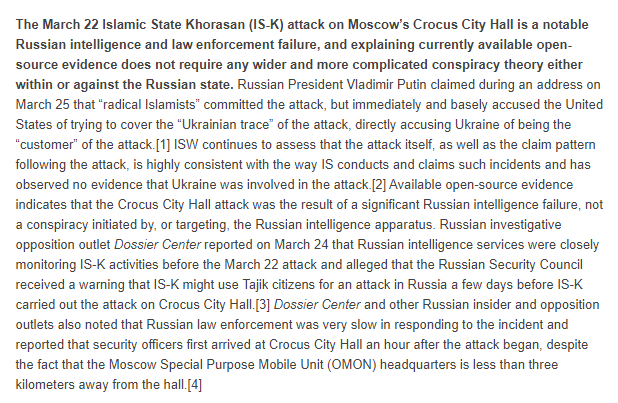
NEW: The March 22 Islamic State Khorasan (IS-K) attack on Moscow’s Crocus City Hall is a notable Russian intelligence and law enforcement failure, and explaining currently available open-source evidence does not require any wider and more complicated conspiracy theory either within or against the Russian state. 🧵(1/5)
2/ Putin claimed during an address on March 25 that “radical Islamists” committed the attack, but immediately and basely accused the United States of trying to cover the “Ukrainian trace” of the attack, directly accusing Ukraine of being the “customer” of the attack.
3/ ISW continues to assess that the attack itself, as well as the claim pattern following the attack, is highly consistent with the way IS conducts and claims such incidents and has observed no evidence that Ukraine was involved in the attack.
Key Takeaways from the March 24, 2024 Russian Offensive Campaign Assessment (🧵1/6):
Russian forces conducted a series of drone and missile strikes against Ukrainian energy infrastructure on the night of February 23 to 24, mainly targeting southern and western Ukraine.
2/ Russian forces are reportedly approaching the outskirts of Chasiv Yar, Donetsk Oblast but are unlikely to threaten the settlement with encirclement or seizure in the coming months.
The seizure of Chasiv Yar would offer Russian forces limited but not insignificant operational benefits.
3/ The Islamic State’s (IS) Amaq News Agency published footage on March 23 purportedly filmed from the perspective of the attackers involved in the March 22 Crocus City Hall attack.
Russian forces will likely continue offensive operations through Spring 2024 while preparing for an expected offensive effort in Summer 2024, although Russian forces will likely struggle to launch a concerted large-scale offensive operation in multiple operational directions in Ukraine at the same time. (1/4)
2/ Russian forces likely seek to exploit current Ukrainian materiel shortages while preparing for efforts that will force Ukraine to expend a sizeable portion of the Western security assistance it may receive in the coming months.
3/ Imminent packages of Western security assistance may address Ukraine’s pressing immediate shortages, but Russian offensive efforts will continue to force Ukraine to expend materiel in ways that can reproduce similar shortages over time in the absence of more consistent security assistance.
The Russian military command appears to be forming reserves capable of sustaining ongoing offensive operations in Ukraine, but these reserves are unlikely to be able to function as cohesive large-scale penetration or exploitation formations this year. (1/4)
2/ Large-scale Russian manpower losses are likely more significant than armored vehicle losses at this point in the war, particularly since Russian forces adjusted their tactics and transitioned to infantry-heavy ground attacks to conserve armored vehicles at the expense of greater manpower losses in fall 2023.
3/ It is unclear what kind of “strategic reserve” Russia is forming based on open-source reporting but known Russian manpower and material limitations suggest that Russia will likely not commit these “strategic reserves” as a cohesive formation to fighting in Ukraine but will instead use them as a manpower pool to replenish losses along the frontline.
NEW: Russian offensive tactics will likely increasingly pressure Ukrainian defenses as long as delays in Western security assistance persist. 🧵(1/7)
2/ RU forces are generally relying on their manpower and materiel superiority to conduct a relatively consistent tempo of assaults against UA positions along the frontline in hopes of wearing down UA defenders and setting conditions for exploiting UA vulnerabilities.
3/ Russian forces are also expanding their use of tactical aviation, drones, and electronic warfare (EW) systems in Ukraine to prepare for and support these assaults while reportedly conducting artillery fire exceeding Ukrainian artillery fire at a ratio of up to ten-to-one.
Kremlin-affiliated actors in the pro-Russian Moldovan autonomous region of Gagauzia are invoking narratives that mirror previous Russian claims about Ukraine in the years leading up to Russia’s 2022 full-scale invasion of Ukraine, likely as part of the Kremlin’s wider hybrid efforts to destabilize Moldova. 🧵(1/4)
2/ Yevgenia Gutsul, the governor of Gagauzia, stated in an interview with Russian outlet Izvestia published on March 20 that she would like Gagauzia to receive “zashchita” (a word that means both “defense” and “protection”) from Russia so that Gagauzian residents can have the right to a prosperous life, Gagauzian farmers can export their products to Russia, and Gagauzia can receive gas at a lower price — points Gutsul recently claimed she spoke about with Russian President Vladimir Putin.
3/ Gutsul’s claims that the Moldovan government is not adhering to the law on Gagauzia’s special status parallel the Kremlin’s previous accusations that Ukraine did not adhere to the Minsk Agreements’ stipulations on the “special status” for the Donetsk People’s Republic (DNR) and Luhansk People’s Republic (LNR).