This, the last flying Martin Mars, is finally going to its forever home. Many of us were afraid it would be scrapped but a benefactor has stepped in to save it. One last flight is to come. Sproat Lake, British Columbia, Canada. 1/10 #planespotting #avgeek #aviationlovers #milair
This is one of only 5 production Martin JRM Mars built for the US Navy in WW2. They were the largest USN flying boat to enter production. Intended for long range patrol and transport, they came late in the war and their usefulness soon dwindled. The last was retired in 1956. 2/10
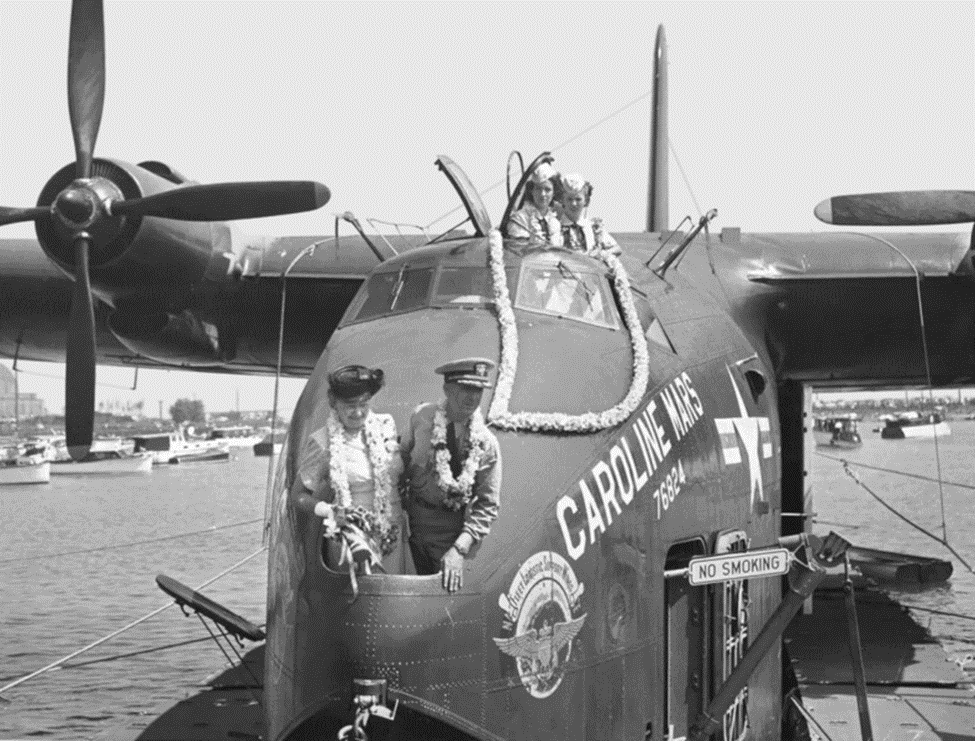
Each had its own name: Marianas Mars, Philippine Mars, Marshall Mars, Caroline Mars, and Hawaii Mars. On 5 April 1950, the Marshall Mars was lost near Hawaii when an engine fire consumed the airplane after her crew evacuated. 3/10
In 1959 the last 4 were sold to a Canadian firm, Forest Industries Flying Tankers, built as fire bombers with a 6000 gal. tank filled by scooping water from lakes at speed. 30 tons could be taken on in 22 seconds. They went for USD $25,000 each including tons of spare parts. 4/10
Marianas Mars crashed at Northwest Bay, BC, on 23 June 1961 in firefighting operations; all 4 crew were lost. A year later, 12 October ‘62 while parked onshore at Victoria airport, Caroline Mars was destroyed by Typhoon Freda when she was blown 200 yards, breaking her back. 5/10
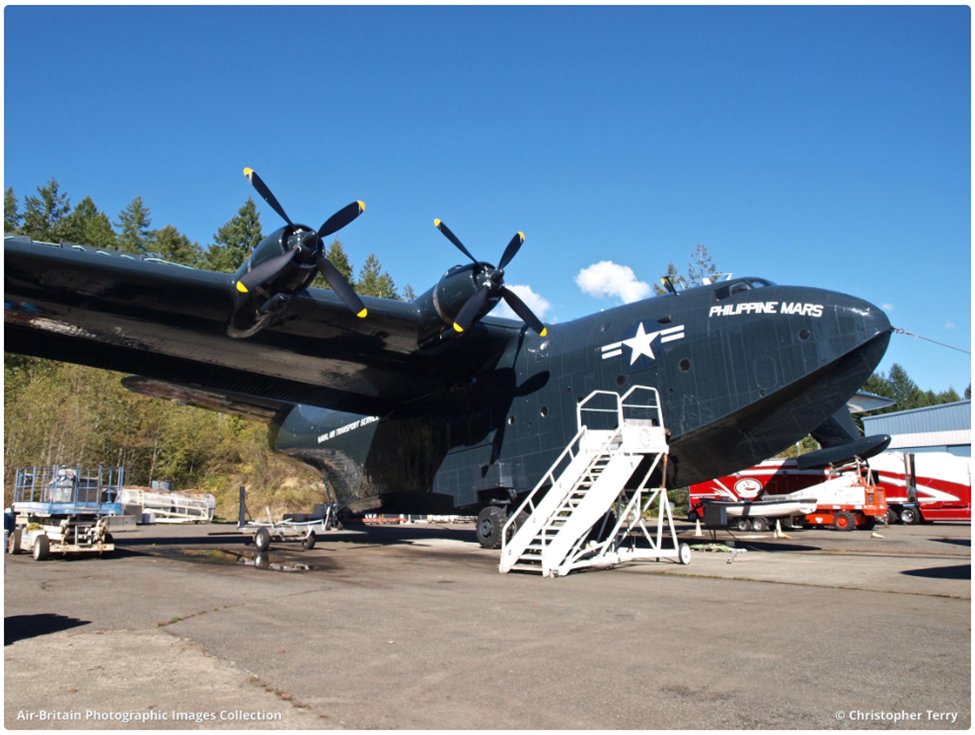
The last two, Hawaii Mars and Philippine Mars, are now both at Coulsen Aviation’s facility at Sproat Lake, BC. Coulsen acquired them in 2007. Hawaii Mars has flown regularly on contract until 2016 and Philippine Mars last flew in 2012 and has been used as a spares donor. 6/10
It was announced in March 2024 Hawaii Mars C-FLYL was acquired by the British Columbia Aviation Museum in North Saanich, B.C. It will be the centerpiece of a new exhibit. If all goes well, its last flight will take place next fall from Coulson's base on Sproat Lake. 7/10

Coulson Aviation will enlist five certified maintenance engineers and four flight crew to complete about 10,000 hours of aircraft preparation and flight retraining over the next six months to prepare the red-and-white Hawaii Martin Mars for its last flight. 8/10

The other bird, "Philippine Mars" C-FLYK, was retired in 2012 and remains at the Coulson facility on Sprout Lake. At one time it was slated to go to a museum in Pensacola, Florida but for whatever reason, this never happened. Its future is still uncertain. 9/10
There are lots of videos of Hawaii Mars. Here’s one I particularly like. 10/10
• • •
Missing some Tweet in this thread? You can try to
force a refresh

Passersby on Turnbull Bay Rd. next to New Smyrna Beach Airport, Florida are afforded the briefest of glimpses at what is clearly the fuselage of a PBY Catalina... 1/6 #avgeek #aviationdaily #aircraft #aviationlovers #aviation #milair
I’m unable to discover this fuselage’s identity; perhaps it's a parts donor for something incredible that’s inside these hangars. This is the home of American Aero Services, renown for restoration of vintage warbirds and their current project is something very special. 2/6
Inside the main hangar is a years-long restoration of PBY-5A Bu. No. 2459, a warbird in the truest sense of the word. It destroyed three German U-boats and damaged a fourth- the very first PBY to ever sink a U-boat. 3/6
What the…? Yes, it is real and yes, it served a military purpose. It’s a Jet Commander with a MiG23 nose. One of a kind. Israeli Air Force Museum, Be’er Sheba, Israel. Here’s the story. 1/7 #planespotting #avgeek #aviationdaily #aircraft #aviationlovers #aviation #milair
Aero Commander, founded in 1944, was known for its twin-engine Commander. Rockwell acquired Aero Commander in 1958 to enter the growing aviation market. In 1967 Rockwell merged with North American Aviation to form North American Rockwell, which now had two competing assets. 2/7
Rockwell Int'l had bought the latest jet version of the Commander, & the North American Sabreliner. These were two early generation business jets. But along with the Bizjet market, Rockwell also inherited a large contract for the military version of the Sabreliner, the T-39. 3/7
Imagine strolling on a long empty beach in Mexico- no one else for miles; the fresh sea breeze; the waves kissing the pristine sand; the cry of gulls…then you come across this: 1/8 #milair #avgeek #aviationdaily #aircraft #aviationlovers
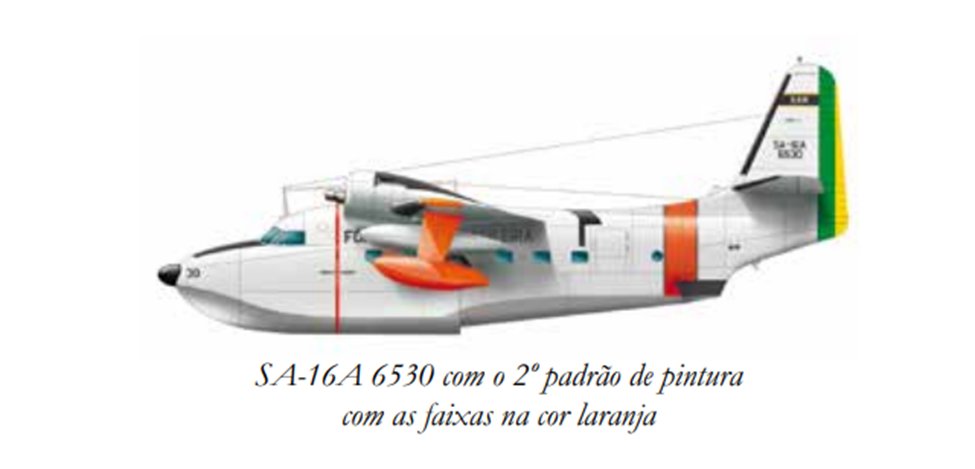
This is ill-fated Grumman SA-16 Albatross XB-JHH slowly being consumed by sea wind, salt water and sand at Playa de la Ventanilla, near Puerto Escondido, Oaxaca, Mexico. Here’s its story. 2/8
In 1949 it was built for the U.S. Navy as PF-1A 124297 but went to the USAF instead as SA-16A 49-0074. From 1958 to 1980 it flew for the Brazilian AF as SA-16A 6530. From 1980 it was in storage. It came back to the U.S. in 1994. 3/8
Sometimes I still get a “What the…?” moment. This happened recently when I was looking through snapshots someone posted from an airshow at Reading Regional Airport in Pennsylvania. This was a new one to me! 1/10 #milair #avgeek #aviationdaily #aircraft #aviationlovers
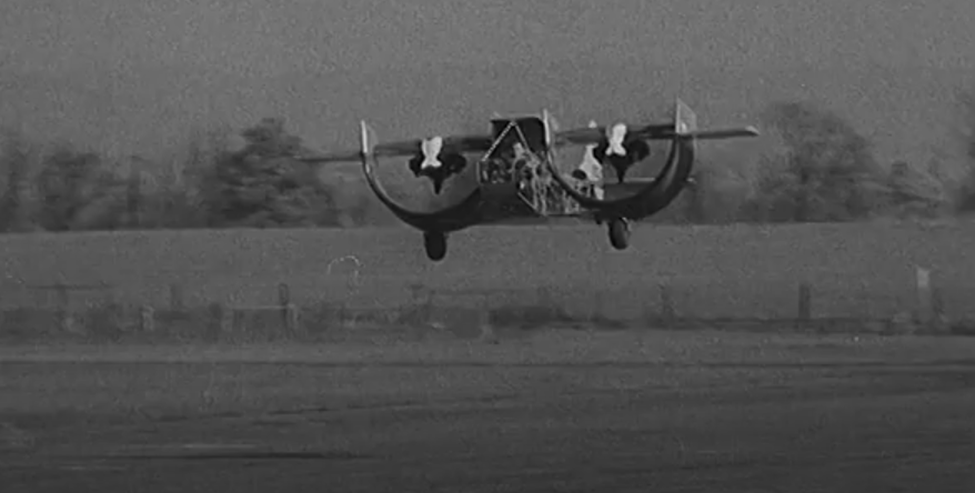
In the 1940s American inventor Willard Ray Custer was working on a novel concept for a very slow flying STOL aircraft. He called it a “Channel Wing”. The channel was shaped like a half venturi with a pusher engine sucking airflow through it. 2/10
His rationale was that if a full venturi creates a low pressure zone at its center, a half venturi would create low pressure that would create lift toward the open half. His test flights seemed to bear this out with his claims that he could fly at 20mph and land at 11mph. 3/10
Near the intersection of two suburban streets, one of hundreds in the U.S town of Manitowoc, Wisconsin, there is a small brass ring imbedded in the road. This marks the exact point where, in September 1962, the Space Age came to Manitowoc. 1/9
On May 15, 1960 the unmanned Korabl-Sputnik 1, known as Sputnik 4 in the West, left Baikonur Cosmodrome, Kazakhstan for a 4-day mission to study life support systems & the stresses of flight. The craft radioed both extensive telemetry and prerecorded voice communications. 2/9
Although the mission was a success, there was a problem on reentry. The spacecraft was not in the correct attitude when its retro fired, & the spherical descent module separated from the instrument module but neither reentered as planned. They remained in orbit for years. 3/9
There is a reason this farmer’s crop rows take a bit of a curve here. This spot at the end of a long footpath in rural Iowa is hallowed ground. For the thousands that come here it is a shrine to a loss of more than lives in a small plane crash. It’s where the Music died. 1/12
In the winter of 1958-‘59 Buddy Holly and several other musicians were on a “Winter Dance Party” tour of Midwest U.S. on a bus with a broken heater. Temps were below zero F. Holly’s drummer actually had to leave in the middle of tour because he got frost bite on the bus. 2/12
The night of February 2nd brought them to the Surf Ballroom in Clear Lake, Iowa which still exists. 3/12