Russian threats to Druzhkivka and Kostyantynivka are very operationally significant since these “fortress” cities help form the backbone of the Ukrainian defense in Donetsk Oblast and of eastern Ukraine in general. (1/3)
2/ ISW is neither forecasting that Russian forces will seize Chasiv Yar nor forecasting that Russian forces will be able to threaten or even seize Kostyantynivka or Druzhkivka.
3/ ISW offers these considerations of the threat that the Russian seizure of Chasiv Yar would present because they are a plausible most dangerous course of action (MDCOA) especially if the US does not rapidly resume the provision of military assistance to Ukraine.
• • •
Missing some Tweet in this thread? You can try to
force a refresh

NEW: The current US debate about providing additional military assistance to Ukraine is based in part on the assumption that the war will remain stalemated regardless of US actions. That assumption is false. Russian advances will accelerate absent urgent American action. 🧵(1/8)
2/ The Russians are breaking out of positional warfare and beginning to restore maneuver to the battlefield because of the delays in the provision of US military assistance to Ukraine.
3/ Ukraine cannot hold the present lines now without the rapid resumption of US assistance, particularly air defense and artillery, that only the US can provide rapidly and at scale.
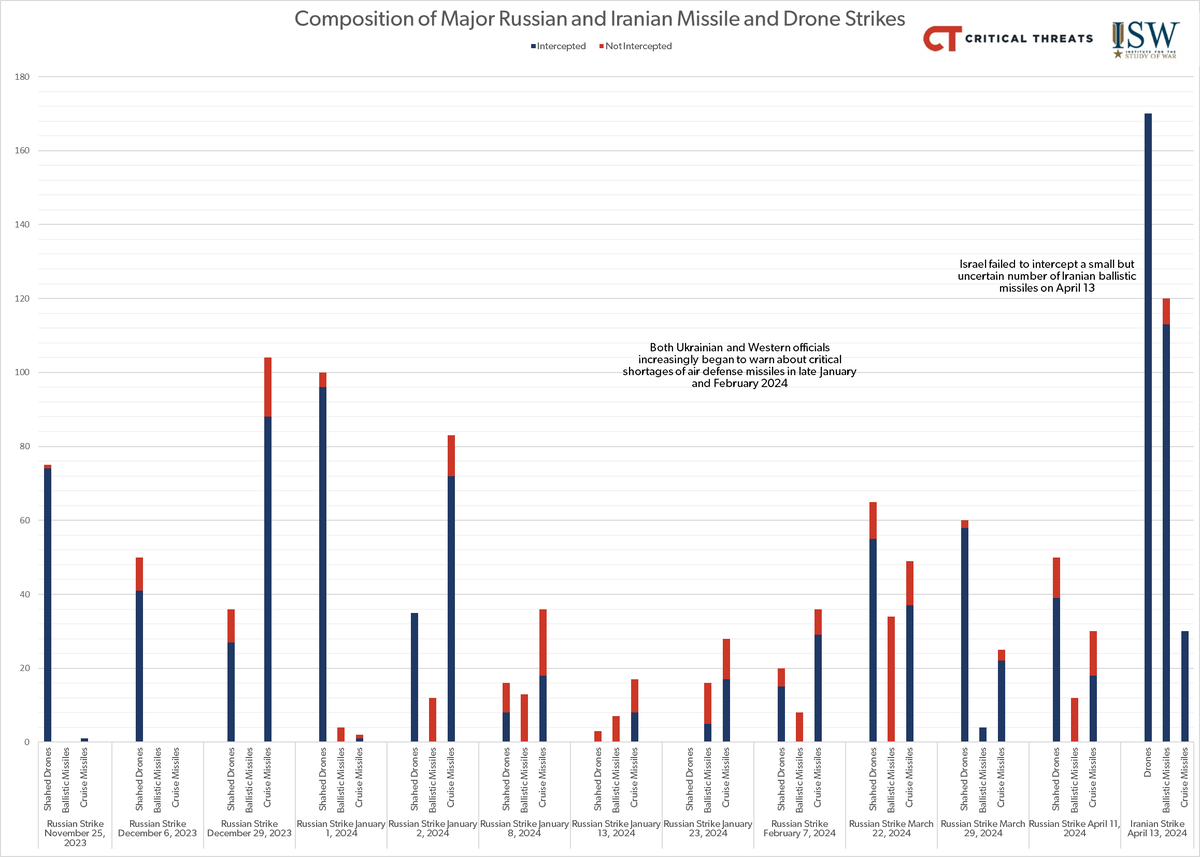
2/ Russian forces have experimented with cruise missile, ballistic missile, and drone strikes of varying sizes and combinations, and are now routinely conducting large, combined strikes against targets in Ukraine.
3/ Iran’s similarly large, combined strike package was far less successful than recent Russian strikes in Ukraine, however, with Israeli air defenses intercepting almost all of the roughly 320 air targets except several ballistic missiles.
4/ Iranian drones and missiles had to cross more than 1,000 kilometers of Iraqi, Syrian, and Jordanian airspace before reaching Israel, affording Israel and its allies hours to identify, track, and intercept missiles and drones on approach to Israel.
NEW | Russian Offensive Campaign Assessment, April 14, 2024
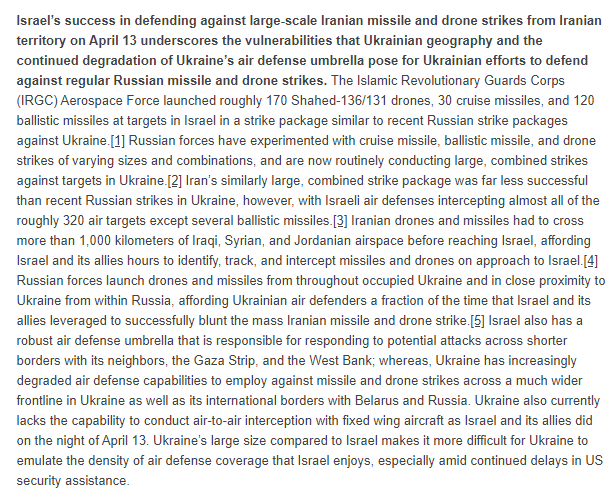
Israel’s success in defending against large-scale Iranian missile and drone strikes from Iranian territory on April 13 underscores the vulnerabilities that Ukrainian geography and the continued degradation of Ukraine’s air defense umbrella pose for Ukrainian efforts to defend against regular Russian missile and drone strikes. (1/4)
2/ The exhaustion of US-provided air defenses resulting from delays in the resumption of US military assistance to Ukraine combined with improvements in Russian strike tactics have led to increasing effectiveness of the Russian strike campaign in Ukraine.
3/ Russia’s strike campaign against Ukraine demonstrates that even a limited number of successful ballistic or cruise missile strikes can cause significant and likely long-term damage to energy and other infrastructure, highlighting the need for an effective and well-provisioned air defense umbrella capable of a sustained high rate of interception.
NEW | The Iranian April 13 missile-drone attack on Israel was very likely intended to cause significant damage below the threshold that would trigger a massive Israeli response. The attack was designed to succeed, not to fail. 🧵(1/9)
2/ The strike package was modeled on those the Russians have used repeatedly against Ukraine to great effect.
The strike consisted of approximately 170 drones, 30 cruise missiles, and 120 ballistic missiles.
3/ The drones were launched well before the ballistic missiles were fired, very likely in the expectation that they would arrive in Israel’s air defense window at about the same time as the cruise missiles and drones.
The Russian military command likely assesses that Ukrainian forces will be unable to defend against current and future Russian offensive operations due to delays in or the permanent end of US military assistance. 🧵(1/8)
2/ Though Russian forces likely lack the ability to conduct more than one simultaneous effective large-scale operational effort as they have throughout the war, Russian forces are now able to use multiple alternating offensive efforts to stretch Ukrainian defensive capabilities amid Ukrainian artillery and air defense shortages.
3/ The current pattern of Russian offensive operations allows elements of units participating in less intensive efforts to rest and reconstitute while other units, presumably those that are more rested or those that have recently received reinforcements.
NEW: The Islamic Revolutionary Guards Corps (IRGC) Aerospace Force launched a large-scale drone and missile attack from Iranian territory that targeted Israel from Iranian territory on April 13 - the first time Iran has targeted Israel directly from Iranian territory. (1/5)
2/ Members of Iran’s so-called “Axis of Resistance” appear to have conducted attacks targeting Israel simultaneously with Iran’s first wave of attacks.
3/ Iran warned Israel’s partners, particularly the United States and Jordan, not to intervene in Iran’s attack against Israel.