FPV Drones: Avdiivka's Western Front (31-04-2024)
The fall of Avdiivka on the 17th of February 2024 is one of the more sobering junctures of the Ukrainian-Russian war. This article intends not to investigate the circumstances which led to the fall of Avdiivka but will try to understand the situation the Armed Forces of Ukraine (AFU) faced there.
Full article:
tochnyi.info/2024/04/fpv-dr…
The fall of Avdiivka on the 17th of February 2024 is one of the more sobering junctures of the Ukrainian-Russian war. This article intends not to investigate the circumstances which led to the fall of Avdiivka but will try to understand the situation the Armed Forces of Ukraine (AFU) faced there.
Full article:
tochnyi.info/2024/04/fpv-dr…
1/n To explore the progression of FPV drone usage and its impact on the conflict, it is important to understand that the data analyzed within this article is based on geolocated and verified attacks recorded by operators, and released in either edited or unedited versions on Telegram channels. The strikes recorded in this database, despite having been verified and geolocated with extreme care, represent only a portion of all total attacks.
2/n Uncertainty regarding data arises from various factors, one of which is the time constraints associated with editing and distributing each strike. However, by analysing the observed data over an extended period, it is possible to identify trends crucial to understanding this new weapon system and its usage.

3/n This, however, changed notably after December 2023, which marked a turning point for the usage of FPV drones in infantry operations [7]. Since then, Ukrainian forces have continued to conduct more strikes than their Russian counterparts. The highest level of usage thus far for Russia has occurred in January 2024, with a steady decline observed thereafter.
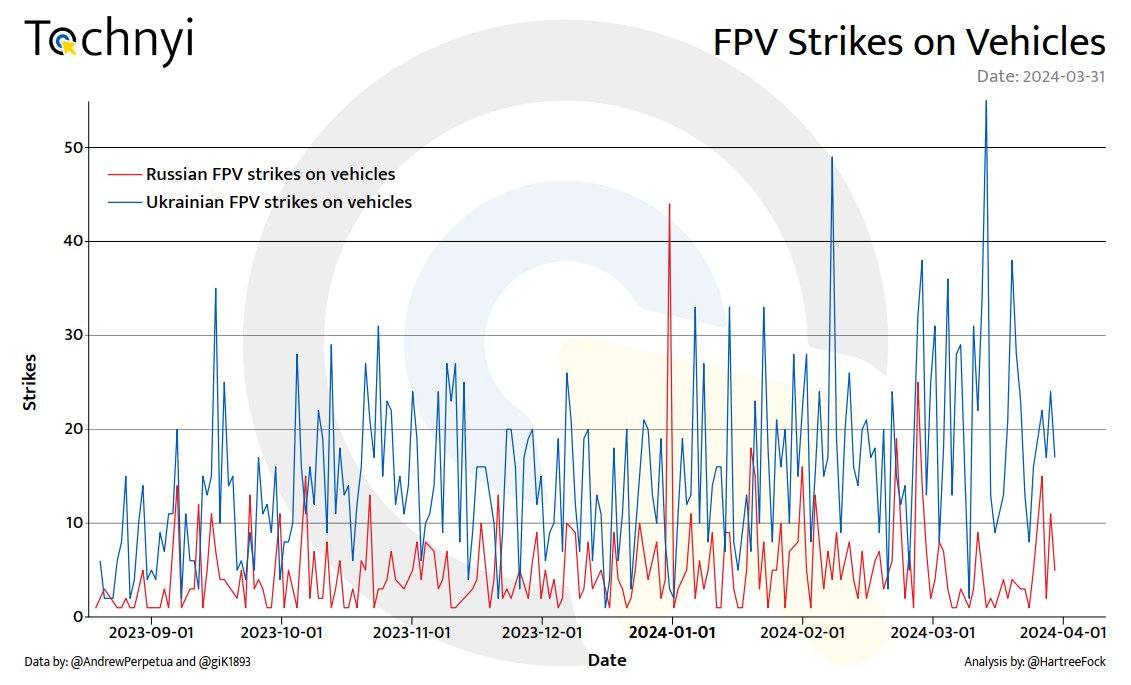
4/n If the situation regarding infantry strikes has seen a significant shift, the situation regarding vehicle strikes has changed similarly. A significant increase in FPV drone strikes on vehicles was observed, with Ukrainian forces striking 229, 311, 353 and 536 more vehicles each month from December to March respectively, reaching an astonishing maximum of 639 hits on vehicles in March alone. Russian forces have not been able to match Ukraine in its number of vehicle strikes per month.
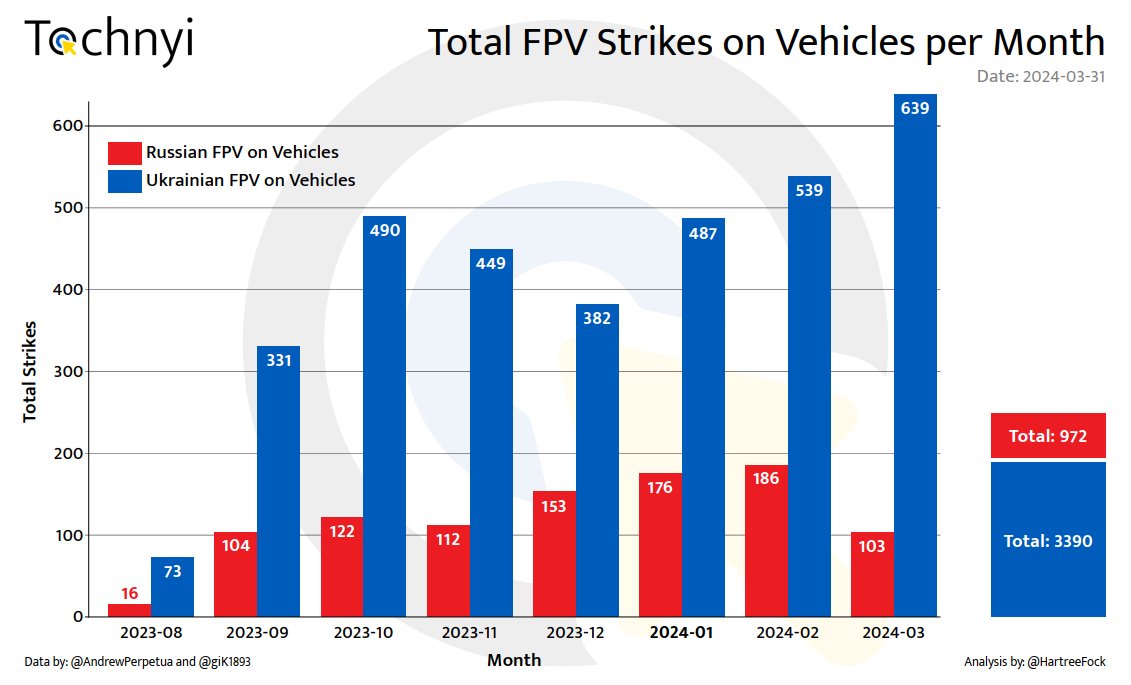
5/n Both Russia’s and Ukraine’s strategies can be observed in the daily graph of vehicle strikes, in which Russia maintains similar results and records a small, but increasing, gap for Ukraine. Overall, Ukraine continues to use FPV drones as an effective weapon to attire Russian resources; saving Ukraine’s precious artillery shells in the process for more critical fire missions.
6/n The situation on the ground
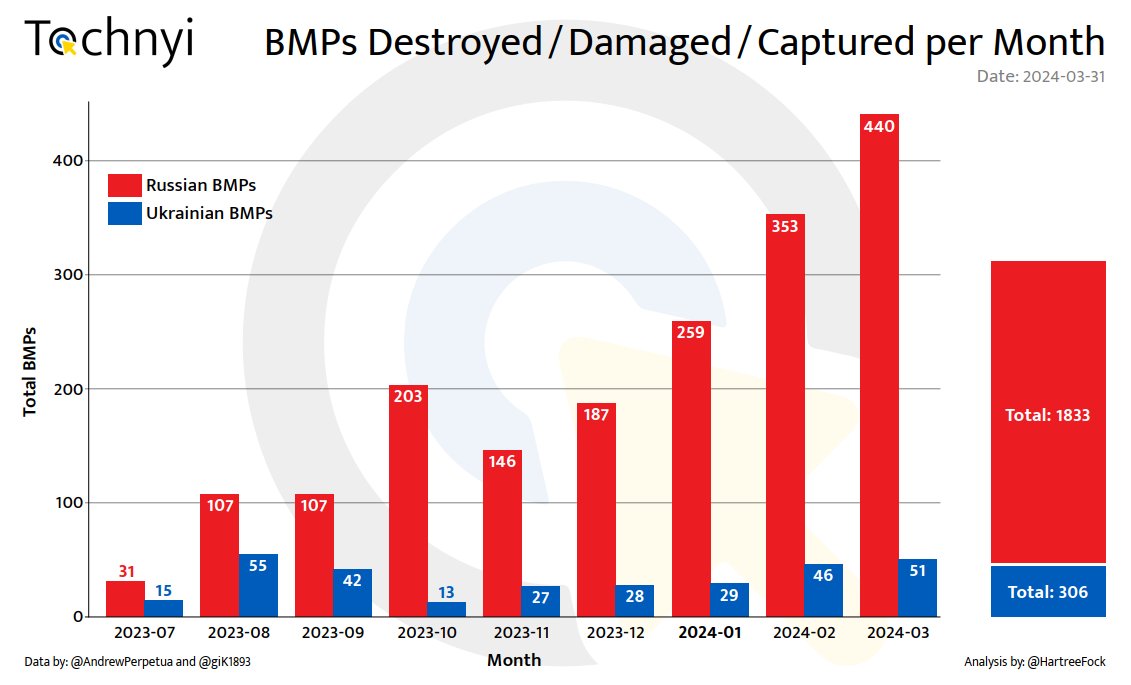
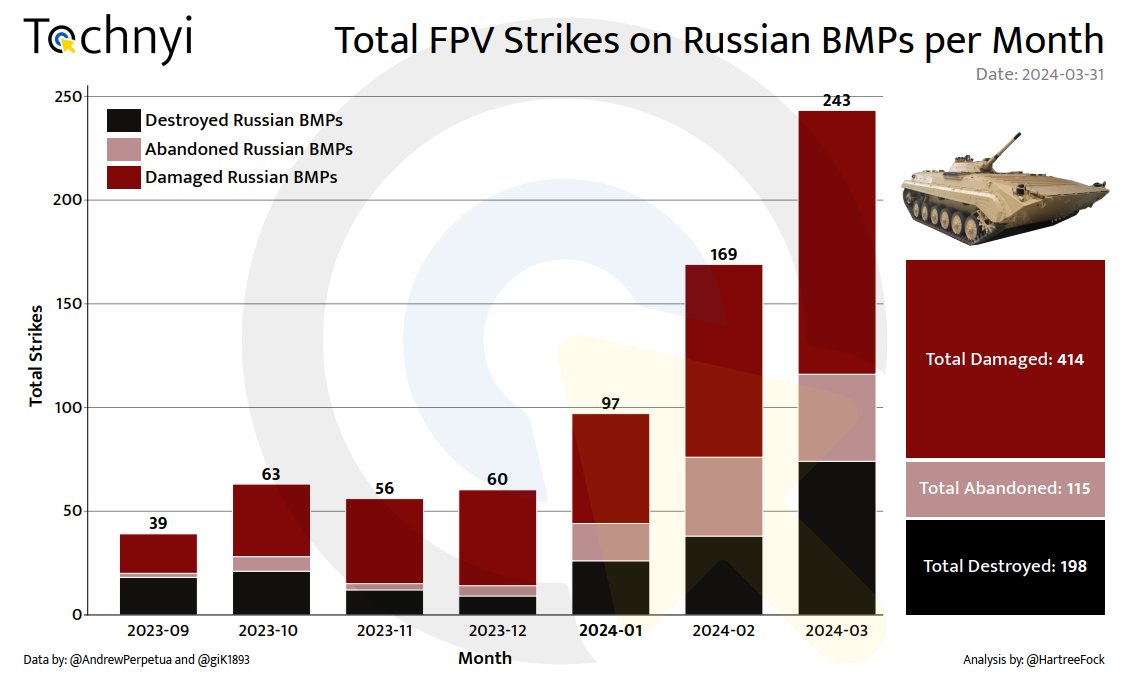
Two particularly active areas for FPV drone activity will be considered for analysis: Avdiivka, and Chasiv Jar. These locations serve as notable examples of the increasing usage of FPV drones on the Ukrainian battlefield at present. The prevalence of FPV strikes in these locations may also suggest that Electronic Warfare has been less effective or less extensively deployed. A trend becomes evident upon analysing the increasing losses of Russian BMPs registered since December 2023, supported by video evidence, satellite imagery, and geolocation data provided by @AndrewPerpetua and his team. The graph above shows the total loss of BMPs either destroyed, captured or damaged by any means. It is apparent from this data that Russian operations escalated leading to a force more exposed to several threats including FPV drones.
Two particularly active areas for FPV drone activity will be considered for analysis: Avdiivka, and Chasiv Jar. These locations serve as notable examples of the increasing usage of FPV drones on the Ukrainian battlefield at present. The prevalence of FPV strikes in these locations may also suggest that Electronic Warfare has been less effective or less extensively deployed. A trend becomes evident upon analysing the increasing losses of Russian BMPs registered since December 2023, supported by video evidence, satellite imagery, and geolocation data provided by @AndrewPerpetua and his team. The graph above shows the total loss of BMPs either destroyed, captured or damaged by any means. It is apparent from this data that Russian operations escalated leading to a force more exposed to several threats including FPV drones.
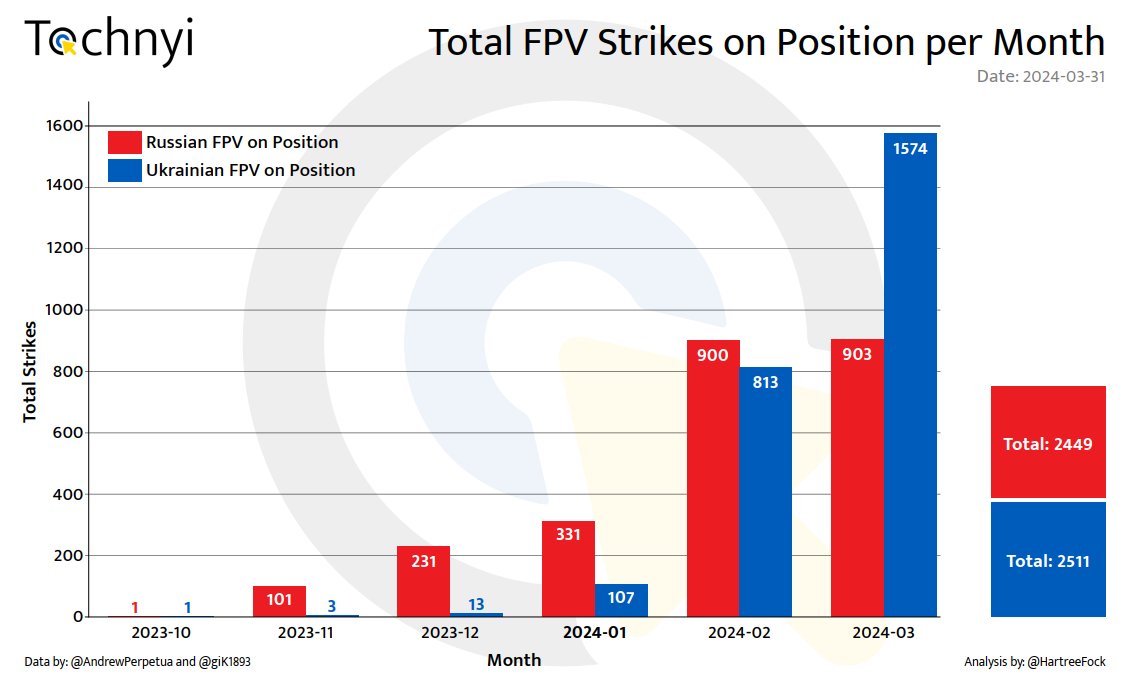
7/n The use of First Person View (FPV) drones in attacking positions has been noted to have significantly changed the ground situation. The graph illustrates the data collected and verified through geolocation and analysis of open-source videos. From January to February 2024, Russia increased the number of its FPV drone attacks on Ukrainian positions. This strategy was particularly effective in denying the defenders the ability to hold their positions, especially during urban fighting in both Marinka and later in Avdiivka, as demonstrated in a previous article. However, Ukrainian forces quickly responded and achieved a certain level of parity in February. Remarkable in this regard is the number of strikes registered in March, with Ukraine recording 1574 strikes against Russian positions, while Russia maintained a high level of strikes, 903 in total.
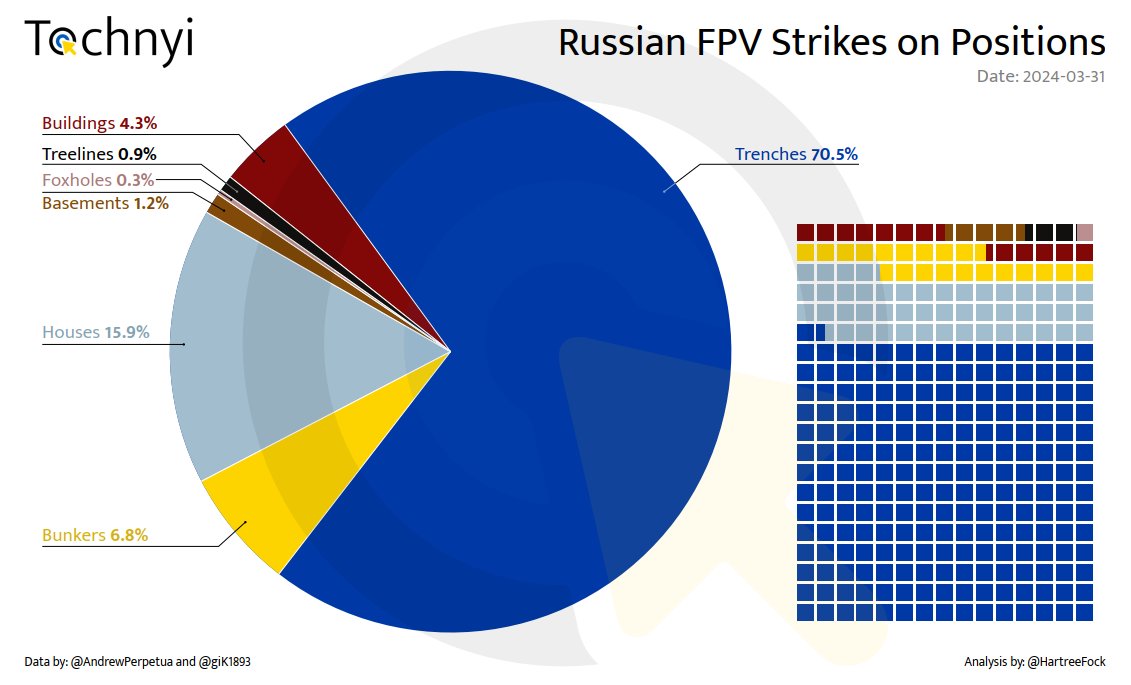
8/n In any analysis of strikes on positions, it is important to understand where most of the Russian FPV drone strikes have occurred. Overall, 70.5% of all the strikes have targeted trenches. As previously analyzed, the precision of FPV drone strikes poses a significant threat to defensive lines, especially when exposed to unchallenged aerial reconnaissance performed by surveillance drones using thermal vision. Houses are the second most struck target and become even more vulnerable when Russian ground forces move their offensive operations into towns.
9/n The situation on the ground: Adiivka
To gain a clear understanding of the effective use of FPV drones from the Ukrainian side it is crucial to have a clear picture of the offensive manoeuvres of the opposing side and Avdiivka is one of the areas where the highest concentration of FPV strikes have been recorded and geolocated. The map shown below is based on several open-source intelligence analyses, in addition to data compiled and corroborated by researchers such as @Pouletvolant3 [14], who has posted near-daily updates of the ground operations within the most active areas of the frontline.
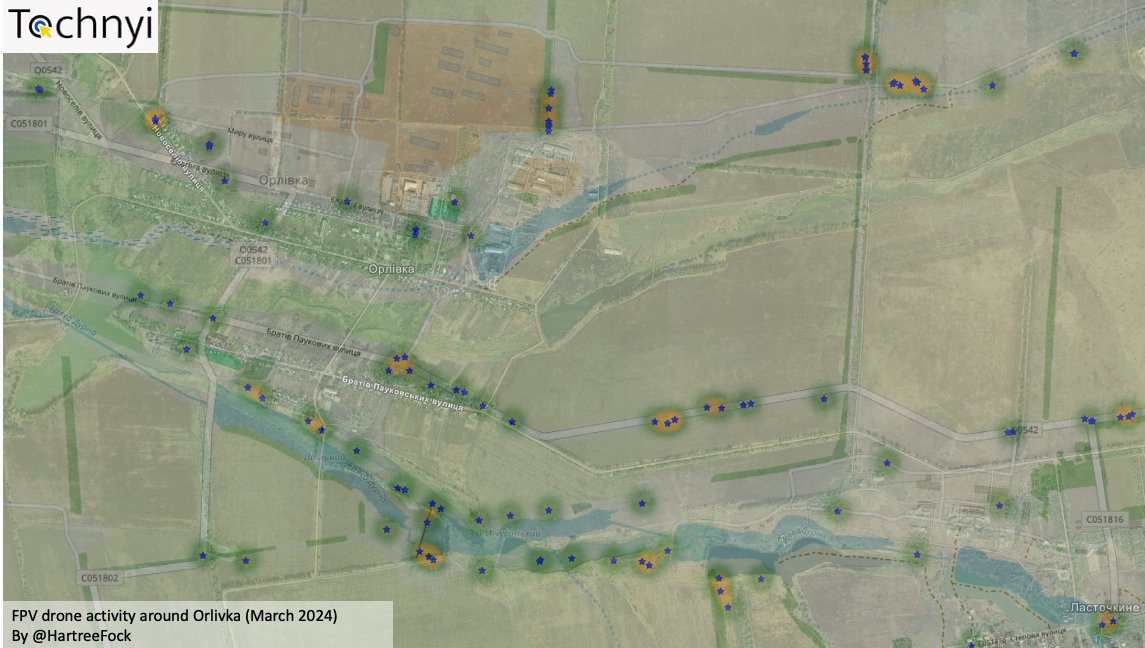
When we superimpose the map created by Poulet and the data of Ukrainian FPV drone strikes (represented by blue stars), we can get a better understanding of the importance of the directions where Russian forces attempted to push the Ukrainian lines forward - the Stepove-Berdychi direction and the Lastochkyne-Orlivka direction. Going south, there are two more vectors, from Tonenke and lastly towards Pervomaiske in the defense of Avdiivka’s western areas.
To gain a clear understanding of the effective use of FPV drones from the Ukrainian side it is crucial to have a clear picture of the offensive manoeuvres of the opposing side and Avdiivka is one of the areas where the highest concentration of FPV strikes have been recorded and geolocated. The map shown below is based on several open-source intelligence analyses, in addition to data compiled and corroborated by researchers such as @Pouletvolant3 [14], who has posted near-daily updates of the ground operations within the most active areas of the frontline.
When we superimpose the map created by Poulet and the data of Ukrainian FPV drone strikes (represented by blue stars), we can get a better understanding of the importance of the directions where Russian forces attempted to push the Ukrainian lines forward - the Stepove-Berdychi direction and the Lastochkyne-Orlivka direction. Going south, there are two more vectors, from Tonenke and lastly towards Pervomaiske in the defense of Avdiivka’s western areas.
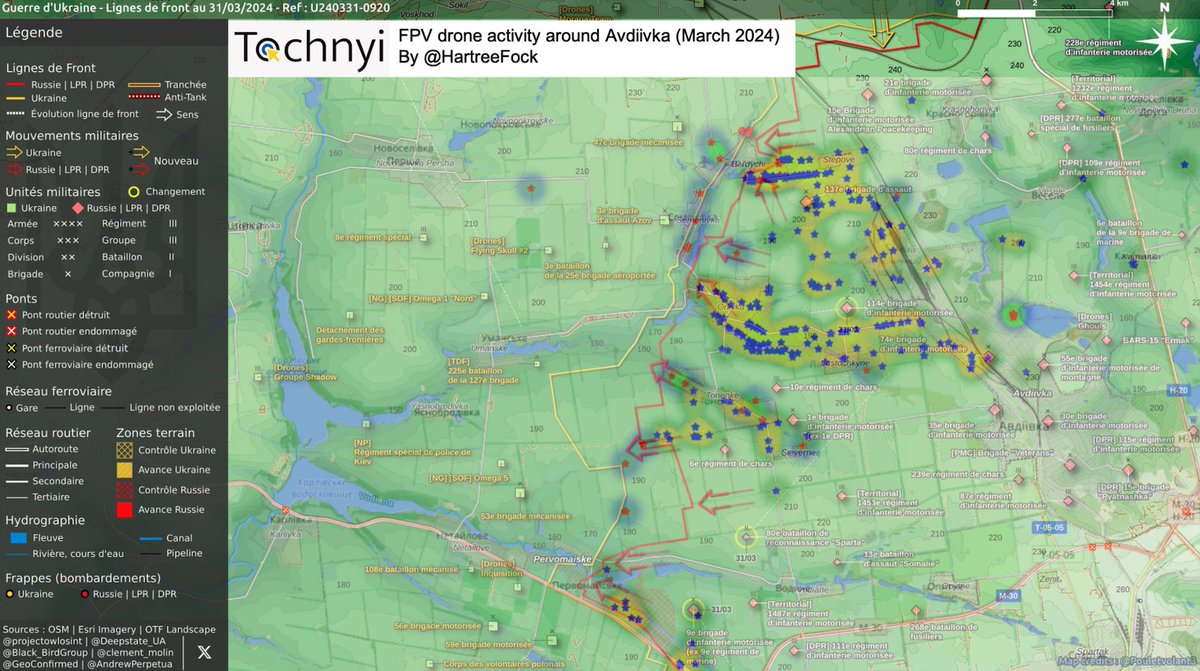
10/n The use of FPV drones has been of particular intensity along attack routes and main supply routes, as well as tree-line positions away from roads where troops were on rotation and reconstituting. This, combined with relentless strikes to the Russian rear areas, has contributed to blocking and delaying Russian advances. Consequently, this has also allowed Ukrainian troops to reorganize their defensive lines. A comparatively flat terrain and inherent absence of cover, and the Russian troops' need to use their numerically superior advantages to retain momentum have made it easier for Ukrainian FPV drones to inflict severe casualties. This has forced the Russians to intensify aerial bombing campaigns to destroy or deny AFU defenders their positions.
11/n Technological development: Night Vision/Thermal race
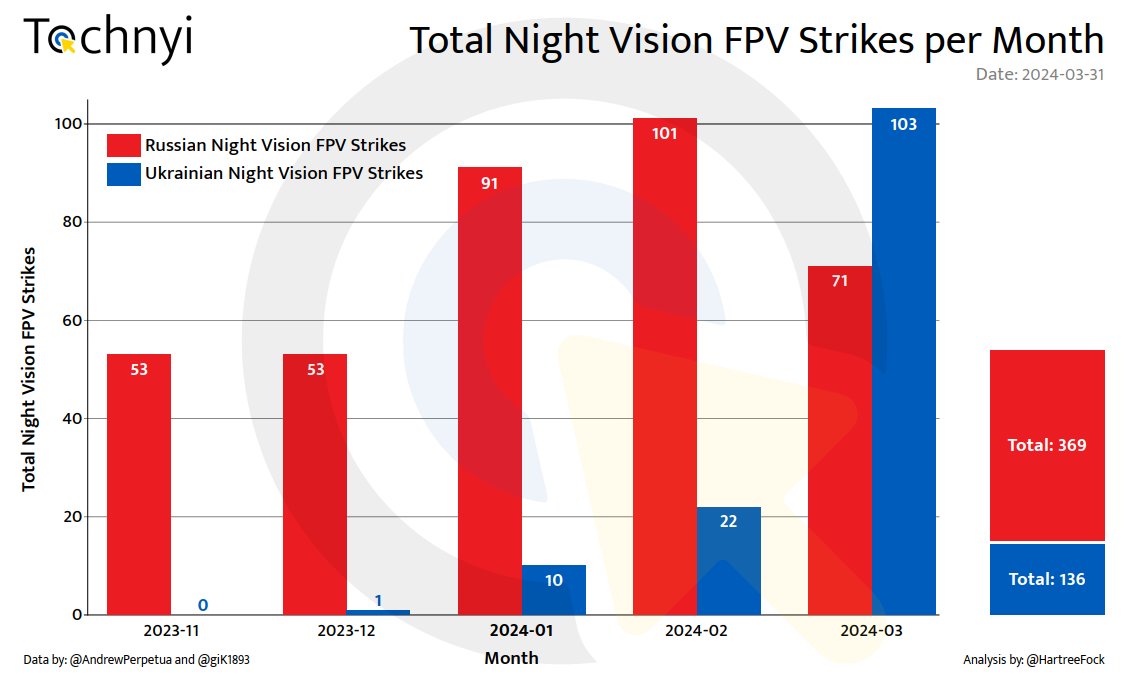
Another area where significant changes have occurred is night vision usage in FPV drones. This constitutes a significant development and, as the collected data shows, Russian FPV drones with night vision capabilities have had considerable success since their introduction in November 2023, with no apparent recorded response from Ukrainian forces.
Significant changes occurred over the last three months, marked by exponential growth in March 2024. Such rapid expansion may be attributed partially to drone operators reporting their nighttime operations more frequently, although this alone cannot fully justify the surge recorded. One of the primary challenges in deploying night vision devices is the cost of the optical components, often a thermal sensor. While a basic FPV drone typically costs around $300 to $400, incorporating a more sophisticated thermal sensor can significantly escalate the price to over $1,000. The complexity of integrating a thermal sensor into such a confined and weight-constrained device contributes to this increased cost [15].
Another area where significant changes have occurred is night vision usage in FPV drones. This constitutes a significant development and, as the collected data shows, Russian FPV drones with night vision capabilities have had considerable success since their introduction in November 2023, with no apparent recorded response from Ukrainian forces.
Significant changes occurred over the last three months, marked by exponential growth in March 2024. Such rapid expansion may be attributed partially to drone operators reporting their nighttime operations more frequently, although this alone cannot fully justify the surge recorded. One of the primary challenges in deploying night vision devices is the cost of the optical components, often a thermal sensor. While a basic FPV drone typically costs around $300 to $400, incorporating a more sophisticated thermal sensor can significantly escalate the price to over $1,000. The complexity of integrating a thermal sensor into such a confined and weight-constrained device contributes to this increased cost [15].
12/n The microbolometer's remarkable sensitivity and precision render it indispensable in thermal imaging technology and often represent the most critical and expensive component. Their cost and the difficulties involved in acquiring them pose a real bottleneck in thermal FPV drones. However, this challenge has been addressed by Ukrainian volunteer groups such as the Wild Hornet, who have adopted general-purpose infrared bolometers [16], which are widely available and are an order of magnitude cheaper than specialized microbolometers. Infrared cameras, covering a broader range of applications, offer models at various levels of complexity, resulting in a broader spectrum of financial expenses. For basic low-light functionality, an effective IR camera is more affordable, especially when intended for use on loitering munitions.
13/n FPV Drones advances in on-purpose warheads
One of the most significant progress in the development and specialization of FPV Drones is the production and use of dedicated warheads. The evolution of FPV drones has been propelled by the need to innovate swiftly, utilizing relatively scarce resources, in real-time adaptability to battlefield demands. Such an effort has been accelerated, as mentioned earlier, by the dire situation of the AFU’s artillery ammunition resources to date.
Ukraine has been at the forefront of developing advanced armour-piercing ammunition for FPV drones, as reported by Defence-UA [20]. The country's innovative approach to drone warfare has resulted in the creation of highly effective Explosively Formed Penetrator (EFP) shells, capable of piercing armoured targets. This development represents a significant leap forward in the realm of anti-armour warfare, empowering drones to engage armoured vehicles with unprecedented effectiveness.
One of the most significant progress in the development and specialization of FPV Drones is the production and use of dedicated warheads. The evolution of FPV drones has been propelled by the need to innovate swiftly, utilizing relatively scarce resources, in real-time adaptability to battlefield demands. Such an effort has been accelerated, as mentioned earlier, by the dire situation of the AFU’s artillery ammunition resources to date.
Ukraine has been at the forefront of developing advanced armour-piercing ammunition for FPV drones, as reported by Defence-UA [20]. The country's innovative approach to drone warfare has resulted in the creation of highly effective Explosively Formed Penetrator (EFP) shells, capable of piercing armoured targets. This development represents a significant leap forward in the realm of anti-armour warfare, empowering drones to engage armoured vehicles with unprecedented effectiveness.
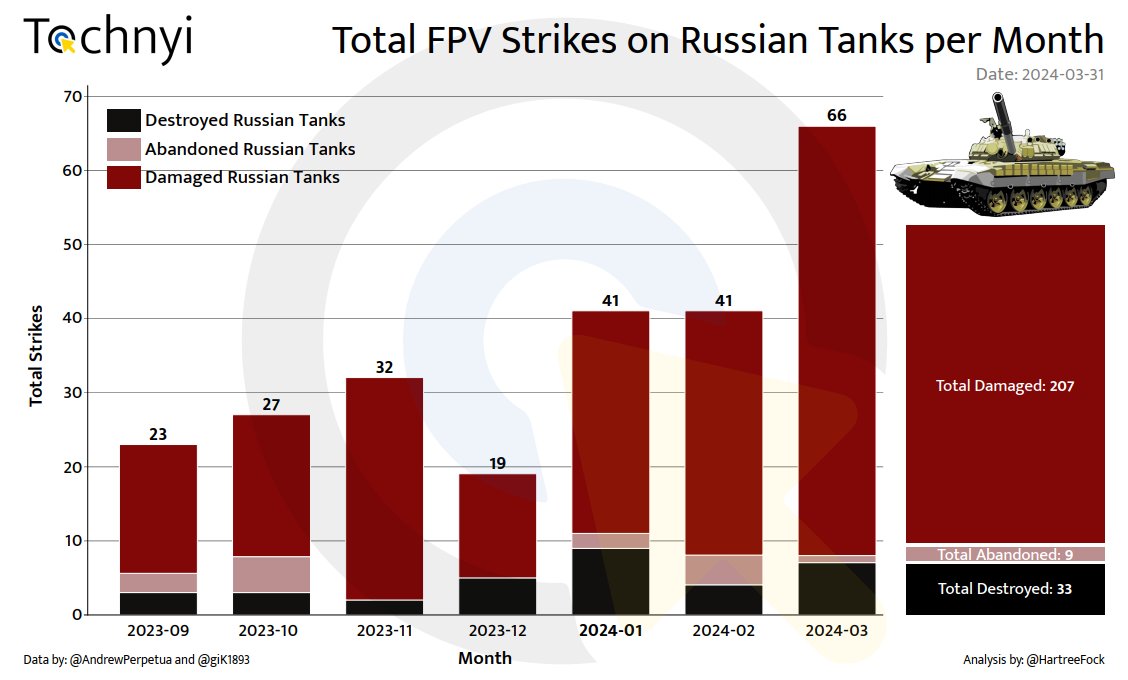
15/n An analysis of the visual evidence is summarised by the graph below, where the data on FPV strikes on tanks about total hits, damaged, destroyed and abandoned vehicles, is reported. Of the 249 visually identified strikes on tanks, 83% are classified as vehicles being damaged, 13% of the strikes are classified as destroyed vehicles and the remaining abandoned/captured. It is worth noting that this trend is similar to the data regarding overall FPV drone usage, with a similar drop noted in December 2023.
16/n An even more dramatic toll on Russian vehicles is observed in the data from FPV drone strikes on all BMP types, where a total of 727 visually confirmed strikes were recorded. Among these, 57% of said strikes resulted in clear vehicle loss due to damage, 27% led to the destruction of the vehicle and the remaining strikes led to abandonment or capture of the vehicle in question. The increasing number of Russian IFVs destroyed is indicative of a continuation of an offensive doctrine adopted by the Russian forces in the early stage of the new year.
The integration of FPV drones with advanced warheads represents a paradigmatic shift in modern warfare, offering military forces unprecedented capabilities on the battlefield. As this technology continues to evolve, it is likely to play an increasingly prominent role in shaping the outcome of conflicts around the world. From precision strikes against armoured vehicles to the decimating of enemy infantry formations - at a relatively low cost, FPV drones are holding an increasingly significant share in the panorama of warfare in the 21st century.
The integration of FPV drones with advanced warheads represents a paradigmatic shift in modern warfare, offering military forces unprecedented capabilities on the battlefield. As this technology continues to evolve, it is likely to play an increasingly prominent role in shaping the outcome of conflicts around the world. From precision strikes against armoured vehicles to the decimating of enemy infantry formations - at a relatively low cost, FPV drones are holding an increasingly significant share in the panorama of warfare in the 21st century.
17/n REFERENCES
[1]
[2]
[3]
[4]
[5]
[6] Congressional Research Service, Ukrainian Military Performance and Outlook, CRS Report Link (Last Access 18-04-2024)
[7] US Defense News, How Ukrainian FPV Drones Destroy Russian Infantry Columns on Avdiivka Front Line, (Last Access 18-04-2024)
[8]
[9]
[10]
[11]
[12]
[13]
[14]
[15]
[16]
[17]
[18]
[19]
[20]airforce-technology.com/news/isw-russi…
forces.net/ukraine/avdiiv…
kyivindependent.com/governor-russi…
rferl.org/a/ukraine-mili…
lookerstudio.google.com/reporting/dfbc…
tochnyi.info/2024/03/trench…
smallwarsjournal.com/jrnl/art/clust…
oe.tradoc.army.mil/2023/12/15/tra…
forbes.com/sites/davidaxe…
theglobeandmail.com/world/article-…
kyivpost.com/post/30173
youtube.com/live/zqGRMMA8-…
forbes.com/sites/davidham…
forbes.com/sites/davidaxe…
forbes.com/sites/davidham…
en.defence-ua.com/news/ukraine_d…
[1]
[2]
[3]
[4]
[5]
[6] Congressional Research Service, Ukrainian Military Performance and Outlook, CRS Report Link (Last Access 18-04-2024)
[7] US Defense News, How Ukrainian FPV Drones Destroy Russian Infantry Columns on Avdiivka Front Line, (Last Access 18-04-2024)
[8]
[9]
[10]
[11]
[12]
[13]
[14]
[15]
[16]
[17]
[18]
[19]
[20]airforce-technology.com/news/isw-russi…
forces.net/ukraine/avdiiv…
kyivindependent.com/governor-russi…
https://x.com/DefenceHQ/status/1755513566872895488?s=20
rferl.org/a/ukraine-mili…
lookerstudio.google.com/reporting/dfbc…
tochnyi.info/2024/03/trench…
smallwarsjournal.com/jrnl/art/clust…
oe.tradoc.army.mil/2023/12/15/tra…
forbes.com/sites/davidaxe…
theglobeandmail.com/world/article-…
https://x.com/Pouletvolant3/status/1774701440964981089
kyivpost.com/post/30173
youtube.com/live/zqGRMMA8-…
forbes.com/sites/davidham…
forbes.com/sites/davidaxe…
forbes.com/sites/davidham…
en.defence-ua.com/news/ukraine_d…
END
I would like to acknowledge the incredible work of @AndrewPerpetua and @giK1893 in creating this significant amount of data. At the same time I would like to thank the entire @tochnyi team in particular @wendy_dyers for his work proofreading, please read the full article it is worth your time and also @clockworkChris for the work done on the graphics. Again full article here: tochnyi.info/2024/04/fpv-dr…
I would like to acknowledge the incredible work of @AndrewPerpetua and @giK1893 in creating this significant amount of data. At the same time I would like to thank the entire @tochnyi team in particular @wendy_dyers for his work proofreading, please read the full article it is worth your time and also @clockworkChris for the work done on the graphics. Again full article here: tochnyi.info/2024/04/fpv-dr…
• • •
Missing some Tweet in this thread? You can try to
force a refresh