The US Congress finally passed the $95 billion National Security Supplemental Appropriations Act, which includes aid for Ukraine, Israel & Indo-Pacific allies, and invests in the US Defense Industrial Base.
But what is actually in the bill, and where does the money go?
🧵 1/36
But what is actually in the bill, and where does the money go?
🧵 1/36

The Supplemental is actually comprised of 4 bills, which were packaged together by the US House under 1 rule, passed and messaged to the Senate. It includes Supplemental Appropriations Acts for Israel, Ukraine, the Indo-Pacific, and an omnibus sanctions bill.
2/36
2/36

This thread will exclusively cover the Ukraine Security Supplemental Appropriations Act (USSAA). Threads on the Israel & Indo-Pacific bills will follow next week. Don't expect one on the sanctions bill next week, but my friend @GLNoronha is a great source on that topic.
3/36
3/36
If you haven't already, I strongly encourage you to read my previous thread on US security assistance to Ukraine before proceeding any further. I know its very long but everything in this thread will make a lot more sense if you read it first. ⬇️
4/36
4/36
https://twitter.com/ColbyBadhwar/status/1777328492566471120
Next step: forget everything you've already read about this bill from others. It was almost certainly wrong. I can't count the number of journalists who have claimed that the bill provides $60b in military aid directly to Ukraine, when in reality it's a fraction of that.
5/36
5/36


USSAA appropriates a total of $60,776,672,000, of which $50,679,672,000 (83.4%) is for security related accounts, and $10,097,000,000 (16.6%) is for economic/humanitarian aid. While almost all of the latter category is for Ukrainians, most of the security related $ is not.
6/36
6/36
This is immediately clear with the first two Department of Defense (DoD) subcategories, which USSAA starts with: MilPers and O&M, Services. This chart shows the enacted funding in USSAA, compared to the Senate's proposal and President Biden's original budget request.
7/36
7/36

On the far right column is the purpose the funds are being appropriated for, which in this case is US European Command (EUCOM) Operations. There is $6.5 billion for these two categories, which, though included in a "Ukraine aid bill", doesn't go to Ukraine, it goes to DoD.
8/36
8/36

Under Operation Atlantic Resolve, the US has deployed additional forces to Europe in response to Russia's invasion. These funds for EUCOM cover the expenses incurred through these troop rotations & operations. So while "Ukraine related", it isn't funding that helps Ukraine.
9/36
9/36

This next section has two critical line items: the Ukraine Security Assistance Initiative (USAI) & the replacement fund. Both of these are explained in the previous thread, if you need a refresher. $18.9b had been appropriated for USAI to date, so $13.8b is a large sum.
10/36
10/36

The USAI program is a disaster though. There's still $6.6b uncontracted, and the Biden Admin has refused to use these funds to procure Ukraine's highest priority item: additional Patriot systems. Whether these new funds are used more responsibly or not is a key benchmark.
11/36
11/36

The DoD should immediately commit USAI funds to procure the balance of available artillery ammunition via the Czech & Estonian initiatives. Then, they should coordinate with NATO members on placing large orders for new Patriot systems for both Ukraine & themselves.
12/36
12/36

This is essential for Raytheon to be able to invest in increasing their production rate. They have facilitization for 1 per month, but the labour and supply chains are not in place to actually produce that many. Without orders for dozens of systems, they won't scale up.
13/36
13/36
As for the replacement fund, this $13.4 billion is a major shortcoming. The $18b requested by the Biden Admin was already totally inadequate. It's unclear why the Senate bill cut $4.6b from the request, but it was a mistake for the House to not fix it.
14/36
14/36

Given the DoD already needs $10 billion to cover replacement costs for defense articles already drawndown for Ukraine, they are left with just $3.4b to cover replacement costs for $3.9b in existing Presidential Drawdown Authority, plus $7.8b in new PDA.
15/36
15/36
This is obviously an abysmal situation. By summertime the Biden Admin could conceivably declare that they have to stop Drawdowns to Ukraine because they have run out of replacement funding, as they arbitrarily did in December 2023.
16/36
16/36
At a bare minimum, $34 billion in replacement funds was needed to cover the existing $10 billion hole, plus the new & existing PDA. Utilizing all of the available drawdown authority could easily result in a $20 billion shortfall in funds needed to buy replacement stocks.
17/36
17/36
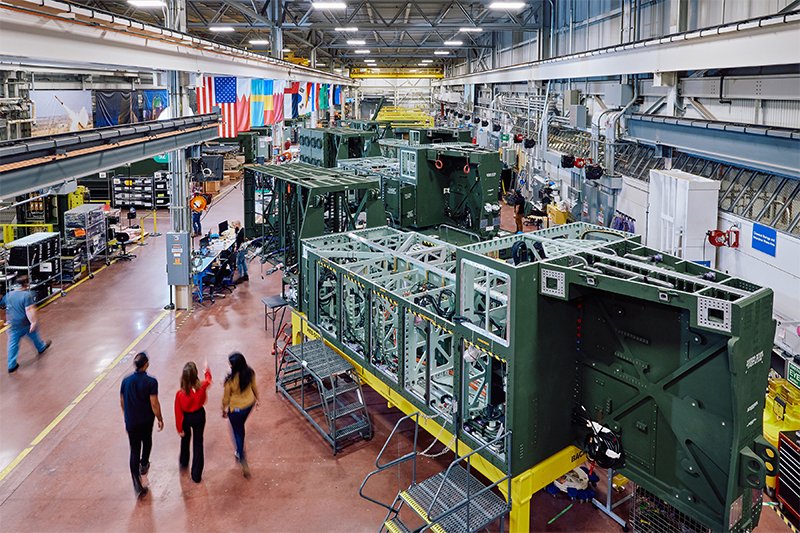
Procurement: like the Services' MilPers and O&M accounts, although these funds are part of the Ukraine supplemental, they aren't for Ukraine. This $13.3b is primarily for the Services to increase production and procurement of key munitions, and for EUCOM cybersecurity.
18/36
18/36
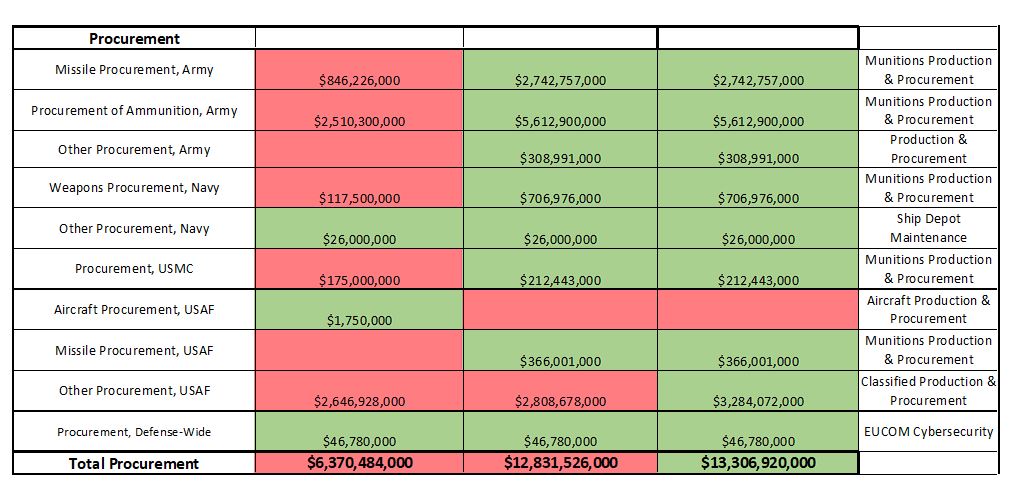
Ukraine does indirectly benefit from increased US munitions production, but that is not the primary purpose of these funds, which the Admin has requested in all 4 previous supplementals too. The main question here is why the Senate exceeded the requested amount by $6.5b?
19/36
19/36

The Senate's decision to cut $4.6b from the replacement fund, only to add $6.5b to the Procurement accounts is especially strange, given that Congress has significant oversight power over the former account & less on the latter. There may be an informal agreement on this.
20/36
20/36
Perhaps it was the Senate's way of locking in a portion of the money for replacement of certain weapon systems that they want the President to drawdown from DoD stocks. The large increases for Army Missile & Ammunition Procurement lends some support to that theory.
21/36
21/36

Congress is already able to effectively do that though, given their oversight power over reprogramming actions for the replacement fund; which is also more transparent for the public. So it remains a mystery for now. The bottom line is that there still isn't enough money.
22/36
22/36
I'll also note that the one difference between the Senate & House bills here is the extra $475m for Other Procurement, Air Force. The House moved those dollars to that account from O&M, Air Force; also unknown why this was done; there's something they want the AF to buy.
23/36
23/36


Closing out Defense: $633m for RDT&E to support cybersecurity and other needs in EUCOM, $8m for the DoD IG to conduct oversight of aid to Ukraine, and $2m for the IC to support Russian war crimes investigations.
A total of $48.4b goes to DoD managed funding accounts.
24/36
A total of $48.4b goes to DoD managed funding accounts.
24/36

The Department of Energy gets ~$150 million to provide nuclear & radiological response support to Ukraine, and $98 million for nuclear isotope production. The Admin had initially requested those funds for nuclear reactors but the Senate put the money in this account.
25/36
25/36

The $10.1b economic & humanitarian aid is divided between HHS & the State Department, with the majority going to the $7.9 billion forgivable loan for the Economic Support Fund, and $1.6 billion in assistance to Ukraine & other impacted countries in the region.
26/36
26/36

The last appropriations is the $2 billion for State Department managed security assistance programs: $400m for civilian law enforcement/security needs, and $1.6b for Foreign Military Financing loans for Ukraine & others in Europe to fund purchases from the US via FMS/DCS.
27/36
27/36

In the past, INL funding has actually been used to fund the procurement of vehicles for Ukraine's State Border Guard Service, including the Canadian produced Roshel Senator MRAP. This would be a prudent use of that new $400 million, as Roshel has a robust production rate.
28/36
28/36

As I noted in my previous thread, only $1.6 billion for FMF is unfortunate. Long term security assistance to Ukraine is better placed in this program rather than USAI. FMF gives the Ukrainians more control; the Biden Admin can't spend it on things Ukraine don't want.
29/36
29/36
When you compile all the security assistance to Ukraine made available by the bill, both actual funds & the new Drawdown authority, it's only $23.6b. Excluding PDA, you're left with the actual funding for their defense: $15.8b, out of $60.8b. Just 26%. Not very much.
30/36
30/36

This is the fundamental problem with the way the Biden Administration has structured their budget requests since the beginning of the war. The Ukraine supplementals are filled with money that isn't for Ukraine, and Congress hasn't had the sense to correct this mistake.
31/36
31/36
It creates a false illusion that Ukraine is receiving far more money and far more assistance than they actually are. The media has been very guilty in exacerbating this problem as well, by failing to actually read the legislation and explain it to their audiences.
32/36
32/36
All of this is very helpful to Russian disinformation efforts. The public has been led to believe that Ukraine has been sent $113 billion in hard cash, and American politicians are still making this worse by failing to craft a bill that addresses Ukraine's actual needs.
33/36
33/36
The bill has been signed by President Biden though. We can only hope that he makes the most of the resources he asked for. The $1 billion drawdown and extremely overdue provision of 300km range ATACMS are good first steps, but there's 2 years of past mistakes to correct.
34/36
34/36

Sullivan said yesterday that the funding will cover all of Ukraine's needs in 2024. It will need to, because I'm not confident on another bill passing this year. If Biden asks for another, Congress would be right to ask why he didn't submit a larger request to begin with?
35/36
35/36

In all likelihood another Ukraine aid bill will be needed; certainly in early 2025, if not sooner. We can only hope that all parties involved learned important lessons about the fulfillment of their responsibilities. Ukraine is still counting on it's friends for support.
36/36
36/36

I hope that this explanation was helpful to you. I'd appreciate it if you'd RT the thread, and follow myself & my colleagues at @InsiderEng & @tochnyi for more.
https://twitter.com/701156462177947652/status/1783481116126740652
• • •
Missing some Tweet in this thread? You can try to
force a refresh