The effectiveness of Ukraine's Excalibur GPS-guided rounds decreased from 70% to 6% within six weeks as Russia adapted and employed various EW assets to counter them. Source: congress.gov/118/meeting/ho…
Yesterday, we published the latest RedHorizon update, and below is a summary of the key developments from last week. This will be a long thread.
Let’s start with Ukraine.
We continue to assess that the war has entered its most operationally precarious phase to date. Russian forces maintain the initiative across much of the front and, aside from limited Ukrainian gains—particularly around Kupyansk—the Ukrainian Armed Forces appear exposed on several axes.
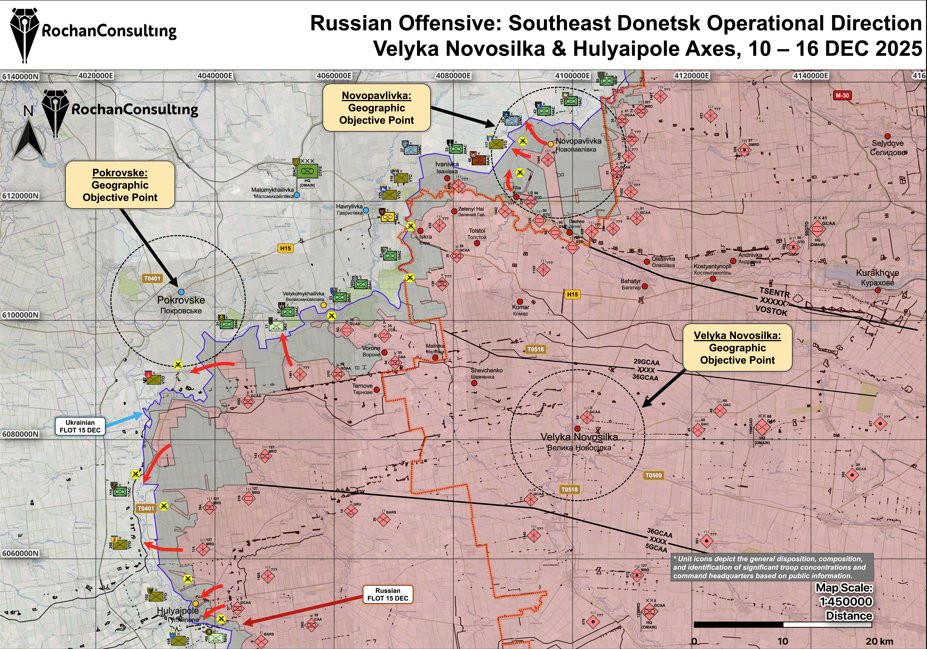
The Hulyaipole axis remains the most threatened. Although Russian gains there were limited last week—amounting to roughly 7 sq km—they were operationally significant. Russian forces crossed the Yanchur River within the city at at least two locations and succeeded in dislodging Ukrainian defenders from most of Hulyaipole.
Turning to Pokrovsk, since late November, we have assessed that Ukraine has been unable to resupply its forces in Myrnohrad by ground, with logistics increasingly reliant on UAS. The situation in the city remains dire and continues to trend toward full Russian capture. Based on our observations, the deployment of the 76th Guards Airborne Division has accelerated Russian progress. Absent a Ukrainian counterattack, Russian forces are likely to seize the city within the next two weeks. Last week alone, Russian forces captured approximately 21 sq km around Pokrovsk and Myrnohrad, with further gains likely this week. A persistent feature of Russian operations, however, remains their inability to exploit tactical success through the timely commitment of echeloned forces to translate local gains into broader operational breakthroughs.
Earlier today, we sent out the latest edition of RedHorizon to our clients. Here are some snippets.
The past fortnight could prove to be one of the war’s defining weeks. Russia advanced on multiple axes, escalated strikes on Ukraine’s grid, and Kyiv entered winter under severe systemic pressure.
Last week alone, Russians captured ~130 km² north of Huliaypole, achieving a tactical breakthrough. More than 50% of all Russian gains across Ukraine occurred on this axis. This week is trending towards the same outcome. Situation near Seversk is deteriorating, too, as Russians crossed the Seversky Donets River and established a bridgehead near Dronivka and Platonivka. Yampil is on the verge of being cut off. Russian forces are some 17 km north of Slovyansk.
Russian air and missile attacks focused on nuclear-grid substations & gas infrastructure, forcing rolling blackouts and NPP output cuts.
Dwa tygodnie temu wróciłem z 10 wizyty studyjnej na Ukrainę. Poniżej znajduje się kilka wniosków płynących z tej wizyty (Baardzo długi wątek).
Najpierw jednak krótkie przypomnienie o najważniejszym wniosku z lipcowego wyjazdu.
Z tamtej wizyty wróciłem z nieco ostrożniejszą oceną ukraińskich perspektyw obrony. Wówczas Ukraina miała już coraz większe trudności adaptacyjne na coraz bardziej zorganizowane rosyjskie taktyki użycia dronów, w szczególności rozwijane przez jednostkę Rubikon. Rubikon systematycznie niwelował jedyną przewagę, którą Ukraina wciąż posiadała – przewagę w dronach. Do połowy 2025 roku rosyjska aktywność UAV koncentrowała się głównie na atakowaniu ukraińskich żołnierzy w pobliżu linii styczności, podczas gdy Ukraińcy próbowali razić siły rosyjskie, zanim zdążyły podjąć kontakt. Rubikon całkowicie zmienił tę logikę: operując na dystansie 10–20 km w głąb zaplecza, atakuje nie tylko elementy wsparcia – w dużej mierze uzależnione dziś od UAV – ale także kluczowe zdolności, na których opiera się ukraińska obrona – WRE, artyleria, drużyny dronowe, drony.
Od tego czasu rosyjskie wykorzystanie dronów nadal ewoluuje. Rosyjskie pododdziały ogólnowojskowe stosują lepiej zorganizowane taktyki atakami dronami, rażąc ukraińskie oddziały do 10 km w głąb, podczas gdy Rubikon wciąż wywiera presję na tyłach - +10km. W efekcie straty ukraińskie wśród personelu wsparcia i operatorów dronów przekraczają dziś straty piechoty – choć trzeba podkreślić, że liczebność ukraińskiej piechoty jest już poważnie uszczuplona.
Teoretycznie ukraińska mobilizacja nadal generuje co miesiąc znaczącą liczbę nowych żołnierzy, lecz nie ma to żadnego odczuwalnego wpływu na front. Powody są strukturalne, organizacyjne i głęboko zakorzenione w ukraińskim systemie. Według doniesień ukraińskich mediów liczba przypadków samowolnych oddaleń (AWOL) nadal rośnie. Choć wielu żołnierzy ostatecznie wraca do swoich jednostek, nic nie wskazuje, by problem ten miał zostać szybko rozwiązany.
I’m pleased to announce that @konrad_skorupa and I have just released our new report, Zapad-2025 in Belarus: Structure, Conduct, Implications.
We analyse this year’s Russo-Belarusian exercise, which—despite its smaller scale—confirmed deep operational integration between both armed forces.
Zapad-2025 involved ~7,000 troops, including ~1,000 Russians — far below earlier claims of 13,000. The reduction reflected Moscow’s manpower constraints, yet the exercise preserved its core aim: testing the Regional Grouping of Forces (RGF) and validating joint command procedures.
Belarus is an operational enabler. Minsk led on paper, but command, doctrine, and training remained Russian-defined — solidifying Belarus’s subordination within Russian operational planning.
Here’s a brief update on the situation in Ukraine, focusing on Donbas and the air picture.
Over the past week, Russian elements from the 57th and 33rd Motor Rifle Regiments penetrated Ukrainian defensive positions along the TO504 road linking Pokrovsk and Konstantynivka. Although this line has long ceased to serve as a reliable GLOC, the tempo and vectors of Russian advances northward remain concerning. (Orange colour is fortifications - made by @Playfra0->give him a follow)
Russian forces are advancing along three primary axes toward Konstantynivka:
- The eastern axis from Chasiv Yar, which has seen limited gains over months;
- The southern axis via Toretsk, currently contested with Ukrainian forces holding firm;
- The eastern flank, which has gained operational momentum and now threatens Ukrainian rear areas, complicating sustainment and force disposition.
The rapid pace of the eastern push risks outflanking Ukrainian defensive lines and denies time for construction of new fortifications. Should Russian forces secure a breakthrough near Rusyn Yar, it would constitute a critical tactical gain, severely degrading Ukrainian defensive depth.
From a terrain perspective, movement from Novooolenivka toward Stepaniva affords the Russians dominant ground, enabling fire control over approaches to Konstantynivka and interdiction of Ukrainian reinforcement routes from Druzkivka.
Paradoxically, these territorial gains coincide with a reported overall reduction in Russian ground offensive operations across the front, including near Pokrovsk and Toretsk. This raises the question: Why is Russian forward momentum accelerating amid diminished ground attack activity?
The past few weeks have shown relatively substantial Russian territorial gains both north and south of Kurakhove. Although, using Ukrainian parlance, the overall situation remains "difficult but manageable," we generally expect the continuation of Russian ground attacks and territorial gains in the area.
On 19DEC, Russian forces reportedly launched assaults on Ulakly and Konstiantynopil, both pivotal for Ukrainian efforts to maintain their defensive line near Dache and Kurakhove. While unverified Russian reports suggest progress near both villages, confirmation of these advances would significantly undermine Ukrainian positions. If these reports are accurate, Ukrainian forces in the salient could again face difficulties in conducting effective defensive operations and risk partial encirclement. Moreover, the loss of any built-up areas would degrade Ukraine's overall ability to defend more effectively.
Although the terrain in this region favors defensive operations due to the presence of waterways, the ongoing Ukrainian personnel shortage prevents full utilization of these natural features to stall Russian advances. Currently, Ukrainian units in the area are focused on static defense operations, leaving them vulnerable to drone, artillery, and glide bomb strikes. This lack of manpower also limits their ability to launch counterattacks, which could otherwise disrupt Russian momentum in the area.
On 14DEC, the commander of the OTUV Donetsk, Brig. Gen. Oleksandr Lutsenko, whose AOR span between Velyka Novosilka to the Toretsk area, was dismissed due to poor engineering preparations and quick Russian advances. Lutsenko has been replaced by Brig. Gen. Oleksandr Tarnavsky. Tarnavsky is an experienced commander, but his problems will take weeks and months to fix, let alone many issues (such as training and the quality of draftees) are beyond his control. As such, his impact on the frontline may take weeks to materialize.
Kurakhove remains a tactical target for Russian forces. Capturing it, which is now imminent, will open pathways for further advances westward. As Ukraine is currently in no position to halt Russian advances, we expect Russians to capture the terrain between Dache and Zelenivka over the coming couple of weeks.