Jim Bianco Profile picture
May 8 9 tweets 3 min read Read on X
1/9

I've been asked about my stance on yields. Do I still think the 10-year yield is going to 5.00%—5.50%?

Yes

But I also took a neutral stance a few weeks ago.

75% of the move is over.

🧵
2/9

Where did 5.00% - 5.50% come from.

The belief is that the 40-year bond bull market is over (in 2020), and a multi-year bond bear market is continuing.

So, 5.00% - 5.50% is a higher high than the 5% peak of last October, as would be expected in a bear market. Image
3/9

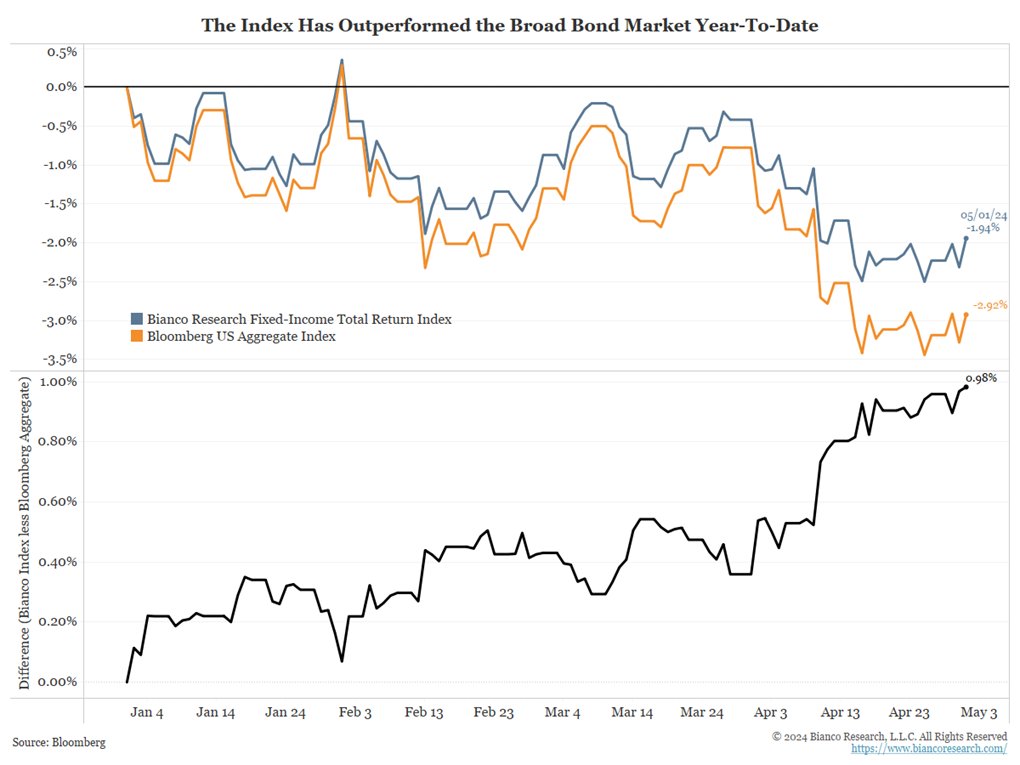
That said, we did move our Index to neutral duration from being short since late last year. 75% of the move is over.

Recall we manage the Bianco Research Total Return Index. The ETF $WTBN tracks our Index (similar to SPY tracks SPX)

Explained here
biancoadvisors.com/may-2024-index…
4/9

Our index was 98 basis points ahead of the Bloomberg US Aggregate Index (bottom panel) through the end of April.

biancoadvisors.com
Image
5/9

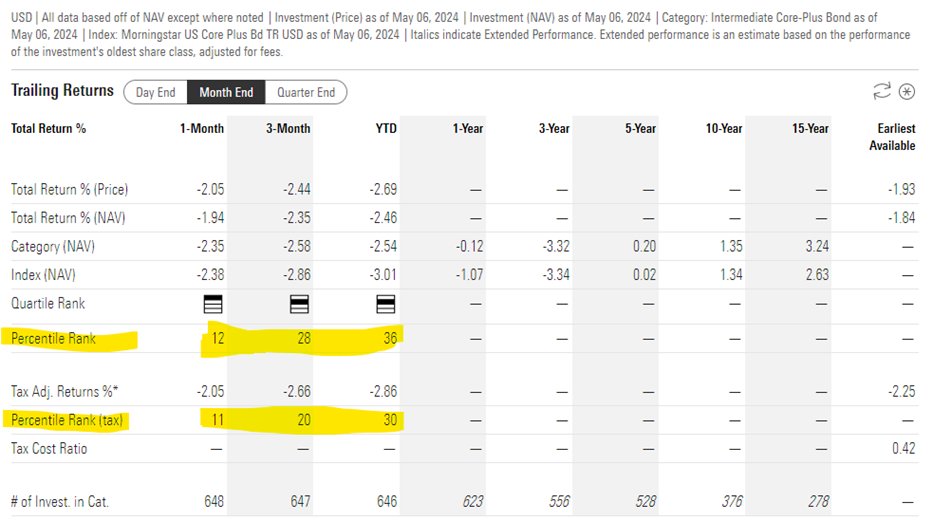
And here is how $WTBN is performing relative to its peers, as calculated by Morningstar.

morningstar.com/etfs/xnas/wtbn…
Image
6/9

So if we moved to neutral, why still thinking that 5.00% - 5.50% is still possible.

No capitulation yet

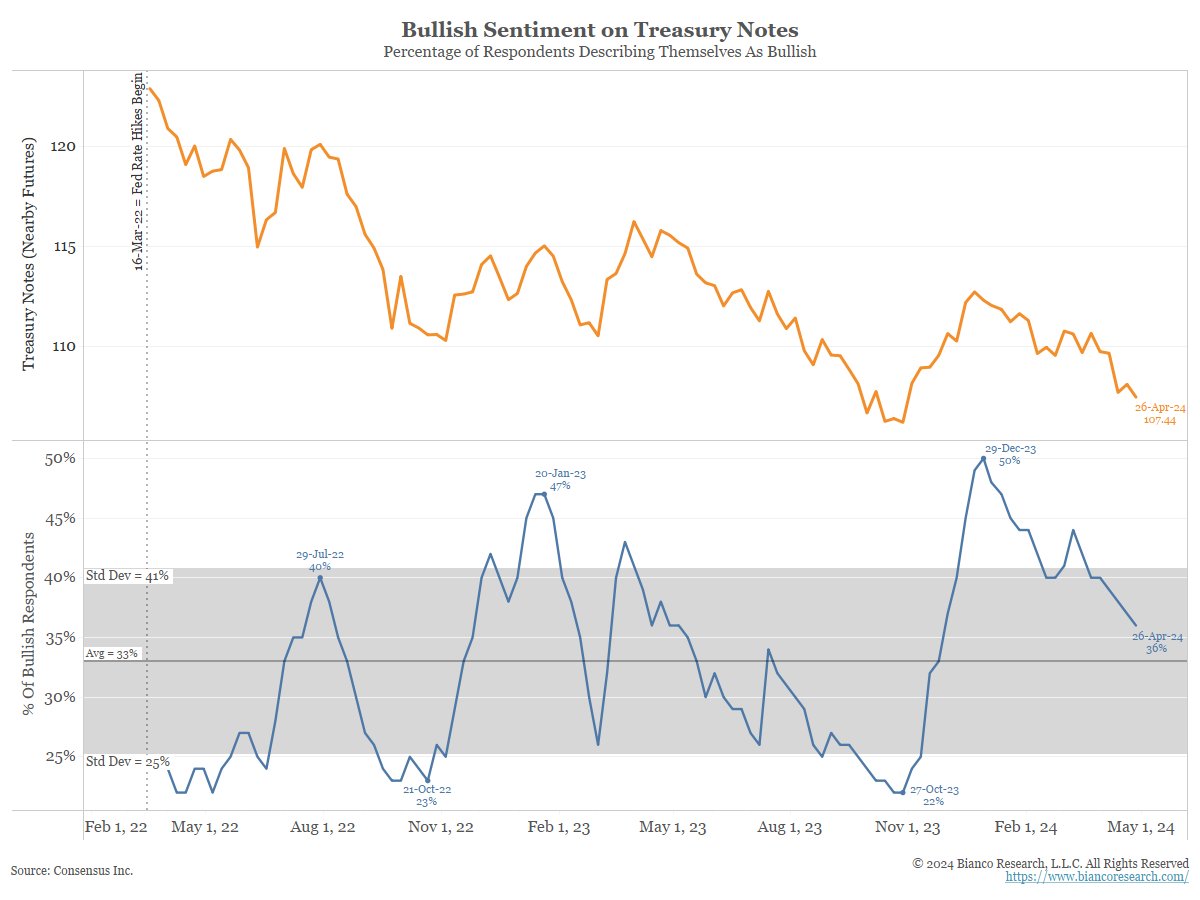
Consensus Inc. surveys brokerage house reports. They divide them into two piles: bullish and "not bullish."

The chart started when the Fed began hiking rates. Image
7/9

So, the chart above has never been above 50% bullish, as bonds have been in a huge bear market.

That said, the current reading of 36% is slightly above the average of 33% since March 2022.

So, the thinking is 5.00% - 5.50% produces an extreme reading, then get long bonds.
8/9

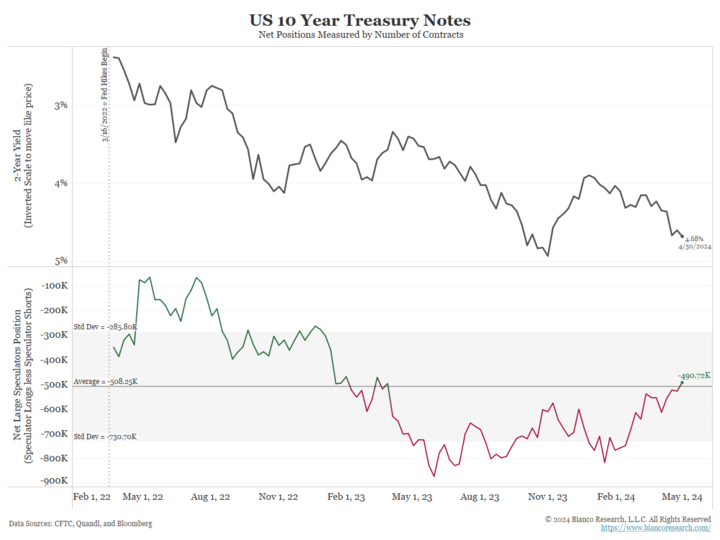
Ditto the CoT report. Net Large Trader (Speculator) positions are on their average since the Fed started hiking in March 2022.

(Specs = holds 1,000 contracts and does not trade in cash mkt)

Move to 5.00% - 5.50%, and my guess is a capitulation, then get a long duration. Image
9/9

We are close enough to the end of this rise, so we moved neutral.

I expect a 10-year yield move to 5.00%—5.50% to produce extreme sentiment and set up a decent bond rally.

Will discuss more when/if we get above 5.00%.

• • •

Missing some Tweet in this thread? You can try to force a refresh

 

Keep Current with Jim Bianco

Jim Bianco Profile picture

Stay in touch and get notified when new unrolls are available from this author!

Read all threads

This Thread may be Removed Anytime!

PDF

Twitter may remove this content at anytime! Save it as PDF for later use!

Try unrolling a thread yourself!

how to unroll video
  1. Follow @ThreadReaderApp to mention us!

  2. From a Twitter thread mention us with a keyword "unroll"
@threadreaderapp unroll

Practice here first or read more on our help page!

More from @biancoresearch

May 5
1/6

A great piece by @EconTodd and James Carter about how the US Treasury messed up the last 15 years ago. (h/t @judyshel)
---
Rather than issuing 50- or 100-year bonds when interest rates were at rock-bottom, the US Treasury dismissed this option and simply continued to borrow on a short-term basis. Now that US interest payments are ballooning, the scale of this blunder has become apparent, as have the implications for future generations.

project-syndicate.org/commentary/sup…
2/6

This almost triggered me to read as I have been arguing the same thing.
---
April 29, 2012

“I don’t get why the Treasury thinks floaters are a good idea with short-term rates at zero percent, as they only have one way to go, and that’s up,” said James Bianco, president of Bianco Research LLC in Chicago in an interview on April 24.

“They should be lessening the cost of financing the United States government for the taxpayers,” Bianco said. “The Treasury should be issuing 100 year or perpetual bonds until the market can’t stand it anymore to lock in these rates.”

bloomberg.com/news/articles/…
3/6

In a 2019 op-ed I wrote for Bloomberg ...
---
For more than 60 years, the Treasury has relied on a select group of primary dealers – currently numbering 24 - who are not only authorized to trade with the Fed, but are also obligated to bid at government debt auctions. That means they are expected to put their own capital at risk and buy the securities issued by the Treasury. This group of dealers accounts for a large chunk of the Treasury Borrowing Advisory Committee, or TBAC, which counsels the government on its financing needs.

The Treasury has historically placed a great deal of weight on this group’s recommendations. The TBAC has lately stressed the importance of regular and predictable securities issuance, along with demand for that issuance. When the Treasury brought up the idea of ultra-long bonds in 2017, the TBAC cautioned against the move and pointed to surveys of investors that suggested tepid interest.

bloomberg.com/view/articles/…
Read 6 tweets
May 1
1/6

As this chart shows, the current BTC price is the average purchase price of the Spot BTC ETF buyers. ~$57K to ~$58K Image
2/6

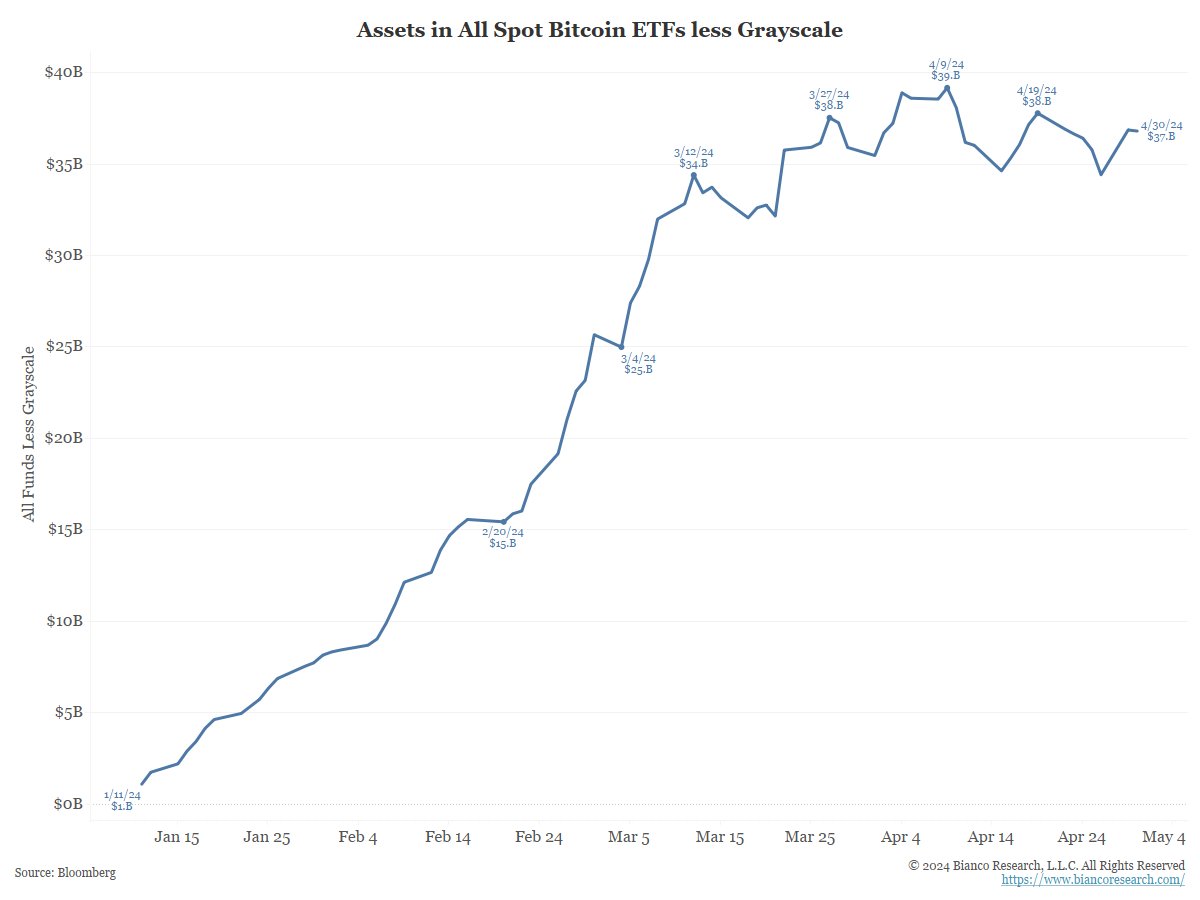
So, about $37 billion in Spot BTC assets (x-GBTC) now have no profits and maybe a small loss. Image
3/6

As I have been detailing, the 13F shows very little institutional buying of these ETFs. 95+% of the buyers are either hedge funds, institutional investors holding less than $100m, or retail degens.

Retail degens dominate.


Read 6 tweets
Apr 28
1/11

The more data we get, the more I worry about the risks involved with Spot ETF.

🧵to update
--
Investment Advisors hold about 35% of all ETFs. However, they hold less than 1% of the new Spot BTC ETF.

"Here come the boomers" was/is a myth.

2/11

Why does this matter?

It confirms my fear that the Spot BTC ETFs are effectively "orange FOMO poker chips" for paper-handed small-time traders (degens).

These degens are getting close to their breakeven, which could turn them in big-time sellers.

Let's dig in.
3/11

A Citi study shows that investment advisors (IAs) hold ~35% of all ETFs. The table shows the 4 largest BTC ETFs. IA's (blue ribbon) hold less than 1% of the New BTC ETFs.

For comparison, see the two popular non-equity ETFs, GLD and TLT. IAs hold 22% of HYG and 40% of TLT. Image
Read 11 tweets
Apr 21
1/6

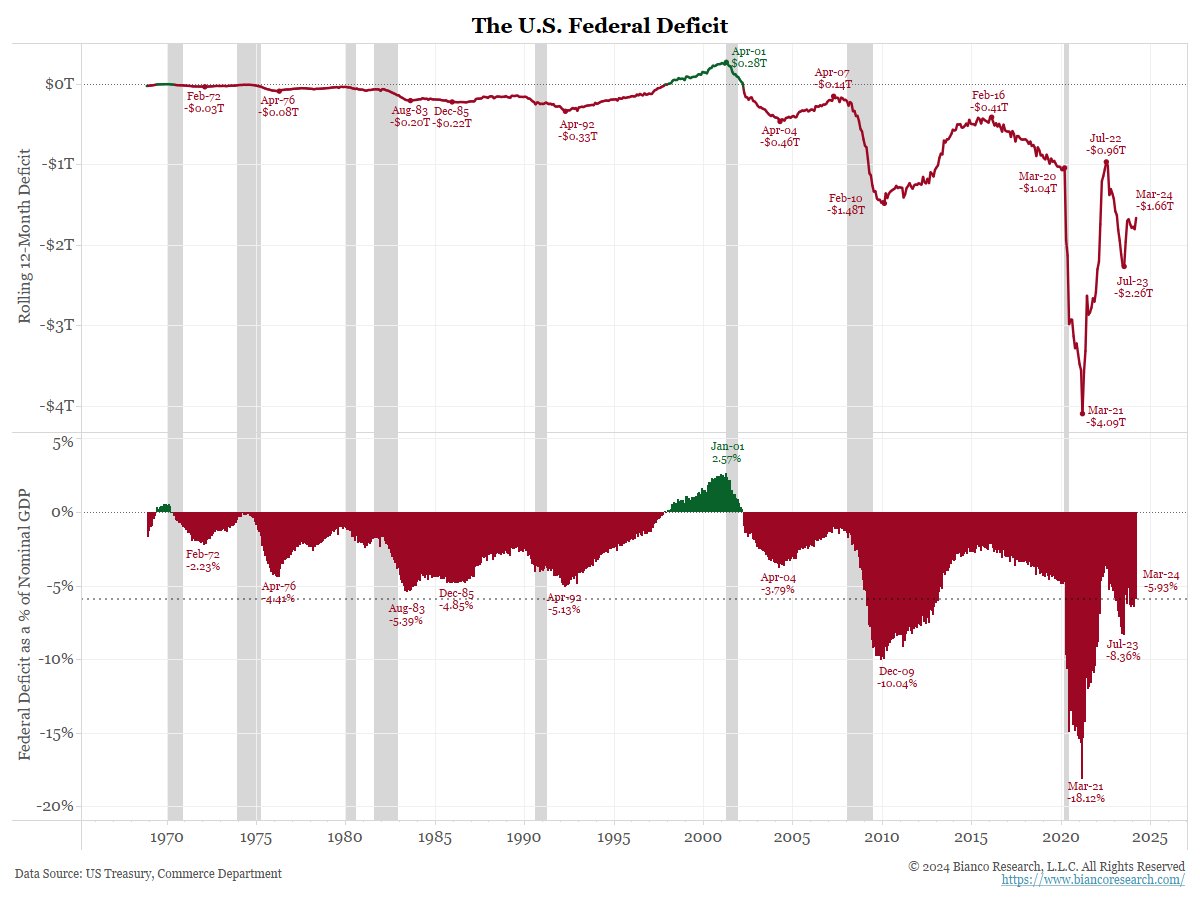
The deficit as a % of GDP (bottom), now 5.93%, is higher than in any period except the Great Recession (2007 - 2009) and the 2020 COVID shutdown (dotted line).

The government is borrowing to spend money like the economy is trying to recover from a recession. Image
2/6

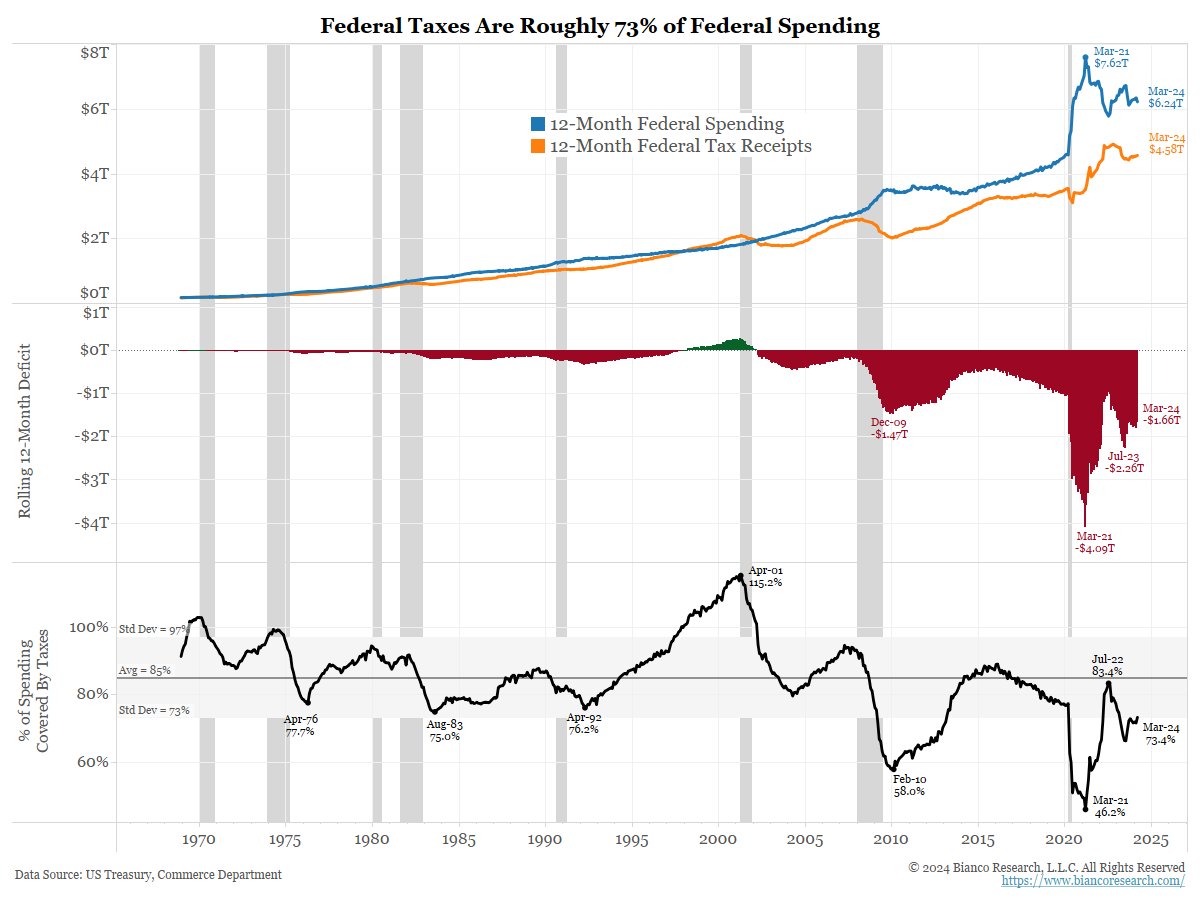
This separates Federal revenues (orange) and spending (blue).

The difference is the deficit (middle panel).

The bottom panel (black) shows that taxes only cover 73% of federal spending. The other 27% has to be borrowed. Image
3/6

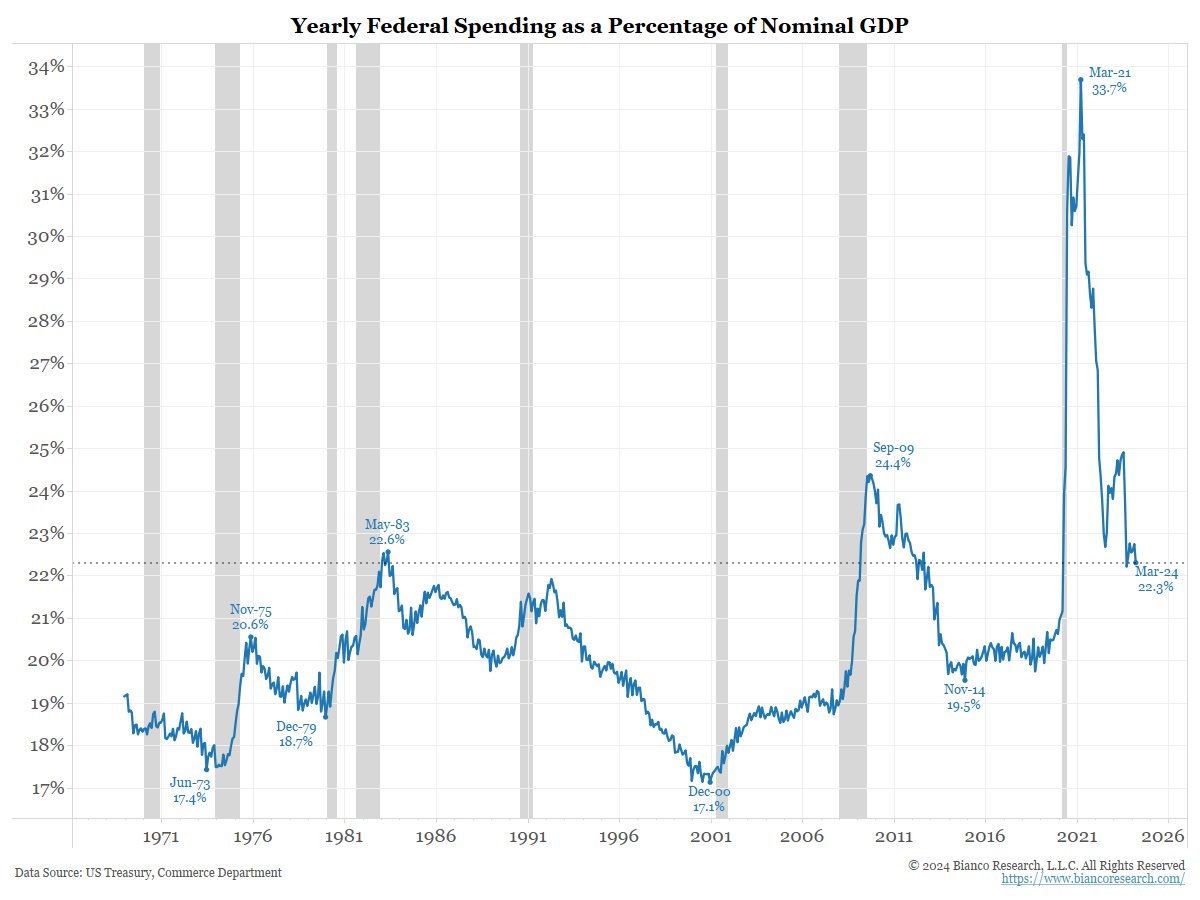
Yearly federal spending is $6.24 trillion or 22.3% of the US economy (or nominal GDP).

Like the deficit chart above, the only time the government has spent this much as a % of GDP is when trying to get the economy out of a recession.

The economy is in year 4 of a recovery.Image
Read 6 tweets
Apr 19
1/7

Happy Bitcoin halving day Degens!

A 🧵on

The flows peaked in a frenzy in Mid-March.

The 13Fs are a disappointment. Very little wealth manager adoption so far (like 1%).

Unrealized gains are shrinking fast.

Why I've been skeptical of Spot BTC ETFs.
2/7

* March 11 = only $1B inflow day.

* March 12 = Brokerage report saying $220B of inflows over the next 3 years (effectively predicting constant inflows, forever).

* March 13, all-time high close (5PM ET price)

Since the mid-March frenzy, inflows peaked (top panel). Image
3/7

The 3/31 13Fs are coming out, and they are disappointing for those who thought a big boomer wave of buying BTC ETFs through wealth managers was underway. Only odd lots.

IBIT has only 27 13Fs with more than 10,000 IBIT shares (~$360k), way less than 1% of outstanding shares. Image
Read 7 tweets
Apr 16
1/15

What's going on with the bond market?

It is not pretty.

And if the bond market is ugly, everyone else suffers.

🧵
2/15

First, let's remember how this year started.

On December 18, 2023, BofA published its December 2023 Global Fund Manager Survey.

This graphic shows that these managers were the most bullish on rates since they started asking the question 20 years ago (2003). Image
3/15

Global fund managers agreed that 2024 would be the best time to be long-duration (lower rates) in the last 2 decades.

They were more bullish on rates now than on the 2008 financial crisis or the 2020 global economy shutdown (both were massive gains, if long-duration).
Read 15 tweets

Did Thread Reader help you today?

Support us! We are indie developers!


This site is made by just two indie developers on a laptop doing marketing, support and development! Read more about the story.

Become a Premium Member ($3/month or $30/year) and get exclusive features!

Become Premium

Don't want to be a Premium member but still want to support us?

Make a small donation by buying us coffee ($5) or help with server cost ($10)

Donate via Paypal

Or Donate anonymously using crypto!

Ethereum

0xfe58350B80634f60Fa6Dc149a72b4DFbc17D341E copy

Bitcoin

3ATGMxNzCUFzxpMCHL5sWSt4DVtS8UqXpi copy

Thank you for your support!

Follow Us!

:(