STUDY: 10% to 27% of Non-Citizens Are ILLEGALLY Registered to Vote in the United States
A new study shows that between 10% and 27% of non-citizens are ILLEGALLY registered to vote.
This means that due to there being around 30 million non-citizens in the U.S. — more than enough to sway elections decided by thousands of votes — American elections are being illegally and illegitimately decided.
In 2014, the academic journal Electoral Studies published a groundbreaking study by three scholars who estimated how frequently non-citizens were illegally voting. Based on data for the 2008 presidential and congressional elections, the study found that:
• “roughly one quarter of non-citizens” in the U.S. “were likely registered to vote.”
• “6.4% of non-citizens actually voted.”
• 81.8% of them “reported voting for Barack Obama.”
• illegal votes cast by non-citizens “likely” changed “important election outcomes” in favor of Democrats, “including Electoral College votes” and a “pivotal” U.S. Senate race that enabled Democrats to pass Obamacare.
The academic study, accepted for peer-review publication at the journal Electoral Studies, estimated non-citizen voter registration data from two key sources:
• A national survey in which 14.8% of non-citizens admitted that they were registered to vote.
• A database of registered voters that reveals what portion of the surveyed non-citizens “were in fact registered” even though “they claimed not to be registered.”
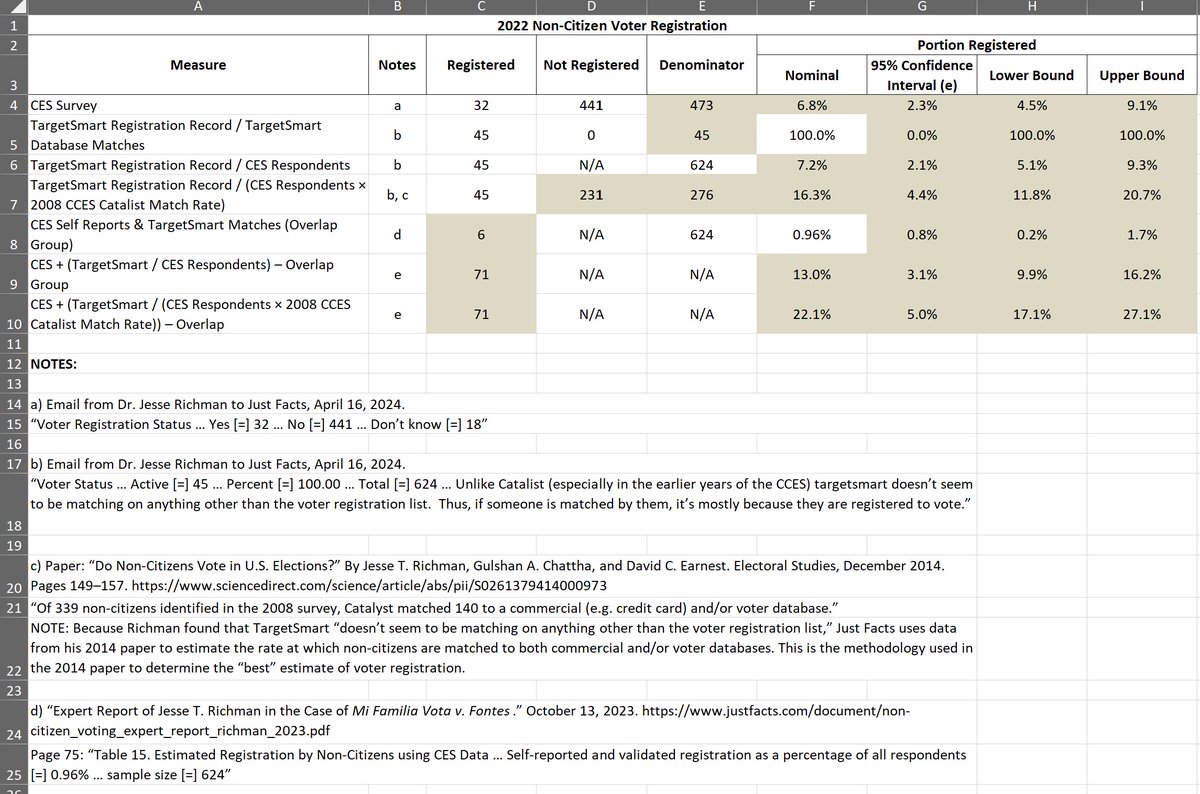
Just Facts used an "enhanced version" of the 2014 Electoral Studies methodology to find that roughly 10% to 27% of non-citizen adults in the U.S. are now registered to vote, as of 2022.
In order to stop illegal voting by non-citizens, House Republicans recently introduced a bill to “require proof of United States citizenship” to register to vote in federal elections.
Every single Democrat opposed.
• • •
Missing some Tweet in this thread? You can try to
force a refresh

Did You Know: The Southern Poverty Law Center published a dishonest attack against Charlie Kirk ONE DAY before his assassination?
The SPLC infamously put TPUSA on its "hate map."
This was not the first time its "hate map" was used by a radical to justify political violence.
In 2012, a gunman walked into the Washington, D.C. headquarters of the Family Research Council (FRC), a conservative Christian advocacy group.
He said “I don’t like your politics,” pulled a gun, and shot the unarmed security guard Leo Johnson in the arm. Johnson tackled and disarmed him, stopping the attack.
The attacker, Floyd Corkins, wanted to k*ll as many people as possible because the FRC opposed gay marriage and he found it via the SPLC’s "hate map." He got 25 years in prison.
So, the SPLC put out this statement one day before Charlie Kirk's assass*nation.
“Turning Point USA’s primary strategy is sowing and exploiting fear that white Christian supremacy is under attack by nefarious actors, including immigrants, the LGBTQ+ community and civil rights activists,” SPLC argued.
“TPUSA and its spokespeople often warn their audience that their children, wives, religion, way of life and they themselves are under attack by various constructed enemies. TPUSA exploits complicated feelings of insecurity and anxiety to manufacture rage and mobilize support to revive and maintain a white-dominated, male supremacist, Christian social order.”
In December 2025, Rep. @ChipRoyTX held a hearing to investigate the SPLC's links to left-wing political violence.
Here is a partial transcript of his opening statement:
"Today, the Subcommittee meets to examine a troubling reality: one of the most politically motivated, financially lucrative, and ideologically extreme nonprofits in America, the Southern Poverty Law Center (SPLC), has been permitted to wield extraordinary influence over federal civil rights policy, law enforcement training, and even private sector mechanisms that increasingly determine who can participate in civic life.
This situation marks a significant departure from the SPLC’s early reputation as a group focused on concrete litigation against civil violence and organizations like the Ku Klux Klan. Over time, the SPLC has transformed into what critics describe as a political fundraising machine built around an ever-expanding, ideologically driven 'hate' mission.
Since 2000, the SPLC has published an annual “hate map,” which places bright red markers across the United States to indicate the locations of designated hate groups. This map is widely circulated in the media and has been used by activists and even federal agencies as though it were a neutral source of intelligence.
This raises an important question: how did a tax-exempt political organization come to label a wide range of groups as extremists? These include mainstream faith-based organizations, parental rights advocates, certain Muslim groups that reject terrorism, student organizations like Turning Point USA, and others who disagree with its ideology. Critics argue that these labels are fed into federal systems, potentially contributing to real-world consequences, while the organization continues to raise funds based on the fear such designations generate.
The SPLC maintains that it is engaged in monitoring extremism, but critics argue that its work functions more like a political weapon than a neutral watchdog. SPLC leadership has acknowledged that its designations are based on ideology rather than criminal behavior or evidence of violence, meaning its 'hate group' labels reflect opinion rather than objective criteria.
Examples often cited include organizations like the Center for Immigration Studies and the Federation for American Immigration Reform, which focus on immigration policy but are labeled as hate groups by the SPLC. Critics also point to more recent incidents, including a 2025 extremism bulletin that flagged certain public figures for their policy positions rather than any unlawful activity.
Concerns about real-world consequences are often tied to the 2012 attack on the Family Research Council. The attacker reportedly used the SPLC’s hate list to identify the target. Despite this, federal agencies have continued to reference SPLC materials in various contexts, including intelligence products.
A similar pattern is alleged in later events, where individuals or organizations labeled as extremists were subsequently targeted, raising questions about whether such classifications contribute to a broader climate that could enable violence.
These concerns extend to the role of federal agencies, including the Department of Justice, the FBI, and the Department of Education. Critics argue that reliance on SPLC materials raises serious questions about accountability, objectivity, and the potential chilling of speech. They question how a private organization, with no formal oversight, became so embedded in federal decision-making processes.
More broadly, the SPLC is described as part of a larger network of foundations, donors, media organizations, and advocacy groups that collectively shape narratives around extremism. This network is said to influence corporate policies, public discourse, and government action, often framing ideological disagreement as a civil rights or security issue.
Critics argue that this represents a shift in the purpose of civil rights enforcement—from protecting equal treatment under the law to policing political dissent.
They contend that such developments narrow the boundaries of acceptable speech and blur the line between advocacy and violence.
This is why the hearing is considered significant. Supporters believe that a thorough investigation is needed to follow funding sources, examine coordination among organizations, and understand how these networks influence federal policy. They argue that many of those affected are ordinary Americans—parents, religious leaders, students, and community members—exercising their constitutional rights.
Civil rights laws, they emphasize, were not intended to penalize individuals for holding religious beliefs or advocating policy positions such as border security. At the same time, the financial incentives tied to expanding 'extremist'
classifications are substantial.
The SPLC reportedly holds hundreds of millions of dollars in assets, with a large endowment and additional funds in investment vehicles.
Ultimately, the hearing is framed as an effort to reaffirm a core principle: that the Constitution—not private organizations, donors, or political pressures—defines the limits of American liberty. The goal, as stated, is not to restrict free speech but to ensure transparency and accountability in how influence is exercised within the federal government.
The American public, it is argued, has a right to understand these connections and their implications for civil rights, free expression, and democratic participation."
Here is the testimony of an SPLC organizer:
"My name is Andrew Sypher, and I serve as the Executive Vice President of Field Operations for Turning Point USA.
In this role, I have overseen the organization’s growth across college and high school campuses, helping build what has become the largest campus chapter network in the country. My work has also included managing major events, such as Charlie Kirk’s “Prove Me Wrong” tables. These events centered on open dialogue with students who held opposing views and played a key role in expanding his reach on social media. Through direct, often challenging conversations, he connected with millions of young people in a way that emphasized engagement rather than division.
Over time, both Charlie and Turning Point USA have faced criticism from organizations like the Southern Poverty Law Center (SPLC). According to critics, the SPLC characterizes their campus activities as harmful and applies labels such as “hate group” to organizations with differing political viewpoints. They argue that this approach can blur the distinction between genuine extremism and ideological disagreement, potentially misleading institutions that rely on such classifications.
Shortly before his death, Charlie expressed concern about being included on the SPLC’s “Hate Map.” He argued that placing groups like Turning Point—whose members advocate for constitutional principles, the Bill of Rights, and pro-life, pro-family positions—alongside historically violent organizations could increase the risk of targeting.
Following his death, supporters described his warnings as prescient. Charlie was killed during one of the same open-dialogue campus events he had long promoted. Those events were often intended to reduce tension and encourage constructive debate among students. Supporters say his work reflected a commitment to free speech, drawing students not only for the spectacle but to see how difficult conversations could be handled in a more human and less hostile way.
Those who continue his work describe it as an effort to preserve that approach. They reject the idea that controversial or opposing viewpoints should automatically be labeled as harmful speech. Instead, they argue that limiting dialogue can deepen divisions, while open conversation offers a path toward understanding, even among people with strong disagreements."
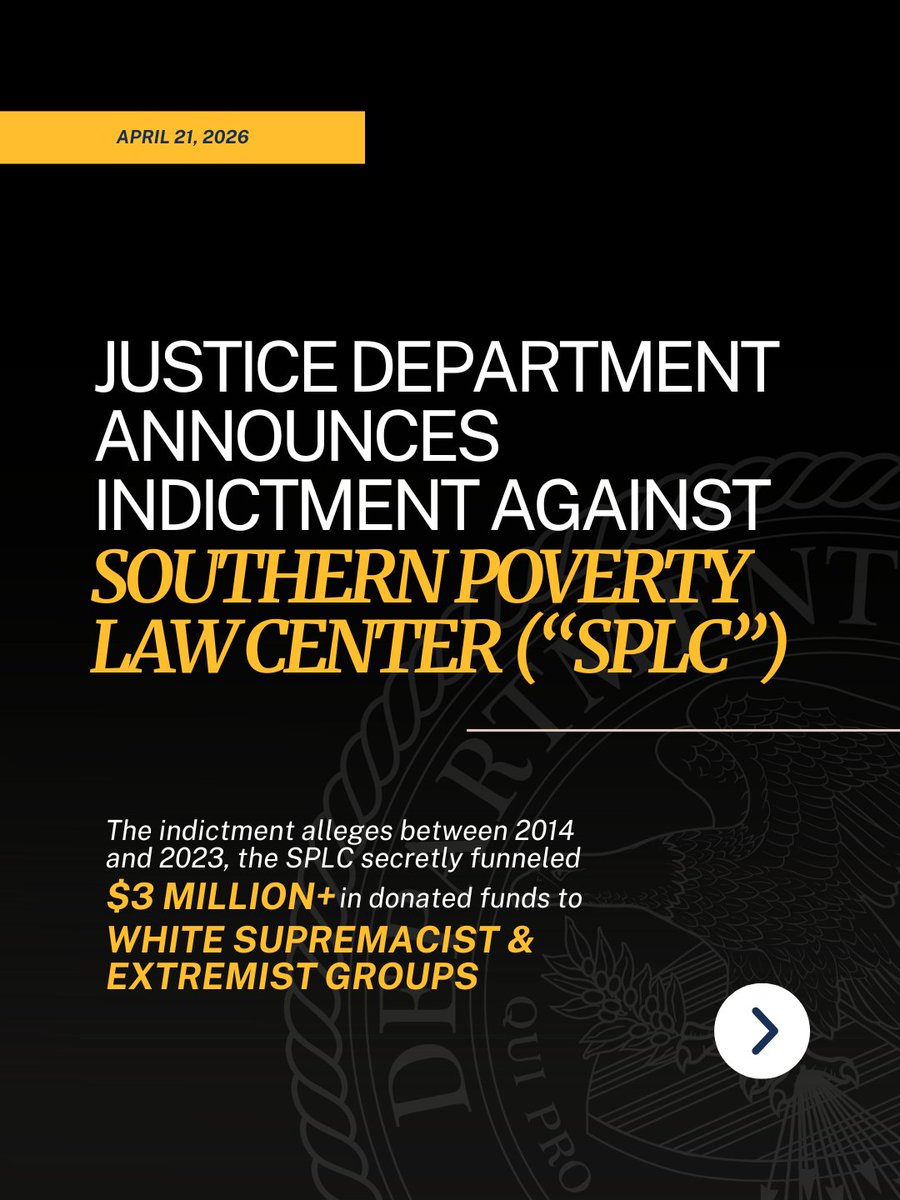
The SPLC was just indicted for allegedly funding "hate groups."
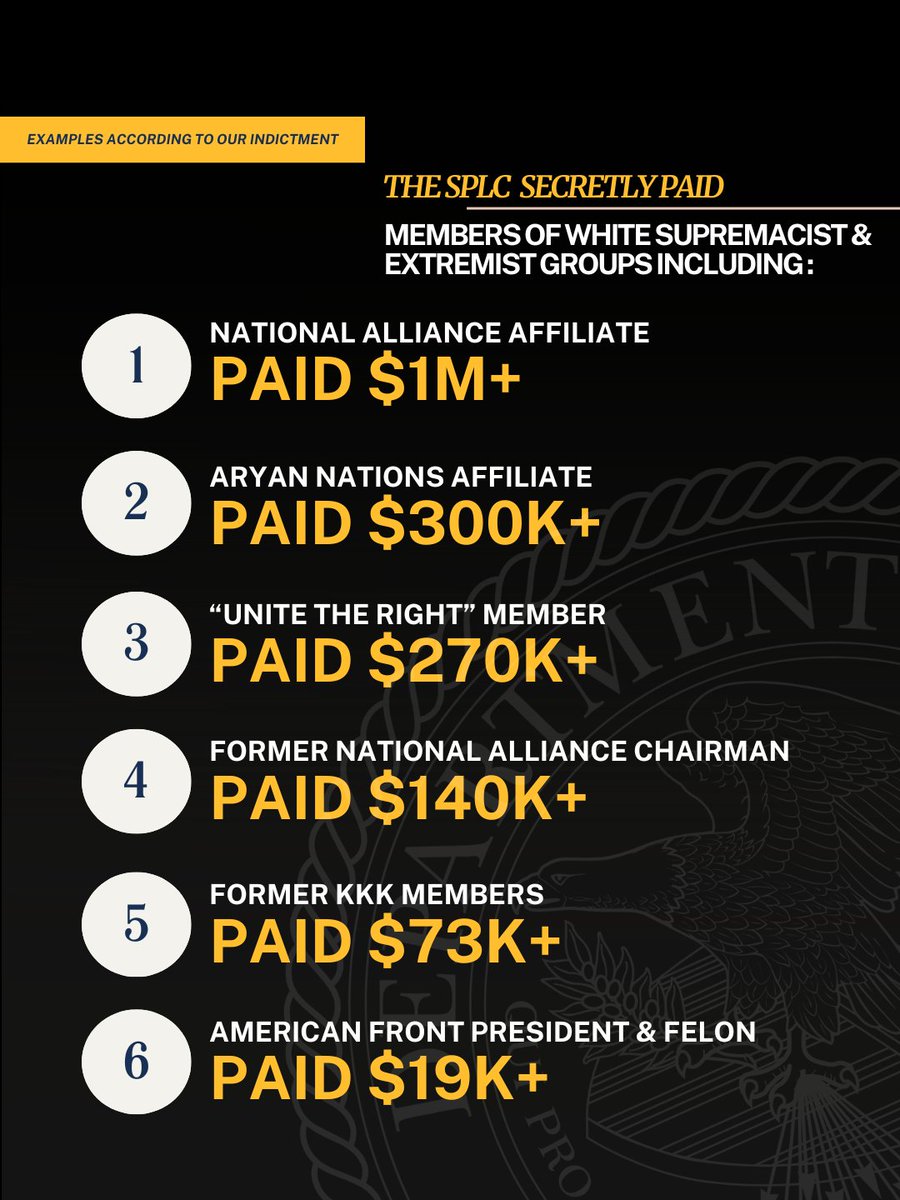
The U.S. Department of Justice alleges the SPLC funneled over $3 million in donor money to white supremacist and extremist groups it built its reputation attacking.
According to federal prosecutors, the SPLC is charged with wire fraud, false statements, and conspiracy to commit money laundering. The scheme allegedly ran from 2014 to 2023 and used shell accounts to hide where the money was going. The Federal Bureau of Investigation says the investigation is ongoing.
The indictment names the following alleged "right-wing" racist groups:
• American Front
• American Nazi Party
• Aryan Nations
• Ku Klux Klan
• United Klans of America
• Unite the Right
• National Alliance
• National Socialist Movement
• Sadistic Souls Motorcycle Club
Federal officials are blunt about what this means. Acting Attorney General Todd Blanche said the SPLC was “manufacturing the extremism it purports to oppose,” and FBI Director Kash Patel said the organization misled donors while financially supporting the very groups it claimed to fight.
For years, the SPLC has been accused of inflating statistics about so-called “right-wing” extremism while downplaying or ignoring left-wing political violence.
Despite that, the FBI has relied on SPLC data and methodology in training its agents, embedding those assumptions into federal law enforcement.
"Revolver News is willing to address the matter directly in the following three questions:
- In the year leading up to 1/6 and during 1/6 itself, to what extent were the three primary militia groups (the Oath Keepers, the Proud Boys, and the Three Percenters) that the FBI, DOJ, Pentagon and network news have labeled most responsible for planning and executing a Capitol attack on 1/6 infiltrated by agencies of the federal government, or informants of said agencies?
- Exactly how many federal undercover agents or confidential informants were present at the Capitol or in the Capitol during the infamous “siege” and what roles did they play (merely passive informants or active instigators)?
- Finally, of all of the unindicted co-conspirators referenced in the charging documents of those indicted for crimes on 1/6, how many worked as a confidential informant or as an undercover operative for the federal government (FBI, Army Counterintelligence, etc.)?"
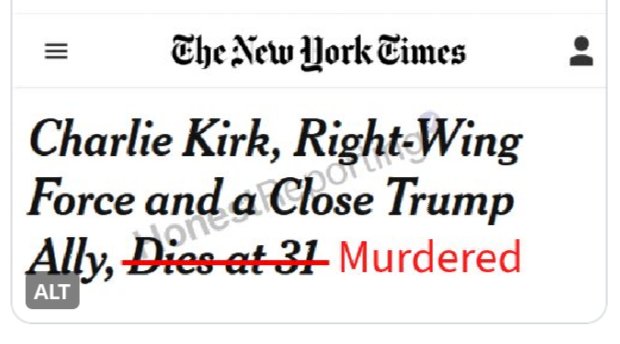
Here is the intellectually dishonest piece in question.
There is no recanting of Piker's NUMEROUS unmistakable calls for violence against people who simply disagree with him about politics. nytimes.com/2025/09/13/opi…
"The United States of America is still reeling from the worst border invasion in its history.”
“This invasion could not have been accomplished without a colossal partnership with the NGO community."
The Biden regime led the biggest human trafficking operation in history.
This was nothing less than a state-led foreign invasion of the United States.
It was absolutely criminal. We are all still waiting for basic accountability.
Video credit: @WallStreetApes
The human misery caused by child trafficking. Thousands of fentanyl deaths. Drug cartels taking over entire neighborhoods. Foreign nationals from enemy regimes pouring across our border.
A nightmare for national security. All of it was known "collateral damage" to the Biden regime.
The human suffering went ignored because the only thing the Democrats care about is political power. Monstrous.
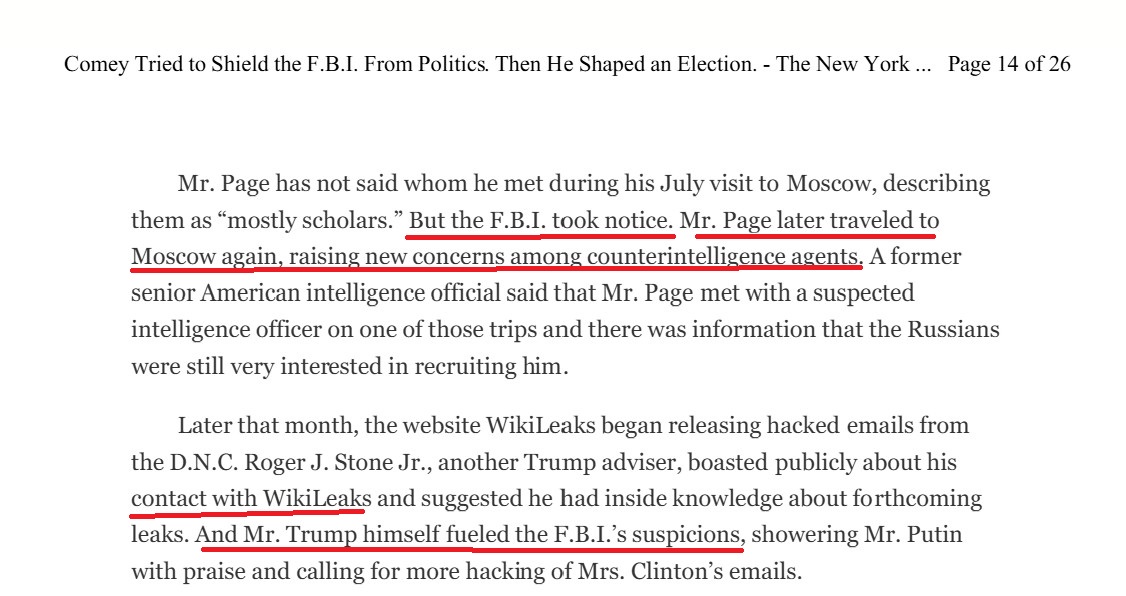
Here are the names of journalists assessed as laundering classified information in the Russia Hoax.
The New York Times. Washington Post. The Wall Street Journal.
All had reporters who appear to have participated in recycling the Democratic Party's talking points based on faulty and misleading intel dumps.
This is not "journalism." This is being an accomplice to state propaganda.
These "journalists" are partly responsible for dividing the nation for years and seeking to overturn the will of the people as determined by a free and fair election.
This is Russia Hoax ground zero. And it was all part of an operation to carry out a "coup" against a duly elected president.
The New York Times piece was particularly egregious in rehashing a "scoop" on Carter Page and repeating baseless innuendo about Roger Stone.
This publication won "Pulitzers" for its "journalism."
This is nothing less than state propaganda. It isn't "reporting."
"Page has publicly said that he was a source for the CIA, which would provide an innocent explanation for his Russian contacts."
You might recall that Clinesmith lied about this subject.
No, he did not go to jail. Judge Boasberg, who was on the FISA court, and approved illegal renewals, thought 'no harm, no foul.'